The Grow Awards 2026 🏆 








Likes
8
Share
@Kirsten
Follow
31.12.24:
I have been readjusting the LST pegs and wire daily. Sometimes, twice a day! (I know, too much time on my hands)! 😆
The plants have responded fantastically! I'm so glad I gave it a go. Some plants have been a bit too tall, and I snapped Do-sì-dos P3, pulling the stem down. Audibly snapped 😬I let it be, though. It seems to have healed mostly, in only 2 days.
I have increased the lighting to 70%. They're getting watered a few times a week, with 1 litre of Dechlorinated water, containing the following nutrients and additives;
1ml of Biobizz Bio-Grow,
1ml Biobizz Top Max,
1ml of Biobizz Bloom,
2ml of cal-mag,
1g of Ecothrive Biosys.
The plants are responding well to this concoction, so it's all good so far. The leaves are looking greener and are getting darker.
Will be monitoring to continue readjusting the LST ties. Also, to monitor the increased lighting level, to make sure they can handle that yet.
1.1.25:
Happy New Year!
I have continued to readjust the LST wire and plant pegs. Several times a day.
Coincidence would have it, I have a 6ft tropical aquarium which was time for cleaning! I always water my Acer tree in the front yard with this water, with beautiful results 😍 👌 🍁 I decided to try it out in my indoor garden. I'll post photos of before and after to see the difference, good or bad 😅
3.1.25:
Plants are doing very well, except for PPP3 I'm quite disappointed in that one, as I feel like it's wasting a space. I guess I'll have to keep it, along with the Do-sì-dos that I snapped twice, which refuses to die 😅
I started to lightly defoliate, which is difficult because I always get carried away with it.
I'm going to water again with the nutrients in description of this week.
4.1.25:
Continuing to defoliate and adjust the LST pegs and wire.
Watered today with 1ltr of dechlorinated water PH'd to 6.0. With the following nutrients;-
2ml Biobizz Bloom,
4ml Biobizz Bio-Grow,
2ml Cal-Mag,
2ml Ecothrive Flourish,
0.2 g/ltr of Ecothrive Biosys.
I've increased the Nitrogen by adding double the amount of Biobizz Bio-Grow. I'm trying to keep them growing for as long as possible! I really want to keep the strength up and keep the leaves nice and lush green! 💚
Will update here with more photos and videos.
Thanks for checking out my diary 🍃 ✌️
Likes
23
Share
@Kindbudz
Follow
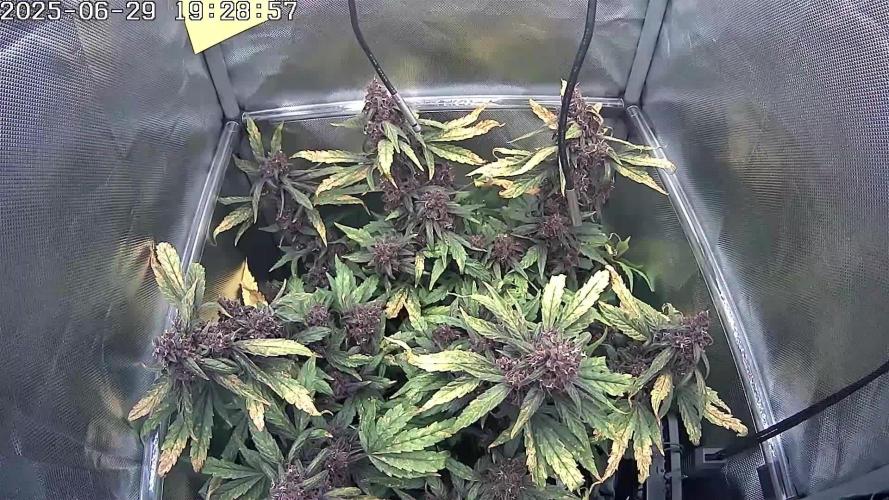
It’s been a good week. The buds are starting to form. I will be adding an additional light soon to provide more of a red spectrum of light to the tent. I’ve been watering one day neutrients, one day pH water and one day nothing. The plants appear very happy and I’m looking forward to the upcoming weeks!
Likes
17
Share
@HowtoBubatz
Follow
It’s the third week of vegetation, and both plants are growing like crazy! 🌿
They’re super healthy and pushing forward with lots of energy. I’ve been feeding them with the BioBizz nutrient schedule for veg and adding Root Juice to boost their root development. 🌱💧
I’m trying different LST (low-stress training) techniques with both plants.
For one, I’ve applied LST to the entire plant, bending the main stem to get more light exposure across the canopy. 🌿🔄
The other plant is a bit different—I’ve only used LST on the lower branches to encourage better side growth while letting the main stem do its thing. 🌱📈
Both plants are responding really well, and I’m excited to see how these different techniques impact their development. Things are looking promising! 😁✨

Processing
Likes
12
Share
@Cannabot
Follow
This strain loves the nutes that's for sure.The way the main cola is forming ...gna be huge.Sweet asf smelling,gna feed her tmw again, every 2/3 days she needs to eat atm.Cant complain


Likes
10
Share
@DutchDudeGrow
Follow
hellooo growers,❤️
crazy week last week, from police helicopter flying again around and near my growlocation from diffrent hights but not for 15min but more like 6 hours...That's really abnormal so we will see...
and with growing last week was a heavy one because I had my first fungus gnats infestation ,(mystery where they come /came from I think some teleportation lol ) it started really slow but within couple of days it was not a couple but dozens so that was not funny, with some research I came 2the conclusion yellow sticky papers/plates and canna cure was not solving the problem but more running behind the problem.. so that was a mistake.. I read about mites and little nematodes , fascinating stuff, I know very little about them and they where a eye opener on a lot of different ways. love to learn new things..
I think the infestation did some damage in slow grow but I'm not sure because I never grew amnesia auto before and this is my second grow in total so.. but after a couple of days after I released the nematodes and mites i saw i huge diffrent in flying around gnats, and now 11-12 I only saw 2 or 3 in total last 3 days so that's great! the smell is strong already a fine sweet but strong present aroma with a hint of citrus smell, amazing... now and then I close my eyes and focus on the great smell it gives and sometimes with fascination thoughts..
12- 12 I see already some of the girls are growing very good now so that's great to see I give the lady's all 700ppm from canna call/mag agent 20ml a 15 L or Atami callmag 20ml a 15L Canna A& b 35ml a15L rhizotonic 25ml a15L cannazyme 25ml a 15L BAC sillica power 5ml a 15L
canna cure spray every 3the day
lights power draw is 150watt of 480w quantom boards and the viparspectra p4000 also 150watt and the rubol Josephine 50 watt farRed cob is always on 50watt
stay tuned new updates in progress!
Cheers🤛🏻❤️
Likes
5
Share
@CanarianGrow92
Follow
First week of flowering for the girls.
We started with some master bloom from Xpert nutrients and continue with master root also from xpert nutrients.
We placed a net above the poants to guide some of the taller branches and create a more equal canopy.
We defoliated some lower leaves and for the rest it looks quite good, some plants showed a little sign of overfeeding so we lower the dosis this week.
Likes
12
Share
@L_Choppa
Follow
things are still getting thicker things are getting near a finish just watered with cal-mag and alaska fish fertilizer going to be feeding two more weeks or so then start the flushing after the 9 weeks of flower

Likes
Comments
Share
@Opulent_Amber_69
Follow
I took these on my Snapchat is why there is so many of them 😅 I'm currently doing the 48 hours of darkness to help produce more trichomes. I did SO MUCH to this plant, it looks like it will DEFINITELY have some weight to it, but you will have to wait until it's dry 😄
Likes
2
Share
@johnjoe9525
Follow
had big bud over the weekend, The soil was very dry when I came in on Monday so give it 2 litres hopefully last the next day or 2. Still very tempted to defoliate but unsure if it is the right time or what to remove.
Decided to try and defoliate it a bit. see if it has any impact. still a bit worried about things like this what wiht it being my first plant

Likes
8
Share
@VanillaGorilla
Follow
OCT 14 - DAY 51 - She's starting to stack the buds tight and fat. great fun!
Likes
26
Share
@Ukfarmer420
Follow
As you can see i had alot of growth over the week. i put my net up to see how it looked.

Likes
32
Share
@Borberad
Follow
Keine Samen trotz Pollenbeuteln. Glück,
Gehabt, viel Glück gehabt. Pflanze lecker und stark, sehr guter Rosin produzent! ⭐️⭐️⭐️⭐️⭐️

Likes
2
Share
@Dsant
Follow
D24 - 10/02/2025
Last week was really good, none of the girls showed any signs of toxicity after the full strength feed, which is good.
I’m already seeing signs of pre-flowering on some of the girls, next week for sure we enter flower mode.
Applied some LST to the girls and some defoliation. Fan leaves were taking a lot of space, now internal nodes should have more light to use. Not going too crazy on this though.
Unfortunately snapped a branch of Northern Lights #1 while applying the LST, must take extra care next time.
Still haven’t changed the reservoir, should do that later this week.
—
D27 - 13/02/2025
Changed the reservoir and mixed nutrients for pre-flower.
I’ve been adjusting the LST, but other than that there’s not much of an update. Girls are looking really great and growth is exploding.
PPFD is around ~500 on canopy level.
—
D28 - 14/02/2025
Did another defoliation session. Went a bit more heavy this time. Now we let them recover for a few days.
Likes
2
Share
@Mastr
Follow
Hi everyone
This week I did defoliation and remove most large fan leaves to get air flow and light will do same next week then I won't touch it until finish
This week I feed my plant with 2ml bloom and 2ml top max
2ml activera
Each Plant drink 2litre water every day morning and once a week just water
Willing to start germinate new seed for next grow I order new seed today (bubble kush)
Usually I veging for 4 weeks and 8 weeks flowering and always I get around 4 oz per plant ans I start growing last year so I'm new in growing but I learn how to veg very fast and strong the nutrients I use for start it cost €50 for 4 plant and you don't need any other nutrients just plain water and in flowering just feed with bloom and bloom booster
Likes
9
Share
@Bigtinyy
Follow
Being my first grow not 100% sure what was going on there.. They did slow growth for a few days..
Likes
23
Share
@Chi_K24
Follow
This strain of Kings kush is a smelly one, I still can put my finger on the terp profile yet. Almost a kushy herby dank is all I can describe atm.
Growing these plants, I would suggest pruning every second node once you get her into flower since the bugs tend to push up against each other and may cause bud rot. Say ontop of defoliation and try to qork on them on a daily basis rather than lolipoping.
Another key thing is to keep rH in range during flower, I will recomend to set it to 40-50rh in flower. Also if you are growing outdoors, Be sure to cover them up during rain when in flowering, I uses a transparent tarp for the last 5 weeks of flower. Save my plants from 9 huge rain events during the last 5 weeks, my plants would of died from br.
This strain had some decent cold resistance also! She stay alive with with few events of temps getting down to 4 deg c.
Likes
19
Share
@GoldenWeedGrower
Follow
Legend
Timestamp: 📅
Measures: 🛠️
Water: 🌊
Actions: 💼
Thoughts:: 🧠
Events: 🚀
________________________________
📅 D08/V06 - 31/08/23
🛠️
🌊
💼
🧠 She's very fast 🚀
🚀
________________________________
📅 D09/V07 - 01/09/23
🛠️
🌊
💼
🧠 She's growing fast and short and it's just perfect
🚀
________________________________
📅 D10/V08 - 02/09/23
🛠️
🌊
💼
🧠 I'm thinking to change her home
🚀
________________________________
📅 D11/V09 - 03/09/23
🛠️
🌊 RES Changed 💦💦💦
💼 Home changed. Posed another RUNTZ auto
🧠
🚀
________________________________
📅 D12/V10 - 04/09/23
🛠️ EC 0.8 - pH 5.5
🌊
💼
🧠
🚀
________________________________
📅 D13/V11 - 05/09/23
🛠️
🌊 Added pure water
💼
🧠 Now she's growing better
🚀
________________________________
📅 D14/V12 - 06/09/23
🛠️
🌊
💼
🧠 The distance between th two girls is about 2 weeks, I need to keep in mind this difference alongside the grow cycle
🚀 Head of the little one is out, welcome😍

Likes
18
Share
@MinorMonster
Follow
Heute ist sie genau 31 Tage alt, ich meine erste Anzeichen von Blüte zu sehen. Nächstes Giessen dann mit Hesi Boost und Blühkomplex 👍
Drückt mir die Daumen, und ja, ich weiß, das darf man alles mit Autoflowern nicht machen. Freut euch auf das Lollipopping in der Blüte 😂
Happy growing 🥦😎
Likes
19
Share
@AlpenZilla
Follow
Harvest – Day 66 (BT42 / July 3rd)
✂️ Today was the day – RedPure#4 was harvested!
📅 Right on schedule at BT42, just as the breeder described.
⚖️ Wet weight: 454 g
Now it’s time to dry and hope I can beat the 50 g dry weight from the last run 😎
Fingers crossed! 🤞💨