


Likes
Comments
Share


@Timbo_Growz
Follow
Picture 1 and second video:
20th and 21st November
Plant is looking really healthy so far and can take a decent amount of Water and Nutrients. Also the first Pistols are showing up!
pictures and video (3-5):
25th November
Plant made a good stretch and reached a height of 145cm. Looking like a bonsai tree right now. Gave her 10l with a 2.3EC on the 24th and she is looking very healthy!
I’m looking to thin her up a bit at thursday (day 21) to get some light penetration. I will also do some lollipopping to get this plant to its full potential.
pictures and video (6-9)
28th November
Gave her a really aggressive cut/lollipopping and deployed the scrog net… also did a little lst to get an even canopy.
The plant was quite big before and I was a little scared that she will stretch too much…. But we will see 😜🤟🏻
See ya next week

Likes
92
Share


@DogDoctorOfficial
Follow
Week 10 - Second Week of Flowering 🌸
As week two of flowering begins, the garden’s growth is unstoppable! These ladies are thriving, stretching up while staying beautifully vibrant and green. Every inch of this tent is optimized—each plant is soaking up light, nutrients, and water precisely as they need, filling the room with energy.
Room Conditions 🌡️
• Temperature: 27.3°C
• Humidity: 62.6%
• CO₂ Levels: 800 ppm
• VPD: 1.36 kPa (excellent range for robust flowering)
• Lighting Intensity: 818 PPFD
Solution & Medium 💧
• Solution Temp: 21.5°C | TDS: 470 ppm | pH: 6.02
• Medium: Moisture 100% (recently dried to 67%), TDS 510 ppm, Temp 22.5°C
The “dry-out” to 67% was a strategic move, helping boost nutrient uptake and root strength. Meanwhile, our slight increase in reds seems to be having the desired effect, nudging these ladies further along in the flowering process.
Eye Safety & LED Lighting 🌞🕶️
With powerful LED systems like the ThinkGrow and ICL-300, eye protection is critical. LED grow lights emit high-intensity light across the full spectrum, including intense UV and infrared components that are not easily detected by the human eye. Long-term exposure without adequate protection can lead to eye strain, and in extreme cases, damage to vision.
• Blue Light Hazard: LEDs often have elevated levels of blue light, which can harm the retina over time if proper precautions aren’t taken.
• UV Protection: Even low doses of UV can accumulate and harm eyes, so grow glasses with UV protection are essential for any indoor gardener.
Investing in quality grow room glasses can help protect from glare, UV, and infrared rays, making plant care safer and more comfortable.
Lighting Enhancements: ICL-300 In-Depth 🔆
The ICL-300 is our newest addition, specifically designed for inner canopy illumination. This LED offers a targeted light boost under the canopy, enhancing flower growth in lower and shaded areas—ideal for maximizing yield and light efficiency.
• Dual Spectrum Technology: The ICL-300 provides a custom spectrum designed to penetrate deeper into the plant canopy, promoting robust bud formation throughout.
• Enhanced Light Distribution: With strategically positioned diodes, the ICL-300 reduces shadowing and balances light distribution to all parts of the plant.
• Energy Efficiency & Heat Management: This light is designed to be energy-efficient, running cooler and reducing the risk of heat stress within the grow space.
The inner canopy light gives the plants exactly what they need, particularly during the flower stage when bud sites deep in the canopy can benefit from more direct exposure. However, after noticing slight leaf burn on some plants, I’ll hold off a bit longer before fully integrating this light to ensure optimal adjustment.
Looking Forward 🌟
As we continue dialing in conditions, it’s all about balance, precision, and taking proactive steps to optimize every aspect of the grow environment. We’ll keep a close watch on the canopy height, and next week, I’ll aim to fine-tune the light integration even further with the ICL-300.
P.S. - ICL-300 and CO₂ Sensor 🌱
The TrolMaster CO₂ Sensor (MBS-S8) has been crucial for real-time CO₂ adjustments, ensuring the plants get exactly what they need without constant monitoring. Combined with the ICL-300’s spectrum flexibility, these tools make an unbeatable setup, allowing for nuanced control over plant growth and development.
As always, a huge thanks to the Grow Fam for the tips, support, and enthusiasm! I’m excited to see what these next weeks will bring as these plants reach their full flowering potential. Stay tuned for more updates, and don’t forget: eye safety first, growers! 🌞🌿
Discount Codes so you can save big on your next check out 💚💚💚
Kannabia - DOGDOCTOR 30% off
SeedsmanSeeds - DOGDOCTOR 10% off
CannaKan- DOGDOCTOR 15% off
terpyz.eu - DOCTOR 15% off
The Neutralizer - PORKIT5-DOG 15% off
As always thank you all for stopping by, for the love and for it all , this journey of mine wold just not be the same without you guys, the love and support is very much appreciated and i fell honored and so joyful with you all in my life 🙏
With true love comes happiness 💚🙏 Always believe in your self and always do things expecting nothing and with an open heart , be a giver and the universe will give back to you in ways you could not even imagine so 💚
Friendly reminder all you see here is pure research and for educational purposes only
Growers Love to you all 💚💚💚


Likes
17
Share

@Bncgrower
Follow
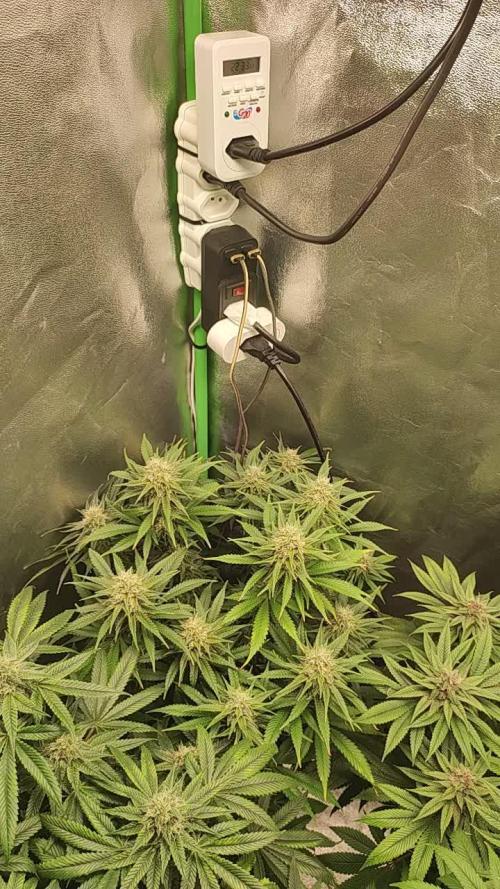
This girl is really doing very well, I loved the development and more by the color of the trichomes I would say that it would already be a great time for harvest, but it doesn't seem ready to me.. I will follow the schedule this is the last week with the hand well loaded with nutrients.. and in the next weeks I will slow down the pace and in the other I will do the wash.. I had never grown with mineral before, I had no idea how much salt accumulates, even using the cleanse a few times a week.. it is surreal so the wash in the last week has to be very well done.. It will be an excellent result, I am sure.
Thank you for taking a little of your time to pass on my humble diary. 🙏✌️👊🌿🌿🌿
Likes
69
Share


@Natrona
Follow
Flowers are developing nicely but slowly. Very few feeder leaves are turning yellow yet. I saw some webs between one of her branches and Lemon Cake. So I sprayed them with alcohol and burned some leaves. She and L. Cake have the same dense bushy structur. The buds are tight to the stems which traps humidity and moisture. Inviting pests and fungus.

Likes
48
Share


@Rodamis_Prime
Follow
Just starting week 6 and These girls are starting to get some smell finally . This is the same strain as my other big plant but I learned that this strain doesn't like to be over fed so I have been feeding these 4 plants a light feeding but the two plants in the back are showing they are hungry so this feeding today I upped their food . Checked the soil ph and it was in at 6.4 . Defoliated a few of the big fan leaves that were blocking the buds down the stalks and its looking pretty fat. Also the trichome production is much farther ahead then my big plant at this stage . The small leaves are covered in them . Still have about 4 to 5 weeks to go .
Likes
8
Share

@Prilyfe13
Follow
04/04/2026
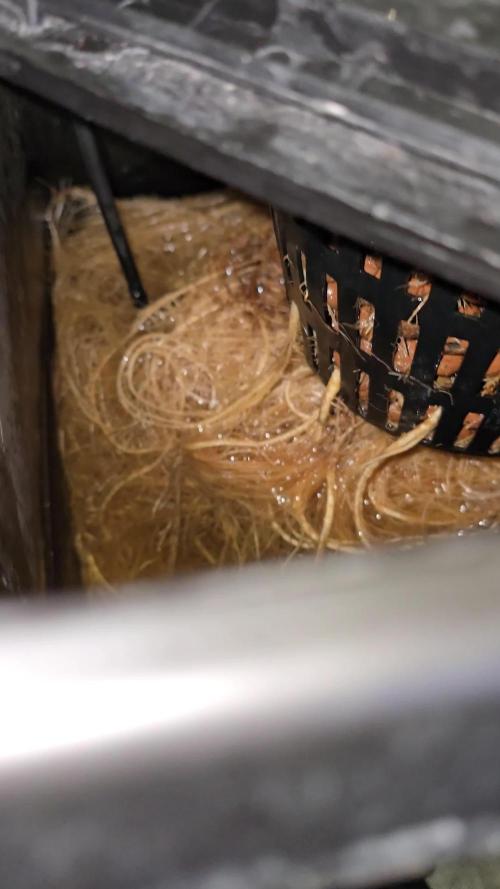
Water change day! We're adding Overdrive and taking out big bud. I. Pretty sure she has 2 to 3 weeks left. I haven't checked trichomes yet. No point when I can tell they aren't ready yet. Just by the amount of white pistils. And somehow I can tell she's not ready. Colors, swelling and water intake.
Readings:
pH: 6.58
EC: 1214 cm
TDS: 858 ppm
Temp: 67.8°
The environment is a bit wonky today. 73° and 50% humidity. I have a feeling the heat is being blocked by the canopy. That's why the environment is off today. No heat increased humidity and decreased temp. Honestly not sure what to do here. I'll just have to let it do its thing. I'm pretty sure it was from me opening the tent up. Oh well. She does look happy. Good nice green. Excluding the dark color of course.
There's a bit of an issue with the rear fan. The way she's moving around the tops has left one of them to fall right onto the oscillating fan. Not to mention the area around the fan is super stressed. Not exactly sure what to do about that.
Anyway, lots of work to do.
04/05/2026
Readings:
pH: 6.55
EC: 1180 cm
TDS: 820 ppm
Temp: 70.2°
Readings after pH:
pH: 6.08
EC: 1190 cm
TDS: 850 ppm
Temp: 65.5°
So we can see that there is a fluctuation in all readings. The EC went up by 10 cm. TDS went up 30 ppm. Temp dropped 4.5°. Finally there's the pH. I dropped it to a reasonable level. Around 5 points.
Something I'd like to note. The buckets don't drain completely. There's roots in the way. So there's always a gallon or so left in the bottom of the bucket. After pHing, everything changed. I believe that is just a common pH swing. A little high, but I brought it right down. I'm going to check later this afternoon and see if it leveled out. Hopefully it'll be around 6.1. That's when you know the pH perfect is working.
The EC and TDS are higher than yesterday. But I'm assuming the pH was high as well as the water temp. It should be down to about 65° and that would fix the portability of the nutrients.
The environment is doing pretty good. Temps right there at 73° the Humidity is a bit high today. 47%. I'd really like it down to 40% but that's probably not happening until this wet weather goes away. Then everything should level out.
04/06/2026
Readings:
pH: 5.95
EC: 1158 cm
TDS: 823 ppm
Temp: 67.3°
04/07/2026
Readings:
pH: 5.68
EC: 1187 cm
TDS: 836 ppm
Temp: 68.4°
After pHing:
pH: 6.04
EC:1192 cm
TDS: 878 ppm
Temp: 67.1°
After Topping off the bucket:
pH: 5.8
EC: 1240 cm
TDS: 880 ppm
Temp: 65.3°
04/08/2026
Readings:
pH: 5.54
EC: 1250 cm
TDS: 889 ppm
Temp: 63.1°
After pHing the jug:
pH: 6.17
EC: 1465 cm
TDS: 965 ppm
Temp: 69.1°
Bucket Readings:
pH: 6.15
EC: 1302 cm
TDS: 927 ppm
Temp: 66.7°
04/09/2026
Readings:
pH: 5.91
EC: 1288 cm
TDS: 917 ppm
Temp: 69.4°
It seems as though this lady may be a bit hungry. TDS and EC are both dropping. Not much, but I can see a pattern. She wants more. But she's stressed out. The tacoing is real! But I'm not sure it's from the light. What else is there?
There's more spots on the top leaves. Definitely seems like a deficiency to me. Along with the tacoing. Which I might add also has tons of trichomes to help protect the leaves and buds.
The environment is looking good today. However, the heat must have been on this morning when the light turned on. Oh well. An ice bottle from last night would have done nothing.
04/10/2026
Readings:
pH: 5.5
EC: 1298 cm
TDS: 528 ppm
Temp: 67.8°
Reading top off water:
pH: 5.8
EC: 1244 cm
TDS: 949 ppm
Temp:67.3°
Likes
48
Share

@DogDoctorOfficial
Follow
An in to soil she and her sister testers go, i know that for know everything looks the same , apart from the photos, but this will start changing with them growing. For now all of them are growing pretty much the same and now that they move in to soil and start feedings they will start showing the phenotype and genetic differences, but for now all looking great , healthy and strong af!!!
Haded a intro video from seed in to now, including how i transplant and what i use wen doing it so, and from here the moon is no limit for this babes i believe , so stay tuned as this testers they promise to be a interesting ride <3 <3 <3
They are growing great , number 10 moving in to an indica side i think lets see
As always thank you all for stoping by and for supporting me on this journey, i am super passion about growing and fell blessed to have you all with me on this new journey <3 <3 <3
Genetics - Fast Buds Tester 08 09 10 11
Ligth - LUMATEK ZEUS 465 COMPACT PRO
Food - APTUS HOLLAND
#aptus #aptusplanttech #aptusgang #aptusfamily #aptustrueplantscience #inbalancewithnature #trueplantscience #fastbuds #dogdoctorofficial #growerslove
With true love comes happiness <3 <3 <3 Always believe in your self and always do things expecting nothing and with an open heart , be a giver and the universe will give back to you in ways you could not even imagine so <3 <3 <3
All info and full product details can be find in can find @
https://2fast4buds.com/ wen released
https://aptus-holland.com/
https://autopot.co.uk/
https://lumatek-lighting.com/
<3 <3 <3 Growers love to you all <3 <3 <3
Likes
5
Share


@mobbly
Follow
Week 3: Since this is my first grow, I love to see how quickly the cannabis plant grows, and it's accelerating rapidly. They are thriving and healthy. This week, I used fertilizer for the first time, starting with half the amount recommended in the feeding schedule. 0,5/ml per liter.


Likes
6
Share


@Aleks555
Follow
ROYAL QUEEN SEEDS - Blue Gelato - 80 days
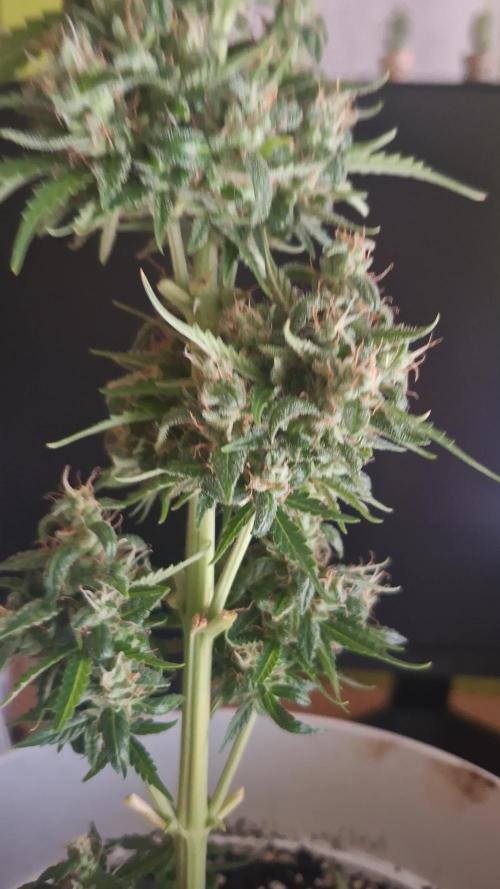
Today marks 80 days of growth for Blue Gelato from Royal Queen Seeds. She’s been flowering for 32 days and looks absolutely fantastic! The buds keep swelling, and the leaves remain a rich, healthy green. Trichomes densely cover the buds, creating a stunning crystal-like effect, promising a powerful outcome at harvest. Her aroma is getting stronger each day, and I’m sure the taste will be just as impressive.
We’re still feeding her Xpert Nutrients, and the results speak for themselves — everything is on track, and the harvest is looking very promising!

Likes
2
Share


@7circleshg
Follow
Como era de esperarse el ScrOG no detuvo a estas cracks y crecieron su ultimo estiron, ya que cambiaremos el ciclo al de 12-12. Si bien, es logico, aun no vemos los pistilos pero como ya hemos echo nuestro cambio de ciclo, procedemos a darle la produccion enzimatica a nuestras chicas para tener un buen desarrollo de esas preciadas flores, cambiando nuestros nutrientes a los adecuados y con una aplicacion foliar de Delta-9 en su HORARIO DE NOCHE. Si se replica lo de vegetacion..... uff mejor ni me adelanto.

Likes
Comments
Share


@TTerpz
Follow
One has a helmet hat gonna keep an eye out on her
Update: Helmet hat came off
2/16 update: all 3 doing well
Likes
41
Share


@Ganjagrandaddy
Follow
DAY 56 f: well here we are folks. The final week for these girls to impress and sparkle with the build up of their trichromes.
The Six Shooter are the closest to the harvest time and i think i will be taking them out 1st. They have some beautiful purples and dark reds on their leaves and buds and the smell is so damn potent too. Very fuel terped so far but really potent to inhale. Both have different sizes but identical buds to represent the strain really well. I think their bag appeal will be top drawer.
The Mexican airline are also close now and smell.so fruity fresh that it hits your throat with a sting. Lol not the biggest ladies for production but some beautiful looking buds on them.
The Strawberry pies are another level altogether....
#1 is so fresh and vibrant looking with most of her leaf left on stil. I think she may go another week before her sweet spot is here though. She has a lot of good sized mains around the plant and they look and smell line fresh chopped pineapple so far. #2 has had her main leaf taken out for the past 5 days to encourage as much light around the numerous beautiful buds she has produces. I did supercrop her main to keep her from hitting the light and have noticed how floppy she is becoming from the weight building in the bud tips. I love how she looks now with the edible looking buds everywhere. Some of the best buds I have had the pleasure of seeing in these autos. Roll on harvest time. The soil has performed brilliantly throughout the whole grow this run and with a no-till method being used in the trays , I expect it to get better each new run. The organic/vegan soil also means any edibles are as clean as can be from home growing. The lack of harshness from using nutes is very noticable in my grows now and drying really is just about the moisture removal and natural chemicals so curing is a lot shorter. Instill get the gassy , initial conversion when using jars but it is more about the potency of the hit than the harshness of residual chemicals. While there is a slight loss in yield from soil , the smoke quality certainly makes up for it. So there we have it growmies. A great final week ahead and some beautiful bud porn for you to enjoy in the pics. Have a brilliant start to your 2022 and the future. Be well.
Likes
5
Share


@ReggaeShark_420
Follow
Harvest time for this naught OG kush from FastBuds. Not a lot that have been harvested, but there was a lot of tests that took placed. one thing i focused on this grow is how this gall is gonna operate when temps reaches 5 degrees and lower at sleep time and throughout the whole grow, how wil she do with 35% humidity. It was not outdoor grow season here so the challenge was on. She dit super well and at the end showed off some of the best colours I've seen in a long time with a tricone production that is thumping to the eye. Outside season, with no of the perfect conditions, this girl ripped it out and impressed me. I didn’t focus on massive hield but looked at how she performs and how the end product looks. Only have 2 things too say, beautiful buds, thumping smoke!
I realy appreciate the creation of this strain by fastbuds. Really recommend this girl for all growers and to grow in extreme weathers.
Long live FastBuds
Likes
18
Share


@Pokan187
Follow
The trichomes on the Runtz are all milky and I'm getting some amber on the sugar leaves, I think the end is near 😁
The G13 is looking great and smelling wonderful, the buds are getting heavier and same for the GDP

Likes
5
Share


@CannaBossBizz
Follow
My First diary.
First time growing Fastberry bay Fastbuds.
Hyped af.
Hope for a big plant.
Maybe you'd Like to follow this grow.
Processing
Likes
2
Share


@pendeja420
Follow
Wow!! It was sunny and hot all week! You can see that they almost doubled their size and are looking pretty much more healthy. That is also because I followed @MadeInGermany 's advice and decided to wait more until I had to water. They seem to have liked that, beacuse there is no more sign of Ca blocking in the leaves. And they grew very nicely, no need of everything. Also following his advice I will use Cal/Mag in the next watering. But, you know, I'm making it cheap... so I will use another home-made recipe: wood ash fertilizer, which include those nutrients and some that are needed in flowering stage -which seems to be starting, so next week will have the flowering label-. It also degrades the N in the soil that could be still causing a little overfeeding (leaves' tips are a bit burnt). However, I admit that my mistake was overwatering from the beggining. Lesson learned! No watering for the whole week and the plnat didn't seem to worry about it.
Man! If only it had been this sunny all the time! Plants look very healthier and are way bigger, with huge new leaves. A little amount of pistils showed up in the last days, so I guess it is the moment for stretching. Knowing that, I decided to do a little training on Sweet, as it is the one a bit behind. You can see in the last picture how I took a couple leaves that were blocking light from side branches-future bud sites- and taped them, so they didn't. If results are good I might do the same with Rebel, but I have a feeling that she'll do good without it.
Sadly, next week will be all rainy and cloudy... Nothing to do tho. Any commentary will be thanked, even if it is about how cheesy the videos are! 😂


Likes
8
Share

@Greybeardbud
Follow
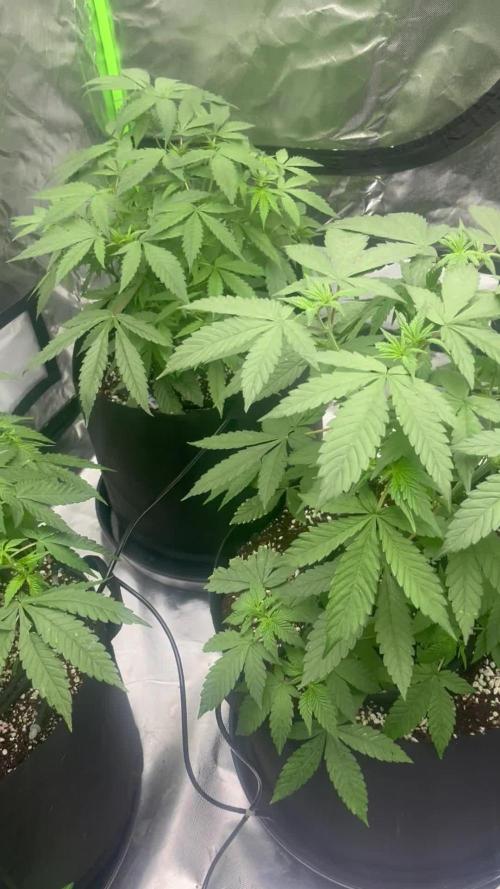
Changed to automatic watering 3 litres per 24 hours on drip hose. Everything going really well
Each plant is getting a slow feed at 118ml/min in 30 minute intervals spaced evenly over a 24 hour period
Only 2 weeks till turning, smallest plant is 23cm but in the last week has started growing well, largest is 40cm