The Grow Awards 2026 🏆 





Likes
Comments
Share
@XanHalen
Follow
Nov 29:
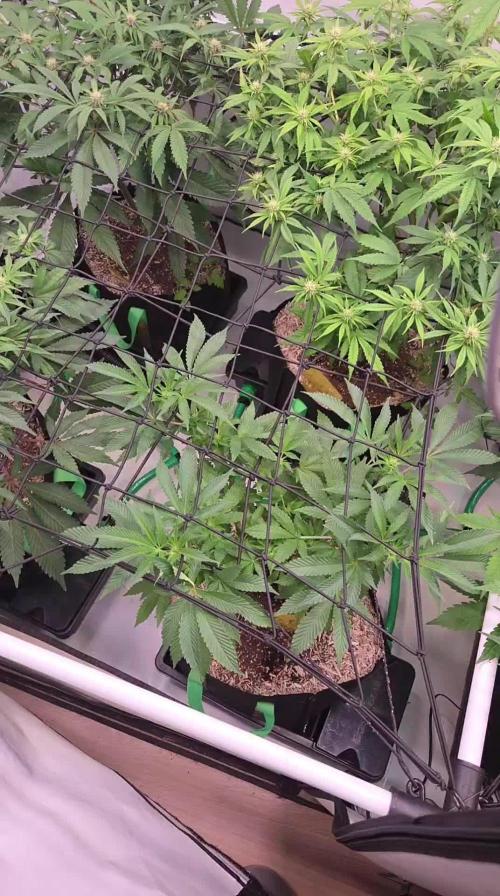
They seem to be accelerating in veg growth but I see a small portion of the leaf on the smaller plant either grew in mutated or somthing cut it, I haven’t seen a single bug in the box so I don’t think it’s that but you never know, and the bigger plant has some issues near the base of its stem, I noticed it before I did the LST and now I’m wondering if I should have addressed that issue before starting the LST. Let me know what you guys think!
Dec 2:
Walked into the room and noticed a faint smell, wasn’t any smell last night when I started the LST on the slower girl. Further inspection showed some white pistols on the bigger girl, I believe she is the culprit for the smell as the other seems about a week behind. They are both now LST‘d and leaf tucked. Enjoy the pics and vid’s!
Dec 6:
I have tied down some of the longer chutes on the bigger plant (will see in week 5 update) to create more airflow and light penetration as I didn’t even realize how bushy the stem and node sections had gotten. I have also cut the chutes coming off the first true leaf. I don’t think I will make any cuts to the smaller one as it’s already a slower growing pheno. Going on a trip starting the end of week secede to late week 8, so I have a automatic feeder coming from Amazon, and I will continue using it through flower to reduce open tent time.

Likes
70
Share
@ICEGrow
Follow
Wow die Blüten schwellen immer fetter und fetter an. Ich will mich ja nicht zu weit aus dem Fenster lehnen aber ich gehe davon aus das 550g plus werden.
Ich bin gespannt !!!


Likes
4
Share
@KCChiefers
Follow
Day 65 Update: Watered both plants with almost a gallon until runoff. Plant #2's water was dosed with Terpinator at 25ml/gal. 11 days left of flushing on Plant #1. This will be Plant #2's last nutrient watering, as she will start the flushing process next watering. Also added two yoyo hangers and two stakes to Plant #2 as her branches are getting heavy (not complaining 🤷♂️)
Day 68 Update: Starting flush on Plant #2 today. Plant #1 has 8 days left of flushing. Watered both plants with almost a gallon of pH balanced water until runoff.

Likes
14
Share
@LokalGrenz
Follow
Jan 13th ordered a Dehumidifier today should be here Monday need to get the humidity down for flower I can only get it down to 57% so Hopefully it will work
One of the amnesia haze plants have some type of deficiency not sure have brown spots on leaves
Got humidity some decent control but I’m sure amnesia haze 1 is dealing with PH issues the PH meter is cheap and I’m sure it’s been off a bit so I’m going to look for new one this week


Likes
102
Share
@Hashy
Follow
This was my 1st photoperiod grow on growdiaries and I'm glad I tried these Fast flowering photoperiods for it. Big thanks to Heather and the Fastbuds team. I have grown the Gorilla Cookies auto before so this photoperiod fast version has something to live up to. She grew way taller then i was expecting, hence the many bends and breaks. To be honest she was great to grow and the favourite plant of the grow. Because this grow was going so good I decided to switch back to photoperiods for the next few grows i just wish i had left her in veg for 1 more week.
Total dry weight for the grow, decent buds=136g
Light power
Total= 200.43Kw
18hrs for 28 days = 504hrs
12hrs for 67 days = 804hrs
Total hours for lights= 1308hrs
200.43÷1308=0.153Kw/hr average.
Average 153w/hr
Total g/W=0.89g/W
Power used for grow=508.78Kw @0.30p =£152.63
Each gram cost £1.12
The buds have been curing for nearly 2 weeks so I haven't had a sample yet. There will be more pictures added once I try the buds and write up a smoke review but for now I'll just leave a video of the grow and a picture.
Thanks to all who have viewed my diaries and a big thanks to all that posted likes and comments, it's much appreciated.

Likes
61
Share
@Cariboo_OG
Follow
Grape Ape Cake !
Lineage;
Hotcakes
(Katsu Bubba Kush X Burnt Toast (from Raw Genetics)
X
Grape Ape
An Exciting New Collab from Katsu Bluebird !
Welcome back, & or Thanks for Joining me !
Week 15, & the End of 9 weeks of flowering (65 Days of 12/12)
Well Here we are, the last flower entry.. only one more entry the HARVEST of these Gorgeously Dank Flowers from Katsu.
We are Seven Days into the flush & thus far everyone is holding steady ! Only 3-7 more day's for the group ! As your can see plants One & Five are the quickest of the Pheno's, they received their last watering today & once they dry back 50% of todays water they'll be into 24-48 hours darkness before the chop.
As for Plants Two & Four are they Longest running of the Pheno's they will likely receive another watering, & run another 7 days.
Plant Three is the one i'm watching closest ! this plant is SHOWSTOPPING... Grape Candies Dipped in Gasoline floods the floor, the moment I open the tent.. This particular pheno may go 7 more days maybe not.. Its very close to the finish line either way... I'm Drooling.
The most exciting part about starting to pull plants is the ability for my to take some better isolated Bud Shot photo's ! :)I wish I had the funds to keep upgrading my photography gear but its an expensive hobby...maybe ONE DAY lol!💪
The Boys Club saw a little bit of action this week as well.. a long over due hand job for the jizz monster. I am very excited to cross this guy back with a cut of Pheno 3.. & maybe something else but I need to find it first.. any thoughts ? Grapes &...?
This process used to be SO damn time consuming.. until the Trim Bin..
The recommendation is to use 1/10 ratio of baking flower as a natural absorbent to keep the moisture away from your pollen.. as you can see I dumped a bunch out after the first photo lol
I cant wait to Share coming weeks as the Wonderful Harvest is almost here !
Thanks for Reading 🙌
If you have a question or a comment leave it down below otherwise,
I Hope You Check in Next Week,
Stay Safe out there & Happy Gardening
Cariboo

Likes
48
Share
@PrairieFrostGrow
Follow
******** Week 9 - Feb 3 to 9/20 (Days 57 - 63 from seed popping out)
She has continued to swell this week and stacking her buds. The hairs are turning this week. More at the top of the plant but some on the bottom as well. Still has many white hairs and a good thickness as well. This week has been one of those......is today the last feed.....no one more.......is today last feed......no one more.....🤨🧐🤨🧐 😃😃😃 And so it finally came down to Saturday Feb 8, Day 62 as the last day of feed. Plan it to just flush with water and Rezin & Liquid Weight to the end.....or early 70’s anyway.
Kind of a boring week in a way because she has been such an awesome girl to grow!! She is dense with a lot of leaves but I am trusting this next week will continue to bring significant swelling. She has been fine with the fluctuations that happen through a grow and has been vigorous all the way through.....great genetics! She is a real beautiful little girl with how she has grown....a couple of the pictures on the stand show just how well she grew and then how much bud is now on those branches. On bigger branches I would clip off another node lower than I did to give a little more energy to fill in the tops. Not sure this girls top colas will fill in as much as one would like but........take your time girl😀 Also.....I think it could be worth a run doing this girl in a 5 gal pot.....if she has no problem going 77 days or so then maybe there is time build a nice mass????
I am concerned at the end of the week that I may be seeing signs of root bound with the leaves clawing down?????? Don’t think its light.....was the same the morning before watering so don’t feel its over watering......could be nitrogen toxicity???? Not going to chase it at this stage but would like to know for next run to correct. Became more visible Feb 6/7/8 idea....appreciate any comments😕
Have not spent anytime looking at Trich colour this week.....too early anyway. What I have noticed is one crazy amount of frost forming on this girl in the last week!!!!! Wednesday had to do a double take on some of the images and zoomed in on a bud.....DAMN!!!!💪👍🙏 Hope she continues to be happy and keeps pushing out them trichs.......DAMN😃😃😃
Changed the light schedule again this week. Moved her to 19.5 hours of light because she is still not falling to sleep at lights out.
Will be avoiding use of Flawless Finish for now and I suspect she has two weeks left in her. If something changes and she ripens quicker then may use.
Little more detail to come..........
Feb 3/20 - Day 57
- Water feed today. Runoff in tray was 6.1pH.....good
- 3L given with Sensyzime @ 1ml/L. 80ppm and 6.15pH going in.
Feb 4/20 - Day 58
- Full feed today. Pot still had some weight.
- 3L off full feed with 1125ppm and 6.05pH
- Runoff water in tray before feed: 900ppm and 6.03pH
- Runoff water in tray after feed: 1300ppm and 6.2pH
- she had small leafstrip today.
- removed most of the LST today. Left two ties.
Feb 5/20 - Day 59
- nothing today.
- Light cycle changed to 19.5hrs on and 4.5hrs off.
- Her hairs are still long an reaching.....good sign for growing longer
Feb 6/20 - Day 60
- Verify medium today....close to flush
- 3L feed of Sensyzime and Rezin @ 2ml/L and Liquid Weight @ 1.5ml/L. = 100ppm and 5.8pH
- Runoff was 680ppm and 6.25pH.
- ppm is a little low and pH is creeping up.
Feb 7/20 - Day 61
- Nothing today, still heavy.
- slow growth happening??? Thickening behind the scenes???
Feb 8/20 - Day 62 - ********Last Feed********
- Full strength feed......base nutes both at 0.5ml/L
- 6L feed with 1150ppm and 5.4pH going in.
- pH was a little high so lowered for this feed.
- Medium got a good soak and good runoff amount
- Runoff: 1500ppm with 6.05pH
- ppm might be a little high but hopeful she will go two weeks......will be flush a fair bit of water at minimum.
Feb 9/20 - Day 63
- Dry out day
- the "CLAW" is more prominent today. Mainly on top couple of leaves on the large colas.
- raised the light a bit.....will use lower pH water in flush......not much else other than let her dry out at this stage.......
Hope we can drag out harvest day until Feb 22 or 23rd.......🤞😁😁😁.....Thanks for the read and hope you have a smooth week!
Likes
14
Share
@Organnabis
Follow
The plant on the left has definitely developed quicker than the other. Not quite sure why the right plant is curving all sorts of ways.
Currently dealing with fungus gnats which could be the reason but I'm glad one plant is showing strong signs.
Trying to avoid harsh chemicals that may deplete microbial life so I'm hoping the plants can withstand gnats. I'm also sparsely watering to avoid further life cycles for them.
Enjoying watching them grow. So far so good I hope.


Likes
62
Share
@balansa
Follow
i think mexican airlines is ready for flushing. i will flush her next week smell and aroma is wonderful nore like skunky. moby dick has 2-3 weeks left i think she has more sweet smell. i wanna tell you the smth i know that its unwrighten rule that u should not touch the plant before harvest but i smoked both and they are impressive ))))


Likes
4
Share
@AustinRon
Follow
OG 4Q24 Flower Week 10
Orangegasm (Fem) [ IRIE Genetics ]
12/12 @ Bolt (Day 21)
Germination: 20 November 2024
#3A Earliest Harvest Date: 9 February 2025
#3B Latest Harvest Date: 19 February 2025
_________________________________________
Start of Week: [Wed Feb 12, 2024 CR2 4Q24 64:F:9:1]
End of Week: [Tue Feb 18, 2024 CR2 4Q24 70:F:9:7]
OrangeGasm Fertigation:
- MAX: EC: [ 1.6, mS]
- LightIntensity MAX: [ 850, µMol/m2/s]
______________________________________
__
Wed Feb 12, 2025
OG 4Q24 64:F:9:1
Refresh Reservoir
- Amount: [ 5, gal]
- EC: [ 1.6, mS]
- Primer A&B: [ 48, ml]
- SLF-100: [ 15, ml]
Reclaim Dehu
- Amount: [ 4, gal]
EC: 1.6
Runoff
- Amount: [ 1.25, gal ]
- EC: [4.3 , mS/cm2]
- EC∆: [ 1.6 , mS/cm2] # Danger!!! (I don’t think so - Happy Plants)
__
Thu Feb 13, 2025
OG 4Q24 65:F:9:2
Runoff
- Amount: [ 2, gal ]
- EC: [ 4.6, mS/cm2]
EC: 1.5
Refresh Reservoir
- Amount: [ 2, gal]
- EC: [ 1.5, mS]
- Primer A&B: [ 32, ml]
- SLF-100: [ 10, ml]
Reclaim Dehu
- Amount: [ 2, gal]
If we see the pistils of the last two plants shrink/collapse in the next 3 days, we may be ready Tuesday/Wednesday . . .
I also note we’re about 2 days after from OPTIMAL BUD Structure, Foxtailing is becoming less well formed at largest top and some of the sooner ready buds …
__
Fri Feb 14, 2025
OG 4Q24 66:F:9:3
EC: 1.4
1.5 gal dehu
3 gals+ refresh
Reduced Fertigation Time 50% as Tank is at refill after 4+ gal yesterday, again. :-{
__
Sat Feb 15, 2025
OG 4Q24 67:F:9:4
Reclaim Dehu
- Amount: [ 2.5, gal]
Refresh Reservoir - 2 Gal
- Primer A&B: [ 17.9, ml]
- Resin Bloom: [ 9, ml]
EC: 1.3
Runoff
- Amount: [ 0.5, gal]
- EC: [ 3.0, mS/cm2]
- EC∆: [ 1.7, mS/cm2]
__
Sun Feb 16, 2025
OG 4Q24 68:F:9:5
Refresh Reservoir - 2 Gal
- Primer A&B: [ 16.5, ml]
- Resin Bloom: [ 8.3, ml]
Runoff
- Amount: [ , gal]
- EC: [ , mS/cm2]
- EC∆: [ , mS/cm2]
EC: 1.2
__
Mon Feb 17, 2025
OG 4Q24 69:F:9:6
EC: 1.1
__
Tue Feb 18, 2025
OG 4Q24 70:H:9:7
1000
- Remove Plants from Tent
- Remove Drip Tray
- Remove Light
- found water unseen in bottom tray - the reason for unreasonable humidity
- Removed Drip Rings
- Dried bottom drip tray
- Resealed Tent - Low RH
_______________________
Harvest Log
Max Min Average
Height (in)
40 21.5 29.875
Weight (g)
700 157 385.5
Secondary Stem Count 30 17 21.125
Est Dried Trimmed Wt 140 31.4 616.8

Likes
15
Share
@I_Identify_As_A_Dan
Follow
Week 24 for Peyote Zkittlez by seedsman,
Shes defenetely getting frostier & the smell of Zkittles is coming in strong too!😍
Think she will be the last to come down in the garden.
Processing
Likes
14
Share
@PlantGod
Follow
switched my light cycle and excited to see things take off
Hoping to keep things under control
Only budding 3 of the plants while the other one is still Vegging in another tent.
Probably toss it in next week
I tie them down constantly
LSD is beautiful
Green Gelato has grown wild
Royal Gorilla is very bushy
Hulk Berry has long strong Branches with minimal side branching...That is why I am vegging it longer
March 9th Everything is going awesome at the end of week 1 of flowering
-All plants are in 4x4 tent
-If anyone has any questions let me know


Likes
25
Share
@Heady_McDank
Follow
Stressed out plant went from the branch straight into thé freezer, made some Nice icolator hash from it, 50 Nice grams hashies tried one of thé 25micron sift and damnright its à sativa 😁
All will be pretty fine for sure upcoming monts 🙃
#SeedStockers
#CNNBS
#MillsPaysTheBills
#cultureIndoor
#Indoorled
#MisterySativas2
#BubbleatorBQuick
#ZamnesiaWebShop
Likes
Comments
Share
@eldruida_lamota
Follow
Vamos familia, actualizamos la primera semana de floración de estas Sagrada amnesia de Seedstockers, salieron las 5 de 5, 100% ratio éxito.
Aplicamos varios productos de Agrobeta, que son increíbles para aportar una buena alimentación a las plantas.
Temperatura y humedad dentro de los rangos correctos dentro de la etapa de crecimiento.
La tierra utilizada es al mix top crop, por cambiar.
De 5 ejemplares seleccioné los 3 mejores para completar el indoor y trasplanté directamente a macetas de 7 litros, cambie el fotoperiodo a 12/12 y también aplique una buena poda de bajos, se ven bien sanas las plantas, tienen un buen color y progresan a muy buen ritmo por el momento, ya marcaron preflores.
Agrobeta:
https://www.agrobeta.com/agrobetatiendaonline/36-abonos-canamo
Hasta aquí todo, Buenos humos 💨💨💨

Likes
4
Share
@S2993
Follow
Had a pooling problem in nft tanks so i think growth has been stunted a little?


Likes
14
Share
@GoldenWeedGrower
Follow
D57/F13 - 27/05/23 - Added sunset and sunrise (only red lights for 1,5 hours at the start and 1,5 at the end)
D58/F14 - 28/05/23 - I set up my AFD (see picture). I find a way to feed her automaticly when I 'll be out, Every day I start the pump for 30 sec (about) to give her 2 liters of nutes with my AFS (Automatic Feeding System)
D59/F15 - 29/05/23 - Automatic feeding
D60/F16 - 30/05/23 - Automatic feeding
D61/F17 - 31/05/23 - Automatic feeding
D62/F18 - 01/06/23 - Automatic feeding
D63/F19 - 02/06/23 - I'm back, Nora looks ok, automatic feeding works. A little bit of problem with timelaps framing, but it's ok, I've got all info I need. EC 0.9 and pH 6.5