Likes
Comments
Share
@Dither
Follow
J'ai encore les autres Cherry Hills à récolter, plus les Lemon Haze et Lemon Cheese. 🍒🍋🧀 Mais les prématurés CH sont bonnes, fruitées ; un curing va encore les améliorer. 👍😋
Likes
4
Share
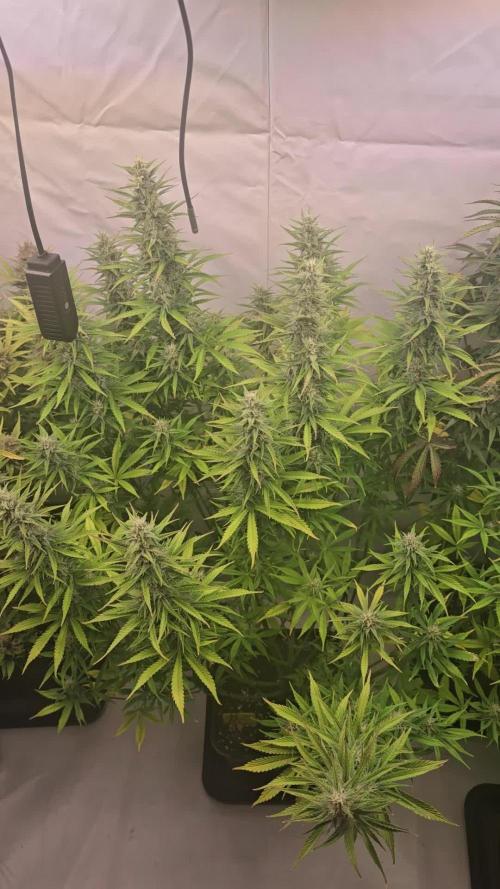
Welcome to week 2 of flower on this lovely project! The ladies are stretching like crazy and it won't be long till we see some lovely flower tops starting! Some really cool genetics featured this run by a really cool breeder Hidden Vault Genetics. Genetic breakdown: Banana Smoothie ( Banana Split x G.O.S ) Creamy Cereal Crunch ( Watermelon Z x G.O.S ) MacMelonz ( Mac Burger x Zour Watermelon ) Huge shouts go to both the breeder and @MarsHydroLED for the awesome gear they make! Huge huge shout out goes to all my followers and supporters you guys inspire me to become the best grower I can be! Be sure to follow along for the latest updates cause this shows getting juicier by the day! -The Projexx Day#8F Put in net , trained down some of the taller plants. Plants are stretching along nicely. Day#9F Plants bounced back from the scrog training very quickly. They're picking up the pace with stretching! Day#10F Plants are just bursting in new growth, Creamy Cereal Crunch is getting huge! Day#11F We got the start of cotton balls going! Day#12F Pictures N/A. Ladies continue to explode in growth, defoliated some of the older leaves that aren't getting any light. Day#13F The ladies continue their stretch! Creamy Cereal is absolutely beasting out! Day#14F Cotton balls are getting bigger and bigger. Plants continue to stretch with minor signs of slowing down. Recap: Things went extremely well this week , the plants absolutely exploded in growth and have developed cottons balls. With some time left on the stretching period and lots of time left overall on this grow I'm very excited to see the end results with these cool genetics.
Likes
69
Share
🌸 Eternity Cup • Week 4 Flower • Runtz Phenos 1 to 5 Welcome back to the garden, my dear growers! This week, we enter Week 4 of Flower, and the energy is shifting — it’s subtle, like a foggy winter morning where everything is still, but alive with quiet anticipation. Our beloved Runtz girls — phenos 1 through 5 — are beginning to reveal themselves fully, forming those early floral structures (the “ears,” you know the ones 🌱💚), and each one is expressing her beauty in unique, yet strikingly similar ways. This kind of uniformity only proves how stable and powerful these Zamnesia genetics truly are. They are fulfilling the scrog like queens — compact, bushy, and ready for the next phase. This week, I noticed a slight decoloration in the leaves — just a whisper of pale green — and it felt like the perfect moment to adjust the feeding to bring out that lush vibrancy again. We’re now running the following dosages in our reservoir: • Regulator: 0.15 ml/L • System Clean: 0.25 ml/L • RO Water Conditioner: 0.8 ml/L • All-In-One Liquid: 2 ml/L • Plagron Green Sensation: 1 ml/L This blend brings us to an EC of 2.225 and a pH of 6.07 — right in the sweet spot. Let’s see these ladies rise up and glow 🌞 Since it’s been a little cold — temps started the week around 16°C and are now slowly climbing up to 23°C, with a humidity of about 50%, this gives us a VPD of around 1.50, which is still looking great considering the lower ambient conditions. CO₂ is sitting at 1000+ ppm, and light intensity is cruising around 550-600 PPFD, which we’ll increase in the coming weeks to match their needs as they bloom. The Autopots keep our medium at 53% moist like clockwork, but I’ve added a water heater to the reservoir — aiming to gently raise soil temperature by warming the solution. That 16°C in the substrate wasn’t doing us any favors, so let’s bring the roots a little cozy love. Everything we do, we do with intention and care. Visually, this week feels like a quiet fog has settled — like watching the garden through a soft lens. The atmosphere is calm, with the girls standing strong and steady under the ICL 300s and the Model Ones, which are doing a phenomenal job creating the perfect stage for this show. Let’s take a moment to thank this beautiful community — the lovers, the learners, the OGs, the curious ones just passing by — your presence means everything 💚 Massive gratitude to Zamnesia for the incredible genetics, Zamnesia, Plagron and to Grow Diaries for hosting this Eternity Grow Cup. And of course, deepest thanks to all the sponsors making this magic possible: Aptus Holland, Grove Bags, TrolMaster, ThinkGrow LEDs, Promix, Cannakan, FOG and Ziggy Papers — your support grows more than plants, it grows stories, friendships, and futures. P.S. Before we wrap it up for the week, I just wanted to add a note about one of the biggest tasks we tackled — the defoliation. It was time. The girls had grown into a dense jungle of love and leaf, and it was clear they needed more room to breathe. More airflow, more light. More photons reaching deep into their hearts. That’s what we aim for. So, leaf by leaf, gently, carefully — with respect for each one — I went in. Four, maybe five hours of focused silence (with my jam on the back ground), removing what needed to be removed. It was a lot. And as I moved through them, it became clear: the Scrog net, too, had done its part. But now? It was just in the way. These girls are so compact, so thick, so full of presence and power — they can hold themselves. So, I took the bold move. I freed them. No more net. Just them, as they are, open to the light and thriving on their own terms. It was a beautiful moment — one I wanted to share with you here, just quietly, before we say goodbye for now. 🌬️ Until next week — stay warm, stay growing, and let the fog roll gently through your garden. Genetics - Runtz https://www.zamnesia.com/6000-zamnesia-seeds-runtz-feminized.html Nutrients - Plagron https://plagron.com/en/hobby - Aptus Holland https://aptus-holland.com/ Controls - Trol Master https://www.trolmaster.eu/ LED - https://www.futureofgrow.com/en LED - https://www.thinkgrowled.com Soil - https://www.promixgardening.com/en Germination - Cannakan https://cannakan.com/?srsltid=AfmBOopXr-inLXajXu3QFgKXCXXos4F1oEvScjMKIB5MR5dk8-GJ-F49 DOGDOCTOR 15% off Smoking Papers - https://ziggioriginal.com/ Terpene saver - https://grovebags.com/ As always thank you all for stopping by, for the love and for it all , this journey of mine wold just not be the same without you guys, the love and support is very much appreciloved and i fell honored with you all in my life With true love comes happiness Always believe in your self and always do things expecting nothing and with an open heart , be a giver and the universe will give back to you in ways you could not even imagine so As always, this is shared for educational purposes, aiming to spread understanding and appreciation for this plant. The journey with nature is one of discovery, creativity, and respect. Let’s celebrate it responsibly and continue to learn and grow together! Growers Love To you All 💚 #EternityGrowCup #RuntzHunt #GrowersLove #CannabisCommunity #AptusHolland #ProMixSoil #TrolMaster #Zamnesia #Plagron #ZiggiPapers #Grovebags
Likes
5
Share
Bien aquĂ­ esta el dĂ­a esperado la cosecha, es mi primer cultivo y considero que lo logre. En muchos medios de lectura y en especial en vĂ­deos mencionan que no puedes esperar mucho es tu primer cultivo. En mi caso es falso y lo demuestro ya que si aprendes, investigas por cuenta y lees lo suficiente, obtendrĂĄs un alto porcentaje de que los resultados se den. Muy contento con mi plantas y sus tonos morados. Puntos a mejorar tener una carpa de cultivo y por su puesto un extractor de humedad para que baje la humedad preferiblemente a 45 grados VendrĂĄn mejores contenidos y cosechas mas abundantes. Gracias a todos por su vistas y comentarios. Saludos y bendiciones!
Likes
22
Share
It grew so fast, I’d definitely recommend it for a first time grower, im gonna try growing a photo next time, It’s was very sweet tasting, but a bit dry think I need to learn a bit more about drying and curing before my next grow
Processing
Likes
34
Share
My first time making alcohol tintcure Using the c1 , Hold on tight gonna be a trip
Likes
63
Share
And like in every grow things get to an end, and this one is no exception to that rule, did not yet end but is pretty dam close from it, gave her a last and only defoliation so far, this will help me in a few days wen i harvest her, and for now she looks way more beautiful to my eyes, man she did turn out outstanding , i mean, the looks, the smells , the over all everything this one is a champ. Love her Xmas tree kind a grow with a beautiful and modestly gigantic main cola, covered in beautiful and colorful trichomes, that glue to anything they touch living a complex and unique fragrance that follows you wherever one goes, she is a delight thats for sure. Not much to do besides observing this Queen Mama and wait for her to tell me she is ready to came down <3 <3 <3 As always thank you all for stoping by, for checking my journey , for the love support and for it all, i am blessed and humble with you all. Just a reminder , all i grow is medicine for myself, for me and for my best friend with is me nothing to sell, so don’t even ask. 

All info and full product details can be find in can find @ https://ganjafarmer.com 

https://aptus-holland.com/ #aptus #aptusplanttech #aptusgang #aptusfamily #aptustrueplantscience #inbalancewithnature #trueplantscience #Ganjafarmer #growerslove
 With true love comes happiness 💚🙏 Always believe in your self and always do things expecting nothing and with an open heart , be a giver and the universe will give back to you in ways you could not even imagine so 💚💚💚 More info and updates @ https://growdiaries.com/grower/dogdoctor 
https://instagram.com/dogdoctorofficial
 https://youtube.com/channel/UCR7ta4DKLFMg2xxTMr2cpIg
 💚💚💚Growers love to you all 💚💚💚
Likes
13
Share
@Chef_LA
Follow
Die Damen haben ordentlich zugelegt. Gorilla ist sehr hoch gewachsen, hat schöne Äste entwickelt und nun sprießen die Blüten. Sie wird definitiv länger brauchen wie Tropicana. Lady Tropicana bleibt klein, bekommt aber einen traumhaften Headbud. Die Farbe besticht durch ihre schönen violetten Nuancen. Der Duft wird immer stärker und wenn ich das Zelt öffne verströmt ein Citrusduft der Appetit auf mehr macht. Ich freue mich schon auf den Tag wenn ich das Glas mit den gereiften Blüten öffnen darf und es verkosten kann. Zusätzlich zum normalen Dünger habe ich einmalig mit 100ml/L Brenneseljauche gedüngt. Die Stigmen werden langsam braun und jetzt heißt es gut beobachten.
Likes
11
Share
Let’s go day 19 of flower🌺 y’all!!! These girls are doing so amazing, especially the smell for these already , just absolutely lovely! We are heading into week 3 of flower alot of very nice bud spots to build on , these girls are gonna be one of a kind so y’all don’t want to miss them next updates, keep them eyes peeled! Y’all have an amazing productive day and let’s grind the rest of this week out and have an amazing weekend! Peace love an positive vibes to all y’all Cheers 😶‍🌫️💨💨💨💨💨🤙🏻
Processing
Likes
3
Share
Beautiful purple buds there are only 2 out of 5 phenos of bslck cherry punch 🍒 👊 that have purple flowers. The aroma just like her sisters is ver very sweet for real. Very nice fruity sroma, it gives you very good vibes man. I'm in love with this strain, basically because the 5 bslck cherry punch have the exact same aroma, and that's awesome because obviously these are not clones as you can see,all of them started from seed, and I think I've found a very good híbrid to my favorite list. She's been grown 100% organically without any sinthetic nutrients, no bottle nutrients. Just 100% organic living soil with very rich in beneficial bacteria and fungus thanks to the use of Florganics FLO, Silicium flash by biotabs that contains bug shit very rich in life. And also bat guano and seaweed powder by guanokalong. Peace everybody! 💚✌️❤️👨‍🌾
Likes
10
Share
She is growing very nicely. The buds are getting bigger now and look frosty so far. This should be great strain to smoke and grow in future 💪
Likes
19
Share
@Naujas
Follow
The girls look good :) I have never raised without LST, this time it will be just like that :)
Likes
7
Share
The plants are growing nicely! They were all flushed with plain pH balanced water on Friday and will be fed nutrients listed above on: 5/31
Likes
45
Share
In general i am very satisfied considering the biggest problem i had which was the heat during all the growing period. I also had a power cut which stressed the plant very much to the point it stopped growing for a few days ( the most critical days 😡 😤 ) and developed 3 finger leaves. Despite the heat the buds are very frosty, they have a very strong smell like brown sugar and cookies and the density is decent. The buds dried for 9 days at 22 °C and 60% RH and now are placed at PP tapers with boveda envelops to cure. Smoke report at 2-3 weeks.
Likes
52
Share
Its time to prepare for war. *Blows bagpipe* FISH SH!T THE ORGANIC SOIL CONDITIONER (used twice before and always noticed instantly) Fish Shit is a living product! It provides a complex Microbial profile that includes thousands of different species of bacteria, fungi, and protozoa. This profile is closer to a natural ecosystem than anything you will find on the market. Fish Shit helps release essential oils and terpenes which contribute to the building of a myriad of flavonoids. Flavanoids play a key role in the development of the most potent aromas and tasteful flavors of a plant and its fruit. Fish Shit contains beneficial microorganisms that help plants maximize nutrient uptake. It does this by transforming nutrients into more usable forms and keeping these nutrients in the soil longer. During photosynthesis plants naturally produce exudates (chemicals that are secreted through their roots). Through these exudates, plants can attract the types of good bacteria that are beneficial to them at different points in their growing cycle. These good bacteria cover the roots and act as a barrier to the invasion of disease-causing organisms that may harm the plant. What Are Enzymes? Before we dive headfirst into how, exactly, enzymes can benefit cannabis plants, it helps to understand a little about what these microscopic proteins do. Essentially, enzymes facilitate chemical reactions. They do so by binding with a substrate and forming or breaking molecular bonds. In this context, the substrate is the molecule upon which an enzyme acts to boost the efficiency of a reaction. •substrate /sŭb′strāt″/ •noun •The material or substance on which an enzyme acts. A surface on which an organism grows or is attached. An underlying layer; a substratum. Enzymes are proteins with complex 3D shapes that feature regions called active sites. When the substrate binds to these active sites, it forms an enzyme-substrate complex that causes a chemical reaction to take place, temporarily changing the structure of the enzyme and ultimately causing molecules to either come together or break apart. As a result, molecular products are released, and the enzyme returns to its original shape. Specific enzymes are capable of binding with certain substrates, as the substrate fits into the active site more or less via a lock-and-key principle. Although, new research suggests a more accurate theory of "induced fit", in which enzymes and substrates undergo structural changes to facilitate the reaction. If you take the human body as an example, we have an abundance of enzymes in our saliva and digestive system. These molecules bind with substrates in these regions (food particles), working to break down the food we eat into usable parts before converting them to energy. Enzymes in cannabis work in a similar way to the example highlighted above. Typically, enzymes occur in soil naturally, but if your soil mix is lacking organic material, or you're growing hydroponically, then adding enzymes directly to the substrate is crucial. By using them in cannabis growing, enzymes not only help break down essential nutrients into smaller, more readily available pieces, but they also support the digestion of dead root cells, clearing a direct path for nutrients. Overall, enzymes make it easier for your cannabis plants to absorb all the elements they need to reach their full potential. For growers, a plant that reaches its full potential means a bucketload of juicy buds come harvest. This is essential if you want to reuse a pot with old systems left over like mine. Common plant enzymes include: •Cellulase •Xylanase •Beta-glucosidase •Hemicellulase •Amidase Amino acids are a crucial, yet basic unit of protein, and they contain an amino group and a carboxylic group. They play an extensive role in the gene expression process, which includes an adjustment of protein functions that facilitate messenger RNA Nitrogen, phosphorus, and potassium are the three main pillars of nutrient solutions and fertilizers, but there are countless other nutrients that your cannabis plants need to produce the best possible harvest. Amino acids are one of them. You may have noticed that amino acids get a lot of attention from bodybuilders and other athletes. That’s because they play a key role in the synthesis of protein, which, as you probably know, is super important for sports recovery and muscle growth. Amino acids are the building blocks of protein and the foundation of both plant and animal life. But what do amino acids do for cannabis? WHY IS PROTEIN IMPORTANT FOR CANNABIS? Just like proteins are important for the human body, they are equally important for the growth and development of plants. For example, proteins help plants: •Facilitate the growth of intracellular plant structures •Promote energy generation •Stimulate metabolic processes •Facilitate the absorption and transportation of nutrients So, where do plants get these vital proteins from? Well, unlike humans, plants can’t source proteins or amino acids from other organisms. Instead, they need to create their own amino acids, and then use these to build protein. That's why gardeners, much like athletes, go wild for amino acid supplements. Amino acids help plants by… • Increasing their production of chlorophyll, which ultimately improves their ability to photosynthesize • Serving as an easily absorbable form of nitrogen • Stimulating the synthesis of key vitamins • Improving their resistance to pests and diseases • Boosting the strength of their cells Amino acids also serve as the precursors to auxins, a group of plant hormones produced in the meristems—the apex of the stems where new leaves and stems are born. Auxins play a key role in the plant, activating genes for plant growth and development by triggering a multitude of vital plant functions. In other words, they determine what its size and architecture will look like. Auxins influence the development of branches, flowers, and roots, and even help to regulate the photoperiod response of the plant. Some amino acids, like cysteine, also work together with antioxidants like glutathione to help cannabis plants deal with oxidative stress, which can be caused by high-intensity lighting, some nutrient solutions, and high levels of CO₂. Unlike humans, plants can synthesize all the amino acids they need to survive and develop properly. Unfortunately, however, amino acid synthesis is a really high-energy process, and plants may struggle to produce enough amino acids when exposed to stress. WHAT FACTORS AFFECT A PLANT’S ABILITY TO SYNTHESISE AMINO ACIDS? Any kind of stress can affect a plant’s ability to produce enough amino acids. This includes: • Drought • Temperature extremes • Poor soil health • Pests • Diseases • Poor lighting • Lack of space • Poor root health WHAT DOES ALL OF THIS MEAN FOR WEED PLANTS? If you want to push your plants to their extreme in terms of floral growth and resin production, you should look into amino acid fertilizers. By making amino acids readily available to your plants, they’ll be able to use crucial energy to grow and bloom, rather than focusing on synthesizing amino acids themselves. Game of Inches, this is another Plants can absorb amino acids via their roots and leaves. They can also benefit from amino acids during both their vegetative and flowering phases. The fastest way for plants to absorb amino acids is via their leaves. The foliar application of amino acids is believed to improve the transportation of nutrients, increase transpiration, and boost photosynthesis. Hence, I recommend feeding your plants with foliar amino acid fertilizers. When doing so, however, carefully measure the amount of fertilizer you use, as—like with any nutrient—overfeeding can damage your plants. FOLIAR FEED AND SOIL SOAK • 1 crushed queen anne carrot • Add 2 tbsp of NPK Raw powdered water-soluble cane molasses • 20ml h2o2 • 1 crushed radish • 0.25 tsp NPK Enzymes • 0.25 tsp NPK Amino Acids • 50ml coconut water ( nature's own amniotic fluid packed with amino, enzymes ) + The sound of songbirds. Onto the predators 1250 -Green Lacewings Lacewings are extremely voracious predatory insects that feed on several pests. In adulthood, it feeds on pollen and nectar. In the larval stage, it feeds on aphids, thrips, and mealybugs at all stages of growth. It can also attack spider mites in moderate quantities. It is initially an aphid predator, but very effectively controls thrips and mealybugs infestations. It is so voracious that in the absence of prey, it will feed on its congeners. Lacewings are cannibalistic if there is no food available for them. It is therefore important to introduce them into an infestation situation, and not just preventively. •congener /kŏn′jə-nər/ •noun •A member of the same kind, class, or group. •An organism belonging to the same taxonomic genus as another organism. •A thing of the same kind as. or nearly allied to, another; specifically, in botany and zoology, a plant or an animal belonging to the same genus as another or to one nearly allied. Ideal temperature 20°C – 26°C Ideal humidity 60% – 70% Predatory stage life cycle 21 days Introduction rate 4 weeks Storage Refrigerator Use Immediately Are there any specific instructions on how to use this predator? Lacewings are available on small paper cards that you can hang to plant stems. On the cards are dozens of eggs ready to hatch. There are also sterile eggs they can feed on once they have hatched before they are ready to disperse in the foliage. It is important to use them quickly upon receipt to avoid cannibalism. If you don't use them right away, you can store the cards in the refrigerator for 24 to 48 hours to prevent the eggs from hatching too quickly. Avoid storing them for longer than this or you risk losing eggs. 1250 eggs are divided into 7.5 cards, 2500 eggs on 15 cards, and 5000 on 30 cards. The application rate is one card per square meter of growing surface. Is this predator best used for preventive or curative treatments? Lacewings are used as a curative solution. Anything else I should know? Lacewing eggs hatch approximately 24-72 hours after the cards are exposed to room temperature. When they emerge, the lacewings are just 1.5-2 mm long. They are very small so they are difficult to see. Once hatched, they will stay on the cards for a few hours and then disperse in the foliage. You quickly lose sight of them if you have not witnessed the hatching. They then live in the foliage for about 3 weeks. Often, you will see them towards the end of their larval cycle. After feeding for 3 weeks, they will triple and even quadruple in size. At that point, they are easier to see. But they remain very discreet insects, it is not abnormal not to see them. Egg carcasses left behind on the cards do not disappear after the hatching has happened. It's normal to see eggs still on the cards. Visually it is very similar before and after hatching. Also, on the boxes, there are sterile ephestia eggs which are used to feed the lacewings once hatched. Not all lacewing eggs are viable either. Only a certain percentage of lacewing eggs will hatch. Once hatched, the eggs are white. You can observe this using a magnifying glass. With, 5000 Stratiolaelaps Scimitus It is used to prevent or control thrips pupae, fungus gnats larvae, and root mealybugs in the soil. It can also be used for red mites in bird farms or hen houses. The adult is about 1 mm long and is medium brown with a beige triangle on its back. Another fun fact about them is they can survive without prey. They can eat algae and plant debris. This is why they can reproduce and stay in plants for long periods. Ideal temperature 15°C – 23°C Predatory stage life cycle 18 days Introduction rate 2 weeks Storage Room temperature Use Within one week Are there any specific instructions on how to use this predator? Sprinkle directly on the growing media. They can live in all types of substrates like potting soil, coconut fiber, rock wool, cedar mulch, etc. Stratiolaelaps establish easily so they are permanently fighting pests. One introduction is generally enough unless you have an infestation. In this case, introduce them at least twice at a 2-week interval for best results. If you grow your plants in a 100% mineral substrate, it will have to be released more often since there is less organic matter than in traditional soil. Do I need to take any specific precautions? Stratiolaelaps breed in the top layer of the soil. So it is important not to disturb them in the first days following their introduction. They don't like temperatures below 8 ° C. So be sure not to introduce them in a water-saturated or cold environment. Release them 24-48 hours after your last watering. They are very sensitive to chemical acaricides and diatomaceous earth. These methods are incompatible with their use.
Likes
20
Share
Semana bem fria, temperaturas a noite chegaram a 7 graus, e ainda tive um inicio de mofo em um dos top buds, foi vacilo meu, acabei dobrando ele demais e tirei ele da circulação de ar. Retirei esse bud e fiz uma vistoria bem feita nos outros, não encontrei nada… semana que vem eu colho e já sei que preciso de mais um ventilador hehe
Likes
34
Share
@Tower84
Follow
🇩🇪 GrowDiaries – Wochenkommentar Diese Woche hat sich meine Cherry Limeade großartig entwickelt 🌱. Es fühlt sich tatsächlich so an, als wäre plötzlich ein Schalter umgelegt worden. Das Wachstum ist jetzt kräftig und gleichmäßig, die Pflanze wirkt rundum gesund und zeigt weder Mangelerscheinungen noch die zuvor vorhandene Taco-Bildung der Blätter 💚. Am Sonntag habe ich sie getoppt ✂️ und ihr anschließend bis Donnerstag komplett ihre Ruhe gelassen, damit sie sich erholen kann. Seitdem läuft das Low Stress Training. Mit Drahtankern ziehe ich die Triebe vorsichtig nach außen, um eine möglichst breite und gleichmäßige Pflanzenstruktur aufzubauen 🌿. Die Positionen der Drahtanker passe ich täglich an, damit alle Triebe optimal Licht erhalten ☀️. Endlich habe ich auch die perfekte Einstellung für die vier Maxi-Blumat-Tropfer gefunden 💧. Das System hält die Saugspannung nun konstant zwischen 90 und 100 mbar, genau dort, wo ich sie haben möchte. Das gibt mir ein richtig gutes Gefühl – besonders, weil ich nächste Woche vier Tage beruflich unterwegs bin. Ohne ein zuverlässig eingestelltes Blumat-System hätte ich jetzt ein echtes Problem. So kann ich ganz entspannt verreisen 😌. Auch das Cover Crop wird langsam weniger 🌾. Ich schneide es mittlerweile fast täglich zurück, damit vor der Einleitung der Blüte nur noch wenig davon übrig ist. Langsam aber sicher gewinne ich diesen Kampf 💪. Das Gleiche gilt für die Trauermücken ?. Gestern habe ich 6.000 Hypoaspis miles ins Beet ausgebracht und abends, kurz vor dem Ausschalten der Beleuchtung, zusätzlich 3 Millionen SF-Nematoden gegossen. In einer Woche folgt eine zweite Behandlung mit weiteren 3 Millionen SF-Nematoden. Hoffentlich ist das dann das endgültige Aus für die Trauermücken 🎯. Ansonsten werde ich die Pflanze jetzt einfach weiter trainieren und in Ruhe wachsen lassen 🌱. Auf Komposttee oder Fermente verzichte ich bewusst, denn im Living Soil sollten mehr als genügend Nährstoffe vorhanden sein 🌍. Im Moment bin ich mit der gesamten Entwicklung mehr als zufrieden und freue mich riesig auf die kommenden Wochen 🚀. 📊 Aktuelle Parameter: 💡 Licht: 400 PPFD (18/6, Stufe 3, 40 cm Abstand) 🌡️ Temperatur: 27 °C 💧 Luftfeuchtigkeit: 72 % 📈 VPD: 1,0 kPa 🌿 CO₂: Ø 670 ppm 💦 Bodenfeuchtigkeit: 90 mbar 🇬🇧 GrowDiaries – Weekly Update This week my Cherry Limeade has developed amazingly well 🌱. It honestly feels like someone flipped a switch. The growth is now strong and steady, the plant looks very healthy, and there are no signs of nutrient deficiencies or the taco-shaped leaves I had before 💚. I topped her on Sunday ✂️ and then left her completely alone until Thursday to allow her to recover. Since then, I have started low stress training. Using wire anchors, I gently pull the branches outward to create a wider and more even plant structure 🌿. I adjust the position of the wire anchors every day to make sure all shoots receive optimal light exposure ☀️. I finally found the perfect setting for my four Maxi Blumat drippers 💧. The system now keeps the soil suction tension consistently between 90 and 100 mbar, exactly where I want it. This gives me a lot of confidence – especially because I will be away on a four-day business trip next week. Without a properly dialed-in Blumat system, this would have been a real problem. Now I can leave home completely relaxed 😌. The cover crop is slowly disappearing as well 🌾. I am cutting it back almost every day so that most of it will be gone before I start flowering. Little by little, I am winning this battle 💪. The same goes for the fungus gnats ?. Yesterday I released 6,000 Hypoaspis miles into the bed and, in the evening just before lights out, I watered in 3 million SF nematodes. In one week, I will repeat the treatment with another 3 million SF nematodes. Hopefully, this will finally bring the fungus gnats under control 🎯. Apart from training, I will leave the plant alone and let her grow naturally 🌱. I will not use any compost tea or ferments for now, because the Living Soil should already contain more than enough nutrients 🌍. At the moment, I am extremely happy with the development and I am really looking forward to the next few weeks 🚀. 📊 Current Parameters: 💡 Light: 400 PPFD (18/6, Level 3, 40 cm distance) 🌡️ Temperature: 27 °C 💧 Humidity: 72 % 📈 VPD: 1.0 kPa 🌿 CO₂: Avg. 670 ppm 💦 Soil moisture: 90 mbar