The Grow Awards 2026 🏆
Likes
27
Share
Not much has really changed this week from last week. They are starting to swell up a bit more. Next week I think will be the time to start flushing them.
Processing
Likes
48
Share
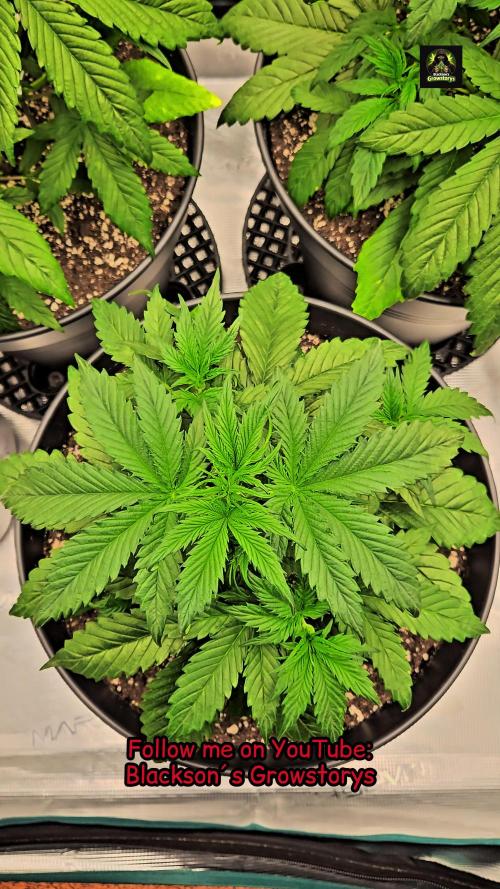
This will be their last week in vegging 😊 will all be defoliated and vegged for a few days then flipped into flower 🌺🌷 also will all be going into a new 80x80x160cm tent . Had a few condensation problems this week too but all under control now .
Likes
11
Share
Bewässerung: 5000 ml jeden 3 Tag in der zwölften Woche pH-Wert: 5,8 EC-Wert: 0,4 mS/cm Temperatur: 20ºC Luftfeuchtigkeit: 65% Schädlingsbekämpfung: Diese Woche haben wir ihr Wasser mit Nematoden gegeben da sich doch vermehrt Trauermücken im Bereich aufhalten. PPFD: Direktes Sonnenlicht DLI: Direktes Sonnenlicht -Tag 75 Heute haben wir sie mit Schachtelhalmjauche gegossen 😘
Likes
77
Share
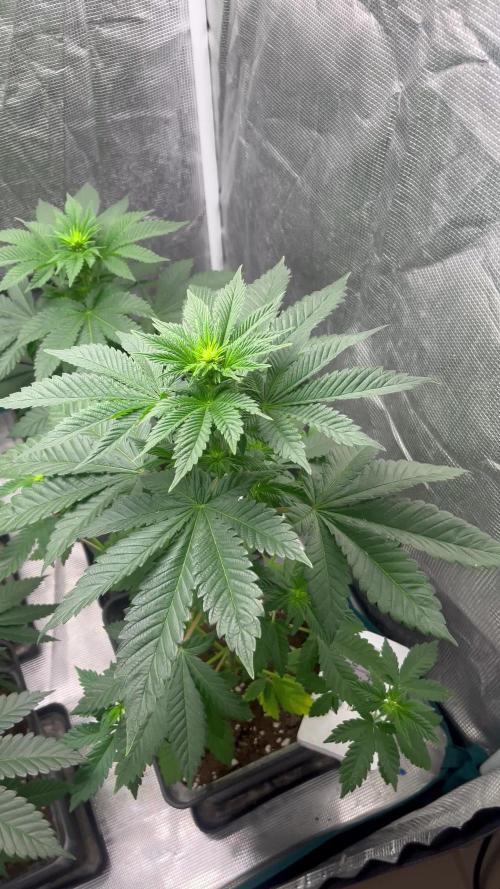
Light = bloomplus bp2500 250watt actuall draw. Exhaust is a ac infinity 6inch with digital controller Inkbird humidity controller with a ram 5l humidifier. Veg only! Soil= biobizz light mix Nutes= biobizz using the 10 week schedule at half dose this run. Heaven =2ml avti vera=2ml Topmax =1ml bloom = 1 calmag=2ml Grow=1ml All nutes mixed to 1l of water Ph= 6.4 Room humidity is 60% Day Temp is 25°c So entering week 3 and the girls are growing fast, gelatocake are putting out pistils to show there sex. The sherbert mimosa are still growing strong and I will bend them and tie them down today. Happy growing guys 👌💪💚
Likes
3
Share
01/01 happy new year start of a new week here. Top dressed with craft blend, pushin p, and ocean blend, and 2/1 mix of buildaflower and castings .and watered in rootwise goodies just 3 gallons also raised vpd to 1.2 and ppfd to 550-600 depending on the spot. 01/02 remembered to shift the hours down to 16/8 definitely gave em to much light for to long looked pissed before lights out. Also have been adjusting light height and power to get the ppfd I want and temp. Think I got it dialed in now. Just keep tucking for now 01/03 made adjustments to light and environment again took controller off AI and manually set everything and the environment is super I dialed in now. Also started the fungal prime mix for a pre bloom/stretch tea. 01/04 watered in 3.5 gallons of plain water and 3.5 gallons with goodies. Very light on NPK this time did some more tucking
Likes
11
Share
@AutoCrazy
Follow
This plant is just Grrreat!! She’s a hungry girl though. Hard to keep up with her appetite. She is really smelling quite wonderful at this point. Very citrusy and sweet!! 😎
Likes
6
Share
Legend Timestamp: 📅 EC - pH: ⚗️ Temp - Hum: 🌡️ Water: 🌊 Food: 🍗 pH Correction: 💧 Actions: 💼 Thoughts: 🧠 Events: 🚀 Media: 🎬 D: DAY, G: GERMINATION, V: VEGETATIVE, B: BLOOMING, R: RIPENING, D: DRYING, C: CURING ______________ 📅 D22/V18 - 07/05/24 ⚗️ EC: 0.7 pH: 5.3 🌡️ T: 22 °C H: 50% 🌊 🍗 💧 💼 🧠 🚀 🎬 1 TL video ______________ 📅 D23/V19 - 08/05/24 ⚗️ EC: 0.7 pH: 5.3 🌡️ T: 22 °C H: 50% 🌊 🍗 💧 💼 Topping and LST 🧠 🚀 🎬 1 TL video of grow and one of the topping ______________ 📅 D24/V20 - 09/05/24 ⚗️ EC: 0.9 pH: 5.4 🌡️ T: 19 °C H: 50% 🌊 🍗 💧 💼 🧠 🚀 🎬 1 TL video ______________ 📅 D25/V21 - 10/05/24 ⚗️ EC: 0.9 pH: 5.4 🌡️ T: 19 °C H: 50% 🌊 12 L 🍗 Calmag, Grow A-B, B52, Hydroguard, Rhino Skin, Bud Candy 💧 💼 🧠 🚀 🎬 1 TL video ______________ 📅 D26/V22 - 11/05/24 ⚗️ EC: 0.9 pH: 5.4 🌡️ T: 19 °C H: 50% 🌊 🍗 💧 💼 🧠 🚀 Out of Home 🎬 1 TL video ______________ 📅 D27/V23 - 12/05/24 ⚗️ EC: 1.0 pH: 5.3 🌡️ T: 20°C H: 50% 🌊 🍗 💧 💼 🧠 🚀 Out of Home 🎬 1 TL video ______________ 📅 D28/V24 - 13/05/24 ⚗️ EC: 1.0 pH: 5.2 🌡️ T: 20°C H: 50% 🌊 🍗 💧 💼 🧠 🚀 Out of Home 🎬
Processing
Likes
66
Share
First week of flush on the way with no where near as much swelling as I hoped, after last weeks question I decided to raise my light another 4 inches to reduce the burning seems to have helped but I'm not quite sure (it was already pretty bad), the EC of my run off varies between 1.4 and 1.8 by the end of the week, next week I am planning to use straight PH'd water however some one has got me questioning my self. But everything is a learning curve and I have learned alot from these ladies and from everyone who has helped and had an input your experiences have helped Next week... HARVEST!! Happy Growing! 👊👍
Likes
7
Share
Всем привет друзья! Очередная неделя с хвостиком. прошла успешно. Жирок на шишках набирается. Начинает меньше кушать. Думаю через пару дней начну проливать водой. Куст мне очень нравится. Всем добра и мира!
Processing
Likes
7
Share
@gablmo
Follow
Finally flower. They are 4 feet now. What am I going to do? I don't want them to burn into the light.
Likes
7
Share
Super Silver Haze (Zamnesia Seeds) — Flower Week 7 (Recovery) Grower: Dog Doctor Strain: Super Silver Haze Breeder: Zamnesia Seeds Stage: Flower — Week 7 (recovery after localized bud rot) Pots/Medium: 11 L fabric pots — living super soil with Aptus pellets and Plagron support Watering: Hand watering; currently water only (see science below) Lights: F.O.G. Black Series 600W + ThinkGrow ICL-300 (inner canopy) + Lumatek Zeus Compact Pro 465W Control & Monitoring: TrolMaster Hydro-X/Tent-X + WCS substrate sensors Air exchange: Dual 6” filtered exhausts + filtered intake; oscillating fans moving canopy air Current environment (example): day ~29–31 °C, night ~24–26 °C, RH mid 50s–60s, CO₂ ~700 ppm ⸻ Quick recap — seed to the present moment • Germination & early veg: 3/3 germinated via Cannakan; strong, even starts. • Transplant: Into 11 L fabric pots with a super soil base inoculated with Aptus Mycor/Micro mixes and buffered for pH stability. • Veg: Compact, steady growth; conservative feeding with Aptus starter lineup. • Early flower: Fast flower transition, pistils and bud sites stacking quickly. Plagron trio (Power Buds, Sugar Royal, Green Sensation) + Aptus boosters used to enhance bloom development. • Bud rot event: Localized Botrytis found inside one cola; removed quickly and thoroughly. Loss minimal. Immediate steps taken (see below). • Recovery week (this report): Plants responding strongly — dense colas, heavy frosting, explosive aroma. We moved temporarily to water-only feed to stabilize the root zone and let the soil biology drive nutrition. ⸻ What happened and how we dealt with it 1. Detection: Small dark spot discovered deep inside a dense cola. Because rot often starts inside dense clusters, early detection is key. 2. Immediate action: Removed the affected flowers and any suspicious material. Cut generously around infected tissue to avoid leaving spores. Placed waste in sealed bags and removed from the growroom. 3. Sanitation: Cleaned tools, wiped surfaces, checked fans and filters for dust pockets, and increased canopy airflow. 4. Environment adjustments: Increased air movement across and through the canopy; checked extraction; planned AC installation to lower day temps and stabilize RH. 5. Observation & patience: Kept strict daily inspections for any new spots; let plants recover without additional heavy nutrient pushes. Result: the loss was minimal, the rest of the canopy stayed healthy, and the plants rebounded quickly. Dense, frosty colas and an incredibly strong smell are the signs they are back on track. ⸻ Why “water only” right now — the science, explained simply We moved to water-only feeds for a short, strategic period. That decision is conservative and backed by three practical goals: 1. Reduce salt and nutrient spikes: After stress and after tissue removal, roots can be sensitive. Water-only flushes prevent sudden EC spikes that can further stress roots. Salt buildup can inhibit water uptake (osmotic stress); clean water restores osmotic balance. 2. Let the soil biology work: You’re growing in a living super soil with Aptus pellets and biological inoculants. Microbes mineralize nutrients slowly and steadily. When plants are stressed, microbial mineralization becomes more important than high-concentration liquid feeds. Water-only gives beneficial microbes a stable environment to supply what the plant needs. 3. Avoid overstimulating lush growth: At late flower, you want carbohydrate partitioning to favor flower filling and resin production, not new vegetative pushes. Limiting NPK pulses prevents a late vegetative response and encourages the plant to allocate sugars to trichome and calyx growth. Practical note: “Water only” does not mean nutrient-starvation. Your living soil still releases NPK and trace elements. Monitor substrate EC (WCS) and plant appearance; if deficiency signs persist for more than a week, reintroduce a light, balanced feed. ⸻ The gear doing the heavy lifting — why the ICL-300 inner canopy lights matter • ThinkGrow ICL-300 (inner canopy lights): These deliver targeted, diffuse light deeper into the canopy. For dense sativas or hybrids that set flowers lower on the plant, inner-canopy LEDs reduce shading and encourage even bud set on lower nodes. They also reduce the need to strip leaves to reach light—so you can preserve biology and microclimate. • F.O.G. Black Series & Lumatek: Provide high PPFD to the top canopy for strong photosynthesis and sugar production. The combination of powerful top light + targeted inner lights = even canopy carbon distribution and more uniformly fat colas. • TrolMaster + WCS: Real-time data on substrate moisture and EC lets you water by need (you’re already using ~19–25% dryness triggers), which prevents both saturation pockets that encourage rot and drought that stresses plants. • Airflow & filtration: Dual exhausts and oscillating fans keep air moving; carbon filters keep air clean. This is essential to lower local humidity around flowers and prevent new rot pockets. All gear together creates a system: light for sugar, airflow for dryness, monitoring for precision, and soil biology for nutrition. ⸻ Observations this week • Colas: Thickening, dense, frosty. Trichome production visible even with the naked eye. • Aroma: Extremely potent — strong typical Super Silver Haze profile developing (citrus/citrus-haze + spicy/earthy back-notes), likely driven by terpene expression and warm room temps. • Leaves: Minor spotting in places earlier; after CalMag adjustments and water-only period, new growth is healthy and vibrant. • Root zone: Very active — roots visible through fabric, good white root color where checked. ⸻ Risks to watch and mitigation steps (practical, daily checklist) • Risk: Secondary rot pockets — Mitigation: daily inspection, move a small headlamp into canopy to view internals, keep oscillating fans moving air between bud layers. • Risk: High night humidity with cooler temps — Mitigation: install AC / run dehumidifier at night, maintain extraction during lights-off. • Risk: Support failure from heavy colas — Mitigation: pre-position soft ties / netting to support colas now before they get heavy. • Risk: Late-flower nutrient imbalance — Mitigation: watch leaf tips/edges for burn or deficiency. If signs appear, use small, dilute corrective feeds rather than heavy dosages. ⸻ What to expect in the next 1–3 weeks • Short term (next 7 days): Continued fattening of calyxes, sustained trichome increase, aroma intensifies. Plants will drink more as flowers bulk. Keep water-only until the canopy is stable and substrate EC is within your target range. • Mid term (weeks 2–3 from now): Major bulk phase — colas will gain weight and density. Trichomes will move from clear → cloudy (start of potency peak). Expect more resin and heavier terpene bouquet. • Near harvest planning: Start planning drying/curing space and harvest timeline once trichome clouding reaches your target (we’ll plan this together when the time approaches). Also plan to stagger harvests if colas mature at different rates. ⸻ Short educational sidebar — why trichomes explode now (brief) Late flower is all about sugar allocation and secondary metabolism. With high light, steady CO₂, and stable root nutrition, plants convert energy into: • Calyx growth (mass) — the physical body of the bud • Trichome production (resin glands) — metabolically expensive, but essential for protection and reproduction; trichomes store terpenes and cannabinoids which act as plant defense and pollinator signals in nature The combination of your lighting, living soil biology, and current conservative feeding strategy drives both mass and resin production. ⸻ Final practical tips for the diary entry • Post a short video walk-through of the canopy with commentary pointing to the saved areas vs. new growth — that tells the recovery story visually. • Photograph a closeup of a supported, heavy cola to show density and resin. • Note the date of the rot removal and actions taken in the GrowDiaries log — that makes the journal useful for other growers and for troubleshooting later runs. • Keep a small “harvest box” ready: sanitized scissors, nets, gloves, labeled trays — you’ll want them when the time comes. ⸻ Gratitude and perspective we acted fast, used sound horticultural judgment, and let biology and environment do their work. That combination saved the run. Super Silver Haze is responding like a champion — dense, frosty, and unapologetically aromatic. This week shows the essence of growing: attentive care + good systems = comeback. 📲 Don’t forget to Subscribe and follow me on Instagram and YouTube @DogDoctorOfficial for exclusive content, real-time updates, and behind-the-scenes magic. We’ve got so much more coming, including transplanting and all the amazing techniques that go along with it. You won’t want to miss it. • GrowDiaries Journal: https://growdiaries.com/grower/dogdoctorofficial • Instagram: https://www.instagram.com/dogdoctorofficial/ • YouTube: https://www.youtube.com/@dogdoctorofficial There’s a new series blooming and it’s more than just plants. It’s about process, patience, and paying attention. ⸻ Explore the Gear that Powers My Grow If you’re curious about the tech I’m using, check out these links: • Genetics, gear, nutrients, and more – Zamnesia: https://www.zamnesia.com/ • Environmental control & automation – TrolMaster: https://www.trolmaster.eu/ • Advanced LED lighting – Future of Grow: https://www.futureofgrow.com/ • Root and growth nutrition – Aptus Holland: https://aptus-holland.com/ • Nutrient systems & boosters – Plagron: https://plagron.com/en/ • Soil & substrate excellence – PRO-MIX BX: https://www.pthorticulture.com/en-us/products/pro-mix-bx-mycorrhizae • Curing and storage – Grove Bags: https://grovebags.com/ ⸻ We’ve got much more coming as we move through the grow cycles. Trust me, you won’t want to miss the next steps, let’s push the boundaries of indoor horticulture together! As always, this is shared for educational purposes, aiming to spread understanding and appreciation for this plant. Let’s celebrate it responsibly and continue to learn and grow together. With true love comes happiness. Always believe in yourself, and always do things expecting nothing and with an open heart. Be a giver, and the universe will give back in ways you could never imagine. 💚 Growers love to all 💚
Likes
3
Share
@Dairon
Follow
Pues empieza la cuarta semana de floración y esto se va poniendo serio, como se puede ver esta Indian Mountain Kush tiene dos fenotipos bien diferenciados pues uno es más ancho y bajo pero reacciona muy bien a poda apical igualando bastante las ramas laterales respecto a las centrales, empieza a florecer mucho más rápido que el otro y olor dulce al frotar el tallo, el otro tiene más porte y tamaño típico en una kush ramas más largas con buenas distancia de internudos, está tardando más en florecer pero seguro que dará buena producción, con el mismo olor dulzón Iré aumentando la EC hasta 1.6 para que se vayan formando buenas flores, sin olvidar antes de que no se pueda de pulverizar por última vez con Leaf Coat de Biobizz para tenerlas protegidas de hongos e insectos
Processing
Likes
9
Share
@BudFox
Follow
Waited for the roots to develop more in the little pot before transplanting to the air pot. Started low stress training on the others. They started a little slow at first but going now.
Likes
3
Share
@Dgessy
Follow
Fin de la 1er semaine, tout se passe bien 😁 Arrosages à l'eau déminéralisée au PH ajusté à 6.8.
Likes
47
Share
What's in the soil? What's not in the soil would be an easier question to answer. 16-18 DLI @ the minute. +++ as she grows. Probably not recommended, but to get to where it needs to be, I need to start now. Vegetative @1400ppm 0.8–1.2 kPa 80–86°F (26.7–30°C) 65–75%, LST Day 10, Fim'd Day 11 CEC (Cation Exchange Capacity): This is a measure of a soil's ability to hold and exchange positively charged nutrients, like calcium, magnesium, and potassium. Soils with high CEC (more clay and organic matter) have more negative charges that attract and hold these essential nutrients, preventing them from leaching away. Biochar is highly efficient at increasing cation exchange capacity (CEC) compared to many other amendments. Biochar's high CEC potential stems from its negatively charged functional groups, and studies show it can increase CEC by over 90%. Amendments like compost also increase CEC but are often more prone to rapid biodegradation, which can make biochar's effect more long-lasting. biochar acts as a long-lasting Cation Exchange Capacity (CEC) enhancer because its porous, carbon-rich structure provides sites for nutrients to bind to, effectively improving nutrient retention in soil without relying on the short-term benefits of fresh organic matter like compost or manure. Biochar's stability means these benefits last much longer than those from traditional organic amendments, making it a sustainable way to improve soil fertility, water retention, and structure over time. Needs to be charged first, similar to Coco, or it will immobilize cations, but at a much higher ratio. a high cation exchange capacity (CEC) results in a high buffer protection, meaning the soil can better resist changes in pH and nutrient availability. This is because a high CEC soil has more negatively charged sites to hold onto essential positively charged nutrients, like calcium and magnesium, and to buffer against acid ions, such as hydrogen. EC (Electrical Conductivity): This measures the amount of soluble salts in the soil. High EC levels indicate a high concentration of dissolved salts and can be a sign of potential salinity issues that can harm plants. The stored cations associated with a medium's cation exchange capacity (CEC) do not directly contribute to a real-time electrical conductivity (EC) reading. A real-time EC measurement reflects only the concentration of free, dissolved salt ions in the water solution within the medium. 98% of a plants nutrients comes directly from the water solution. 2% come directly from soil particles. CEC is a mediums storage capacity for cations. These stored cations do not contribute to a mediums EC directly. Electrical Conductivity (EC) does not measure salt ions adsorbed (stored) onto a Cation Exchange Capacity (CEC) site, as EC measures the conductivity of ions in solution within a soil or water sample, not those held on soil particles. A medium releases stored cations to water by ion exchange, where a new, more desirable ion from the water solution temporarily displaces the stored cation from the medium's surface, a process also seen in plants absorbing nutrients via mass flow. For example, in water softeners, sodium ions are released from resin beads to bond with the medium's surface, displacing calcium and magnesium ions which then enter the water. This same principle applies when plants take up nutrients from the soil solution: the cations are released from the soil particles into the water in response to a concentration equilibrium, and then moved to the root surface via mass flow. An example of ion exchange within the context of Cation Exchange Capacity (CEC) is a soil particle with a negative charge attracting and holding positively charged nutrient ions, like potassium (K+) or calcium (Ca2+), and then exchanging them for other positive ions present in the soil solution. For instance, a negatively charged clay particle in soil can hold a K+ ion and later release it to a plant's roots when a different cation, such as calcium (Ca2+), is abundant and replaces the potassium. This process of holding and swapping positively charged ions is fundamental to soil fertility, as it provides plants with essential nutrients. Negative charges on soil particles: Soil particles, particularly clay and organic matter, have negatively charged surfaces due to their chemical structure. Attraction of cations: These negative charges attract and hold positively charged ions, or cations, such as: Potassium (K+) Calcium (Ca2+) Magnesium (Mg2+) Sodium (Na+) Ammonium (NH4+) Plant roots excrete hydrogen ions (H+) through the action of proton pumps embedded in the root cell membranes, which use ATP (energy) to actively transport H+ ions from inside the root cell into the surrounding soil. This process lowers the pH of the soil, which helps to make certain mineral nutrients, such as iron, more available for uptake by the plant. Mechanism of H+ Excretion Proton Pumps: Root cells contain specialized proteins called proton pumps (H+-ATPases) in their cell membranes. Active Transport: These proton pumps use energy from ATP to actively move H+ ions from the cytoplasm of the root cell into the soil, against their concentration gradient. Role in pH Regulation: This active excretion of H+ is a major way plants regulate their internal cytoplasmic pH. Nutrient Availability: The resulting decrease in soil pH makes certain essential mineral nutrients, like iron, more soluble and available for the root cells to absorb. Ion Exchange: The H+ ions also displace positively charged mineral cations from the soil particles, making them available for uptake. Iron Uptake: In response to iron deficiency stress, plants enhance H+ excretion and reductant release to lower the pH and convert Fe3+ to the more available form Fe2+. The altered pH can influence the activity and composition of beneficial microbes in the soil. The H+ gradient created by the proton pumps can also be used for other vital cell functions, such as ATP synthesis and the transport of other solutes. The hydrogen ions (H+) excreted during photosynthesis come from the splitting of water molecules. This splitting, called photolysis, occurs in Photosystem II to replace the electrons used in the light-dependent reactions. The released hydrogen ions are then pumped into the thylakoid lumen, creating a proton gradient that drives ATP synthesis. Plants release hydrogen ions (H+) from their roots into the soil, a process that occurs in conjunction with nutrient uptake and photosynthesis. These H+ ions compete with mineral cations for the negatively charged sites on soil particles, a phenomenon known as cation exchange. By displacing beneficial mineral cations, the excreted H+ ions make these nutrients available for the plant to absorb, which can also lower the soil pH and indirectly affect its Cation Exchange Capacity (CEC) by altering the pool of exchangeable cations in the soil solution. Plants use proton (H+) exudation, driven by the H+-ATPase enzyme, to release H+ ions into the soil, creating a more acidic rhizosphere, which enhances nutrient availability and influences nutrient cycling processes. This acidification mobilizes insoluble nutrients like iron (Fe) by breaking them down, while also facilitating the activity of beneficial microbes involved in the nutrient cycle. Therefore, H+ exudation is a critical plant strategy for nutrient acquisition and management, allowing plants to improve their access to essential elements from the soil. A lack of water splitting during photosynthesis can affect iron uptake because the resulting energy imbalance disrupts the plant's ability to produce ATP and NADPH, which are crucial for overall photosynthetic energy conversion and can trigger a deficiency in iron homeostasis pathways. While photosynthesis uses hydrogen ions produced from water splitting for the Calvin cycle, not to create a hydrogen gas deficiency, the overall process is sensitive to nutrient availability, and iron is essential for chloroplast function. In photosynthesis, water is split to provide electrons to replace those lost in Photosystem II, which is triggered by light absorption. These electrons then travel along a transport chain to generate ATP (energy currency) and NADPH (reducing power). Carbon Fixation: The generated ATP and NADPH are then used to convert carbon dioxide into carbohydrates in the Calvin cycle. Impaired water splitting (via water in or out) breaks the chain reaction of photosynthesis. This leads to an imbalance in ATP and NADPH levels, which disrupts the Calvin cycle and overall energy production in the plant. Plants require a sufficient supply of essential mineral elements like iron for photosynthesis. Iron is vital for chlorophyll formation and plays a crucial role in electron transport within the chloroplasts. The complex relationship between nutrient status and photosynthesis is evident when iron deficiency can be reverted by depleting other micronutrients like manganese. This highlights how nutrient homeostasis influences photosynthetic function. A lack of adequate energy and reducing power from photosynthesis, which is directly linked to water splitting, can trigger complex adaptive responses in the plant's iron uptake and distribution systems. Plants possess receptors called transceptors that can directly detect specific nutrient concentrations in the soil or within the plant's tissues. These receptors trigger signaling pathways, sometimes involving calcium influx or changes in protein complex activity, that then influence nutrient uptake by the roots. Plants use this information to make long-term adjustments, such as Increasing root biomass to explore more soil for nutrients. Modifying metabolic pathways to make better use of available resources. Adjusting the rate of nutrient transport into the roots. That's why I keep a high EC. Abundance resonates Abundance.
Likes
5
Share
@Klausi_J
Follow
They grow so fast wow. The smell is incredible.. Exactly like skittles!!