


Likes
201
Share


@Hattiwatti
Follow
Holaa horses 🐴
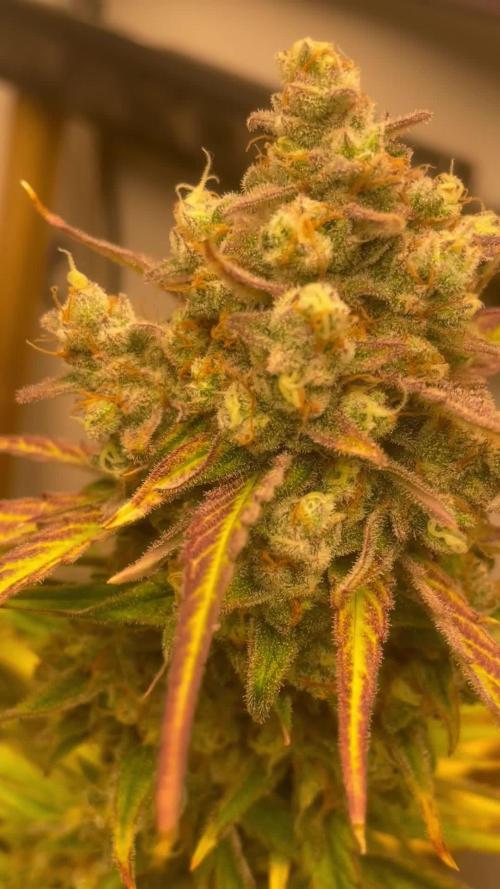
Nice stretch for last week. Auto Kabul just hit 47 DLI marker 🤝 drinking and eating pre flower nutrients. Last week i was thinking how to raise it and now i have to start think how to lower it 😅 Becoming Monster.
Andy's project suffering a bit. Going to move it away from boombox so auto kabul gets more space. It was nice first dripfeed test grow.
16.6 Looks pretty good at the moment.
watered 2L with 1.4ec. Andy moved away.
With High Hopes 🍀


Likes
2
Share

@Skunkinyabag
Follow
Last week. Dropping temps and a good drench with plain water. We shall see.


Likes
6
Share


@RBK2023
Follow
Very happy so far. I've grown this pheno before and it reminds me of last time very much
Likes
1
Share


@coriander
Follow
Christmas gifts that get you stoned are the best gifts in my opinion, so our kitchen gets crazy around this time of year. This stuff turned out real nice. Two pounds, running at about 45mg/tsp. It's not the wildest, but it's perfect for winter hibernation! It's going to be a cozy winter up here in the north.
MERRY CHRISTMAS,
and may all of your gifts also get you stoned. 🎅🥦
Likes
Comments
Share


Likes
19
Share


@Budha420
Follow
Oh boy my first ever harvest is making its way💜💚
Day 61: So these girls have been fattening their budsites and #3 isnt mad about how close the light is😅 these plants have really strong resistance and amazing genetics 🔥
On that note highly recommend Fastbuds seeds. First ever grow and these seed did not let me down. Amazing frost, incredible resistance againts overfeed and high temp (also low).
Plant #1 and #2 are further into flower than #3. 3 has still almost 90% white hairs and definitely non tris that are cloudy. 1 and 2 however have almost all hairs turned to beatiful dark orange🧡 They still have ways to go before harvest. Might start flushing soon.
Day 63: Morning fellow growers 🌅 💜
Checked trichomes this morning with my quite annoying small ass 30x lens. Almost impossible to see them but by the looks of it, atleast on lower buds almost all of em al clear. So imo they have still time to get fat 😎 i think ill start flushing when i see cloudy tris on top buds atleast 90% and chop down when 75/25 cloud/amber.
So far my first grow has gone very well all things considered! What to remeber to do for my cookies and runtz, is that i will keep the cannopy level so i dont have one 120cm plant and two 60cm plants😂 also i have doubts about my offbrand light. Prolly will see 2 harvests trough and see if both times i get skinny nugs i will switch it out😎 stay lifted💚
Day 66: harvest is getting closer but seems like trichomes are mostly glassy still. Been feeding normally but cut the gro out this week. So only calmabg bloom and micra. Ph round 6.1. It seems like buds wont get that much denser or wont do much anymore. Would love some opinions what to do at this point!
Edit: since growquestions are bugging, decided to harvest 1 top from 2 plants. Just to see hows the high and some closer looks. Seems like i might be a day or two early for my liking but opinions and comments are appreciated 💚
Likes
3
Share

@Organic_G
Follow
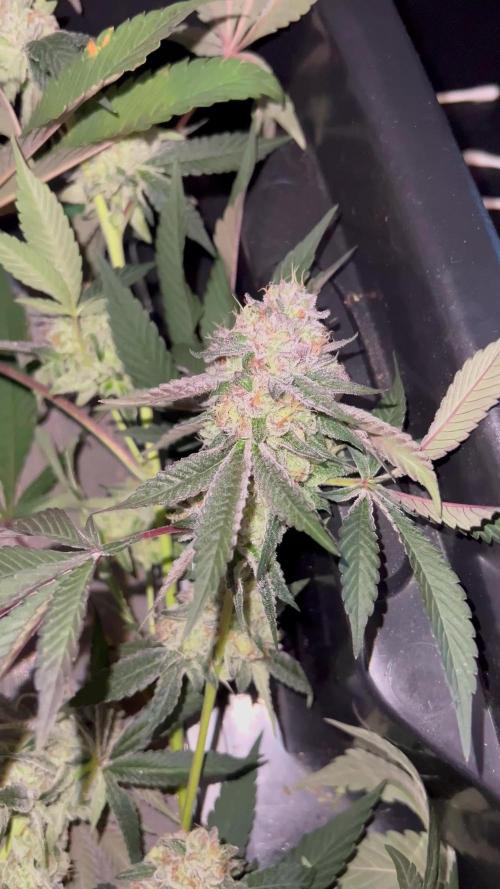
Das obere Drittel wird geerntet, sehen wunderschön aus.
Die Qualität wird von Grow zu Grow immer besser.
Super Juicy, richtig lecker und einfach wunderschön wie aus dem Lehrbuch.
Sind nun am Trocknen danach kommt der Rest ab.

Likes
21
Share


@Siriuz
Follow
Day 37
We started with nutes today
Then all day long outdoors
From 6AM to 6PM
Plus CFL afterwards
They rest for 3 hours and then CFL again
Btw accidentally snapped one part of one big leave but that okay
Since we don't do defoliation on her
We guessing it's okay she will recover soon
Day 38
Since she's such a queen we wanted to upload a video showing how she starts flowering for the record, thanks a lot
You can Always follow me at Instagram
@cannagrowersiriuz
Also don't forget to add your comment below, it is important to us!
We want to learn, any tips, suggestion, more than welcome my friends
Happy Growing
Day 39 Some mins before installing ScroG
Day 40 Wonderful, she's out of there already so huge, full of buds
Day 41 she's actually doing great full of buds but those 2 first leaves are a little bit sad looking weird plus those black dots idk and it's turning yellow in between I decided to remove it and well, I'm hoping she's doing well what else I could think of guys any help or concerns?
At the end of the day, she's overall healthy and strong
Day 42 Time to feed the babies, so we added 900PPM (300ml) floranova grow
Followed by 1590ppm (300ml) flora nova bloom to make sure she's got all nutrients balanced well, also added 400ml of plain water after that so they could get a nice run off.
I think they're happy and we gonna check on them in a couple days to see how they go, Ph is around 6.2
which is great
Temp outdoors from 7-@
1pm around 25C to 36C
Then back indoors
Temp is 28C and drop to 22 at night and dawn so they're good and comfortable
Keeping humidity lvls around 40/65% top
Nice AC and Fan for air circulation
Thank you all for your support

Likes
17
Share


@Reyden
Follow
Purtroppo la volta scorsa forse avevo dato da bere troppo ravvicinato e ho visto che questa volta fa più fatica ad asciugare..quindi aspetto che asciuga bene anche dentro, non è mai un buon segno però la pianta 🌱 non sembra proprio stare male..proverò a dare da bere solo dal sottovaso la prossima con una saluzione a 1700 di EC e PH 6.8 ✨✨✨ la Auto Purple OG Punch non è stata sottoposta a nessun tipo di allenamento 🏋️♂️ Perché volevo vedere come diventerà e che conformazione dei rami riesce a sviluppare, visto che ho praticamente cambiato a 12/12 dopo due settimane di crescita…in effetti le Autofiorenti sono fatte per crescere a 18/6 per far emergere il loro massimo potenziale, contando che è cresciuta con 12 ore di luce cercherò di tenerla anche qualche giorno in più per farla maturare come si deve 😀🤞

Likes
6
Share


@pzwags420
Follow
Week 6 went well. The buds are putting out a second wave of pistils and are starting to fatten up. Jilly is starting to smell more and put out more trichs on sugar leaves. She smells very sweet and fruity so far.

Likes
Comments
Share


Likes
22
Share


@Stork
Follow
Day 8 Mon
PH 5.7
EC 0.8
DLI /19h /
PPFD /
Water 23c
Day 9 Thue
Change the water and add nuts 10 L
PH 5.2/5.8
EC 0.8/0.8
DLI /19h /
PPFD /
Water 25c
Day 10 Wed
I've confidently carried out defoliation on the lower branches of my autoflower plant. Despite the advice against it for autoflowers, I've decided to trust my intuition and follow my gut feeling. Time will tell the results. 😎
PH 6.3/5.8
EC 0.8
DLI /19h 17
PPFD /
Water 22c
Day 11 Thu
PH 6.1/5.8
EC 0.8/0.9
DLI /19h 17
PPFD /
Water 22c
Day 13 Sat
Add water to lower EC
PH 5.8/
EC 1.0/0.8
DLI /19h /
PPFD /
Water 22c
Day 14 Sun
The plant was slow to grow, but now it's starting pre-flower early.
Add water to lower EC
PH 5.2/5.8
EC 0.9/0.6
DLI /19h /
PPFD /
Water 20c
Likes
4
Share


Likes
8
Share


@Mo_Powers
Follow
it is stable in the wind, withstands hot days and continues to grow. it is showing the first signs of flowering. i think it will go into full bloom next week. she still has 2 months before i move. i hope she makes it. she gets fertiliser every 2 days.
Likes
29
Share


@Spliffing_Around
Follow
Big mistake I made with lightning , which made this strain suffer a lot. Inderlit buds lead to larf, will reduce that next time. I didn’t really weight it, it’s going for hash, but left at least 100g as flower.


Likes
8
Share


@Adkguerrilla44
Follow
All in all this was an amazing strain to grow and looks and smells insanely delicious 😋 i cannot wait for her to cure up so i can get a proper session in!!!
Likes
92
Share


@DogDoctorOfficial
Follow
Week 3: TrolMaster Chronicles – Transplanting, Growing Strong, and Thriving in PRO-MIX HP 🌱✨
Hey Grow Fam! Another exciting week has flown by in the grow room, and I’m thrilled with the progress! We kicked off Week 3 with our first set of transplants. The Gorilla Melon was transplanted at the end of the week, while the Papaya Zoap is still patiently waiting for its turn to shine. Each plant that’s been transplanted is now comfortably settled in 15-liter Autopots, filled with PRO-MIX HP BIOFUNGICIDE + MYCORRHIZAE, and wow, I’m loving this mix!
🌱 Why PRO-MIX HP is a Game-Changer
For those of you unfamiliar with PRO-MIX HP, let’s take a closer look. This soil provides superior drainage and aeration, thanks to its high porosity. The addition of fibrous peat moss and coarse perlite creates an ideal environment for water flexibility. It’s been perfect for the girls as they transition into their final homes. Plus, the biofungicide and mycorrhizae are doing wonders for root development, giving them all the support they need for vigorous growth. The plants are showing off a beautiful, vibrant green, each with its own unique characteristics—no two plants are the same, and I love that!
🌡️ Environment Update: Temps, RH, and More
Let’s talk about the conditions the girls are thriving in! We’re sitting at:
• Temperature: 26.7°C
• Relative Humidity: 62.9%
• VPD: 1.30 (I know it’s a bit high, but they’re handling it like champs)
• CO2: 800 ppm
• pH: 6.18
• TDS: 215 ppm
• Solution Temperature: 23.2°C
To make things even more efficient, I’ve adjusted the light height, keeping the PPFD around 360 to 400 to save on energy. These beauties are still soaking in the light perfectly, and I couldn’t be happier with how they’re responding.
💧 Watering and Feeding
At this stage, the plants are thriving with just enough nutrients to keep them happy. I’ve kept things simple with a balanced solution, ensuring everything stays within the perfect range. The PRO-MIX HP, with its mycorrhizal fungi, is really helping with nutrient uptake and boosting overall health. It’s amazing to see how quickly they’ve adapted!
🌟 Transplants Complete – Progress Feels Incredible!
I’m super excited with how everything is shaping up! Most of the transplants went smoothly, and the growth we’re seeing is just amazing. The Papaya Zoap is still waiting for its final move, but it’s growing strong, getting ready for the next step. It’s an honor to work with these genetics—they’re each unique, yet all thriving in their own way. 🌱💚
🌍 Shoutouts and What’s Coming Next
I couldn’t do this without the support of my amazing sponsors and all of you, Grow Fam! A huge shoutout to TrolMaster and Aptus Holland for their top-notch gear and nutrients, and of course, to all my followers—whether you’ve been here from the start or are new to the journey, thank you for the love and support! 💚🙏
Don’t forget to check out my Instagram and YouTube, where the Seed to Harvest Series just kicked off! I’m going deep into all the gear, techniques, and day-to-day grow updates you see here. Exclusive content and more are waiting for you on those platforms, so come by and join the fun!
Growers Love to everyone, and here’s to another epic week of growth! 💚🌱 Let’s keep pushing the limits and making magic happen.
• Nutrition: @aptusholland @aptus_world @aptus_es @aptusbrasil @aptus_thailand @aptus_portugal @aptususa_official @aptusplanttechnz @aptusplanttechaus
• Controls: @trolmaster.eu @trolmaster.eu.support @trolmaster.support @trolmaster.agro
• Soil: @promix_growers_eur @promix_cannabis @promixmitch
P.S. Let’s talk about these new Model One LED bars I’m running. 🌿💡 They’re not just any lights—these are full-spectrum beasts designed to give my plants exactly what they need at every stage of growth. The real magic, though? The dimming feature. With just a quick adjustment, I can dial down the intensity without sacrificing the quality of the light. This means I’m saving on energy costs while still delivering top-tier PAR and maintaining a balanced spectrum. It’s not just about blasting plants with light; it’s about giving them the right light at the right time. By fine-tuning the PPFD (Photosynthetic Photon Flux Density), I’m hitting that sweet spot where the plants thrive, and I don’t have to run the LEDs at full power. So, while I save a bit on electricity, my plants still get the perfect environment to reach their full potential. 🌱✨
This level of control lets me optimize the growth, and trust me, my plants are loving it—just another reason I’m thrilled with the Model One setup.
💚💚💚 Growers Love everyone 💚💚💚


