The Grow Awards 2026 🏆
Likes
Comments
Share
@Ninjabuds
Follow
The pound cake auto so far is an amazing plant. It has grown great and is super strong. Honestly it might be the strongest growing plant I have ever grown The weather is starting to warm up a bit it has been below freezing for over 30 days and now the snow is starting to melt finally it’s a lot easier to keep the humidity on point when it’s like 32 outside compared to 10
Processing
Likes
1
Share
@Lukazw
Follow
Semanas finales endulzado los cogollos con melaza y maca peruana.
Likes
11
Share
Likes
18
Share
@Canadian
Follow
The plant is monster even though I top at the 6th note she is 59 in tall almost 5 feet and smell nice fantastic today I brought them outside the tent to give them a good water down in order to drain out any excessive buildup in the soil. I will continue to update but thank you for reading have a happy grow.
Likes
95
Share
Week 4 day 2 since i start germination, and i think they are evolving quite ok. CS1 is for now the queen in all aspects, shes the stronger, the most beautiful formation with no problems what so ever , CS2 is following and CS 3 also but with mutant leaves all over her, i will however keep giving her love and dedication, mb in the end she compensate with some beautiful flowers 🤞 As for the Tropicannas, TP2 its an amazing girl, no mutations and growing as it should, TP1 is recovering fast from her accident 😅🤞 and she is on the way to become a strong and beautiful girl. They are adapting super well to the new ligth 😅 one less solution to find 👌 Day 27 veg And I’ve been kind off busy, sorry i miss 2 days of updates, but between this 5 girls, my veg room and harvesting my flower run, time only stretches so much since one still have a life beyond the love gardens 😅 but non or less here we are and they look fantastic 🤩😆 all showing strong genetics and i thing i will have different phenotypes on the Chocolate department lets see😁 so far the strongest CS still is number one and number three still mutating her self from day one 😆 but she will take all my love till the end ( we never know ) on the Tropicana department, both looking amazing, number one completely recovered from the led accident 😅 end growing in a way t hat i start to think that she will catch up with the rest pretty soon 🤞TP2 is now the tallest plant of them all With 16cm high 👏 Day 28 veg No updates , all going as it should 😅🤞 Little battle between Topicanna Poisen from @sweetseeds vs Chocolate Skunk from @00Seeds (just for fun) TP = Tropicana Poison CS = Chocolate Skunk All i grow is medecine for myself, nothing to sell, dont even ask !!!! Stay safe and do it with love for the love ❤️ 🙏
Likes
13
Share
2022-10-30 It was pure Joy to Grow them again. In the Beginning of Flower i was not so happy with them, but after another Week in the Floweringroom and some Nutrients, they packed up. Plants loved the Setup with god Temp,VPD, Wind, Nutrients and Light!! They are colorful and absolutely Pleasing. a Big Role in this Grow were the new Lights Playing All the Plants loved the Spectrum of the HYPHOTONFLUX HPF-4000 (2x) Plants were growing vigor, looking superhealthy Harvest was an easy Job! Bringing me well formed thick and dense Buds with alot of Frosting on them Just look at the Pictures
Likes
8
Share
Papaya sherbet truly a fun plan to grow buds for days. Nice thick color
Likes
45
Share
8/21, 8/22 TOASTED TOFFY WAS TREATED WITH PLANT DOCTOR ON THE 22nd. It's been a few days of rainy dreary weather. This morning I went over and did some MORE defoliation on the toasted toffy trying to get all infected leaves off. I then used the rest of the k bicarb on the gmo in the middle. I haven't seen hardly any pm. So that seems to be working. However I don't want septoria to spread through my garden either. Hopfully the plant doctor will take care of the problem. If not I'll get something different. I can make a diy Dr. Zymes or I could just go to the store and buy something specific like trichodermia. The weather has been a fungus nirvana. The conditions couldn't have been anymore perfect for mold development. I'm super impressed with the k bicarb treating the pm. I took tons of pictures yesterday but I've been sick and couldn't upload them. I still need to sanitize and put my supports up. I'll keep this updated with what I'm doing. UPDATE: AFTER UNCKES FUNERAL I WATERED THE SHERB PIE THAT I DIDNT LAST TIME AND THEN I FED. I DIDNT FEED THE TOASTED TOFFY DUE TO IT BEING TREATED WITH PLANT DOCTOR. EVERYTHING GOT A QRT THE 50GAL GOT MORE. TWO GALLONS TOTAL USED. I NOTÌCED SOME SLIGHT PM ON THE GMO IN THE MIDDLE. IT WOULD BE TIME TO TREAT AGAIN ANYWAY. I PLAN ON WATERING TOMORROW AND TREATING THIS PLANT AGAIN. IM HESITANT TO UsE PLANT DOCTOR (do to feeding tonight) RIGHT OFF SO ILL PROBABLY USE YHE K BICARD. IT WORKS GOOD. I SHOULDNT HAVE FED THAT PLANT SO I COULD APPLY THE PLANT DOCTOR INSTEAD. THAT SEEMS TO BE WORKING REALLY WELL. LAST TIME I USED IT WAS ON FUSARIUM AND THATS JUST A LOSING BATTLE. DID A QIICK VIDEO ILL UPLOAD TOMORROW. 8/23 I HAD A CRISIS SITUATION AND I FUCKED UP THE DIARY. I THINK I JUST DIDN'T RECORD WHAT I DID ON THIS DAY. 8/24 I checked the bags and they were heavy. I watered the sherb pie today as it missed the last watering. Everything but the toasted toffy got fed yesterday. I noticed some slight pm on the middle GMO that I've been treating with k bicarb. Just a couple leaves. Looks like a couple spots I missed. I was going to apply it again but I dodnt have time. I'll be back over soon and I'll treat it and do the defoliation needed. Maybe I'll even sanitize and get support up. Since I fed yesterday I don't want to use the plant doctor for a few more days. I'm thinking of treating everything with it. I need to read and see when the next application for toasted toffy is due. Things are really starting to flower. Once I get the work done I may add beastie bloom to my nute line up. I think I'll do another k-bicarb app on the plant with pm. It's doing a good job. Since the l bicarb I don't see any pm. I should've held off feeding it so I could've used plant doctor. I'm monitoring toasted toffy and if it keeps working good I'll treat everything preventatively. WENT BACK OVER AROUND 11:30 BECAUSE IT HAD CLIMBED INTO THE UPPER 80'S. AS I SUSPECTED THE PLANTS NEEDED WATER. THEY COULDVE WAITED UNTIL TONIGHT BUT UNFORTUNATELY I HAvE TO DO THINGS WHEN IM ABLE TOO. EVERYTHING GOT A GALLON EXCEPT THE GMO IN THE MIDDLE IN THE 30, THAT GOT 1.5. SHERB PIE GOT IT YESTERDAY AND ISNT FLOWERING AS VIGEROUS SO IT USES LESS WATER. BEFORE WATERING I WENT THROUGH THE ENTIRE GARDEN AND DEFOLIATED WHAT NEEDED TO BE DEFOLIATED. I HAVE A FEW SMALL LIMBS I SHOULD PRUNE BUT THAT STUFF MAKES GOOD HASH MATERIAL AND ACTUALLY ADDS UP. I NOTICED A LITTLE BIT OF PM ON THE GMO I TREATED. Just a couple spots on a couple leaves and I removed them. I MIXED UP K BICARB AND ILL APPLY IN THE MORNING. I WANTED TO USE PLANT DOCTOR BUT SEEING THAT I FED ILL WAIT. ID LIKE TO GIVE THEM ALL PLANT DOCTOR AS A PREVENTATIVE. SUPPOSABLY IT STIMULATES AN IMMUNE RESPONSE WITHIN THE PLANT WHICH FIGHTS THE PATHOGENS THEN LEAVES POTASSIUM AND PHOSPHORUS BEHIND AFTER 4 DAYS FOR THE PLANT TO USE. I THINK ITS GETTING CLOSE TO TREATING THE TOASTED TOFFY AGAIN. ILL HAVE TO LOOK. I TOOK A VIDEO BUT ILL HAVE TO UPLOAD IT it. 8/25 I know the diary is fucked up. But I know I watered yesterday. Except the sherb pie. I didn't check the weight bit did a bunch of defoliation. I made another half gallon of k bicarb with a drop of dawn and sprayed all the gmos. I only saw a COUPLE spots with pm on them and I removed them. Still though I wanted to make sure it doesn't get out of control. I should've checked the weight of the sherb pie but I'm sure it's fine.. I took a video but I can't upload it yet. WENT BACK OVER AROUND TWO. IT WAS A BLISTERING HOT DAY IN THE 80'S. THE BAGS WERE DRY. THEY HAD A LITTLE WRIGHT TO THEM AND MOST SOME LEAVES WERE PRAYING. SOME WERE STARTING TO DROOP THOUGH. I WATERED EVERYTHING A GALLON EXCEPT THE SHERB PIE I GOT THIS MORNING. I gave the gmo in the 30 1.5. THE EVENT HORIZON IN THE MIDDLE COULDVE WAITED UNTIL MORNING BUT AT LEAST I CAN KEEP TRACK OF IT EASIER THIS. MAYBE I SHOULD GIVE THE 50 MORE WATER AT A TIME. IM GETTING YELLOW LEAVES. I THINK ITS PROBABKY SENESCENCE. ITS ABOUT THE SAME TIME EVERY YEAR I START LOSING SOME LEAVES. IT SEEMS TO BE JUST THE SHERB PIE AND THE BIG ONE IN THE 50. THAT PLANT HAS QUARTER SIZE BUDS ON IT THOUGH. ITS AMAZIBG HOW MUCH THE WATER INTAKE CHANGES WHEN ITS 60 OR UPPER 50S WITH HIGH HUMIDITY TO WHEN ITS IN THE 80S ALMOST 90. I HOPE IM NOT WATERING TO OFTEN. ITS BEEN COLD AT NIGHT. IN THE 50S. THE EVENT HORIZON HAS TURNED A NICE PURPLE ON MANY LEAVES. THE GMO'S AND SHERB PIE ALSO ARE TURNING PURPLE AND OTHER FALL COLORS. I SAW WHAT LOOKED LIKE SEPTORIA SPOTS CRAWLING UP KY EVENT HORIZON IN THE BACK. IN GOING TO TREAT IT WITH PLANT DOCTOR TOMORROW. 8/26 Rainy day. I noticed some septoria on the toasted toffy climbing a bottom branch. But it is time to reapply plant doctor. I saw a couple spots on the event horizon and I treated it today with 1/4 gallon of 2tsp per gallon plant doctor. I sprayed the leaves then I used the rest on the soil. The k bicarb is still keeping any pm at bay. I haven't seen a spot. I hope the plant doctor helps the event hotlrizon. I'm not even sure if it has it but I want to be cautious. I'm thinking of treating them all with plant doctor. I'm also going to use beastie bloom on some of the more advanced plants. I wasn't expecting it to rain but it wasn't for at least a couple hours after I sprayed. I ran another support line across the cage. I need to lst both event horizons and defoliate the sherb pie. It's weird but it seems like EVERY day I go over the flowers are bigger! I see birds darting out when I approach. Maybe that's why i haven't been finding pillars. I found ONE hairy one this week trying to escape to the soil on a string. I got him though. We'll see how it goes. If not I have other options for treatments if needed. That plant in the 10 is HUGE. I'm suprised it got that big in 10gals! Trying to upload videos but they are LONG so I don't know if they
Likes
92
Share
Week 10 - Second Week of Flowering 🌸 As week two of flowering begins, the garden’s growth is unstoppable! These ladies are thriving, stretching up while staying beautifully vibrant and green. Every inch of this tent is optimized—each plant is soaking up light, nutrients, and water precisely as they need, filling the room with energy. Room Conditions 🌡️ • Temperature: 27.3°C • Humidity: 62.6% • CO₂ Levels: 800 ppm • VPD: 1.36 kPa (excellent range for robust flowering) • Lighting Intensity: 818 PPFD Solution & Medium 💧 • Solution Temp: 21.5°C | TDS: 470 ppm | pH: 6.02 • Medium: Moisture 100% (recently dried to 67%), TDS 510 ppm, Temp 22.5°C The “dry-out” to 67% was a strategic move, helping boost nutrient uptake and root strength. Meanwhile, our slight increase in reds seems to be having the desired effect, nudging these ladies further along in the flowering process. Eye Safety & LED Lighting 🌞🕶️ With powerful LED systems like the ThinkGrow and ICL-300, eye protection is critical. LED grow lights emit high-intensity light across the full spectrum, including intense UV and infrared components that are not easily detected by the human eye. Long-term exposure without adequate protection can lead to eye strain, and in extreme cases, damage to vision. • Blue Light Hazard: LEDs often have elevated levels of blue light, which can harm the retina over time if proper precautions aren’t taken. • UV Protection: Even low doses of UV can accumulate and harm eyes, so grow glasses with UV protection are essential for any indoor gardener. Investing in quality grow room glasses can help protect from glare, UV, and infrared rays, making plant care safer and more comfortable. Lighting Enhancements: ICL-300 In-Depth 🔆 The ICL-300 is our newest addition, specifically designed for inner canopy illumination. This LED offers a targeted light boost under the canopy, enhancing flower growth in lower and shaded areas—ideal for maximizing yield and light efficiency. • Dual Spectrum Technology: The ICL-300 provides a custom spectrum designed to penetrate deeper into the plant canopy, promoting robust bud formation throughout. • Enhanced Light Distribution: With strategically positioned diodes, the ICL-300 reduces shadowing and balances light distribution to all parts of the plant. • Energy Efficiency & Heat Management: This light is designed to be energy-efficient, running cooler and reducing the risk of heat stress within the grow space. The inner canopy light gives the plants exactly what they need, particularly during the flower stage when bud sites deep in the canopy can benefit from more direct exposure. However, after noticing slight leaf burn on some plants, I’ll hold off a bit longer before fully integrating this light to ensure optimal adjustment. Looking Forward 🌟 As we continue dialing in conditions, it’s all about balance, precision, and taking proactive steps to optimize every aspect of the grow environment. We’ll keep a close watch on the canopy height, and next week, I’ll aim to fine-tune the light integration even further with the ICL-300. P.S. - ICL-300 and CO₂ Sensor 🌱 The TrolMaster CO₂ Sensor (MBS-S8) has been crucial for real-time CO₂ adjustments, ensuring the plants get exactly what they need without constant monitoring. Combined with the ICL-300’s spectrum flexibility, these tools make an unbeatable setup, allowing for nuanced control over plant growth and development. As always, a huge thanks to the Grow Fam for the tips, support, and enthusiasm! I’m excited to see what these next weeks will bring as these plants reach their full flowering potential. Stay tuned for more updates, and don’t forget: eye safety first, growers! 🌞🌿 Discount Codes so you can save big on your next check out 💚💚💚 Kannabia - DOGDOCTOR 30% off SeedsmanSeeds - DOGDOCTOR 10% off CannaKan- DOGDOCTOR 15% off terpyz.eu - DOCTOR 15% off The Neutralizer - PORKIT5-DOG 15% off As always thank you all for stopping by, for the love and for it all , this journey of mine wold just not be the same without you guys, the love and support is very much appreciated and i fell honored and so joyful with you all in my life 🙏
 With true love comes happiness 💚🙏 Always believe in your self and always do things expecting nothing and with an open heart , be a giver and the universe will give back to you in ways you could not even imagine so 💚 Friendly reminder all you see here is pure research and for educational purposes only Growers Love to you all 💚💚💚
Likes
52
Share
UPDATES: - Pushed them a little too hard as you can tell by the pics, pushed temps up to 31/32'C. Pulled temps back down to 29'C, seems to be the sweet spot. -Just waiting to harvest GENETICS: -MSNL - Gorilla Glue Auto ~ my favorite strain, as you can tell by my username! WATER: -Condensed (Starting at 40ppm) -Disinfected prior to adding nutrients etc. (Using COOSPIDER UVC - 253nm & 187nm bulb) CLIMATE: - Ambient Air Temp = 29'C ~ 28'C LST ~ Leaf to air temp variance of between 1'C - Night Temp = 22/23'C ~ Day/Night temp differential 6-7'C - Under Canopy Temp: 26'C (Day) ~ 21'C (Night) - Relative Humidity = 50-60%RH (Avg. 55%RH) - VPD = 1.45kPa (Avg.) - Co2 ranges from 900ppm to 1500ppm (Avg. 1200ppm) AIR PRESSURE: - Ambient Air Pressure (outside tent) = Mean Avg. 1010 mbars (101 Kilopascals) - Actual Air Pressure (inside tent) = Mean Avg. 1005 mbars (100.5 Kilopascals) - Air Pressure Differential = up to 0.5 kPa range between inside & outside LIGHT: - UVB ~ 2 hours daily mid light cycle. - Warm White 3000K/White 5000k/Far Red (660nm) - At plant canopy = PPFD 900-1000umols/s/m2 ~ Lux 45,000-55,000 ~ Daily Light Integral 55-65 - Under canopy lighting ~ Blue (460nm)/ Red (630nm) NUTRIENTS: - Mostly Advanced Nutrients (For base nutrients and most additives, as only company I could find scientific data on) - Canna (For Calmag Agent and Cannazym) - Plant Success (Great White Mycorrhizae) ADDITIONAL GROW TECHNIQUES: - Mostly getting out of the plants way and letting nature take its course. - Some LST. (i.e. tying down branches and tucking large leaves away) - No HST or Defoliation. INFECTION PREVENTION & CONTROL: Infection control practices i.e -PPE, Alcohol Hand wash -Gray room outside tent, -Carbon filter -HEPA filter -Plasma Ionizer -Inline UV-C germicidal bulb - Also using an additional higher powered COOSPIDER (UVC) 253nm & 187nm bulb, to disinfect the gray room outside of the tent once a week for 30 mins. - Ozone (o3) gas that is produced using the COOSPIDER, is then directed into the tent to further control any unwanted pathogens. - Ed Rosenthal (Zero Tolerance organic pesticide), sprayed once a week as preventative measure. On hand for heavier use (Once every 3 days before lights out for 15 days) in the case of an outbreak (No outbreaks yet, due to aforementioned preventative measures)
Likes
56
Share
What's in the soil? What's not in the soil would be an easier question to answer. 16-18 DLI @ the minute. +++ as she grows. Probably not recommended, but to get to where it needs to be, I need to start now. Vegetative @1400ppm 0.8–1.2 kPa 80–86°F (26.7–30°C) 65–75%, LST Day 10, Fim'd Day 11 CEC (Cation Exchange Capacity): This is a measure of a soil's ability to hold and exchange positively charged nutrients, like calcium, magnesium, and potassium. Soils with high CEC (more clay and organic matter) have more negative charges that attract and hold these essential nutrients, preventing them from leaching away. Biochar is highly efficient at increasing cation exchange capacity (CEC) compared to many other amendments. Biochar's high CEC potential stems from its negatively charged functional groups, and studies show it can increase CEC by over 90%. Amendments like compost also increase CEC but are often more prone to rapid biodegradation, which can make biochar's effect more long-lasting. biochar acts as a long-lasting Cation Exchange Capacity (CEC) enhancer because its porous, carbon-rich structure provides sites for nutrients to bind to, effectively improving nutrient retention in soil without relying on the short-term benefits of fresh organic matter like compost or manure. Biochar's stability means these benefits last much longer than those from traditional organic amendments, making it a sustainable way to improve soil fertility, water retention, and structure over time. Needs to be charged first, similar to Coco, or it will immobilize cations, but at a much higher ratio. a high cation exchange capacity (CEC) results in a high buffer protection, meaning the soil can better resist changes in pH and nutrient availability. This is because a high CEC soil has more negatively charged sites to hold onto essential positively charged nutrients, like calcium and magnesium, and to buffer against acid ions, such as hydrogen. EC (Electrical Conductivity): This measures the amount of soluble salts in the soil. High EC levels indicate a high concentration of dissolved salts and can be a sign of potential salinity issues that can harm plants. The stored cations associated with a medium's cation exchange capacity (CEC) do not directly contribute to a real-time electrical conductivity (EC) reading. A real-time EC measurement reflects only the concentration of free, dissolved salt ions in the water solution within the medium. 98% of a plants nutrients comes directly from the water solution. 2% come directly from soil particles. CEC is a mediums storage capacity for cations. These stored cations do not contribute to a mediums EC directly. Electrical Conductivity (EC) does not measure salt ions adsorbed (stored) onto a Cation Exchange Capacity (CEC) site, as EC measures the conductivity of ions in solution within a soil or water sample, not those held on soil particles. A medium releases stored cations to water by ion exchange, where a new, more desirable ion from the water solution temporarily displaces the stored cation from the medium's surface, a process also seen in plants absorbing nutrients via mass flow. For example, in water softeners, sodium ions are released from resin beads to bond with the medium's surface, displacing calcium and magnesium ions which then enter the water. This same principle applies when plants take up nutrients from the soil solution: the cations are released from the soil particles into the water in response to a concentration equilibrium, and then moved to the root surface via mass flow. An example of ion exchange within the context of Cation Exchange Capacity (CEC) is a soil particle with a negative charge attracting and holding positively charged nutrient ions, like potassium (K+) or calcium (Ca2+), and then exchanging them for other positive ions present in the soil solution. For instance, a negatively charged clay particle in soil can hold a K+ ion and later release it to a plant's roots when a different cation, such as calcium (Ca2+), is abundant and replaces the potassium. This process of holding and swapping positively charged ions is fundamental to soil fertility, as it provides plants with essential nutrients. Negative charges on soil particles: Soil particles, particularly clay and organic matter, have negatively charged surfaces due to their chemical structure. Attraction of cations: These negative charges attract and hold positively charged ions, or cations, such as: Potassium (K+) Calcium (Ca2+) Magnesium (Mg2+) Sodium (Na+) Ammonium (NH4+) Plant roots excrete hydrogen ions (H+) through the action of proton pumps embedded in the root cell membranes, which use ATP (energy) to actively transport H+ ions from inside the root cell into the surrounding soil. This process lowers the pH of the soil, which helps to make certain mineral nutrients, such as iron, more available for uptake by the plant. Mechanism of H+ Excretion Proton Pumps: Root cells contain specialized proteins called proton pumps (H+-ATPases) in their cell membranes. Active Transport: These proton pumps use energy from ATP to actively move H+ ions from the cytoplasm of the root cell into the soil, against their concentration gradient. Role in pH Regulation: This active excretion of H+ is a major way plants regulate their internal cytoplasmic pH. Nutrient Availability: The resulting decrease in soil pH makes certain essential mineral nutrients, like iron, more soluble and available for the root cells to absorb. Ion Exchange: The H+ ions also displace positively charged mineral cations from the soil particles, making them available for uptake. Iron Uptake: In response to iron deficiency stress, plants enhance H+ excretion and reductant release to lower the pH and convert Fe3+ to the more available form Fe2+. The altered pH can influence the activity and composition of beneficial microbes in the soil. The H+ gradient created by the proton pumps can also be used for other vital cell functions, such as ATP synthesis and the transport of other solutes. The hydrogen ions (H+) excreted during photosynthesis come from the splitting of water molecules. This splitting, called photolysis, occurs in Photosystem II to replace the electrons used in the light-dependent reactions. The released hydrogen ions are then pumped into the thylakoid lumen, creating a proton gradient that drives ATP synthesis. Plants release hydrogen ions (H+) from their roots into the soil, a process that occurs in conjunction with nutrient uptake and photosynthesis. These H+ ions compete with mineral cations for the negatively charged sites on soil particles, a phenomenon known as cation exchange. By displacing beneficial mineral cations, the excreted H+ ions make these nutrients available for the plant to absorb, which can also lower the soil pH and indirectly affect its Cation Exchange Capacity (CEC) by altering the pool of exchangeable cations in the soil solution. Plants use proton (H+) exudation, driven by the H+-ATPase enzyme, to release H+ ions into the soil, creating a more acidic rhizosphere, which enhances nutrient availability and influences nutrient cycling processes. This acidification mobilizes insoluble nutrients like iron (Fe) by breaking them down, while also facilitating the activity of beneficial microbes involved in the nutrient cycle. Therefore, H+ exudation is a critical plant strategy for nutrient acquisition and management, allowing plants to improve their access to essential elements from the soil. A lack of water splitting during photosynthesis can affect iron uptake because the resulting energy imbalance disrupts the plant's ability to produce ATP and NADPH, which are crucial for overall photosynthetic energy conversion and can trigger a deficiency in iron homeostasis pathways. While photosynthesis uses hydrogen ions produced from water splitting for the Calvin cycle, not to create a hydrogen gas deficiency, the overall process is sensitive to nutrient availability, and iron is essential for chloroplast function. In photosynthesis, water is split to provide electrons to replace those lost in Photosystem II, which is triggered by light absorption. These electrons then travel along a transport chain to generate ATP (energy currency) and NADPH (reducing power). Carbon Fixation: The generated ATP and NADPH are then used to convert carbon dioxide into carbohydrates in the Calvin cycle. Impaired water splitting (via water in or out) breaks the chain reaction of photosynthesis. This leads to an imbalance in ATP and NADPH levels, which disrupts the Calvin cycle and overall energy production in the plant. Plants require a sufficient supply of essential mineral elements like iron for photosynthesis. Iron is vital for chlorophyll formation and plays a crucial role in electron transport within the chloroplasts. The complex relationship between nutrient status and photosynthesis is evident when iron deficiency can be reverted by depleting other micronutrients like manganese. This highlights how nutrient homeostasis influences photosynthetic function. A lack of adequate energy and reducing power from photosynthesis, which is directly linked to water splitting, can trigger complex adaptive responses in the plant's iron uptake and distribution systems. Plants possess receptors called transceptors that can directly detect specific nutrient concentrations in the soil or within the plant's tissues. These receptors trigger signaling pathways, sometimes involving calcium influx or changes in protein complex activity, that then influence nutrient uptake by the roots. Plants use this information to make long-term adjustments, such as Increasing root biomass to explore more soil for nutrients. Modifying metabolic pathways to make better use of available resources. Adjusting the rate of nutrient transport into the roots. That's why I keep a high EC. Abundance resonates Abundance.
Likes
19
Share
Hello 👋 Im Sinne der Nachhaltigkeit werden etwas ältere Samen als frühes Outdoorprojekt auf dem Balkon gestartet. Genutzt wird ein gebrauchtes Hochbeet, dass ich für einen feuchten Händedruck über Ebay Kleinanzeigen erworben habe. 50l biobizz lightmix + der Rest meines älteren flo Düngers haben dort drinnen Platz gefunden. Den Boden habe ich mit tonkugeln ausgestattet. Nematoden. wurden dem Boden hinzugefügt. Ist ein früher Start, und ich bin gespannt ob die Samen überhaupt kommen. Alternativ hab ich immer noch eine crit (da weiß ich dass sie klein bleibt) und die Baby Boom von kannabia. Der Wunsch ist, dass die Pflanzen nicht höher als 50-60 cm werden. Bin gespannt ob mir das mit 50l Substrat gelingt. Die Genetik sollte allerdings auch etwas kleiner bleiben. Das Lernen steht dieses Mal wieder erneut im Fokus und nicht das Ergebnis. 24. März Ein Samen hat ordentlich gekeimt. Habe in direkt in das Substrat gesetzt. Ein Samen hat nur eine Miniwurzel entwickelt. Habe sie dennoch eingepflanzt. Kann sein dass es zu früh war but we will see. Der dritte Samen blieb unverändert und er bleibt in der Tüte. Er bekommt noch ein paar Tage, notfalls wird er ersetzt. Weiteres kleines Update: habe das eBay-Kleinanzeigen setup um wasserdichte led streifen für 10€ von Amazon erweitert. Damit sollte ich verhindern können dass mir die Sämlinge gailen falls die Sonne nicht wie gewüncht mitmacht. Na dann halt lila 😅Aber jetzt erstmal hoffen das zumindestens 2/3 kommen. 26. März trotz entspannten 9 grad nachts in der Box hat es die erste creamatic an die Oberfläche geschafft. Die zweite lässt noch auf sich warten, der dritte Samen ist nun minimalistisch in der Tüte aufgegangen. Hab das Hochbeet am Abend reingeholt und ziehe die kleinen.doch am Fenster vor. 28. März Zwei von drei sind as der Erde geschlüpft :). Das Wunschziel wurde damit erreicht trotz des „hohen Alters“ der Samen. Hoffe. Wir dennoch mal auf nr. Drei
Likes
6
Share
@brutoll
Follow
22/10/2023 - Día 50 - Empieza la semana 8 de cultivo. Sigo con Green Sensation, Top Auto y Top Candy. La planta 1 mide 39 cm, las planta 2 mide 54 cm y la planta 3 mide 53 cm. Cómo se están poniendo los cogollos, esto pinta muy bien! 😋 23/10/2023 - Día 51 - Todo correcto. Espero que el buen tiempo aguante y que siga así el desarrollo. Llegan los 10 días clave para ver el resultado final. 24/10/2023 - Día 52 - Las flores van engordando poco a poco y la resina cada vez se aprecia más. 25/10/2023 - Día 53 - OMG! Las flores se están poniendo en modo hulk! Creo que por fin se avecina una cosecha digna! 😋 26/10/2023 - Día 54 - Pongo fotos del aspecto del cogollo principal de cada planta. 27/10/2023 - Día 55 - Fotos de cogollos secundarios. 28/10/2023 - Día 56 - Hoy se acaba la semana 8 de cultivo. Adjunto video del estado de las 3 plantas.
Likes
18
Share
F43 a bit of nutrient burn because of the high temps. SD2 smell : engine grease mixed with kerosine. Imagine spilling grease in a corner of a tire shop. SD2 isnt developing normal and wont probably yield much. SD3 smell : sweet engine grease.Very pleasant. Sour Diesel needs getting used to in terms of smell and aroma
Likes
11
Share
15.08 Second week going great. The mimosa pheno I hunted is a true monster. Thick stem already nearly as big as the 1.5 inch rockwool cube. Easily over 1 m high. Stacking beautifully. I have a new setup for the 5x5 tent. Vevor EC fan 150mm. With temp and humidity controller paired with prima clima 900m3h carbocone filter which is huge. Also new Mars hydro fc e 8000 light with Bluetooth controller. So far very cool. We will see how it performs. Since I have co2 boosted we will have it cranking at max when the girls hit the bulk phase.
Likes
10
Share
Likes
4
Share
@Ryno1990
Follow
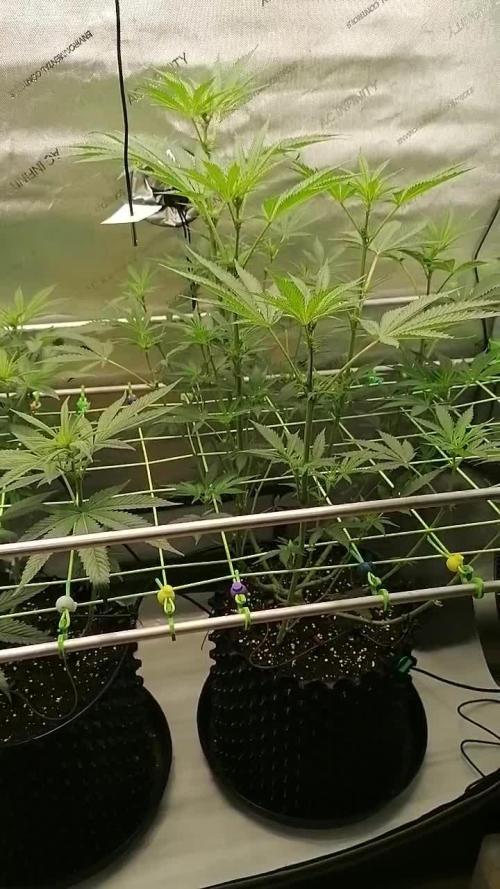
The Snow Panda from Atlas seeds is doing amazing begining week 5 her tops shot up after being topped an she's been bushing out nicely under this fold 6 from medic grow she's been nice an healthy also using these cultured biologix nutrients Ending week 5 the Snow Panda is doing great all her tops are shooting up an she has been growing healthy an strong
Likes
8
Share
She's looking gorgeous, very healthy thanks to my Florians living organics,she's has everything she needs, I'm dealing with some problems with fungus gntas due to all tje organic matter that there is in tje soil so I'll be fixing that problem using nematodes steinernema feltiae, fungus gnats eat you plants roots and all the nuts of your soil, so it's important for you to fight them as fast as possible. Enjoy the diary! ✌️💚❤️✌️