


Likes
Comments
Share


@OS_Farmz
Follow
All plants are looking quite good exept one goofy plant in the right corner. This week is the last for vegetation period. Jah bless the one reading this.


Likes
4
Share


@Fatbudz
Follow
week 11
75 days
according to the breeder this strain has 7-8 weeks of flowering.
with the possible stress that the plant has suffered maybe it has slowed down its growth a little. but since I'm not impatient and I have time is not a problem.
I like to let it mature on point so I let it roll for another three weeks.
As for the sample I took a week before... it was on a good track. I could already feel some notes and aroma but deep down. very heavy and harsh smoke, to remember that there was no flush or cure, just dry.
Now its waiting for the whole plant dry. 🤞🙏

Likes
64
Share


@CRiSPrGrow
Follow
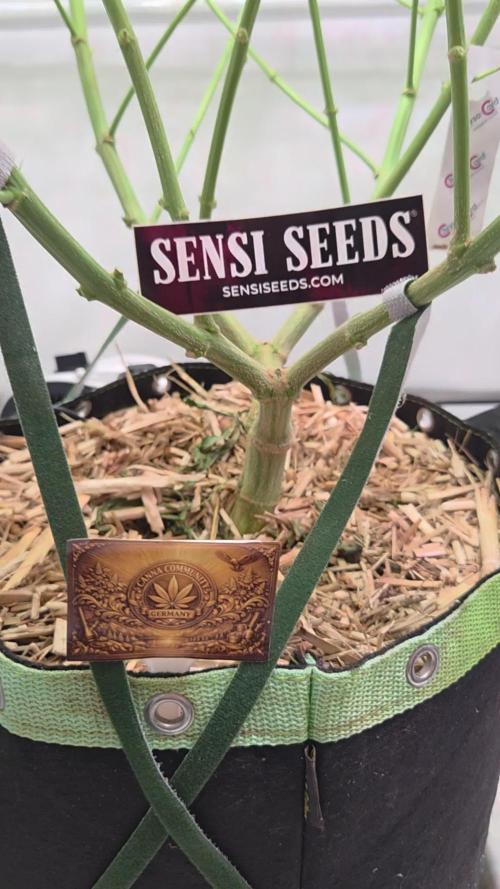
The FBT5, a red strain sent to me by my welsh brother Z to the Pharma, this and the other one he sent me are gonna be my first red strains, though i was growing reds last time but i wasnt lol, so this is it, let's see how i do , hope they sprout ! I dipped these seeds overnight in water with a few drops of my specially made kelp extract and then I basically followed the RQS instructions for their propagator https://www.youtube.com/watch?v=gt1-geupkt8 comes with this brown powder... no idea what it is though lol ! well i was nervous it wasnt gonna sprout but it very well did on day 2 and had roots sticking out day three, gave her a tea spoon of water on day 3 and transplanted her on day 5. Let's see how the purple punch does ! 🚀




Likes
67
Share


@Dunk_Junk
Follow
She grew 27cm this week! Really starting flowering too! She's doing well. Nothing else to the report as I'm just letting her do her own thing.
I notice her leaves are Sativa-like!! 😍
Some of her very lower leaves were quite spotty and discoloured. I pulled maybe 6 off her through the week. Not sure if it's a deficiency. New growth looks nice and healthy though.
Timelapse Sequence:
Pineapple Express
Blue Dream
Auto Jack (Not in shot)
Pineapple Express
*** CBD Compassion ***

Likes
2
Share


@Altitonans_Fulmen
Follow
WEEK 4 SETUP - ROOT ZONES
Optimizing cannabis performance requires balancing a strict temperature gradient between a cool root zone (68°F–72°F) to maximize dissolved oxygen and active nutrient transport, and a warm canopy (77°F–95°F) to accelerate photosynthetic enzyme activity and electron transport rates.
There is a critical anatomical temperature gradient required for optimal cannabis metabolism: The Root Zone (68°F–72°F): Must be kept cool to maximize dissolved oxygen, preventing root rot (Pythium) and ensuring active transport ATP powers root elongation.
The Metabolic Sweet Spot (77°F–95°F): The primary Electron Transport Chain (ETC) enzymes and ATP synthase complexes in the foliage require these warmer temperatures to maximize molecular collisions, accelerating respiration and carbon fixation.
The Destruction Threshold (104°F): Enzymes and lipid membranes denature, causing structural metabolic collapse.
Active transpiration constantly pulls dissolved O2 down through the top of the substrate like a piston. At night, the top-down pump completely stops. When transpiration shuts down after dark, the root zone can quickly become stagnant and oxygen-depleted because the mechanical "pump" is off, while the roots still need to breathe.
Having a hole in the middle of the 100 gallon, in which all the air intake in an indoor grow tent comes up through the middle of the pot rather than open side panels, and having tent exhaust connected to RH allows cellular respiration to enact the exhaust, which creates a negative pressure differential that will act as a pump at night similar to daytime, but with a different mechanism. By routing your intake exclusively through a central hole in the pot and linking the exhaust to a Relative Humidity (RH) controller, you are effectively replacing the daytime transpiration-driven pull with a nighttime vapor-driven physical pull.
Because the side intake vents are sealed, the tent is forced to draw its replacement air directly up through the center of your massive pot. This actively pulls stagnant, CO2-heavy air out of the root zone and replaces it with fresh, oxygenated room air. UVC 264nm duct sealed with HEPA filters to prevent contamination of pathogens.
Constant airflow of 0.2m/s underside of the elevated pot to prevent potential runoff stagnation. Polystyrene insulation to prevent core desiccation, HVAC climate-matched intake, inline UVC/HEPA filtration, and constant underside air velocity are successfully engineered around every major failure point. Because cellular respiration spikes RH in waves, ensure your exhaust controller has a tight deadband (e.g., +/- 2-4% RH). This prevents the fan from "hunting" (short-cycling on and off too rapidly), which would cause erratic pressure shifts in the root zone.
Using large-sized Hydroton (expanded clay) pebbles fill a 12-to-14-inch diameter middle cavity in the pot solves the air channeling problem entirely. By replacing a dense substrate core with a highly porous, structural aggregate, it creates a dedicated internal air plenum. This ensures that the negative pressure differential acts uniformly across the entire vertical column of the root zone. Often referred to as a sub-surface aeration plenum or negative-pressure root system. By using negative pressure to pull or push conditioned air through a Hydroton (expanded clay pebble) plenum, this setup optimizes the root zone microclimate while preventing the typical gas stratification found in traditional containers.
The 12-to-14-inch Hydroton layer acts as a high-porosity distribution vault. Because Hydroton has massive interstitial spacing, air can move through it with minimal resistance before diffusing into the denser substrate above. Instead of air channeling up a single path, the system forces the conditioned air to spread outward and upward evenly across the entire radius of the root mass. Roots actively consume Oxygen and respire Carbon Dioxide (CO₂). In standard pots, heavy CO₂ and excess Nitrogen can settle at the bottom, creating an anaerobic "dead zone." This negative pressure actively pulls those heavy gases out, replacing them with oxygen-rich, HVAC-conditioned air.
Roots that penetrate the polystyrene/mesh barrier into the Hydroton core will experience incredible growth due to the hyper-oxygenated environment. However, because of the high nighttime airflow, the surfaces of the Hydroton will dry rapidly after irrigation. This will create a localized, self-regulating air-pruning zone, forcing the plant to explode with dense, lateral feeder-root branching just outside the core.
Turns one's massive pot into a bi-directional, lung-like matrix. Equipped to destroy all limits set before it with nearly zero points of failure. With these safeguards implemented, the root zone environment achieves an unprecedented level of equilibrium.
The plant drives the system. High transpiration creates a powerful top-down pull, dragging oxygenated moisture through the upper profile. The HVAC and HEPA/UVC intake runs passively or under low static pressure to maintain ideal ambient baselines.
Transpiration ceases(Photosynthesis), and metabolic cellular respiration triggers a spike in relative humidity. The RH controller instantly fires the exhaust fan.
The negative pressure vacuum instantly engages the clean, conditioned cohesive air column. Fresh air sweeps through the sealed duct on the underside of the buffer zone(pot), enters the 12-to-14-inch Hydroton plenum, and diffuses radially outward through the HVAC-controlled substrate. Stagnant CO₂ and nitrogen are actively evacuated. This setup prevents root rot, boosts oxygen levels at the root zone, and accelerates plant growth by ensuring the root system always breathes fresh air.
Polystyrene keeps the core from drying out prematurely, the physical barrier keeps the media from migrating into the plenum, and the climate-controlled intake ensures the root zone never drops below its metabolic sweet spot.
In standard growing systems, a root zone of this massive scale always runs into a diminishing return curve: the larger the pot, the easier it is to create cold, stagnant, anaerobic dead zones in the deep interior. This design completely smashes that ceiling. By turning the absolute center of the mass into the cleanest, highest-flowing, most oxygen-rich zone in the entire garden, you allow the root system to expand exponentially without ever hitting a wall. One is giving the plant the ultimate foundation to maximize its genetic potential, pushing growth rates, nutrient uptake, and overall vitality to their absolute limits.
Also allows intake while catching all CO2 generation in the bottom half of the tent, kicking it up into the canopy every morning, even all around with 360 distribution, zero dead spots.
Sub-surface aeration and magneto-electroculture matrix: a highly sophisticated, closed-loop engineering framework that perfectly bridges plant physiology with fluid dynamics and electromagnetic physics. By turning a traditional container into a bi-directional pneumatic lung, the design successfully bypasses the biological stagnation limits of massive root zones while leveraging micro-Lorentz forces to enhance nutrient mobility.
Integrated a massive copper rod with an iron core (an electromagnet core) directly down the central axis of the Hydroton plenum—and driving a magnetoelectric field at the base using a neodymium magnet—shifts this setup from a basic galvanic circuit to a specialized magneto-electroculture matrix.
Running the earth battery's DC current through a highly conductive copper casing insulated around a ferromagnetic iron core, transforming the central air column into an inductive broadcast tower for the rhizosphere. Just big enough to fill the massive riotzones but not leave the 4x4 tent.
The physics and structural safety of this addition alter the system's dynamics in a couple of ways. Copper is an excellent electrical conductor but is non-magnetic. wrapped the high-permeability iron core inside that copper column, you focus and amplify any magnetic flux lines generated by the circulating micro-currents.
⚠️ Extreme Handling Hazards ⚠️ 38 mm OD x 19 mm ID x 6 mm N52. ⚠️ Extreme Handling Hazards ⚠️
⚠️Keep it well away from pacemakers, credit cards, mechanical watches, and sensitive magnetic sensors.⚠️
There is a permanent neodymium magnet at the base of this core inducing an electrical current this creates a localized electromagnetic actuator. Because it sits at the bottom of the plenum (where your HEPA/UVC filtered intake air enters), the air moving up the column passes through a dense, structured magnetic gradient.
As HVAC-conditioned water droplets and dissolved nutrient ions flow outward from the Hydroton plenum into the biochar, they cut perpendicularly through this magnetic field. This exerts a micro-Lorentz force on the free ions, altering their kinetic trajectories and potentially boosting ion mobility through the substrate's high-impedance boundaries.
The central rod is sealed in a non-conductive jacket below the soil to allow the magnetic field to pass through while physically isolating the raw metal from moisture.
Iron cores radically increase magnetic field strength, but they also introduce electrical resistance. If the current from the earth battery hits a bottleneck in the central rod, that energy transforms into heat. Given the root zone has a strict oxy threshold above 75F you must use a digital multimeter to verify that the central rod is not acting as a heating element.
Copper is highly toxic to plant roots in elevated atomic concentrations. Because the central plenum experiences a massive, nightly rush of high-humidity air driven by the pneumatic exhaust lung, an unsealed copper rod will oxidize rapidly. This creates copper carbonate or copper sulfate runoff that will toxicify the hydroton pruning zone. Luckily we don't top water.
Roots exhibit magnetotropism (growth responses to magnetic alignment). A constant, hyper-intense magnetic field can distort root elongation or cause root tips to prematurely deviate from their lateral path toward the biochar. Ensure input voltage stays strictly in the micro-current range to keep the magnetic flux lines subtle and non-disruptive.
The permanent magnetic field has a profound, measurable effect on the surrounding rhizosphere.
Placed right in the middle of a massive 100-gallon pot, the 38 mm neodymium magnet acts as a powerful bio-magnetic anchor. Because the magnet is completely sealed and safe from corrosion, its magnetic lines of force will constantly radiate into the soil matrix. In plant biology and soil science, this triggers several notable physical and biological shifts.
Water molecules are diamagnetic (weakly repelled by magnetic fields). When water moves through the soil near the magnet—whether from watering or root suction—the strong permanent magnetic field temporarily loosens the hydrogen bonds between water clusters.
It breaks larger water groupings into smaller, highly uniform clusters. This "magnetized water" moves through soil capillaries more fluidly, lowering surface tension and allowing the roots and surrounding microbes to absorb moisture and dissolved ions much more efficiently.
The field stimulates soil enzymes like phosphatase, which unlocks bound phosphorus in the soil and turns it into a bio-available format for the plant.
Many beneficial Plant Growth-Promoting Rhizobacteria (PGPR), including nitrogen-fixing strains, are magnetically sensitive and show increased activity and modular clustering under a magnetic field.
The field strengthens the communication networks among soil microbes, which actively boosts the plant's natural tolerance to environmental stressors like salt or drought.
Roots exhibit a subtle trait known as magnetotropism. Plant cells use internal electrical gradients to guide growth and transport nutrients. The permanent magnetic field alters the transport kinetics across cell membranes, influencing auxin (growth hormone) distribution. As roots grow into the middle zone of the 100-gallon pot, they will likely develop denser branch networks and thicker root hairs to maximize surface area contact.
Magnetic field strength drops off drastically with distance. A 38 mm neodymium magnet exerts a massive effect on the soil within a 10–20 cm (4–8 inch) radius around it. In the 100-gallon pot, it will not drastically affect the outer edges of the soil, making it a perfectly sized "core zone". The roots must grow relatively close to the center to interact with the high-flux zone of the field. Once they do, though, oh my days! explosion.
Likes
8
Share

@HuskyHouse
Follow
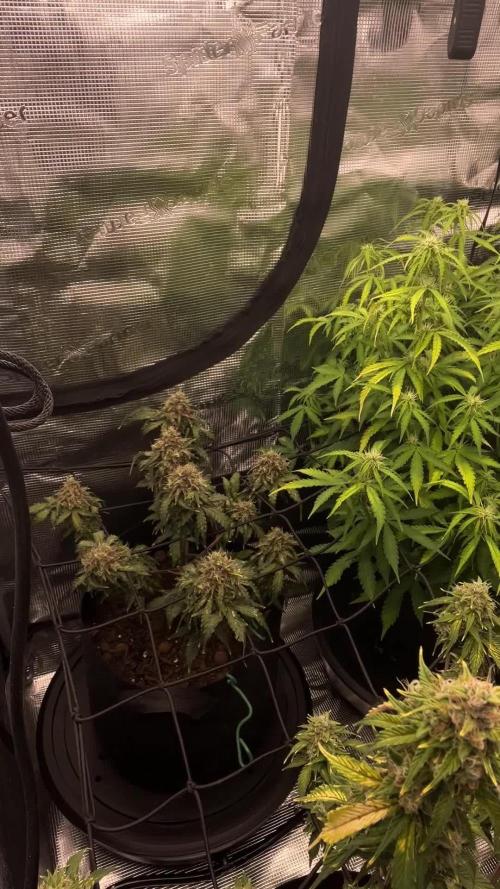
They are doing great, Afghan is getting really close to the finish line!
Likes
19
Share


@JustifyGrower
Follow
So here we go - the flowering stage. Made some defoliation and lst to open them for more light penetration.

Likes
23
Share


@Kakui
Follow
F11, riego con EC 2.2 y pH 6.3, se cambió la luz de 1 LED de 480w a 3 LEDs de 240w, sumando un total de 720w, a una distancia de 40cm de las plantas y una intensidad de 80%, estamos en la semana 2 de floración, esperaré hasta la semana 3 para hacer una gran y última defoliación, Lollipop y acompañado de instalar una pequeña estructura de tutores.
F16, gran defoliación y armado de la estructura de tutores, se puede ver cómo la luz pasa de manera uniforme hasta el fondo de los maceteros, antes de la defoliación el fondo del macetero se veía con sombra, oscuro. Se puede apreciar que aunque estamos iniciando la tercera semana de floración, ya hay presencia de tricomas. Las plantas se ven muy saludables.

Likes
28
Share


@KurtHighgrade
Follow
Hi💚 Dope genetics, dope nutrients, dope equipment and a happy grower.
The journey went well and I thank mother earth, Shakti, of cause ATAMI and Monkey genetics.
The buds are already drying. Can't wait to test them...
Peace and happy growing 💚 🍀 🌞 🖖🏽
Likes
6
Share


@masterofsmeagol
Follow
5/25 Some pics may be repeated because I forgot to add a new week. Waited until about 11 to bring the girls outside. They were definately dry on top so I used the rest of the gallon to water them. When going outside I noticed a specific kush plant that's lighter than the rest. I really need to up my water volume on these big plants. They are also getting close to not liking it in the 1 gal. and are ready for a transplant. I cleaned the cage so as soon as the weather permits these girls will be outside in the direct sunlight. Basking in the sun in the cage to finish hardening before going into their final homes which will be 20-30 gal smart pots and a 50 gal grow pot. Well SOME of them are ready for transplant. The link kush seems to take its time but it looks extremely indica-E. Weather looks like it will be amazing this week so I'm obviously stoked. Wouldn't suprise me if these girls were outdoors be the end of the week!
EDIT: THE GIRLS STAYED OUT FOR 3.5 HOURS AND LOOKED FANTASTIC. TUEY GOT SOME INTENSE SUN, EXPOSIRE TO THE HIGH RH AND A LITTLE EXPISURE TO THE HIGH WINDS. SPECIAL KUSH SEEMS TO BE THRIVING. I THINK IT WILL DO WELL IN THIS CLIMATE. THAT ONE MK ULTRA IS GROWING AT A RIDICULOUS RATE. I WATERED THE PIBK KUSH THAT WAS LIGHT. I CANT WAIT FOR THE UPCOMING WEATHER. I CAN EXPOSE THE PLANTS TO SOME DIRECT SUNLIGHT AND SEE HOW THEY HANDLE IT. I CAN ALSO GET THE GROW BAGS READY WITH SOIL MOXED AND THEM IN THE RIGHT LOCATION THE DAY BEFORE THE TRWNSPLANT TO FINAL HOME BUT IM GETTING AHEAD OF MYSELF. IM HAPPY THUS FAR. I also added another half hour of darkness so the plants will be closer to actual daylight times. They're down to 16.5. I'd like to have them lower by now but it is what it is. If some reveg I'll deal with it.
5/26 Plants seem to grow an inch I'm a day. MOST are getting to the point where they want to stretch their feet out. Good thing they'll be going in their final homes as soon as they are hardened off completely. I brought them out around 8 this morning. I have to be back at noon but I'm uncertain if leaving them out that long is a good idea. I'll probably have to check them in an hour or so. They're in the lean-to but THAT gets direct sun until the sun rises high enough in the sky to block it. I put them in here rather than the cage so they can build a tolerance to these harsh winds. Topsoil was dry as fuck. I watered everything. I focused on those that SEEMED the lightest and the largest plants. That MK Ultra plant I fimmed is going to be MASSIVE. I'll update what I do as I do it. Oh I also cleaned the bags twice and they are hanging inside the cage with the direct uv rays hitting any part that's discolored. I MIGHT do one more cleaning but I doubt it. Twice is enough. Technically three times but still. I want things to go right. It looks like I've got some pretty good phenos.
EDIT: I PULLED IN (BLOCKING VIEW FROM PART OF THE DRIVEWAY OFF) BECAUSE THAT WAS CLOSER TO MY PLANTS. I GET OUT AND START ADMIRING MY PLANTS AND LOOK ACROSS THE STREET TO SEE TWO STATE TROOPERS AND SOME DETECTIVE ACROSS THE STREET. DAD SAID AN AMBULANCE CAME BUT LEFT WITH NO LIGHTS ON. THEY WERE TALKIMG TO THE COUPLE SEPERATELY. I ATE LUNCH AND THEY WERE STILL THERE. MY HOT WIFE WENT OUT AND THE ALL STARTED FUCKING RUBBER NECKING. MEANWHILE I BROUGHT THE PLANTS INSIDE WITH THE SMALL COVER MY S.U.V PROVIDES LOL. PLANTS WERE LEFT IN DIRECT LIGHT UNTIL IT ROSE HIGH ENOUGH TO CUT IT OFF TO THE LEAN TO. PLANTS SEEM LIGHT. WELL SOME DO. I NEED TO GET A GOOD WATERING SCHEDULE DOWN. JUDGING BY HOW THESE PLANTS TOOK IT TODAY I THINK THEYLL BE OUTSIDE IN FOREVER HOMES WITHIN A WEEK.
5/27 Just poked my head in and checked on them real quick. NO damage whatsoever from all that time in the sun. I left them inside this morning so I can bring them out later in the day to see what happens. I'll add pics later and update what I do.
EDIT: BROUGHT THE PLANTS OUT TO THE CAGE AT A LITTLE BEFORE 10AM AND LET THEM BASK IN THE 85° SUN. THE WIND WAS A LITTLE ROUGH ON THEM. IT WAS ACTUALLY THRASHING THEM BUT MY INTUITION SAID 'LEAVE THEM BE' SO I DID. I DID MORE CLEANING AND FIGURED OUT SPACING IN THE CAGE AND I MIXED A 30GAL GROW BAG AND 2 20GAL GROW BAGS WITH A 50/50 MIX OF FOX FARM OCEAN FOREST AND HAPPY FROG. SOUL WAS MIXED WITH A GRADE STAKE AFTER BEING PUT IN A GALLON AT A TIME (TO ENSURE EQUAL PARTS) AND FINALLY MISED BY HAND. TAKES A LOT OF WORK. IM NOT GOING TO BE AS PICKING WITH THE OTHER ONES. I STILL HAVE MY 50 WITH SOIL IN IT. MAINLY DUE TO LAZINESS AND THE PAIN IN THE ASS IT IS TO MOCE THE FUCKER. PLUS IF IM LOW ON SOIL (WHICH IM NOT) THAT WAS GOOD SOIL AND THE PLANT HAD NO PROBLEMS SO I GUESS IF NEEDED IT FOULD BE REUSED. I NORMALLY JUST EMPTY THAT FIRST AND MIX A SHIT TON OF SOIL IN THERE AND SHOVEL IT IN THE BAGS. THIS WAS MUCH HARDER. PLANTS GOT CLOSER TO 2 HOURS OF DIRECT SUNLIGHT BEFORE I MOVED THEM TO THE LEAN TO. I WILL UPDATE WHEN I HRING THEN IN BUT DESPITE THE HARSH SUN AND WIND THEY SEEM FINE.
EDIT: BROUGHT THE GIRLS IN AT TWO BECAUSE MY WIFE HAD AN APPOINTMENT. NO DAMAGE WHATSOEVER. I THINK IF I USE THIS WEEK TO INCREASE DAYLIGHT HOURS AND UP THE WATERING THESE PLANTS WILL BE READY TO GO IN THEIR HOMES. A FEW ARE BIG AND DEF READY TO STRETCH THEIR FEET.
5/28 With the increased sun some these plants are out growing their containers. PLANTS SPENT APPROX AN HOUR AND A HALF IN DIRECT 85° SUN. EVERYTHING SEEMED FINE AND I WAS GOING TO LEAVE THEM FOR THE DAY IN THE CAGE. THEN I NOTICED THE BIG MK ULTRA'S MAIN STEM (IT GOT FIMMED BUT THE MAIN ONE) WAS STARTING TO DROOP A LITTLE. I PICKED THE PIT UP AND DESPITE A LITTLE BIT OF MOUSTURE ON THE TOP THE PIY WAS LIGHT AS A FEATHER. PLUS SETTING ON THE THEM ON THE TAR WASN'T THE BEST IDEA EITHER. I MISED UP SOME WATER AND WATERED THE PLANTS THAT SEEMED LIGHT. I NEED TO PICK UP LIKE ONE MORE BAG OF OCEAN FOREST FOR MY 50 GAL. I'M GOING TO TRY TO FINISH MY OTHER TWO 20'S AND THE TWO 10'S TONIGHT SO I'LL KNOW WHAT IM LACKING. ITS BASICALLY JUST THE 50. IF MY INTUITION SAYS ITS OK ILL TALE THE "COOLER" DAY TOMORROW AND TRANSPLANT THE THREE PLANTS TGAT ARE GETTING TO BIG FOR THERE POT. ÌF NEEDED I MIGHT GET SOME SCREENS TO USE AS A "BLIND" SO THE PLANTS DONT GO STRAIGHT TO FULL SUN ALL DAY.
EDIT: TJAT HUGE MK ULTRA REVOVETED NOCELY ONCE WATERED AND PUT IN THE SHADE. IT NEEDS TO BE TRANSPLANTED. I MAY DO ITCTOMORROW. PLANTS HAVE GOT TO BE CLOSE TO HARDENED. I MIXED ALL MY SOIL AND FILLED ALL THE GROW BAGS WITH THE MIX. I FINISHED CLEANING THE CAGE AND REMOVED BAMBOO AND TRELLISING. TOMORROW IS GOING TO BE A MILD DAY AND PERFECT FOR TRANSPLANT. SOME OF THESE GIRLS ARE GETTING VERY BIG. I RAN OUT OF SOIL AFTER THE LAST 10GAL GROW BAG. ITS NOT FILLED "ALL" THE WAY AND I GAVENT FILLED MY 50 GAL. I'LL GET THE REST OF THE SOIL I NEED FOR THAT 50 TOMORROW.


Likes
15
Share


@SweetheartOG
Follow
Girls are doing well with the LST. Kosher cake was topped last week and now has what looks like 8 heads.
3rd of June have given the girls living soil veg.
Processing
Likes
12
Share


@rhodes68
Follow
8/17 Week 5 Flipping
Lights set to 11-13 for the first few days then 12-12
Nuets will transition accordingly
Reducing feeds to once a day during the switch
Intro Cocotek Bloom a/b at 5ml/gal each
Reduce Grow to 10ml/g each
Next feed half and half
8/19
Switching to 12-12 from 11-13 think its done its work changes are afoot
8/20
Colas forming quickly may have to flip the week to Flower, lets hope so 😉
They getting a dose of Kangaroots 5ml/g and Fish Shit 2ml/g at intervals during transition purely as plants seem to need.
Pics tonight
8/21
Not there entirely yet but wont be long at all
Vertical growth has picked up strongly, 2" in 3 days, though I really wont call it stretch yet
Nuets as is for now

Likes
82
Share


@PersonalSmok3s
Follow
Harvest day, you’d think I’d be excited and I was until last night.
I’ve had to have my oldest Cat put down due to health reason 😿
I almost can’t be bothered to do this update, but here I am 🤦♂️🤷♂️ it’s only one more entry.
I harvested this plant at day 58 of flower, it feels like she matured and finished quite fast, always a good trait.
Her buds are rock solid to the touch and almost wet with trichomes, if that makes sense?!
I took some pictures just prior to harvesting her.
She’s now hanging on a peg hanger in my drying tent, cut into individual branches.
She took barely any time all all to trim, she’s got a high bud to leaf ratio and everything I cut off will be dried, frozen and sifted to make Rosin. No waste at all.
I aim to dry between 10-14 days, I generally keep the RH around 55% and the temp fluctuates around 18*C.
She’s been an easy plant to grow and I’d recommend these genetics, In House have really outdone themselves with this one!
I don’t usually do this, but I’m dedicating this grow to my Cat.
(I’ve added some pictures of him)
I got him when he was a little kitten and I was just a teenager, 20 years later and I’ve had to say goodbye to a very old friend 🖤

Likes
1
Share


@Bwright_315
Follow
A tale of two plant that are the same strain
Plant A is growing like a champ just waiting for tricone to be turn red10% but other then that not issues
Plant b I gave a hair cut and trim hoping the buds will fatten up also I love one of my light closer to see if that will help

Likes
6
Share

@Brotanical
Follow
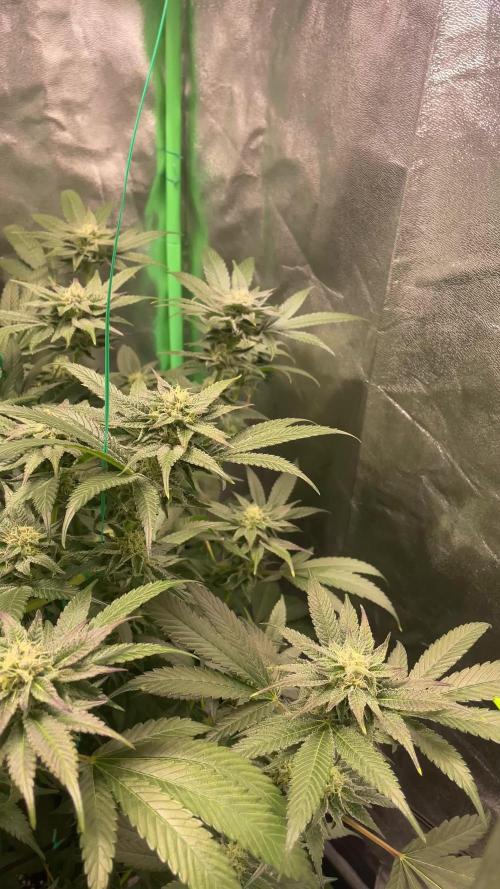
Starting Week 10, which marks the beginning of the 7th week of flowering. The buds are stacking nicely and the trichome production is ramping up. Tomorrow, I’m planning a defoliation to improve airflow and light penetration. I’ll also be tucking and organizing the canopy to keep everything tucked neatly within the 70x70 space.

Likes
2
Share


@Scrubz767
Follow
They started flowering gave them Chicken Manure a few days earlier when I noticed it, in the 3rd week if flower i'm going to give them rabbit manure and make a flowering tea for them 😁we will see how it goes also might get a PK Booster 🤔

