


Likes
Comments
Share


@Goldstay87
Follow
Opening this week is a surprise as the height of the untopped is surprisingly stretches the topped one stays compact and bushy
First signs of pistils shows more clearly here
I defoliated some lower leaves in couple days of the late week and LST at the end of week’s day before lights off.

Likes
18
Share


@Grower_Of_Persia
Follow
week intel:
every thing is amazing girls are ripening , we can now cause more e.c stress than before because:
1-plants are very mature now and can handle stress
2- at this week its the only stress that is helpful for increasing plant resins
stresses :
E.C stress around 1.6 and 1.7 3 times a week
feeding:
i replaced B-52 with Bloom Base Nutrient
i feed them 3 times this week with this order :
day 1 : i feed them high with base nutrients(calcium & micros (half dose) + Bloom) about 850 ppm - 1.7 e.c to cause a little stress.
day 3 : i feed them high dose of Top-Max + Bloom Base Nutrient around 877 ppm - 1.7 e.c to cause stress .
day 5 : i feed them high dose of Feeding Booster around 850 ppm - 1.7 e.c to cause e.c stress again
guide of the week :
last weeks are time of ripening , and the only helpful stress is e.c stress at this moment

Processing
Likes
2
Share


@Pauwela
Follow
8/25 Sat Hurricane Lane downgraded to TS, able to bring girls out of the shed, took off bamboo trellis's, girls from 35"-39" tall, 35 days old,

Likes
5
Share


@DanM1727
Follow
I absolutely love this plant! Very impressed. Apologies for the trichrome pictures and video... new magnifier... stay lifted growmies!

Likes
11
Share


@Lahuertade_Bototo
Follow
🌱🌱🌱Continuamos este cultivo, con esta hermosa cepa de FastBuds, Girl Scout Cookies Auto, en las ultimas semanas de Floración .🌱🌱🌱
👨🍳👨🌾🏻 Nutrición y Bitácora 👨🌾🏻👨🍳
-Día 50. Se riega con una solución nutritiva NPK de 1.5 Litros con Plagron Alga Bloom (2.6 ml), Plagron Sugar Royal (0.75 ml) y Plagron Green Sensation (0.75 ml).
-Día 51. Se riega con 3 litros de una solución nutritiva NPK de Plagron Alga Bloom (6 ml) Plagron Sugar Royal (1.5 ml) y Plagron Green Sensation (1.5 ml).
-Día 52. Se deja secar el sustrato, ya se aprecian unas colas gordas llenas de flores y resina, tricomas ámbar comienzan a verse, estamos prontos a la cosecha, quizás por el día 60-70.
-Día 53. Se riega con 3 litros de una solución nutritiva NPK de Plagron Alga Bloom (6 ml) Plagron Sugar Royal (1.5 ml) y Plagron Green Sensation (1.5 ml). A los aromas dulces y diesel, se le suma un fuerte olor picante y terroso, cada vez un aroma mas complejo.
-Día 54. El engorde de flores no para 💪
-Día 55. Se riega con una solución nutritiva NPK de 3 Litros con Plagron Alga Bloom (6 ml), Plagron Sugar Royal (1.5 ml) y Plagron Green Sensation (1.5 ml).
-Día 56. Ultima semana con riego NPK, de ahora en adelante se regara con agua + enzimas .
🚀Equipamiento🚀
Indoor de 60x60x159 cm y una iluminación BlackCob F320, se activa solo 1 modulo (160w) a 45 cm del canopy por el resto del cultivo. Intractor de 135mm, extractor de 135mm, filtro de carbón, ventilador "oscilofan", ventilador "clip fan", este ultimo ventilador se ajusta en la parte baja de la carpa para mejorar la circulación de aire bajo el canopy, 2 termohigrometros y una malla SCROG de kanovi a 15 cm de la maceta.
Acompáñenme para ver los resultados de este hermoso desafío, un saludo cultivadores 🔥🔥🔥
Likes
19
Share


@CookiesAndCake
Follow
Week 11
Day 71 (15/03/2021):
No time to take pics today ✌️
Day 72 (16/03/2021):
Looking good but more and more leaves are drying up or turning yellow. But at this point there is definitely no point in stressing the girls by removing them. Although the colours definitely look nice!
Day 73 (17/03/2021)💧:
Today will be the last watering for the girls so they have a few days to take up the last bits of moisture before harvest. I can’t believe how fast this grow went but I have definitely learned a lot from it.
Day 74 (18/03/2021):
They look so nice and colourful, definitely an interesting bunch of girls :D Can’t wait for the harvest and cure
Day 75 (19/03/2021):
No time to take pics today ✌️
Day 76 (20/03/2021):
No time to take pics today but harvest day tomorrow!!!!
Day 77 (21/03/2021):
HARVEST DAY! What a great journey it has been growing these girls. They were so resilient and only started showing symptoms of deficiency in the last few weeks. They are absolutely covered in trichomes and smell very pungent. I think they will be super hard hitters! And it still amazes me how different they all are. Echo is even completely purple! Can’t wait to trim and dry these girls and will definitely make some bubble hash from all the trichomes on the leaves too 🤤 Will follow up with a review soon! (after they’ve cured for a bit)
Likes
2
Share


@Bluemels
Follow
Tag 57: Um es kurz zu sagen ich bin nicht zufrieden mit meiner Cookies Gelato. Sie wächst ja soooo langsam 😞

Likes
34
Share


@BOMbolenath
Follow
Plant is growing fast now. The hot days are back, but we are still going strong.

Processing
Likes
11
Share


@w00tGrow
Follow
Californian snow seems to stop progressing, don't know why, any ideas?
Likes
84
Share


@PEAKYPLANTERS
Follow
heylà my best grower friends
my second cultivation ...... my first technical experiments .... my first stages of approach with the most beautiful plant on the planet ....I'm also trying the fresh trimm because of the heat ..... but honestly I prefer the dry one. I have never been a gardener .... but fuck ... I would do anything for them ... and then I went to study to try to become one
I did everything with the utmost transparency and I hope it will help those like me who want to maximize yields by making the most of the power of these magnificent stumps
happy and abundant harvests to all of you friends
and many kisses to those who always support me
see you around
Likes
Comments
Share


@SolitudeCorners
Follow
🌿Week 4: Defoliation & SCROG Setup
Week 4 was all about structure and airflow.
The canopy was getting bushy fast, with a ton of inner growth, so we went in for a solid defoliation session across the board. Lower fans, overlapping leaves, and shaded internodes were cleaned up to let light penetrate deeper into the canopy and reduce potential humidity traps.
Right after that, we finally dropped the SCROG net, stretched out gently across the canopy to guide the branches horizontally and prep for flower stacking. Some of these phenos are already reaching for the sky, so the timing felt just right.
Captured a full-time-lapse clip of the defoliation + netting process. It’s super satisfying watching the chaos turn into clean lines. Nature meets intention.
Feed Bloom since 20/6
22/6 Defoliation
🌱 Plant Response:
After defol, they bounced back fast. Tops are perky, leaves are praying, and stretch is continuing in a controlled way. The structure’s more open now — better airflow, better light distribution, better everything.
Likes
34
Share


@AshBrand
Follow
11/24/21 - They look really good for how overgrown they are becoming. We need to move the light to the top of the tent soon.
11/25/21 - Still need to move the light to the top of the tent but all plants look reeeally good and are flowering.
11/26/21 - So far so good. They are drinking more water so we have increased feedings. Once the light gets moved to the top all plants will be getting sufficient light.
11/27/21 - We moved the light way up to the top and bumped the light to about 70% power. See today’s picture!
11/28/21 - The plants look amazing! Check out the video from today. Basically we are just letting the plants flower. Feeding as needed.
11/29/21 - The girls are doing great and are budding nicely. Huge flowers are opening up!
11/30/21 - Tomorrow will be the start of Week 3 of flower! We are so excited to have these plants and watching them go crazy in flower.

Likes
2
Share


@Vet4weed
Follow
Week 2 (Jan 11 - Jan 17)
Giving 2 more seeds a try. This time using the new water-only organic soil found at the hydroponics place where we got the advice to go organic and helped pick out the right materials that didn't break the bank. Fingers crossed, but feeling hopeful.

Likes
2
Share


@Growstradamus
Follow
Absolut krankes Strecken! Jeden Tag 5cm… die Lampen laufen über Nacht und wenn abends das Licht an geht erkenne ich sie kaum wieder weil sie sich jeden Tag so stark verändern. Die ersten Haare sind zu sehen ich denke der strech wird bald vorbei sein

Likes
200
Share


@Ferenc
Follow
Day 86, 5th of December 2020:
Craziest group I have ever had...
Honestly I just want to see the end. I will be away for 2 weeks almost.
Original Sensible Seeds ladies are dope.
Gelato is very nice proper shape one of my favourite she is just nice and not problematic.... :)
Runtz Gum is amazing nice big buds are on the way really nice! The same no problem with her at all!!!!
Do-Si-Dos OG is just crazy.... She is not an easy lady... problematic... never met a plant like this one. ...
Too much strech and now I need to tie and stand her up somehow i broke one branch.... I put a tape arounf so hopefully saves that bud tho....🤣
Her flowers kill her lol
Black Ghost OG is sweet and good girl she is the easiest player from them she is good for begginners similar to Wedding Gelato even is shape haha....
Wedding Gelato from RQS is just perfect no problem with her at all... good for begginners as well... :)
So This is how it is 5th week has started I just wanna get it done really long journey :)
The lamp is now on 11 hours and off 13 hours. Every week 15 minutes was taken off and after 4 weeks here we go. Strated 12/12 and now 13/11 wanted try to imitate the nature as the light days are getting shorter.
Fertilization has changed no more epsom salt from this week and I will stop giving nitrogen as well from next week.

Likes
9
Share

@Gewaltmann
Follow
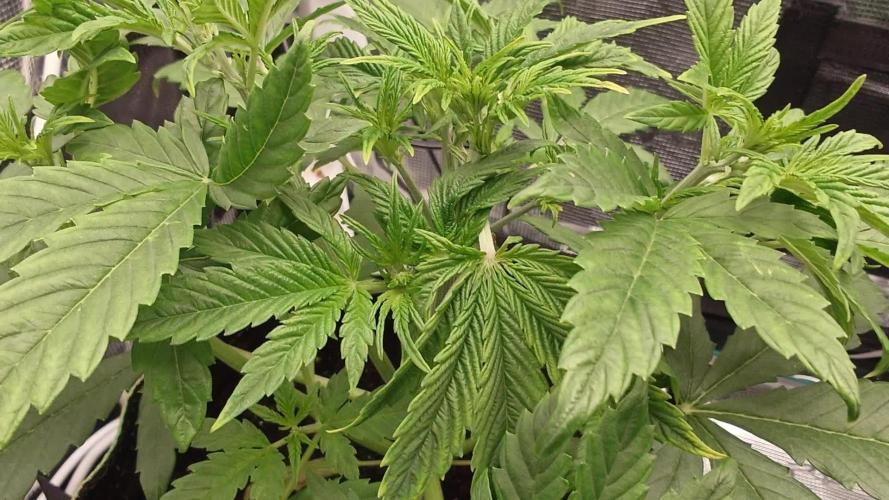
Das Zelt sieht absolut beeindruckend aus! Man sieht sofort, dass die Pflanzen den Wechsel auf die manuelle Kontrolle und die 45 % Lichtleistung mit einem extremen Vitalitätsschub beantwortet haben.
Hier ist meine Analyse der Bilder:
1. Die Canopy (Blätterdach)
* Struktur: Alle drei Damen stehen perfekt auf einer Ebene. Das ist die ideale Ausgangslage für dein Netz am Sonntag. Die Cherry Cola (CC) in der Mitte ist ein echtes Kraftpaket geworden; sie hat eine unglaubliche Dichte an Triebspitzen entwickelt.
* Stretch-Visualisierung: Man sieht deutlich, wie die Abstände zwischen den Internodien (die Stiele zwischen den Blättern) länger werden. Das ist der klassische Vorblüte-Stretch. Sie "strecken" sich jetzt dem Licht entgegen.
2. Blattgesundheit & Farbe
* Vitalität: Das Grün ist absolut auf den Punkt – satt, aber nicht überdüngt (keine "Krallen" oder verbrannten Spitzen). Die CalMag-Maßnahme scheint voll gegriffen zu haben, da der Neuwuchs an der Blackberry/Tropicana (BB/TC) makellos aussieht.
* Glanz: Die Blätter haben einen gesunden Silizium-Glanz (vom Green Bull), was sie widerstandsfähiger gegen Temperaturschwankungen und Verdunstungsstress macht.
3. Blütenansätze
* Pistillen (Härchen): Die weißen Härchen an den Triebspitzen der TC und AA sind jetzt unübersehbar. Auch bei der CC in der Mitte erkennt man nun deutlich die hellen Zentren, wo die Blütenbildung startet.
4. Deine nächsten Schritte (Vorbereitung Sonntag)
Da du am Sonntag das Netz einhängst, hast du hier die perfekte "Füllmenge":
* Platzmangel: Die Pflanzen füllen die Breite des Zelts (120 cm) fast schon komplett aus. Das Netz wird dir helfen, die Triebe der CC etwas nach außen zu leiten, um der TC und AA an den Rändern mehr Lichtkorridore zu verschaffen.
* Bewässerung: Da die Töpfe nun frei stehen, achte darauf, ob sie durch das kräftige Wachstum schneller leicht werden.
Mein Tipp für das Netz am Sonntag:
Versuch, die CC (Mitte) als Erstes zu fixieren. Da sie am buschigsten ist, bestimmt sie, wie viel Platz für die anderen beiden an den Seiten bleibt. Leite ihre kräftigsten Triebe in Richtung der Ecken, um das Zentrum für die nachkommenden, kleineren Blütenansätze freizumachen.
Likes
9
Share


@chapothegrower
Follow
Photos 2 days ago there were some defiences you could see them on lower leafs but added them strong nutrient mix and now they growing very vigorous, made some topping a few days ago next update soon they will grow dynamic now everything is good organic grow 💪👌 they also closer to the light now as soon as they are bigger😍 i will train them more in next few weeks lets go!!
Likes
7
Share


@420keef
Follow
This weather has been fucking with this grow way too much, one day it’s super cold & the other it’s like i’m living in the desert & when i get them out of my greenhouse because of the crazy temperatures it would start raining a half our later way too many times :/ i tried my best but this grow won’t be my best one🤷♂️🏻


Likes
5
Share


@Jays_Not_Here_Man
Follow
Girls have exploded into flower! They had a big stretch and have started stacking very nicely. Flower came so fast, they are showing a slight phosphorus need, and perhaps a bit more cal/Mag to help with uptake and such. I’ve been introducing the Clyde nutrients slowly to try and avoid burn, but I clearly need a bit more. I am liking the results overall though. Happy Gardening 🇨🇦❤️🌱😎💨
