


Likes
Comments
Share


@GhostByte
Follow
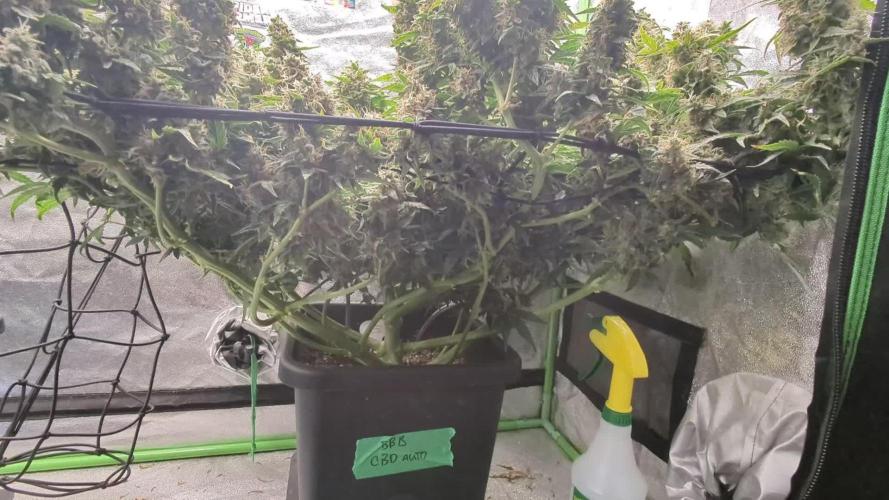
Budding coming along nice, frost is also starting to form on the sugar leaves.

Likes
6
Share


@GroloCup
Follow
We continue forward and the flowers are looking beautiful. Battling pH issues and the drift in this tent is just crazy, especially since I barely have room to move her around to adjust her parameters. I need to not be lazy 😂 and do what needs to be done. She's got a funky grapes profile and berry smell that's getting more acrid as she ripens. From the amount of pistils she's still throwing, I'd say she's gonna be going for a while longer. I'm still in love with that beautiful purple flower and can't wait to see how far I can push her in this micro set up. The power of the Groloponix MiniMax 1G is on full display!!!

Likes
32
Share


@Fatnastyz
Follow
9-3
Little light burn, bumped up.
Good and steady. One of her cotyledon came out black and a little smaller than the other. Seems to be ok.
More worried about the light. 😂
9-6
Good growth. Slight discoloration in leaves. Humidifier blowing on her. Added a fan low, for flow!😱️🤘
500ml yesterday with HP connect.

Likes
51
Share


@MadeInGermany
Follow
Info:
Unfortunately, I had to find out that my account is used for fake pages in social media.
I am only active here on growdiaries.
I am not on facebook instagram twitter etc All accounts except this one are fake.
Hi everyone :-) .
This week she continued to develop very well 😊.
It was poured twice with 1 l each time.
She got training again (topping) and will get it a few more times so that she becomes a real bush :-).
Otherwise everything was cleaned and checked.
Have fun and stay healthy 🙏🏻
You can buy this Nutrients at :
https://greenbuzzliquids.com/en/shop/
With the discount code: Made_in_Germany you get a discount of 15% on all products from an order value of 100 euros.
You can buy this Strain at :
https://www.exoticseed.eu/
Type:
Herz Og
☝️🏼
Genetics:
Larry OG X Kosher Kush
Indica 60 % / Sativa 40 %
👍
Vega lamp:
2 x Todogrow Led
Quantum Board 100 W
💡
Bloom Lamp :
2 x Todogrow Led
Cxb 3590 COB 3500 K 205W
💡💡☝️🏼
Soil :
Canna Coco Professional +
☝️🏼
Nutrients :
Green Buzz Liquids :
Organic Grow Liquid
Organic Bloom Liquid
Organic more PK
More Roots
Fast Buds
Humic Acid Plus
Growzyme Big Fruits
Clean Fruits
Cal / Mag
Organic Ph - Pulver
☝️🏼🌱
Water: Osmosis water mixed with normal water (24 hours stale that the chlorine evaporates) to 0.2 EC. Add Cal / Mag to 0.4 Ec Ph with Organic Ph - to 5.8



Likes
20
Share


@Green_Dream
Follow
So I was thinking that growth is quite slow in the last two weeks. Then I discovered that the roots were looking weird, and noticed fungus growing on them. So I took the roots out and you can see the problem yourself in the pictures. I removed the bottom part of the roots and I added new coco in the pots, then I placed the girls back. It's been one week now and I can see new roots coming out at the bottom of the pots.
The strange thing is that the 2 plants that were healthy(completely white roots) are also having the smallest buds 😒
Btw, I also flushed them with FloraKleen and H2O2(10%, 2ml/l). Then started feeding again, but with reduced nutrients - 630ppm
I also elevated the pots, so they don't touch the trays anymore and started using the dehumidifier(50% humidity). I also bought a RO system and started using RO water instead of rainwater.
Damn, I hope the harvest will look decent!


Likes
3
Share


Likes
13
Share


@smokeycropping
Follow
increible crecimiento de las nenas. 5 semana ya proxima a flora como le encanta el bokashi
a estas cepas de royalqueenseeds.
se ven sanas y comen bien muy pequeñas, muy compactas me sirguen ayudando a darles mas vegeta.
Likes
95
Share


@Roberts
Follow
North lights is doing good. She is just about bulking and will be switched to ph water in a few days. She has a earthy citrus aroma. Everything has been going good. Thank you Divine Seeds, and Spider Farmer. 🤜🏻🤛🏻🌱🌱🌱
Thank you grow diaries community for the 👇likes👇, follows, comments, and subscriptions on my YouTube channel👇.
❄️🌱🍻 Happy Growing 🌱🌱🌱
https://youtube.com/channel/UCAhN7yRzWLpcaRHhMIQ7X4g.

Likes
12
Share


@DeepWaterGrower
Follow
🗓️ WEEK 1 / DAYS 1-7 (flo)
🔙 The first four weeks of vegetation went remarkably smoothly. I gradually increased the EC from 0.6 to 1.2, and the plant responded with healthy, compact growth. By the end of week 4, the plant was bushy, vibrant green, and ready for the flip after a 24-hour flush.
💧 At the beginning of this week I introduced a new nutrient solution with EC 1.6 - PH 6 and also started adding a flowering stimulator to the mix, Power Buds by Plagron. She's definitely thirsty, drinking about 2 LT/day, and importantly, isn't showing any signs of stress from the change.
🌱 With the switch to the 12/12 light cycle, the plant has started the stretching, increasing in height from 21 cm to 29 cm. It's also become incredibly bushy! Given her still relatively contained height, I've decided I won't be using a SCROG net.
Likes
70
Share


@Santica_Garden
Follow
I have added a video to the diary, I prefer to do the videos as I can give out as much information, and also saves you guys from having to read all my crap😅

Likes
33
Share


@AshBrand
Follow
This strain gave us no problems, very simple to grow! The plants both stayed small and bushy until flower, then they took off. We will be back to adjust the weight and add more comments.
8/14/21 - The buds are done curing and it’s 🔥 Smooth and flavorful 💨 We finally smoked it and couldn’t finish a joint lol. It’s a lot stronger than we anticipated. I love indica strains and this is now one of my favorites. Next up we have 2 Lemon Kush and 2 Gelato growing outdoors as a side project in between indoor LED grows.
Blueberry from seedsman was so simple to grow. We messed up on a few things but we got plenty of nice buds and made 2lbs of butter for edibles.
-FIN-

Likes
21
Share


@Budhunter
Follow
As I did the flushing in day 68 I was watching the trichomes and on day 87 I could see 25-35% amber so I decided to cut it. I cut the whole plant on the base and hang them all to dry. For this reason I will update my findings later when it gets dry and trimmed. So far really happy with the results. It won’t yield much but the quality is impressive
Likes
2
Share


@Indicaianer
Follow
Alle 6 haben in 2 Wochen sehr gut angewurzelt und entwickeln sich gut.
Processing
Likes
14
Share


@DUBDOLLASIGN100
Follow
I'm amped up about these 6 Gotti Ogs and these 2 Downtown Finest Og strains, there growing fast eating a lot and the weather is great in Cali. These indoor veg and outdoor flower is really working well for me. I'm using Flora nova bloom and there booming
Likes
4
Share


@yungdanktwanog
Follow
Looking great I think pheno one will end up finishing a week early, maybe soon I will start the flush for pheno 1, as far as pheno 1 and 2 I will keep them going until I see more development

Likes
5
Share


@TheGreenDisciple
Follow
Day 80 ~ Plants are looking and smelling great. I have been keeping an eye on the trichomes for the first plant and she looks like she will be ready right after the harvest moon! So I am excited to harvest her on Friday. While plant 2 is still another week and a half to 2 weeks away!

Likes
35
Share


@The_Bearded_Grower
Follow
Day 80 Harvesting was a bit of a trick with this one because I used to Trellis Nets but it went very smoothly no accidents and in the end I ended up with a staggeringly large amount of wet weight. My wet weights have a minimal amount of stock so that they more accurately represent the actual weight of the flower itself. In three days roughly I will be putting in the dry weight and then putting all the flowers into curing.
welcome to Day 83 this will be my last update i have now done my final trim and got my dry weight 362.30 gram's !! off one plant. that's 12.77 ounce's i don't sell but my god if i didn't care about laws lol, For a plant thats no cured i will sat it tastes smooth AF and has a nice head high that i didn't really expect from her being that its not cured and didn't really look like she had tones of trichomes. This baby is going to be nice in a month.
I'd like to thank everyone that followed this grow and asked questions as always my friends keep your stick on the ice

Likes
346
Share


@Canna96
Follow
Hey now! This week went very well. I feel like she is finally done growing, and just starting to thicken up and ripen. I did switch from the liquid koolbloom to the dry, and within 48 hours or so I really started noticing the weight of the colas start leaning towards the floor. I did support the main colas last week, but this week I noticed several of the smaller unsupported colas started drooping to the floor, so i added a few support lines. I am thinking maybe she has two or three weeks left. I am not a big believer in an all out flush, as I do not wish to stress her out even near the end. Rather, I am gradually weaning her off the nutes over the next 2-3 weeks. She is starting to get brown tips on almost every leaf so not sure if this is just her being near the end or a bigger issue?? Any advice please hit me up! I'm still struggling with humidity issues, but she seems to be ok! Thank you so much to everyone in this community for all the love, support, and help with my first grow. Thanks and blaze on!

Likes
36
Share


@nonick123
Follow
Día 73 (12/08) Riego 500 ml H2O pH 6,55
Todas las plantas muestras las preflores hembras! (excepto LemonPaya)
Día 74 (13/08) Riego 250 ml H2O pH 6,55 . Están muy bien hidratadas
Pequeños ajustes de LST
Día 75 (14/08) Hoy día de lluvias torrenciales
Riego 250 ml H2O pH 6,55
Día 76 (15/08) Detecto mosca blanca en varias plantas. Aplico Spruzit a 10 ml/l ahora que aún no estamos en floración
Riego 500 ml H2O pH 6,55
Día 77 (16/08) Riego 500 ml H2O pH 6,55
La mosca blanca ha desaparecido completamente
Día 78 (17/08) No riego. Mañana a primera hora aplico Top Dress y riego profundo
Va a empezar la floración!
Día 79 (18/08) Alimentemos el suelo con Top Dress! 💥 Aplicamos 4 g/L sustrato de Tasty Flowers TD by Lurpe Solutions.
Total = 84 gramos / maceta
Riego con 1 Litro H2O pH 6,5 con 25 ml/L de Humus de Lombriz Liquido
Aplicación foliar Kelp hidrolizado de Lurpe Solutions a 0,25 ml/l
💦Nutrients by Lurpe Solutions - www.lurpenaturalsolutions.com
🌱Substrate PRO-MIX HP BACILLUS + MYCORRHIZAE - www.pthorticulture.com/en/products/pro-mix-hp-biostimulant-plus-mycorrhizae
