




Likes
3
Share


@BudsBanditUK
Follow
Not much going on, the buds are getting fatter. There is now a faint smell. Some buds now getring some colour. Still taking feed probably at least 2 weeks left.

Likes
62
Share


@Collinsy74
Follow
Had a canny stressful week with the ph levels, got them back up now need to start flowering from tomorrow getting to big now never mind the stretch to come. 😀 Happy growing ✌️

Likes
4
Share


@DRO420
Follow
Uped the nutrients a little , next feeding will be the last , to flush out the soil before harvest.


Likes
112
Share


@Tazard
Follow
Additional supplements: (ml/g) .4 drip clean, .25 roots excelurator, .5 amino treatment, 3.0 multi zen, 2.0 hydroguard.
The tent smells good 😊.
8/2 The goal is to have 6-9" through the scrog at the end of week 3 flower I'm pretty close the taller ones are 6-7" through the scrog now.
8/3 took 7cuttings from Acid Dough "C" for clones.
8/5 could be more level but I'm happy.
8/6 another round of defoliating lots of branches just below the canopy opened them up.

Likes
28
Share


@PrairieFrostGrow
Follow
*
********* Week 11 - June 20 to 26, 2020 - Days 71 to 77 from germination ***********
*
It is the end of flush week and she went into darkness on Wednesday night, day 75, for two days. Saturday will be harvest day and start and the dry process👍
This week she continued to fill in and she also pushed out more frosty tricombs!! The fade happened this week more and she fed off of more of the nutrients within the plant.....perfect😃......would like a little more even but she was ready based on tricombs. Would like to have seen the lower leaves a little more yellow but its good.
I am feeling very strongly that the big part of the pH issues this run was a change in feed water. I have always used bottled RO water for all my grows, except outdoors, but this grow I switched to tap water. Dechlorinated the water with air stone and gave it 24 hours min before using. Wanted to save some money and tired of lugging bottles downstairs a couple of times a week☹️ This is worked out nicely and a lot more convenient. However, the city must be putting some crap in the water that is causing issues in my media and raises the pH after the watering. Out of the tap it is 8.4pH and 275ppm. Since ppm were not too bad in my opinion I moved forward without filtering the water.......oops🤬🤬🤬 Out of options on what is causing the issue, I switched back to RO water late last week........all the girls are happier!!!! F......missed the cause for weeks. Always learning from this plant and my own mistakes to get better every run😉👍
Also wanted to add a little more stress to girl to help push out some increased resin. I drilled a 5/16” hole into the main stem to cause her stress. I did this rather than trying to break a branch and will see it goes this run. Sterilized a new bit in Alcohol and went for it. They went into darkness about a couple of hours later. Excited to see what happens when she comes out to get chopped😃😃
Not really a lot more to add this week as it was mainly looking at the tricombs and her buds. The pH will impact the harvest but she has been fun to grow and very resilient to pest and bug issues as well as grower curve balls. As always.......nice job Sweet Seeds....... SWS56 is very solid and I look forward to running her again one day. Beautiful little girl and makes me smile😃😃😃
Little more detail......
June 20/20 - Day 71
- Rezin and Liquid Weight @ 2ml/L = 285ppm and 4.0pH
- 8L given to get a good flush....pH still running around 7.4
- Runoff in pots already were 7.9pH and 685ppm.
- after 8L water runoff was 7.4pH and 360ppm.
- she is 20” tall and 24” wide.
- a number of clear tricombs but more becoming cloudy.
June 21/20 - Day 72
- dry out day.
- buds are firming up......squeezed a couple🧐
June 22/20 - Day 73
- Rezin @ 1ml/L = 120ppm and pH the water to 2.7!!!!!!!!!
- Given 2L watering.
- No runoff water and I am good with that as I want the low pH water to stay in the medium.
- her frost levels are really coming out now.....was able to lower tent temps to 75 degrees and 51% humidity......its been raining a bit so damn humidity has been high.
June 23/20 - Day 74
- 2L plain water feed - 80ppm and pH to 2.4!!!!!!
- not excited about these crazy low pH numbers but doing what we can
- her tops are getting more pointy now and ripening nicely
- leaves continue to fade......she is close
- checking tricombs, I think we are done and tomorrow will be her last day so that I can take down on Saturday.
June 24/20 - Day 75
- 2L plain water feed - 80ppm and pH to 3.0
- Going into darkness tonight so this was her last bit of moisture.
- drilled a hole into the stem.....was going to do a couple of holes but not trying this method before I decided to leave it with one hole.
- into darkness tonight
So we finish up the week with her in the dark. Next update will be the harvest!!
Thanks very much for taking the time to review my diary!! Sorry for running behind often on this run.........everyone has had a busy life the last couple of months in the world and its been no different here...........a huge Kudos to all the Growmie‘s that are able to keep up with their diaries on daily basis on GrowDiaries.......its a commitment😃👍👍
Sweet Seeds girls are very solid genetics with great vigour and resilience.......this strain is no different........great job Sweet Seeds🙏

Likes
21
Share

@GreenEldritchGardens
Follow
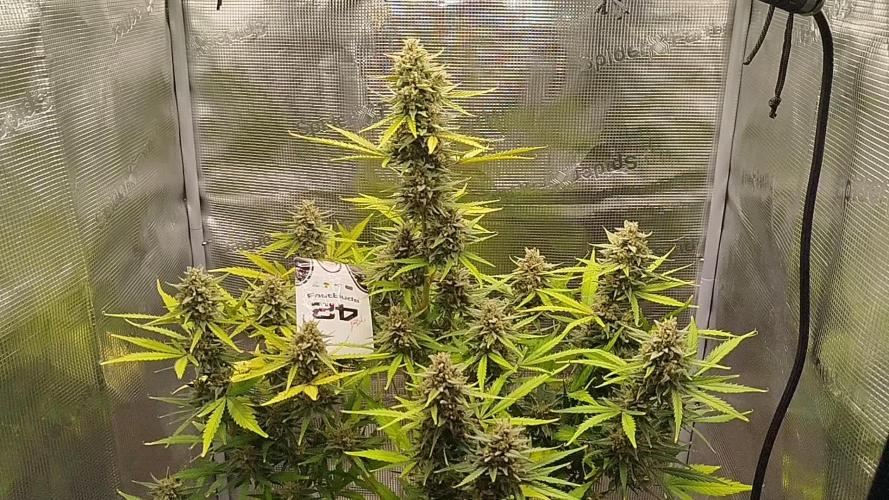
Amazing plant! Lovely terms even in 12/12!
Before the Heatwave blasted Germany I decided to cut her and hang, next week I'll post harvest results
Likes
17
Share


@DoctorCannas
Follow
Dear friends of growdiaries, welcome back.
The two automatic ladies grow up healthy and healthy .
Nutrients are doing a great job.
Unfortunately sharing the grow closet with 5 feminized, which are a jungle, is challenging and requires constant attention.
It was an experiment that I will not repeat, and due to the fact that in the balcony or in the garden the northern European climate would not have allowed a safe and lush growth, moreover, the neighbor bought himself a drone, what an asshole.
The distance from the lamp is 30 cm and I had to raise the pots almost to the tops of the other plants.
But the two young ladies are strong.
And my experience as a grower always finds suitable solutions.
See you next week.
Have fun and happy cultivation friends.
Doctor Cannas

Likes
22
Share


@Albeginner420
Follow
The HOLY GRAIL is fantastic 3 weeks to go and the buds are already gigantic i can't wait to see how they will be at harvest time. She demands a lot of water, the smell that is starting to popping out is amazing. I have to think some way to sustain those buds because they will be heavy, any suggestion? beside the trellis net cause i have to put the pot outside the box to water.

Likes
2
Share

@GreeneScene
Follow
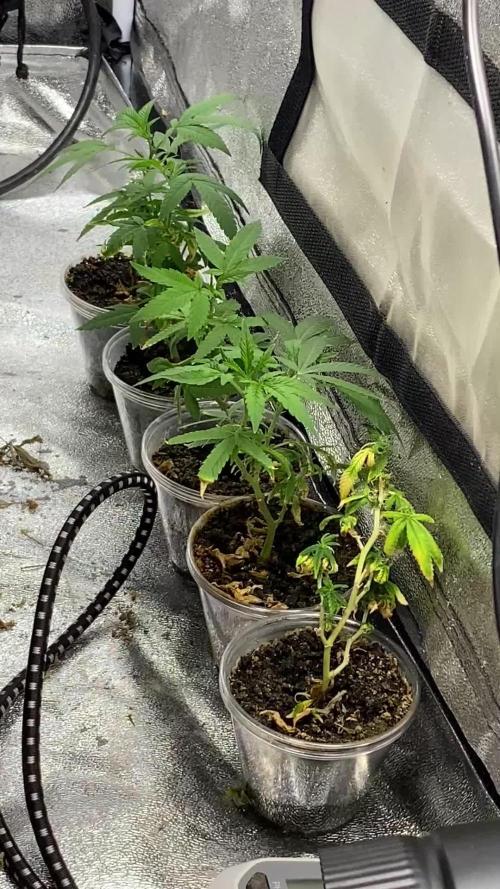
Gave her an almost MegaDose today. Since the last time I uploaded 12 days ago she was watered MegaDose of 80mL nutes in 2 gal of pure compost blend tea concentrate . After that she was given a half a gallon of regular water , followed by a half dose feeding of 40mL in 2 gallons upwards to today where I gave her 60mL in 1 gallon.
Got 9 inches of growing left until shes filled the tent to the brim . 12 days ago there were 12 inches . I’ve included a Timelapse video I’ve been creating since July 22 until Aug 21.

Likes
4
Share

@UglyEarth
Follow
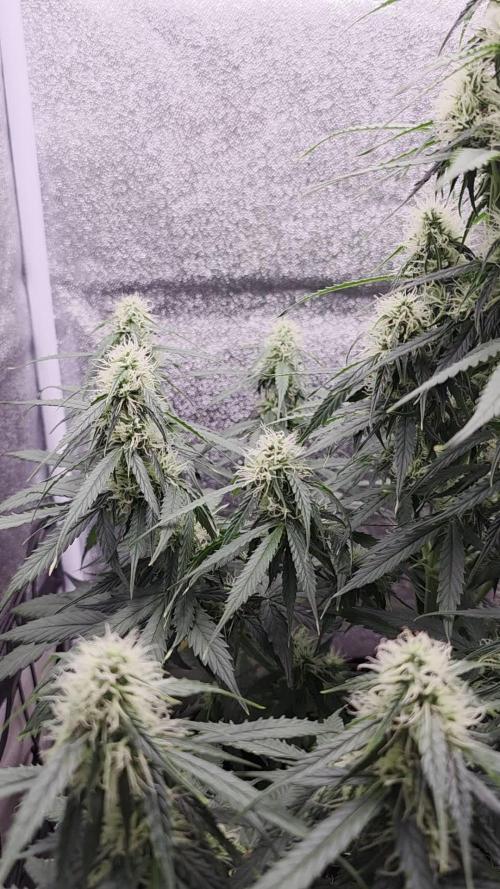
This week was a bit chaotic due to the transplant of the seedlings, setting up a new tent, and the CalMag deficiency in the "big" ones. 🌿 But I managed to get it all under control. 💪🌱


Likes
12
Share


@prebiancagrower
Follow
Hello lads! How are you doing?
So, week 8 and the ladies are amazing, the buds are getting fat is this stage, and I am very happy with it.
Gonna start the harvesting in two weeks.
Thanks for following me!
Likes
2
Share

@RooftopFarmer
Follow
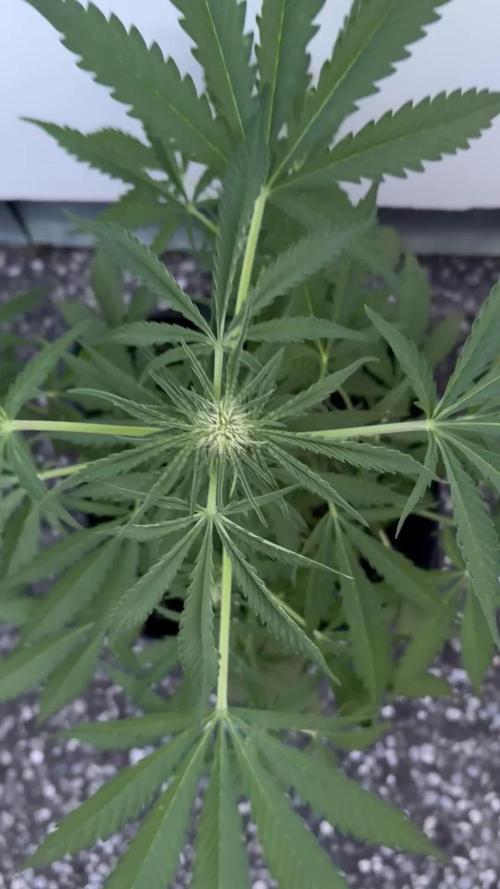
Guava Runtz – Week 7 (Fast Buds Outdoor 2026)
The weather has been excellent. Guava Runtz continues to enjoy lots of sun and consistent nutrients.
She has reached around 37 cm and is growing visibly bushier. You can clearly see her entering the flowering stage now. She has a nice sturdy structure and healthy green color. Really happy with how she is developing.
Likes
1
Share


@kauilmayel1996
Follow
Aplicando tierra de diatomeas
Y creo que va bien...
Me encanta cultivar en exterior pero nunca puedes ir muy alto y los bichos son lo peor....
Vamos avanzando y espero que está nena le siga gustando el exterior


Likes
10
Share


@DarbGrowDiaries
Follow
Beautiful plant, crazy foxtails and crazy smells
I really enjoyed both plants as they grew with the same conditions but very different.
One was a little runt at 55 cm tall while the other was 84 cm.
Did not get very purple but still super colourful.
Cant wait to dry and smoke
Likes
15
Share


@Uwish
Follow
Hello guys,
Here I am again to present you a new run, still with the best leds of the market nevertheless as I changed my growing space from 120x120 to 150x150. So I had to update the material inside...
I will run with 3 EVO 5-150 lamps of 320W or 960W with Bluetooth dimmers.
For the Hydro system, it will be the V-SYSTEM from Alienhydroponics.
In fertilizers I am always with Advanced Nutrients.
I work with osmosis water.
Currently, 4 clones took on 4.
Once the roots are ready, I will transfer the cuttings from the propagator to the V-SYSTEM.
------------------------
since the 16/08, when I transplanted the plants in the RDWC system, I noticed some points that I will mention below and correct next time.
1. The cuttings are too small, allow enough time so that I can completely fill my pots with clay balls.
2. Cut out the bottom of the pots from the cuttings.
3. 3/4 of the cuttings are touching the water, so one is late. Next time when transplanting, add more water, up to the basket in order to immerse all the plants and not to create a difference between each one, consequence now I have 3 that are ready to explode and one that will struggle behind, problem corrected today by increasing the volume of water.
4. The b-52 is a real pain in the ass in RDWC, you have to clean the 2 filters almost every day, with this new soup I'm testing without and I think I'll continue like this just with the base sensi grow A and B, as I use Root rot X, I won't use voodoo juice since all the bacteria would be killed.
5. Use of Voodoo Juice is useless if using Root Rot X which will kill the bacteria.
I don't know why but when I transplanted in the RDWC, I put my set up in growth mode, except that the plants were not ready for it, moreover, I made a FIM on each. So I lost some days, these last days I went back to a ppdf of 150, now that my roots touch the water, I declare growth 0 on 22/08, I will do between 21 and 28 days of growth. And as my roots are doing well and touching the water I'll go to a PPFD of 300
++

Likes
13
Share


@420DeepGrow
Follow
* Actualizo 2 dias antes para cuadrar diarios.
Gracias al equipo de AnesiaSeeds y XpertNutrients sin ellos esto no sería posible.
💐🍁 Frozen Face Auto
Nueva variedad autofloreciente, tan refrescante como una mañana helada con un toque de cereza y lavanda. Esta variedad es una auténtica obra maestra de la cría, con un linaje dominante 70% Sativa que aporta una vibración edificante y energizante a tu cultivo. Perfecta para los que aprecian la belleza veloz de las semillas autofeminizadas y la mezcla única de dicha aromática.
Con un contenido de THC del 30%, Frozen Face Auto promete una experiencia tan estimulante como una zambullida en un lago fresco, dejándote fresco y vigorizado.
Ofrece rendimientos impresionantes de 550 g/m² en interior y hasta 300 g por planta en exterior. Con un ciclo de 70-75 días.
🚀🌻 Consigue aqui tus semillas:
🍣🍦🌴 Xpert Nutrients es una empresa especializada en la producción y comercialización de fertilizantes líquidos y tierras, que garantizan excelentes cosechas y un crecimiento activo para sus plantas durante todas las fases de cultivo.
Consigue aqui tus Nutrientes:
https://xpertnutrients.com/es/shop/
📆 Semana 4:
Continuamos la etapa de vegetación, ella se desarrolla muy bien 😎, comienza el buen tiempo, temperaturas agradables para todos, pronto espero ver las primeras preflores.
Esta semana se aplica una solución de trichodermas para una mejor adaptación aunque realmente va genial.
Se mantiene 1/3 de nutrientes Master Root y Master Grow

Likes
42
Share


@Roberts
Follow
Has been a great plant to grow. Has amazing flavor and appeal. I love strawberry flavored bud. Was a first grow for advanced seeds strain. Curious to try others. Thanks again for likes, follows, and subscriptions on my YouTube. Support is great appreciated. Be safe and happy growing

Likes
14
Share


@Kakui
Follow
23 Noviembre: Se realizó el segundo apical, defoliacion, y Lollipop. Estamos a un par de días de iniciar el ciclo 12/12 de floración y pasar a riego Generativo.
