





@AlpineGoat
Follow
Late update!
I got serious problem with technology and couldn't update my diaries.. After almost 1 month I'm here again to show you my running project!
Pics are gonna be uploaded soon or later this weekend!



@Danylo
Follow
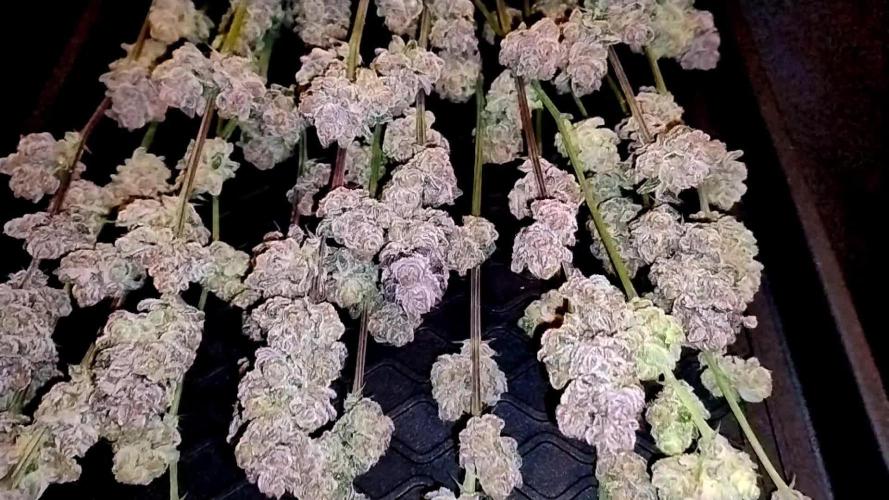
I am an irredeemable wet-trimmer.
Trimming this one was reasonably easy, but because there was so much of it ... it still took some time. Some of the "trim" was completely covered by trichomes but I treated her like any other plant in this regard and I'm satisfied with the results. The trim bucket looks ridiculous though. I added a pic of some of the last trim to the gallery.
I tried to make a few videos too - I think my videomaking style is called "spaceship flies over woodlands" so please don't judge.. at least there is no audio of me making plane noises.. 💩


@Ryno1990
Follow
This big beautiful girl Purple Goat Cheese from Goat Genetics has been such an amazing grow so far she is so stinky an sticky an I love it smelling of straight sourness she is getting her last week of nutrients before flush an then harvest an I can't wait


@MTUZZIO
Follow
flipped to flower a couple days ago. you'll see a defoliation in the timelapse, they bounce back just so quick it's insane. just barely started stretching yesterday/today. super excited for that and to see how my canopy / quadline works out in the end.
i've gone down a whole living soil / organics rabbit hole recently with BuildASoil and One Straw Revolution etc etc. I really think I'm going to switch to large living soil beds for my next grow. That said, I've started adding in some foliar and root drenches with organic products - BuildABloom, fish hydrolysate, freeze dried coconut and aloe. Plants seem to really be enjoying it, after applying they just seem so happy. really happy with the smell I'm getting and don't even have pistils, much less flower yet.
So that's pretty much where I'm at. Wyze camera dropped the ball on the timelapse for the...sixth week in a row. I set it up, it seems to be running fine all week and then at the end it's missing days and corrupted. I got my hands on a linux script to make timelapses out of the raw footage, so this week I'm just recording continuously and going to try and run that.

shorts_status_processing


@hash_thetics710
Follow
Really earthy, sweet aromas. Purples took over last few weeks on some of the leaves. I could of ran maybe even another couple weeks. I actually ran one of the plants another 2 on dry flush. It was a good outdoor run









@DeepRootsGrowTrees
Follow
COSMOS F1 CBD /
ROYAL QUEEN SEEDS
WEEK #4 OVERALL
WEEK #3 VEG
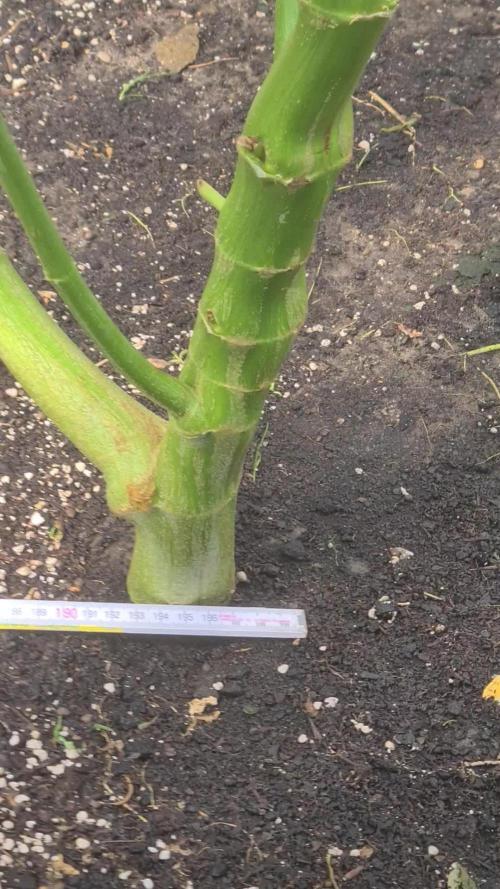
This week her journey continues and she's doing good she really started to grow towards the end of the week. Stay Growing!!
Thank you for stopping by and taking a look it's much appreciated!!
Thank you ROYAL QUEEN SEEDS!!
COSMOS F1 CBD ROYAL QUEEN SEEDS


@The_Lonely_Farmer
Follow
Well they are still here and plodding through eith no issues considering the sudden change in wheather 🌱
Need keep these critters at bay thoug they're out in search of these fruity flowers...
Not really exfoliating to be honest just letting them do their thing now ✌️💚


@MrJones
Follow
OSS Sherbet Moonrocks
🔹⊱╮🔹╰⊰🔹 GROW Started 03.10.24 INFORMATION 🔹╰⊰´🔹⊱╮🔹
🌞Environment - Maintaining 80F and 65%Humidity
🌾Training - Nothing this week just letting the seedlings veg out.
⚱️2-Gallon 📊6.2 PH
💧 Feeding - Using Horti Grow 8-11-21, Bloom 5-15-26, Late Bloom 0-24-26, Cal 12-0-0
🌞Medic Grow Smart 8 760 Watts
🕷️ IPM - CannControl from Mammoth and Mosquito Bits as needed
🔹⊱╮🔹╰⊰🔹 PLANT UPDATES 🔹╰⊰´🔹⊱╮🔹
📝 Notes - Starting Dailiy Reduced Volume Fertigations with Hort-Grow @ 3.3 GRMS Per Gal, and Horti-Cal @ 2.5 GRMS Per Gal.
🗓️04.05.24 Today fed with Hort-Grow @ 3.3 GRMS Per Gal, and Horti-Cal @ 2.5 GRMS Per Gal.
🗓️04.06.24 At the beginning of week 2 I defoliated and now today the beginning of Week 3 I pruned and defoliated again, may look harsh but they will recover quickly!
🗓️04.07.24 Maintaining Temps and Humidity
🗓️04.08.24 Starting Dailiy Reduced Volume Fertigations with Hort-Grow @ 3.3 GRMS Per Gal, and Horti-Cal @ 2.5 GRMS Per Gal.
🗓️04.09.24 Fed with Hort-Grow @ 3.3 GRMS Per Gal, and Horti-Cal @ 2.5 GRMS Per Gal.
🗓️04.10.24 Maintaining Temps and Humidity
🗓️04.11.24 Fed with Hort-Grow @ 3.3 GRMS Per Gal, and Horti-Cal @ 2.5 GRMS Per Gal.
╰⊰🔹╰⊰´🔹⊱╮🔹╰⊰🔹╰⊰🔹STRAIN INFORMATION🔹⊱╮🔹╰⊰🔹╰⊰🔹╰⊰🔹⊱╮
Introducing our latest powerhouse Sherbet Moonrocks one of our strongest weed strains to date setting a new bar for potency and effect. A combination of US genetics Sherbet Cake and Purple Moonbow create this potent sedative with THC levels, above 30% that will take you to celestial bliss.
An exquisite terpene profile offers a tempting treat of sensational fruity tastes, flavors, and aromas that will seduce your mind and body and take you to a serene place of pure tranquillity. Ocimene, Caryophyllene, and Limonene are the predominant terpenes they produce a wonderful array of sugary berry fruit flavours with floral hints and spicy undertone.
Growing these feminized seeds is effortless and straightforward regardless of your growing skills and at harvest time you will be generously rewarded. Plants will mature to a manageable height with a flowering period of 65 - 70 days and will develop thick dense buds glossed in thick layers of THC resin crystals packed with indica power that will lure into a deep relaxation. Expect an indoor yield of 600 - 700 gr m2 and outdoor production of over 1 kilo per plant.
Indulge yourself, add Sherbet Moonrocks to your shopping cart today, and explore the outer spheres!


@MadeInGermany
Follow
Hey everyone 😃.
Another wonderful week is over and they are developing really well 👍😃.
I think I'll put them in the flower chamber for about the next 2 weeks.
until then I wish you all the best 😋
You can buy this Strain at :
https://sweetseeds.es/de/sweet-skunk-f1-fast-version/
Type:
Sweet Skunk F1 Fast Version
☝️🏼
Genetics:
Sweet Skunk Auto (SWS34)
X
Early Skunk
👍
Vega lamp:
2 x Todogrow Led
Quantum Board 100 W
💡
Bloom Lamp :
2 x Todogrow Led
Cxb 3590 COB 3500 K 205W
💡💡☝️🏼
Soil :
Canna Coco Professional +
☝️🏼
Fertilizer:
Green House Powder Feeding
☝️🏼🌱
Water:
Osmosis water mixed with normal water (24 hours stale that the chlorine evaporates) to 0.2 EC. Add Cal / Mag to 0.4 Ec Ph with Organic Ph - to 5.5 - 5.8 .


@PakkaFarm
Follow
Start rinsing day 71 💧🚿
Light 35 cm day 72 💡
Trichomes pics last day for my girl 🍊🤩😭



@DogDoctorOfficial
Follow
# 💙 Project Blue Tent – Week 12 💙
## 🥒 Pickle Lemon Haze F1 – Pheno A
### 🌸 Same Tent. Same Ecosystem. Another Ridiculously Frosty Girl! ❄️😂
Hello everyone, and welcome back to another chapter of Project Blue Tent! 💙🌱
And here we go again...
ANOTHER GIRL LOOKING ABSOLUTELY OUTSTANDING! 😂❄️
Seriously, my friends, what is happening inside this tent?
Every time I think the flowers can't look any frostier, I take another look at the plants, grab the camera, and end up spending far too much time staring at the photographs.
And Pickle Lemon Haze F1 Pheno A?
She's giving us plenty of reasons to do exactly that!
Welcome to Week 12 of our journey, where the major structural work is behind us, the ecosystem is running beautifully, and our attention is increasingly focused on the flowers themselves.
The plants are stacking. The buds are developing. The trichomes are becoming increasingly visible, and the entire tent is looking absolutely beautiful.
This week, we decided to keep the photography more focused rather than taking endless individual pictures. But that doesn't mean we spent less time behind the camera!
Quite the opposite.
We created three separate photo stacks, combining a total of 1,452 photographs.
Yes, you read that correctly.
ONE THOUSAND FOUR HUNDRED AND FIFTY-TWO PHOTOGRAPHS!
😂📸❄️
But we'll get to that in a moment.
First, let's give this beautiful girl her own chapter.
## 🌸 WEEK 12 – PICKLE LEMON HAZE IS SHINING
Pickle Lemon Haze F1 Pheno A is approximately 145 cm tall, and the structure we've worked so hard to establish is now supporting the developing flowers beautifully.
The long vegetative period gave us the framework.
The topping and training helped us distribute the growth.
The first SCROG helped organize the canopy, while the second SCROG provided additional support as the plants progressed through the flowering stretch.
We also performed the major defoliation, improved the airflow arrangement, and made room for the under-canopy lighting.
All those decisions happened over several weeks.
Now we're looking at the result.
And honestly, this is one of my favourite stages of the project.
Not because we're doing more.
Because we finally have the opportunity to step back and appreciate what we've built.
The structure is established. The support is in place. The irrigation and drainage systems are working beautifully, and the plants are continuing to develop.
So we're not looking for unnecessary interventions.
We're watching the flowers, monitoring the environment, and allowing the plants to continue their journey.
And Pheno A?
She's looking absolutely fantastic!
💙🥒🌸
## ❄️ THE FROST – I DON'T EVEN KNOW WHAT TO SAY ANYMORE!
Let's be honest.
The photographs speak for themselves.
Look at those flowers!
The close-ups reveal an incredible amount of detail across the developing buds and surrounding sugar leaves.
The trichomes are clearly visible, the pistils remain prominent, and the flowering sites are continuing to develop.
This is the stage where the details become increasingly fascinating.
From a distance, we can appreciate the overall structure and how evenly the flowers are distributed throughout the canopy.
But when we get closer, there's a completely different world waiting for us.
Individual trichomes. Delicate pistils. Resin-covered sugar leaves. The intricate structure of the developing flowers.
And that's why I love macro photography so much.
It allows us to appreciate details that can easily go unnoticed when we're simply looking at the entire plant.
And this week, Pheno A gave us some absolutely beautiful subjects to work with.
She's frosty.
Her sisters are frosty.
And honestly, the whole tent is becoming a photographer's dream!
😂💙❄️
## 📸 THREE PHOTO STACKS – 1,452 PHOTOGRAPHS COMBINED!
Now, let's talk about the photography, because this week's report has something special to show.
We decided not to take quite as many individual photographs this time. Instead, we concentrated on creating three detailed photo stacks.
Here's what we produced:
- One photo stack combining 666 photographs.
- A second photo stack combining 393 photographs.
- A third photo stack combining another 393 photographs.
That's a total of 1,452 photographs combined into three final images!
And yes, this takes considerably more time than simply taking a few pictures and choosing the best ones.
😂📸
Each stack requires patience, attention, and time behind the camera and at the computer.
But I think the results are worth sharing.
These stacks allow us to explore the flowers in much greater detail and give everyone following Project Blue Tent a closer look at the development we're documenting.
We're not simply trying to produce attractive photographs.
We're also trying to preserve a visual record of the plants as they progress through flowering.
And when you look at the finished stacks, you can really appreciate the intricate details across the flowers and the surrounding sugar leaves.
That's what makes this kind of photography so rewarding.
You start with hundreds of individual frames, work through the stacking process, and eventually produce a single image that reveals a remarkable amount of detail.
Three stacks.
Three opportunities to look closer.
And one very photogenic Pickle Lemon Haze F1 Pheno A!
## 🔬 WHY PHOTO STACKING IS WORTH THE EXTRA WORK
For anyone unfamiliar with the process, focus stacking involves combining multiple photographs taken at different focus distances to produce a final image with a greater depth of field.
In macro photography, the depth of field can be extremely shallow.
You can have one part of a flower beautifully in focus while another part, only a short distance away, falls outside that narrow focus plane.
By combining multiple frames, we can bring more of those details into focus in the final image.
Of course, stacking hundreds of photographs takes time, and the result depends on the source images and how well the stacking process handles them.
But when everything comes together, it can be a fantastic way to document small details.
And that's precisely what we wanted to achieve here.
Rather than filling the diary with endless individual pictures, we concentrated on three detailed stacks that allow everyone to appreciate the flowers from a different perspective.
I'm genuinely happy with the results.
And I hope you enjoy looking at them as much as I enjoyed creating them!
📸💙
## 🌿 SAME TENT. SAME ECOSYSTEM. SAME CULTIVATION APPROACH.
One of the most interesting aspects of Project Blue Tent is that we're documenting individual plants while keeping the shared environment consistent.
The plants share the same tent, lighting environment, irrigation system, reservoir, and nutritional program.
That gives us an interesting opportunity to observe their development side by side.
And when I look at Pickle Lemon Haze F1 Pheno A alongside her sisters, I continue to be impressed by the similarities we're seeing.
The overall structure is remarkably consistent.
The flowering development is progressing beautifully.
And the visible frost across the plants is becoming increasingly impressive.
Of course, we're still documenting each plant separately because individual differences remain interesting, even when the plants look remarkably similar.
The subtle details matter.
Flower shape, development, structure, and the way each plant progresses over time are all worth observing.
That's the beauty of keeping individual diaries.
We can appreciate the similarities without losing sight of each plant's own story.
And today, Pheno A gets the spotlight.
She's earned it!
💙🥒🌸
## 💡 UNDER-CANOPY LIGHTING – COMPLEMENTING THE MAIN LIGHTS
Our two LumiFlora 150W full-spectrum under-canopy fixtures remain part of the setup.
The main LEDs provide the primary lighting from above, while the LumiFlora fixtures supplement the lower portions of the canopy.
With plants reaching approximately 145 cm, the canopy has developed into a substantial three-dimensional structure.
Naturally, different parts of the plant receive different amounts of light depending on their position.
That's why we've been interested in exploring supplemental lighting beneath the canopy.
Rather than treating the overhead lights as the only source of illumination, we're experimenting with adding light to the lower portions of the plants.
And now we have another interesting question to follow throughout the coming weeks.
How will the lower flowering sites continue developing under this arrangement?
We're not going to promise a particular result before we have the observations to support it.
We're documenting the setup and watching what happens.
That's the whole point of this project.
Introduce an idea. Keep the other conditions as consistent as possible. Observe the plants. Record the results.
And learn something along the way.
💡🌿
## 🕸️ THE STRUCTURE IS ESTABLISHED – LET HER DO HER THING
Remember how much work went into getting these plants to this stage?
The topping.
The training.
The first SCROG.
The flowering stretch.
The major defoliation.
The second SCROG.
The airflow adjustments.
All those steps helped us establish the structure we see today.
And now, we're not trying to reshape the plant every week.
The branches are supported, the canopy is established, and the flowering sites are developing throughout the plant.
There is always something we could do.
We could move something, adjust something, cut something, or change something simply because the opportunity exists.
But that doesn't mean we should.
At this stage, stability and observation are just as important as the earlier structural work.
The plant doesn't need us to keep proving that we own scissors.
😂✂️
Sometimes the best decision is to leave things alone.
And that's exactly the approach we're taking with Pheno A this week.
## 🌬️ AIRFLOW – KEEPING THE WHOLE CANOPY IN MIND
The airflow arrangement remains part of the established system.
With a substantial canopy, we want to maintain air movement throughout the upper, middle, and lower portions of the plants.
The earlier defoliation helped open the structure, and the airflow system helps keep air circulating through the available space.
This is particularly relevant when we're working with supplemental lighting beneath the canopy.
Light is one part of the environment, but it doesn't exist in isolation.
Air movement, temperature, humidity, irrigation, and nutrition all contribute to the overall conditions the plants experience.
So we continue paying attention to the entire ecosystem rather than focusing on one piece of equipment in isolation.
The goal isn't to make constant adjustments.
It's to maintain a balanced environment and respond when there's a genuine reason to do so.
## 💧 IRRIGATION AND DRAINAGE – KEEPING THE SYSTEM CONSISTENT
The irrigation and drainage system continues to be an important part of Project Blue Tent.
All four plants share the reservoir, allowing us to maintain a consistent nutritional approach across the tent.
The recorded watering volume is approximately 1.6 litres per plant over 24 hours.
As always, that figure is a recorded value rather than a guarantee that every plant consumes exactly the same amount under every condition.
Plant demand can vary, and our observations remain important.
The key point for this week's report is that we're maintaining the established system while observing the plants.
No unnecessary changes.
No need to complicate something that is already working.
Keep monitoring, keep recording, and let the plants show us how they're progressing.
💧🌱
## ⚗️ NUTRITION – GREEN SENSATION IS PART OF THE RECIPE
Now, let's make sure we document the nutrient program correctly.
We're continuing with the PLAGRON Hydro line, and **Green Sensation is included in the current recipe**.
We are not using Hydro Roots in this recipe.
There is also a small documentation correction underway across the earlier Project Blue Tent reports. Some previous entries listed Hydro Roots where Green Sensation should have been recorded.
Those reports will be corrected to reflect the actual nutrient program. The exact week Green Sensation was introduced will be checked against the original records rather than guessed.
For this week's report, we're recording the current recipe as shown in the diary.
### Current nutrient recipe
- PLAGRON Hydro A — 2.2 ml/L
- PLAGRON Hydro B — 2.2 ml/L
- PLAGRON Power Buds — 1 ml/L
- PLAGRON Green Sensation — 1 ml/L
- PLAGRON pH Plus — 0.03 ml/L, as recorded
- PLAGRON pH Minus — 0.03 ml/L, as recorded
The recipe remains unchanged this week.
The recorded pH is 6.01, and the recorded EC is 2.24 mS/cm.
This also explains why the previous discussion about the EC changing alongside a supposed nutrient substitution was misleading: the report had the wrong product listed. We were already using Green Sensation, not Hydro Roots.
That's an important distinction when documenting a grow.
The written report needs to reflect what was actually being used, not simply repeat an incorrect entry from the previous week.
We'll correct the earlier reports as needed, and from here onward, we'll keep the recipe accurate.
Consistency in the reservoir is one thing.
Consistency in the documentation is another.
Both matter!
## 🌡️ CURRENT BLUE TENT CONDITIONS
- Cultivar: Pickle Lemon Haze F1
- Phenotype: Pheno A
- Flowering: Week 12
- Height: Approximately 145 cm
- Light schedule: 12/12
- Day air temperature: 27°C, last recorded
- Night air temperature: 27°C, last recorded
- Relative humidity: 59%, last recorded
- pH: 6.01, last recorded
- EC: 2.24 mS/cm, last recorded
- Solution temperature: 25°C, last recorded
- Substrate temperature: 24°C, last recorded
- CO₂: Approximately 666 ppm, last recorded
- Pot size: 8 litres
- Watering volume: Approximately 1.6 litres per plant per 24 hours, recorded value
- Under-canopy lighting: 2 × LumiFlora 150W full-spectrum fixtures
- Nutrient line: PLAGRON Hydro
- Green Sensation: 1 ml/L
- Hydro Roots: Not included in the current recipe
The temperature and humidity were adjusted slightly as part of the ongoing environmental management. The values above are the last recorded readings, so any newer measurements should replace them when available.
## 🔭 WHAT I'M WATCHING NEXT
At this stage, my attention is on the flowers and how they continue to develop.
I'm watching the bud formation.
I'm watching the visible trichomes.
I'm watching the lower flowering sites and the areas receiving supplemental light.
I'm watching how the plants continue developing under the established environmental conditions.
And, of course, I'm looking forward to creating more detailed photographs as the journey progresses.
These three stacks have given us a beautiful look at Pheno A, but they're only one moment in a much longer story.
There's still plenty to document.
And I'm particularly interested in seeing how the flowers change as flowering progresses.
We're not going to predict the ending before we get there.
We're going to keep observing and let the plants show us what comes next.
That's what makes this journey worthwhile.
## 💙 FINAL THOUGHTS – PICKLE LEMON HAZE IS LOOKING OUTSTANDING!
My friends, Week 12 has been another beautiful chapter inside Project Blue Tent.
Pickle Lemon Haze F1 Pheno A is looking fantastic.
The structure is established, the flowers are developing beautifully, and the visible frost is absolutely impressive.
The irrigation and drainage system remain part of our consistent setup, the under-canopy lighting continues to supplement the main lights, and the nutrient recipe remains unchanged.
We've also put a considerable amount of time into the photography, producing three stacks from a combined 1,452 photographs.
And honestly, I'm delighted with the results.
The stacks allow us to appreciate details across the flowers that a single photograph might not capture as clearly.
That's one of the things I enjoy about documenting these plants.
There is always another detail to discover, another photograph to create, or another observation to record.
And when I look across this tent, I'm reminded of why we started Project Blue Tent in the first place.
Four individual plants.
Two cultivars.
One shared environment.
And a chance to follow their development separately while keeping the growing conditions consistent.
The similarities are fascinating, the flowers are beautiful, and Pheno A is giving us plenty of reasons to keep the cameras ready.
So, for now, we're keeping things steady.
We're observing.
We're documenting.
We're learning.
And we're enjoying the show.
Because sometimes the best part of cultivation isn't doing more.
It's seeing what happens when you've done the work, established the system, and given the plants the time they need.
And this beautiful girl?
She's making that wait worthwhile.
💙🥒🌸❄️
## 🙏 A HUGE THANK YOU
A huge thank you to Zamnesia for making Project Blue Tent possible and giving us the opportunity to document these beautiful Pickle Lemon Haze F1 cultivars individually.
Thank you to PLAGRON for the Hydro nutrient line supporting the project, including Green Sensation as part of our current recipe.
Thank you to Mars Hydro for the irrigation and drainage equipment helping us maintain consistency throughout the tent.
A massive thank you to Zamnesia for the Phytonaut LED lighting, curved scissors, and clip fans that have become important parts of this ecosystem.
And a special thank you to LumiFlora for the 150W full-spectrum under-canopy fixtures that we're using to explore supplemental lighting beneath the canopy.
Thank you to GrowDiaries for giving us a platform to document the journey, share the photographs, and keep a record of the experiments and lessons along the way.
And, of course, thank you to everyone following Project Blue Tent!
Your support makes sharing every individual chapter even more enjoyable.
We're still learning. We're still observing. We're still finding new details to appreciate.
And Pheno A has given us another beautiful week to document.
Until next week...
Same tent. Same ecosystem. Another beautiful girl.
More flowers, more frost, and more reasons to pick up the camera.
Growers Love, happy growing, and take care everyone! 🌱💙🥒❄️


@CanadianFillmore
Follow
08/25 dry weight came in at 157 grams. Very happy with the second round grow of GG4, she produced a lot more bud with the extra veg time. While I enjoyed this strain, I am moving on from her, to other strains.
Thanks for checking out my grow! 👽🌳🔥💚

shorts_status_processing


@PuraVidaG
Follow
It was a tough week though! I didn’t know what to do in terms of training my girls 🌱🌱🌱🌱, this is my first time so I don’t know shit 💩 haha.
I decided to manifold these beauties, I did it this morning, it kinda hurt to cut them off 😢 since I watched them grow and all that emotional crap 😅 but fuck it let it all be for the greater good, those 8 colas I’m planning to get per plant will look beautiful in a couple of months!
I wanted to ask you all please. What about that hollow stem in one of the plants? I have read that hollow stems could be a deficiency, is that right? How can I correct it? Really hope she continues doing fine and make it through the process!!


@Professor_Daank
Follow
8/30 - Day 65:
All is great. Plant 1 will be harvested very soon, I'm thinking September 6th or 13th... all depends on the trichome development.
I have come across a wicked calcium deficiency that I am solving with foiler spray and a little more supplemented in the nute mix, but I don't quite understand what's happening. I will post a question and update with information. I read it takes about a week to fix, so I'm not to worried about it ruining my harvest, it just sucks and I want to fix it.
8/3 - Day 69: Fuck... man... it's CRAZY how much they change overnight at this stage. We are flushing plant 1 (center plant in photos) Sunday, and we will harvest her September 13th, at the latest. I check her trichomes everyday and they are still not milky — so we wait! Colors are beautiful, bright orange and a wonderful violet purple. The sugar is just piling itself on. Smell is average, but if you bump them, or trim a leaf... it gets much, much more potent. The buds are sticky as literal superglue. I cannot wait to smoke.
We have been fighting a small CalMag deficiency the past 8 days, but I think we are out of it. Typically takes 6-8 days to see any sort of relief from this, and I haven't seen it spread to a few of the older colas, so that's good!
I'll get some more micro shots later this week.
Harvest scheduled for September 13th. Flush starts tomorrow - 9/6. Fuck. Yes.
