





Likes
25
Share


@Belverde
Follow
Hi guys, thanks for stopping by here..
Flowering continued very well..i have some problems to maintain the right range of ur because in my area still rain to almost three weeks..so..i can't stay under 58% during the day and 64% in the night..not extremely bad, but the plants go a little slow because of that..
Anyway..nice smell..and big cola with super sticky trichomes...
See you next upgrade..
Bye✌️

Likes
2
Share

@Fyno_TH
Follow
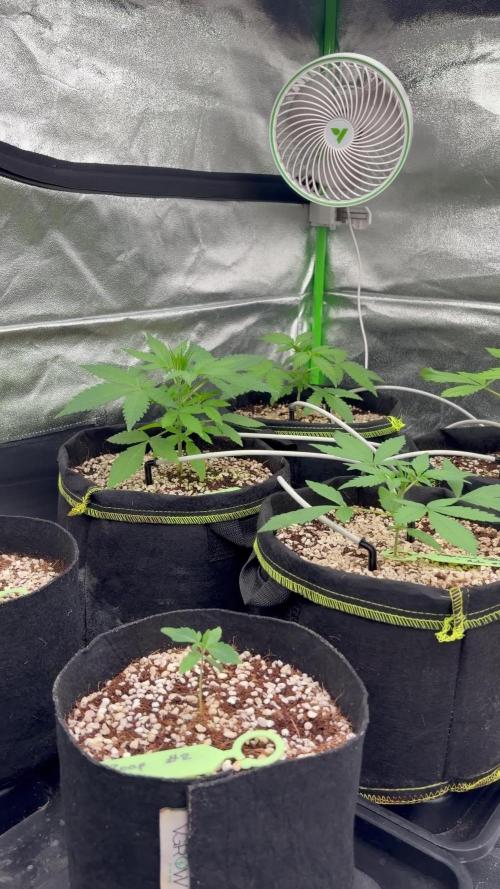
Strong vegetative growth with vibrant green fan leaves and tight node spacing

Likes
12
Share


@Pedro_88
Follow
solo me fui dos días de la casa y cuando llegue así estaba, va muy bien su crecimiento
Bueno como ven e ido podando las hojas bajas para que pueda coger más luz su tallo, ahora mismo la tengo en un indoor casero que tengo por qué el clima está muy lluvioso


Likes
12
Share


@Naidoo_B420
Follow
Day 27..plants are doing well..new light has arrived and the girls have responded well..starting to see a pistol of two on the plant on the left..in the video..small mistake..I planted them and forgot to label them so not 100% sure which is which right now lol


Likes
166
Share


@iMeus
Follow
~ Day 71 Update ~
Hello everyone! Hola! I’m Meus and this is my 10th weekly update for “First Mainline Attempt!”.
I’d like to welcome new & veteran growers, Thanks for taking the time to stop by :)
~ Progress ~
You know, I’m astounded by the level of growth in this past week, my mind is blown! 5" of growth compared to the avg of 1" for the past few weeks (9,8,7, etc), just wow 😱. The smell is pungent, dank, and slightly sweet. I can only dream of what these girls will skunk out, soon, very soon... I’d like to flower now but I have a few small issues.
First: I wanted to stop at 8 toppings but I need clones of the others so everyone gets topped to keep an even canopy. Of course I’m not taking 8 clones each 😏, just 2-3 of each strain (5 strains, 6 plants; 2 phenotypes) to put in my 2nd tent till these girls (mainlined beasts) are harvested. This is ambitious though I’m optimistic that this will work out 🙏
Second: Related to the first issue I’m going to need a trellis net to support these girls with their 16 tops. Thing is, all my plant have varying flowering schedules (55 to 70+ days). I’ll need to make a net set up that I can cut out each plant individually as they’re ready to harvest.
Third: MOLD! Though it’s not a lot I do have a bit of mold developing at the bottom of the fabric pots (which are known to mold). I’m going to switch to Superoots Air-Pot so I can avoid the mold. They’re $10+ a pop so I might have to wait till my next grow to afford the amount I need to make a full switch.
Depending on how things go I’ll start flowering at week 13. Now concerning the mold I found a few ways to deal with my problem without harming or altering taste of these young ladies. This will be a tough 11 - 14 weeks, I’ll keep ya updated fam!
~ Individual progress notes ~ (will post full information soon, update delayed for personal reasons)
[Purple Urkle #1]
Height: 14"
Tops: 8
Notes: 14 inches... That's quite a climb :) Though she's stretchy like her sister I'm excited, can't wait to see the development in the next few weeks of veg 😊
[Purple Urkle #2]
Height: 13.2"
Tops: 8
Notes: I'm surprised at the uniformity of these two sisters, I'm going to veg a bit longer and get me some clones just in case ;)
[CBD Blueberry]
Height: 9.8"
Tops: 8
Notes: I thought this girl was a goner, definitely didn't respond to the mainline well like the others, wonder why? 😶 Still I'm impressed that my smallest plant is filling in, though she looks weird I still love her and her minions <3
[White Widow]
Height: 11.2
Tops: 8
Notes: Well... This was one of my smallest girls, she's by far the bushiest and most filled in. For an example look at her root mass, one word, insane! Roots are spreading everywhere, so aggressive and the trunk is huge, perfect for transporting all those nutes. Tanya here recovered from a split too, awesome :)
[Mazar]
Height: 13.8
Tops: 8
Notes: Taller but just as dense as the white widow, the Mazar has potential! A beautiful, healthy canopy, one of my best girls. It's a good feeling knowing that my hard work is paying off 😭 I'm afraid of topping this one because she is so dense that 16 tops will be off the hook, better make a plan soon 🙏
[Super Silver Haze]
Height: 11.2
Tops: 8
Notes: I’m starting to get impatient, I love this strain! Well, most strains developed by Arjan are great <3 I will need to feed soon with diluted nutes, she looks hungry a bit. Other than that she’s a healthy young lady that’s ready to flower :)
~ Final Thoughts ~
Where to start... I’m excited! Getting my clones are my top priority right now, then I'll focus on canopy support. I’ve come a long way from my first grow, even though I failed I learned a lot. Those lessons are keeping me on my toes and I’m learning more everyday. Thank you to those who have been influential to my success, much love! I can honestly say Grow Diaries is the best! What a fantastic community to just happen upon while skimming forums one day. So again, thank you guys so much for the support! The comments are informative and helpful, I appreciate em all :)
Thanks for stopping by, much love <3

Likes
57
Share


@Grey_Wolf
Follow
Looking For a Keeper
cream of the crop seeds purple paralysis
10th March 2021
So Far So Good for these two , it hasn't rained again since the last downpour but the clouds hanging around this afternoon
look very ominous indeed. 😐
I only water early morning now so that the soil is fairly dry again on top by the time the sun sets in the evening.
this is to limit the extra moisture that could hinder the plants resistance to mold .
I also gave them a good old feed of my Worm castings tea mixed with Mollasses & Seaweed mix. 💪💪
Cheers for stopping by 👍

Processing
Likes
5
Share


@Bombtofu
Follow
I need to get my l.s.t. done. Plan to this weekend. Have been alternating waterings between regular water and water with 2.5ml of fox farm grow big. Have watered all times with 200ml of water and the solution water mix. Been keeping the humidity at about 45% temp around 68. Can tell a huge difference in sizes of the plants and their container sizes. Will be going with at least 3gal pots next grow. Still using a 25w light as well. Will be upgrading that asap. Thanks for the view. And as always, stay safe.


Likes
66
Share


@nonick123
Follow
Photography Credits @TopShelfStealth23
Método de @TopShelfStealth23 (principalmente) and @nonick123
La cosecha
Cuando todos los tricomas estén de color lechoso y algunos ámbar, debes proceder a cortar las plantas
Elige si hacer manicurado en seco o en húmedo, dependiendo de tu capacidad de controlar la temperatura y la humedad relativa en tu cuarto de secado
Seca las plantas durante 7-10 días colgando boca abajo o sobre una mallado de secado (prefiero la primera opción) hasta que las ramas se partan haciendo un sonido como "clack". Siempre en un sitio oscuro, ventilado pero sin corriente de aire directa sobre las plantas o cogollos.
Luego curalas en botes herméticos de vidrio durante 30 días
Después, ya puedes probarlas!
Disfruta!


Processing
Likes
1
Share


@RussianGrower
Follow
Hi, everybody. With you back in touch with the Russian gardener. Today I decided to show you my friend's tent. The size of 100 cm by 100 cm has 5 plants of auto AK 47. 5 plants-63 days. 9 weeks. He did not do LST training, but pulled them with a lamp, raising it every week by 10 cm. This is one of the most common cannabis strains on the Russian market. Thanks to strong undemanding genetics, grows almost anywhere in the most adverse conditions, great for the harsh Russian climate and for novice gardeners who with minimal skills want to get the most.
As you can see, yesterday we planted 21 sprouted young plants that are preparing for guerrilla cultivation in the open air
Later, when we grow them outdoors, I will create a separate diary with a detailed description.
Despite the little experience of growth, my friend is a good student and a reliable person, we have grown grass together and harvested. That's why I trust him. Except him, more no one knows about my Hobbies. In this case it is necessary to observe secrecy.

Likes
21
Share


@Bluemels
Follow
Die Woche ist wieder super gelaufen die Cookie Gelato wächst gut, sie hat ihren stretch fast beendet.
Likes
6
Share


@HolisticCultivators
Follow
Grateful to have the homie along on this journey. Moving the seedling tray from the greenhouse to the tent.
On May 20th the homie GbaGrow cleared some spaced and welcome the new genetics to their new home. The goal is to between himself and I to identify the females, and created an environment to thrive in cultivation with the Holistic Approach. We will be showcasing various videos same species but in different environments, cultivated by different breeders, same team.
RP (Me)
RPB1 @GbaGrow
MAY 23rd Is a visual update, the plants in the trays have been moved into individual solo cups.
#StartedWithASolo
We are excited to see what the future beholds. We are on to something, an unknown haze. Looking forward to feedback
Likes
52
Share


@TheDoctor
Follow
Welcome to the smallest harvest in my grow-tent!
The LSD from barneys farm:
GROW:
This little plant grew extremely well in her 4 Liter pot and took as much nutrients as I wanted to give! She was really small in her vegetative Phase, but she stretched pretty much in flowering and developed nice and strong branches! Her height was about 30 cm and the smallest plant in my grow tent, due to the small size of her pots!
I just wanted to try her and I had a small space between the other plants, so I decided to leave her there! I really liked her structure and her leaves, which looked really wild and rough😍
HARVEST:
I put my LSD into a vase for 2 weeks for ripening, because she developed some bananas in her flowers! But luckily there is no seed in any bud of my plants, so I think I’ve done it well!
I harvested her mostly wet, which made it take much longer...
other than that it was fun to harvest her, came out with 16,7 g dry buds and 7 grams of cuttings! That’s pretty cool for me because she was just a small experiment if I can place a fifth plant in my tent, usually I would have put her outdoors!
BAG APPEAL: 8/10
She surely has a nice sativa-structure in her buds, although no hints of purple or blue in them. The green is really bright and fresh, looks like high quality weed for sure! She is not that hardly trichome-covered like my blue gelato, but sure she has some pretty shiny calyxes!
SMELL: 8/10
Her smell is really musky and earthy, as well as sweet at the end, which makes it a really nice bouquet of flavours to experience when you smell at the jars filled with her buds! Personally I love her smell!
TASTE: 8/10
She already tastes pretty good in my storm vaporiser, but she’s not totally cured yet. I prefer the taste of my strawberry lemonade, but this one definitely has some hints of mint!
EFFECT: 9/10
Her effect is really strong, crawling up your mind and your body really slowly, but lasts for about 4 hours!
When you smoke it, you firstly get the feeling of happiness and classic red and dry eyes, but than it disappears and comes back with a really trippy and colourful effect! It’s like having a window between you eyes and the reality, and this window Is coloured in rainbow colours! Not as intense as mushrooms, but it surely has some relation to this effect. After a funny and giggly time and another few vape-hits, she’ll ,,blast you into another dimension“ - for real! I was so passed out, couldn’t barely speak, but still feeling damn fine and just perfect! Still I prefer the effect of my Shiskaberry due to her more talkactive effect and the need to walk. Also Shiskaberry is more trippy than this one, also related to the effect in your mind, including you thoughts and your state of mind!
I Vaped this strain at 200-220 degree Celsius, which made her producing big clouds of tasty vapour! We smoked 0.6 g in this evening, we were 4 people and 1 of them Is a heavy smoker since years! But she was passed out same as we were😅 so all in all a really nice strain, we smoked it in the evening outdoors, but I think at a sunny day in the park this strain might be even better!
So thank you for reading this harvest-report, see you in the next Report on blue gelato or peyote critical! Not sure yet which one I’ll try next😋
Likes
25
Share


@Prototype0181
Follow
The lady's are a bit shocked after the ✂️ decapitation (topping) on 10-05. going for 6/8 cola's per plant👌
Stay tuned growmies 💚
Likes
154
Share


@Tropicannibis_Todd
Follow
Well growmies ive been looking forward to the FastBud Tester 2311 , the more she went into flower the more the frost would build up , and that's when the terps came out 👉 Sweet , fruity 👈 Buds are tight and full of frost 👈 Couldn't of asked for better Genetics 😉
The smell coming from this girl during the entire grow was just dreamy 👈. Of course I have no clue to what she is but I like it......
Amazing Job FASTBUDS 👏 I would definitely recommend once they release this one 👍
👉 Big thanks to all my Growmies out there in GD land 👈 Much appreciated 🙏
Thanks To MarsHydro for the TS1000
👉I used NutriNPK for nutrients for my grows and welcome anyone to give them a try .👈
👉 www.nutrinpk.com 👈
NutriNPK Cal MAG 14-0-14👉 All Weeks
NutriNPK Grow 28-14-14👉 Weeks 2 & 3
NutriNPK Bloom 8-20-30👉 Weeks 4 to 8
NutriNPK Bloom Booster 0-52-34👉 Weeks 4 & 9 👌👌