Processing
Likes
Comments
Share


@Flydope21
Follow
I will be vegging these for another week or two as mentioned last week. Not quite satisfied yet.


Likes
6
Share

@Elcogollosagrado
Follow
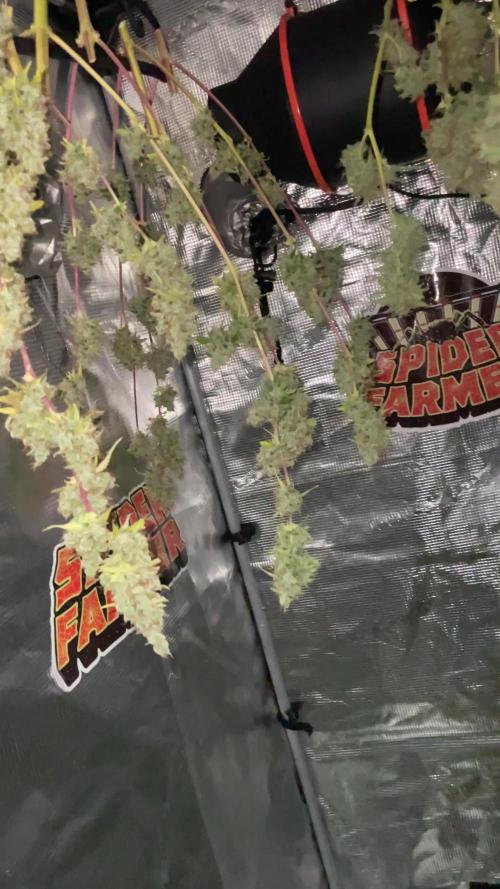
En resumen, todo ha salido bien y los productos han echo su función en el siguiente cultivo cámbiate el sustrato por un ligth mix para poder fertilizar mucho antes y estoy muy asombrado por el sistema de riego

Likes
8
Share


@Kountryboi90
Follow
Day 35 of flower and they're packing on weight. Looking good! Removed the scrog net to rotate the plants.
Likes
34
Share


@F4m0u5
Follow
Harvest some of wifi last week. Its now in jars and looks amazing! Cant wait for the smell when cured!! Got 80 grams already!( started 70% humidity in jars and go for 62% over 3 weeks)
Just finished cuting down some of the cookies right before uploading this, those are some super heavy dense nugs.
*Update*95 grams dry weight so far
Purple punch finally has a few blotchs of purple and will be coming down tomorow night just ran out of time today, that plant is just toppling all over and cant hold evrything up!


Likes
161
Share


@FrontRowAG_BrianG
Follow
START OF WEEK 7 DAY 42
⭐️Nutrients Used⭐️
Front Row AG Part A 4.2g per gallon
Front Row AG Part B 2.8g per gallon
Front Row AG Phoszyme .4g per gallon
Front Row AG Si .5ml per gallon
Front Row AG CleanUp .2g per gallon
This has been an awesome week. Plants have once again almost doubled in size…almost. I cannot stop them from growing out of control and they are suppose to at least double once flower is initiated. So, this week I will completely defoliate all the big fan leaves and after 7 days healing switch to flower.
I have never completely defoliated my plants, but I’m open to new things. Usually I defoliate and lollipop at the 3rd week of flower. Until then I leave them alone with little stress. All in all, I want a full net but also an easier time during harvest so I’m going to remove all the big fan leave’s multiple times this run.
Lights are still on 40% and will gradually get to 75% by week one of flower. All my co2 tanks will be filled this week. I want high temps/high humidity/lots of par/lots of co2. ⭐️THIS IS THE OBJECTIVE⭐️ for the first 6 weeks of flower 👇
1500 on par meter
80-85 degrees
60-65% humidity
1500ppm co2
This is how we get 💪 size colas!
Thanks for stopping by and see you next week.

Likes
3
Share


@Mr_nugs_lover_David
Follow
Beautiful strain to grow, she ended up. With a smaller size compared to her sisters but she's a big quality lady very frosty and sweet, the aroma of this sticky flowers are super sweet and floral, just so wonderful, I love this strain and I'm glad I have black cherry punch in my garden the 5 of them with the same aroma 🔝 can't wait to croptober

Likes
295
Share


@Ju_Bps
Follow
Hello growmies 👩🌾👨🌾🌲🌲,
👋 Plant stretched good during this first week of flowering 🦔🦔
Started Flowering nutes. Did a litle defoliation.
💡 I up a bit the supply of lamp each days.
💪 I continued the training
💧 Give water each 2/3 day
And vaporise plant with water + Plagron Roots (1 ml/l)
1 l Water + Roots + Grow + Sugar Royal
1 l Water + Roots + Bloom
PH @6
RQS - Easy Bloom Booster Tabs
1 tabs/5 l
RQS - Easy Grow Booster Tabs
1 tabs/5 l
RQS - Easy Micronutrients Plus
1 tabs/5 l (1 watering each 10 days.)
💡Mars Hydro - FC 3000
37% 60 cm.
Mars Hydro Fan kit
Setting 6
Have a good week and see you next week 👋
Thanks community for follow, likes, comments, always a pleasure 👩🌾👨🌾❤️🌲
Mars Hydro - Smart FC3000 300W Samsung LM301B LED Grow Light💡💡
https://www.mars-hydro.com/fc-3000-samsung-lm301b-led-grow-light
Mars Hydro - 6 Inch Inline Fan And Carbon Filter Combo With Thermostat Controller 💨💨
https://www.mars-hydro.com/6-inch-inline-duct-fan-and-carbon-filter-combo-with-thermostat-controller
RQS - Titan F1🌲🌲
https://www.royalqueenseeds.com/f1-hybrid-cannabis-seeds/624-titan-f1.html


Likes
84
Share


@Mrs_Larimar
Follow
March 11th.
So its fact, one of Three Survivied
Thats a Pity... but iam thinking about cloning
The Survivor is a strong Little one... In 7 Weeks she will be a "Big Mama"
Atm Iam setting up another "Babytent" with another Light... stay Courious...
Iam finishing and actualising Tomorrow
March 13th.
Iam done with setting up
Now i have another Babytent. and Inside the New Viparspectra XS-1000
and the other Stuff to run the Envoirement
I already ca see a difference between both Tents. If you stand outside and just look with Eyesight
the Viparspectra seems to be brighter// has another color of Light.
I made a Unboxing Video for more informations.
Amazon: http://url-9.cn/0y9i
Amazon US: https://amzn.to/3e0P2bk
Amazon CA: https://amzn.to/3bTnEJC
Amazon discount Code:
it10mlarimar XS1000 10%
it15mlarimar XS1500 5%
it20mlarimar XS2000 5%
it40mlarimar XS4000 5%

Likes
Comments
Share

@Olduffybastard88
Follow
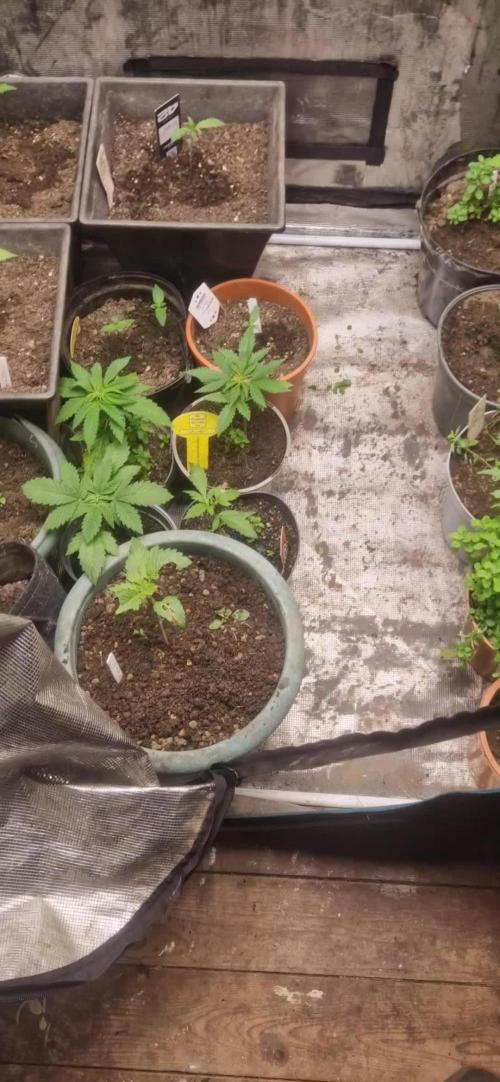
Moved half the girls in the tent kept the others in the greenhouse as I will be planting them outside and flowering these ones inside

Likes
9
Share


@Bakeryguy420
Follow
Gelato what a fucking beautiful plant she is becoming :)! Shit literally looks like some mephisto genetics frosty as fuck. Shit wish I had another tent I'll run the rest of my gelato seeds this shit is prob going be my fan favorite :) but fast buds still has plenty more for me to grow. Tbh every fast buds I grown I haven't been disappointed:).
Looking to harvest this one in next 4 weeks or so so excited:)! Easily 4 zips calling it now ! :)

Likes
2
Share


@Stankmeister
Follow
2 weeks later and Girl crush is throwing out 12's... I will have to top her soon. I took her 1st two liters to prop clones but they failed repeatedly. She isnt a big stretcher and I'm not limited by vertical space at all so I'm not worried [even though my auto's are at the very least 30 and 45 days away from full maturity respectivly.]
The ogreberry is somehow even easier to train than the whiskey zulu at this stage. The canopy is much more even and we'll just have to see if that remains true.
This ogreberry smells fucking wild. The other two plants smell good and unique but the Ogreberry smells like fruit loops, lemon and the strongest note I smell every single time I test it, I can only describe as the "new" smell a baby gives off. I dont know if that's from the sweet cream of baby formula or what because I don't have a much experience with babies, but this is a very baby-like smell. It's shockingly absurd that this plant smells like an infant. This "new" quality reminds me of northern lights.

Likes
67
Share


@AwfulBuddy
Follow
Hi all buddies!
First crop from hydro nft growth.
Growth went well, I had some management problems in changing nutrients from veg to bloom which delayed the harvest for a week or two.
Sensi Seeds' Skunk # 1F is incredibly resistant to mold and insect attacks, very close internodes ensure low height and compact buds.
Unfortunately I chose the mother phenotype wrong, I found the lowest as I wanted but I lost the fatness of the buds present in other phenotypes, but the game was worth the same and I am very proud of it!
I collected after 94 days of flowering, the last 72h 20kg ice cubes in the tank and total darkness which the last 24h without irrigation.
After cutting I hung the whole plants in the tent for 24 / 48h 19 ° C 55% HR.
Two days of wet trim to 8 girls and I hung their colas in the tent to continue drying.
With a girl i tried dry trim but i will avoid next time.
After a week in the tent I cleaned the colas and removed all the sticks, I placed everything in airtight bags in the refrigerator for 5 days 12 ° C 65% HR (daily check).
Now dark storage room at a temperature of 18 ° C 65% HR.
At the last weighing a few days ago it was more than 500g, from now it does not lose any more weight.
Next week I will take pictures of the weigher and the finished harvest🍀🍀🍀
target!!🍀500g dry/cured🔥
Thank you GD community you are precious for everything, criticism, advice, curiosity, thanks 💚🌱✊🏼
Awesome people here on GD🔥🔥🔥

Likes
2
Share


@Ultraviolet_
Follow
67 days since April 16th, 2026
We become aware at such times of man's wonderful ability to bring seemingly unrelated elements into harmonic balance, and receive a glimpse into a world where everything exists in conscious sympathetic attunement to everything else. When we listen to a piece of music that seems to strike a beautiful chord somewhere inside us, or view a painting that simply glows with harmonic awareness well executed, we probably do not spare much time to contemplate the wonderfully intricate combination of vibrations that our sensors make it possible for us to perceive. We tend to appreciate the relationship between the parts of something by an awareness of the harmony or dissonance of the whole. This ability enables us to say "what a beautiful house!" instead of "analysis has proven that this collection of building materials exhibits certain elements of harmonic proportion." While this ability to instinctively appreciate the beauty of true harmony has an important role to play in evolution, a more analytical understanding of the laws involved can be most useful. This is especially so if we wish to create works of art where each part exists in true harmony, not only with the other part of that particular whole, but with the universe within which the creator and the created exist.
Everything vibrates. From the most dense matter to the most subtle cosmic rays, everything which our senses allow our thoughts to become aware of, can be specified in terms of wavelength or frequency of vibration. These two terms define the same thing, but from different points of view.
The following are the approximate wavelengths of various energy carriers:
Cosmic rays 0.000,000,001 mm
Gamma rays 0.000,000,1 mm
X rays 0.000,500 mm
Ultraviolet rays 0.003 mm
Visible light 0.006 mm
Infrared 0.01 mm
Sound waves 1 meter
Radio waves 300 meters
Violet light 400 nm to 450 nm
Blue light 450 nm to 500 nm
Green light 500 nm to 570 nm
Yellow light 570 nm to 590 nm
Orange light 590 nm to 610 nm
Red light 610 to 700 nm
1 nanometer (nm) = 0.000,000,1 cm = 1/10,000,000 cm
If a guitar string is plucked and we hear a sound, it is not too difficult for the human mind to associate this sound with the vibration of the guitar string. With color it is quite different. It is difficult for us to conceive that the color of a substance is not an inherent property of the substance itself, but an indication picked up by our senses of that substance's ability to absorb or reflect the light which happens to be shining on it at that moment. Neither the matter nor the light is colored. What happens is that the brain learns to differentiate between the frequencies reflected or transmitted by the substance the eyes are focused on. The same thing happens with sound. When we say "Oh! Listen, they're playing my favorite song," what we really mean is: "My brain has stored within it a particular pattern of frequencies. I have compared the new information being received with this stored pattern and have deduced the answer that the two patterns are similar within certain specified tolerances." The 'pleasure' involved could have something to do with our running the pre-recorded pattern at the same time, in 'sympathy' with the new pattern as it is received.
The word sympathy describes very well our ability to appreciate color and sound. It also describes the reason behind certain elements of harmony. For instance, if a substance vibrating at 100 cycles per second (tone 1) is in the proximity of another substance vibrating at 200 cycles per second (tone 2), we could perceive, if we had the right equipment, a certain sympathetic relationship between the two.
We will see from this that there is a uniform doubling of the first tone seen in the second. At various points along the waves, the two are the same in amplitude. At other points, they are at opposite poles to each other. This doubled frequency has more points of similarity to the original than any other frequency except the original itself. If the equipment we had available for measuring these two frequencies was a soundboard amplifier and a pair of ears, then we would hear what would sound to us like one tone. If we had the opportunity to hear one at a time, we would hear that although they sound the same, one is higher in pitch than the other. This characteristic of 'the same but different in pitch', musicians have called the octave. Any two tones produced where one has exactly doubled the frequency of the other is called an octave. Speaking in ratios, an octave would appear then as the ratio 2:1 or 1:2, depending on whether we are talking of an octave up or down.
A single note produced by almost any instrument will contain more than one wavelength or frequency. It will have a dominant frequency, the wavelength of which we would call the note's 'fundamental' or 1st harmonic. It will also have a varying number of upper harmonics, gradually fading in intensity into infinity or silence.
Natural harmonics always have the same pattern of intervals between them. The interval between the 1st and 2nd harmonic is a perfect octave; between the 2nd and 3rd a perfect fifth; between the 3rd and 4th a perfect 4th; and so on, the intervals becoming smaller and smaller until they lose any relationship with the western 12 tone scale as it exists at the moment. Just as an octave has certain elements of sympathy with its fundamental, so some intervals have been noted to be more perfectly in sympathy with the fundamental than others. The ratio of the 'perfect 5th' or interval of 7 semitones, as it occurs in the harmonic series, is 3:2 or 2:3, while that of the 'perfect fourth" is 4:3 or 3:4. All the tones in the western 12 tone scale can be expressed in terms of the ratio between the upper tone and its fundamental. This would seem to be an ideal way of generating a scale from any given fundamental and several attempts have been made to do this, the Pythagorean system being probably the most well known. Although when working with a single tone instrument playing on its own, the Pythagorean formula works wonderfully well, if we had several instruments tuned this way together and asked them to play almost any western music, we would find that at times they sounded quite out of tune to each other.
The lack of flexibility of the various scale systems based on the harmonic series has led to what is known as the 'tempered' scale. This uses as its primary unit of interval the ratio of the octave or 2:1. It then proceeds to divide the interval between any fundamental and its upper octave into 12 smaller intervals by applying the ratio: two to the one-twelfth power, to one (21/12:1). This equals 1.059463094, so by multiplying any frequency by this number, we will obtain the tempered semitone next up from our fundamental. We will also find that any tone twelve semitones up from any other tone, in a scale generated in this way, will have exactly double the frequency.
If we took the note middle C on a piano and halved the wavelength, we would have the note C one octave above. If we halved this, we would have the C above, and so on. However, within about 6 octaves, we would find that although a 'sound' was being produced, no human ear could perceive it. If we kept on going, halving and producing upper octaves of our fundamental C, we would proceed through the infrared band, into the visible light spectrum. If we happened to be outside during the day, we would, for one octave only, see the note C with our eyes. The next octave above would already be in the ultraviolet band, and outside the eye's sensitivity range. If we can think of color as being an indication of a substance's vibratory rate or wavelength, we may begin to see a relationship that could exist between the color and sound spectrums.
The logical extension of what has so far been said is that there exists a scale in the color spectrum that corresponds exactly to the scale in the sound spectrum, each color tone being an octave of the equivalent note in the sound range.
This is not the end of the story but only the beginning. If we can for the moment accept that any wavelength in one band has upper and lower octave stretching out to infinity, then the next question is 'fine, but what shall we use as our fundamental? A particular color? A particular sound frequency?' The musicians among us will probably say 'A 440'. This means that the note A should vibrate at 440 Hertz, or 440 times per second. They would tell us that this is standard pitch has been adopted by most orchestras around the world; pianos are tuned to it, instruments are constructed to formulas based on it, and so to them it would probably seem the most appropriate place to begin. Some of these musicians may know of the battle that is still raging with regards to this being the standard, but few would know why A = 440 Hz was chosen except that it worked when it was set to be a suitable compromise between the many different pitches in use at the time.
432 Hz is said to be mathematically consistent with the patterns of the universe. Studies reveal that 432 Hz tuning vibrates with the universe’s golden mean PHI and unifies the properties of light, time, space, matter, gravity, and magnetism with biology, the DNA code, and consciousness. When our atoms and DNA start to resonate in harmony with the spiraling pattern of nature, our sense of connection to nature is said to be magnified.
Another interesting factor to consider is that the A=432 Hz tuning correlates with the color spectrum, while the A=440 Hz is off. Audiophiles have also stated that A = 432 Hz music seems to be non-local and can fill an entire room, whereas A=440 Hz can be perceived as directional or linear in sound propagation.
Once you adopt the idea that sound (or vibration in general) can have an equalizing and harmonizing effect (as well as a disturbing effect), the science of harmony can be applied to bring greater harmony into one's life or tune to specific energies. There is a form of absolute and relative harmony. Absolute harmony can, for example, be determined by the tuning of an instrument. The ancients tuned their instruments at an A of 432 Hz instead of 440 Hz - and for a good reason. There are plenty of music examples on the internet that you can listen to in order to establish the difference for yourself.
Attuning the instrument to 432 Hz results in a more relaxing sound, while 440 Hz slightly tenses up the body. This is because 440 Hz is out of tune with both macro and micro cosmos. On the contrary, 432 Hz is in tune. To give an example of how this is manifested microcosmically: our breath (0,3 Hz) and our pulse (1,2 Hz) relate to the frequency of the lower octave of an A of 432 Hz (108 Hz) as 1:360 and 1:90.
It is interesting to note that 432 Hz was the standard pitch of many old instruments and that it was only recently (19th and 20th century) the standard pitch was increased. This was done in order to be able to play for bigger audiences. Bigger audiences (more bodies) absorb more of the lower frequencies, so the higher pitch was more likely to “cut through”. One of the oldest instruments of the world is the bell ensemble of Yi Zeng (dated 423 BC), tuned to a standard F4 of 345 Hz, which gives an A= 432 Hz. The frequency of 345 Hz is that of the platonic year! Similarly, many old organs are tuned in A=432 as well; for example, St. Peter’s Capella Gregoriana, St. Peter’s Capella Giulia, S. Maria Maggiore in Rome.
Maria Renold’s book “Intervals Scales Tones and the Concert Pitch C=128 Hz” claims conclusive evidence that 440 Hz and raising concert pitch above scientific “C” Prime=128 Hz (Concert A=432 Hz) disassociates the connection of consciousness to the body and creates anti-social conditions in humanity.
The difference between concert pitch A=440 Hz and Concert A=432 Hz is only 8 cycles per second, but it is a perceptible difference of awareness in the human consciousness experience of the dream we share called existence.


Likes
17
Share


@Foggedaboudit
Follow
A wonderful cherry smell! Probably the best terpene profile so far!
Likes
1
Share

@Ninjabuds
Follow
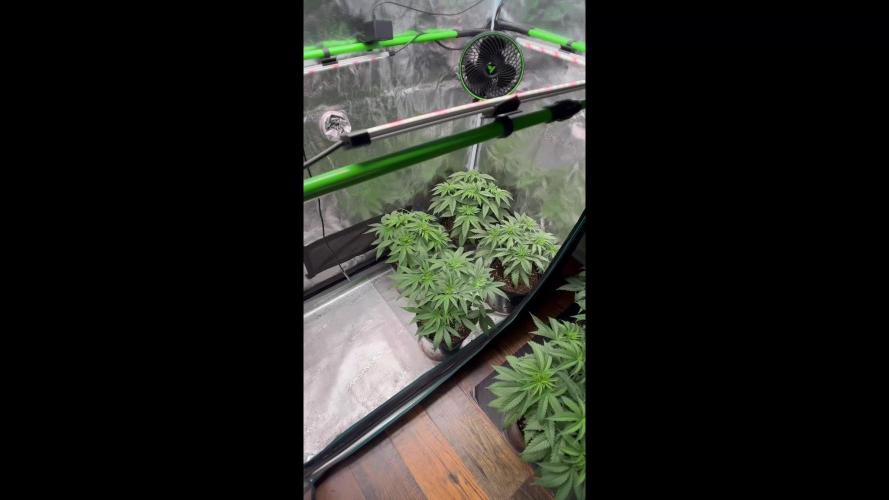
Cereal milk is one of the smaller plants to start. It has really small leaves at the moment. I think it’s a little wary to tell how this one will grow
It’s day 41 from seed and all of the plants are really thriving
Likes
2
Share


@schmeirs
Follow
1L water each day and today
I started to give Stimulateur de floraison Advanced Nutrients Bud Candy (week6)
Auto Banana Blaze is in good health😁
100% power full spectrum and 25% Red/IR/UV