


Likes
Comments
Share


@Kardo
Follow
Ernte Ergebnis von white widow ist 35g von beiden sieht sehr lecker aus und es schmeckt auch sehr lecker

Likes
4
Share


@CandyFarm
Follow
in general, the week was simple, I slowly stretched them over the grid. now we have it, the flowering stage begins

Likes
62
Share


@nonick123
Follow
Día 57 (16/12) CBD Auto 20:1 #1 ha empezado a bajar el consumo de agua... pero sigue creciendo! ¿Tendrá fin el stretch de esta planta?
CBD Auto 20:1 #2 empieza a perder hojas por senescencia. Está a punto de cosecha!?!?!?!
LSD-25 Auto está increiblemente dura y brillante. Un color morado oscuro casi negro
OG Kush Auto ha bajado un poco el consumo de agua, pero empieza a formar unos cogollos monstruosos, completamente cubiertos de resina+
Día 58 (17/12) CBD Auto 20:1 #1 empieza a tocar la lampara! Vuelvo a subir la lampara....
Además presenta una ligera coloración morada en las puntas de las hojas... ¿Coloración natural o deficiencia de P?
CBD Auto 20:1 #2 tiene un montón de hojas con senescencia acelerada de un dia para otro! Ha llegado el día de la cosecha! 😍💥
LSD-25 Auto sigue acercandose al final... todos los cogollos son duros como pelotas de golf 💥
OG Kush Auto estaba practicamente seca! Vuelvo a darle 1250 ml de H2O RO. Va a hacer unos cogollos brutales
Día 59 (18/12) CBD Auto 20:1 #1 - empieza a mostrar coloración morada en las puntas de las hojas ¿Genetica o deficiencia? Aprovecho el riego con BIO PK 5-8 10 ml/L y darle un booster!
LSD-25 Auto - se acerca la cosecha! 😍💥 Cogollos duros como piedras en todas partes y bajando el consumo de agua...
OG Kush Auto - muestra más avanzada a deficiencia de hace unos dias, de modo riego con BIO PK 5-8 10 ml/L. A ver como le sienta!
Día 60 (19/12) CBD Auto 20:1 #1 - sigue mostrando más deficiencia de P con alguna mancha en las hojas superiores. Menos mal que ayer la regué con el BIO PK 5-8!
LSD-25 Auto - Le miro los tricomas y aún no está lista. 50% trasparentes + 50% nublados. Pero solo faltan días!
OG Kush Auto - Está empezando a apilar cogollos de forma brutal, y el olor es una maravilla! Además se muestra sedienta! Eso es buena señal
Día 61 (20/12) Busy time
Día 62 (21/12) LSD-25 Auto - muy cerca de la cosecha. Apenas consume agua....
Día 63 (22/12) LSD-25 Auto - harvest day! Tricomas mayoría nublado y alguno ambar. Perfecta!
💦Nutrients by Bio Tabs - www.biotabs.nl/en/
🌱Substrate PRO-MIX HP BACILLUS + MYCORRHIZAE - www.pthorticulture.com/en-us/products/pro-mix-hp-biofungicide-plus-mycorrhizae
"GDBT420" 15% DISCOUNT code for the BIOTABS Webshop https://biotabs.nl/en/shop/

Likes
70
Share


@Insaniac_0
Follow
All feeds with nutes use either a whole ratio or combination of "Veg Mix" and "Bloom Mix"concentrates DILUTED in water until a total ppm of add in is reached using a (Total Dissolved Solids)TDS Meter measured in PPM (parts per million). The "Veg Mix" concentrate will eventually be added in smaller ratios and "Bloom Mix" concentrate what will eventually replace the "Veg Mix" concentrate entirely with the ppm and ratios listed when I feed. Veg mix recipe is on week 3. Bloom Mix recipe is on week 5.
Day 49
VPD is okay now - temps at 75F RH also now at 65% with ILVent at 50% = VPD of 1.04 -
ppfd also same as yesterday mostly 480 to 490 around the ring with 510 and 520 in the center
Took ph readings as well - 3 readings 6.43, 6.48, and 6.37 to avg 6.426
Which is good because she's starting to show signs of stress after the topping and defoliation from a couple days ago. The leaves are starting to curl at the tips and the bronze color stripping is happening again - however this time seems to be a slower progression so Im hoping that having the correct ph this time will help while she's re-routing her resources. I 'did notice also that the growth tips seem to be growing at a slower rate than before - I think she's at her limit in colas and the roots are having to find more space to spread, may even be too big for the 5 gallon pot. I have no plans to change her out just yet, but will monitor.
Soil is drier today - so I will be watering tomorrow with de-chlorinated water at 6.4ph
Day 50
VPD was good at 74/64 with the tent open while I feed that I left it open for a bit and took time in feeding and cleaning - after all that still good at 74F/61%RH/50%ILV
ppfd was checked after water and setting back - same as yesterday as most of the newest growth is still coming from the new colas - most seem to be adjusting 1 at a time in each split but both are showing growth now on all cuts.
Started feed by making new ph buffer solutions, calibrating/testing both meters. The have about a .15 variance between the two.
Checked weight and made 1.5 gallons of feed. started at 228ppm added 450ppm veg and 150ppm bloom for a total of 833ppm feed/epsom salt - splashed h2o2 and ph'd to about 6.4- I fed via watering can and spray and fed the whole amount slowly since I was feeding until bottom drip and she took it all before starting to bottom drip. Afterwords I let her drain (about a quart came out) and checked ppm from runoff at 2500 (telling me she's okay but isnt eating as much as before her topping yet) ph is a mystery - I show 3 readings from top level of 6.62, 6.57, and 6.57 for an avg 6.586 but 2 separate readings from 2 meters (4 readings total) on the bottom runoff showed 5.3 and 5.6 then confirmed later. I expected a variance since the wood ash probably stuck to the top side of the soil - but I didnt expect that much of a difference. I will monitor but honestly dont know what I should do, if anything other than watch.
made a video of the fan movements and runoff drip
Day 51
What I am calling "stress burn" is progressing as expected. I am monitoring the ph from the top as I did before, but again, not much I can do other than over water, so I'll just watch for now and compare rate of spread until she fixes her resource pathways. It seemed to take about a week to clear up after the ash treatment last time, so I am on day 3 of 7 for now with no treatment. Looking for a spurt of new growth to show and then I'll know she's better.
Adjusted the lights to accommodate a week 6 level of 500 to 600 ppfd - that means I can raise the lights to the top of the tent and increase power. So now set at 3 tick up and 37 inches from the soil or 26" from the plant top. Now her ppfd reads about 540 on both of the center colas and 500 to 510 on the surrounding ring.
Adjusting lights meant I had to adjust the fans up to medium power and re-directed them to blow at the edges of the pot; made a video.
VPD is steady, but still warmer than typical (only by a couple degrees nothing too much) 76F/61%RH/50%ILV for 1.15 kpa on room VPD
Day 52
VPD is higher now that I have the lights to the top of my tent and the fans on the lights blowing down at the pot. I moved the IL Vent to the top sucking out with the motor and vent outside the tent now.
I also opened two lower air holes with my heater set for fan on the opposite side of the tent than the vent. Currently, I am at a max of 1.2 room VPD and ranging down to 1.0 so I'll take it until it does something else. 74F/65% RH/75%ILV - I will monitor to ensure it's stable.
ppfd is same as yesterday as there's little growth still.
Spots are still progressing on the oldest leaves at the same rate as before - however the newest leaves are not showing signs yet, so I will continue to monitor.
Day 53
ppfd was a little changed today, showing that there's growth coming back now. lowest on outer ring was 500 with most at 520 and 530 highest, center colas were tested at 540 and 560ppfd. VPD was stable as I watched it most of the day since I made changes yesterday. Temps were 74 to 76 and RH was 61% to 68%. ILV was set to 33% with the bottom heater on fan to draw in air.
lockout continues on the oldest fan leaves at the last top nodes. New growth is already marked in a couple of spots. I have about 6 gallons of tap water burning off chlorine now and will use about 2 gallons to flush at 8ph. I plan to dunk this weekend with feed so this will allow time to dry out and hopefully reset the ph and lower my ppm readings at the lower part of the pot before then.
Day 54
Took Control pics measured VPD and ppfd
Lights are at the top of the tent and second tick from highest power level. Lights to soil is 37 inches and lights to plant is 12 inches shorter so 25 inches leaves to light. currently ranging 530 to 550 around the ring and 575/580 ppfd at center (after feed and replaced).
Moving the lights (day 51) made the tent hotter so I changed my ILVent to suck out at the top and fresh air in at the bottom - I have been fighting to keep temps under 78 managed to hit 74 to 75 with the heater being set just to fan for the bottom air vents- I did also raise humidity to a setting of 65% a day before moving the lights, so Im hitting 61 to 68% between power cycles on the humidifier. Overall Tent VPD is 1.0 to 1.2 as max.
Took controls for feed. Weight 16lbs 11oz. tested and calibrated 2 meters and took 4 ph readings of 6.55, 6.77, 6.53, 6.85 to avg 6.675. from top of soil (last runoff measured 5.6 and 5.3 on two meters)
prepared 2 gallons of feed at 500 ppm over tap. (burned chlorine off overnight) starting ppm was 217 - added 75/25 veg/bloom ratio. ph balanced to 7.8 and 7.63 on separate meters (rinsed and retested to be sure got 7.79 and 7.63 again)
I used 4 knitting needles in the soil about 3 inches from the plant center. Poured feed water over the needles until it pooled slightly on top of the soil, I then pulled the needle out a little to allow the water to drain into the holes better. I did this in 8 different spots. As soon as she started dripping water from the bottom I poured a little on the leaves and then moved the plant to another drip pan to finish pouring the rest over the top of the soil without dripping any over the sides. Took videos of the drip and waited 10 min before putting her on another clean drip pan and back in the tent.
Runoff from second drip pan was measured twice at 5.8ph and 2410 ppm - and first pan 5.85 and 2670ppm (expected higher ppm since I moved perlite on the bottom with the needles)
Defoliated the oldest leaves before lights out.
Day 55
She mostly looks like she appreciated the clippings and ph balance from yesterday - slower progression of the lockout issue and largest new growth since topping day.
So speaking of new growth, I plan to use LST in the next few days to set these colas in what will hopefully be their last bind around the ring.
VPD is steady at 75F to 77F and RH is between 63 and 68%. My ILV have been set to 33% and the lower fan blowing rather than heat.
top soil ph was measured with 3 readings, on a tested and calibrated meter. 6.47, 6.7, 7.12 to avg 6.763 (kinda wild in those readings so I double checked them all twice and got the same in each hole)

Likes
60
Share


@Roberts
Follow
I switched auto Lavender to ph water about 3 days ago. She has started fading already. She grew great under the Mars hydro FC4800 light, with the Agrogardens nutrition. She grew too big to be honest for my space. She stuffered light burn across the canopy due to size. This is one of those times a net would of served me well. Lots of flowery smelling colas that feel dense. She is starting to fox tail from being too close to the FC4800 before I switched the light to a Medic grow mini sun 2 for summer. She has amazing roots from the Agrogardens nutrition. Thank you Agrogardens, Mars Hydro, and Seeds Mafia. 🤜🏻🤛🏻🌱🌱🌱
Thank you grow diaries community for the 👇likes👇, follows, comments, and subscriptions on my YouTube channel👇. ❄️🌱🍻
Happy Growing 🌱🌱🌱
https://youtube.com/channel/UCAhN7yRzWLpcaRHhMIQ7X4g

Likes
10
Share


@TiRobotProds
Follow
Forte odeur de fruits exotique se dégage de ces dames, elle sont bien givré etle rinçage a commencé.

Likes
12
Share


@Siriuz
Follow
Starting week 9
She is huge that's why we added extra LST to her big main stem so she could have support and hopefully gets more yield!
Day 57
She is doing very good
Full of trichomes
Cant wait to taste it
Day 58
Going hard on nutes
1900ppm
Then lots of light
Soon I'll be showing you pics of progress
Also she's 65cm or more since she's bended
Day 59
She's even better
No nutrient burnt
Everything is Good;
Continues to grow 20/4 schedule
Day 60 Hope you like the video
Day 61.62.63.
Sorry didn't have the time to take pics or bids but overall she's good
Defoliate a lil bit here and there yellow leaves and she's got more Buds around and finally fattening up
I will show you next week
Rh 60/70%
Was rainy outside for couple days
Temp hot 28/30 night and day was 32
Thank God we've got AC....
Likes
56
Share


@Ledbelieve
Follow
This plant is a slow growing strain heavy on the Indica side. Is a connoisseur strain not recommended for commercial Grow. To slow if in it to make some money. But was a pleasure to grow. It is definitely a head turner and is more potent than most purple stains I have tried before. So if ya got time and like something truly special give it a go...happy growing guys0

Likes
23
Share


@Horseluisweed
Follow
Básicamente lo mismo, aunque está semana pilló bastante más horas de luz(tuve que irme fuera de casa dos findes seguidos, en los cuales la dejé con la luz encendida full 24/7 en la caja)
Como experiencia utilicé café reposado 48h para "alimentarla" e intentar bajar el Ph de la tierra (coco ph6+hummus ph7+vermiculita ph8= ph total 7)
El otro experimento fue cubrir la tierra con coco para que el tallo eche raíces y aprovechar su espigamento!
Las horas de luz solía dejarla 8h en bombilla mientras duermo, y el día la pongo en la ventana a que tome el fresco, pero apenas tiene luz directa, me da la sensación que crece más rapido cuando vuelvo del finde, estoy replanteandome tenerla más tiempo en la caja con luz, porque la veo aún pequeña, y quizá ponerle un ventilador de pc o algo🤔..veremos, aún tengo el papel de aluminio al lado de la caja y ni se lo he puesto, con eso os lo digo todo☝️🎃
Processing
Likes
54
Share


@Mimi420
Follow
Hi guys!
Today I removed almost erevry thing under the net.They showing nice grow.I feeded them just al litle so far.Past 3 weeks almost no nutrients.But tomorow I switch to 12/12 and start to feed them with flower nutrients.
Stay green!


Likes
24
Share


@MediciGrade
Follow
Many of the buds starting showing seeds 😞. There must have been more pollen released from the nanners than I had originally thought. The only stress I can think of is light stress. Either light leaks, light intensity, or perhaps a combination of both. All other conditions have been damn near optimal. I guess it could be genetics as well but I'm giving Crop King the benefit of the doubt. Its a shame too because they were just starting to show their fall colors and it seems like another 2 weeks is all I needed.
I will start the flush and as soon as I can get the runoff EC below .2 I'll unplug the light and let them dry in the dark for 48 hours before I chop them down.
Thanks for stopping by!

Processing
Likes
19
Share


@DogDoctorOfficial
Follow
Got ac hehe now We r talking !!!!
So since some of my girls are not stretching as much as the others, i decided to upgrade them a few inches up so that they get more light !
As for the rest, they are looking amazing and they all seem happy !!!
One of my SG Clones turn out to be an Alasken Purple, and i think it's great lol Glad my friend make this mistake wen gave me clones :)
Height :
SG number 6 - 93cm
SG numbers 2 and 3 - 52cm
SG numbers 4 and 5 - 80 cm
SG number 7 - 80 cm Starting to test the aptus all in one on this girl and see if i can find any diferences
Alaskan Purple lol - 57cm
PG - 59cm
HK - 43cm
WM LA1- 68cm
BB- 46cm
So a friend as been teling me wonders of this Aptus all in one liquid base, it's suppose to b full Bio so i decided to givit a try, i know i should wait for a new grow and test it from scracth, but again , all i grow is for myself so its ok to play like this, and if i like the results on the Super Glue lucky number 7, i'l givit a try for my next grow. let's see how it goes :)
Peace Out !!!
D.


Likes
108
Share


@TheFoxFarmer
Follow
Week 3 Flower
After 21 days she's no longer stretching, but now concentrating on her flowers. She's already starting to show trichomes later on in the week too.
Her base nutrients were gradually changed to the above, at a 1:2:3 G:M:B ratio. Now she's finished her stretch, silicon was decreased slightly and will be stopped by day 28. A few leaves were plucked here and there, to stop a few tops from being shaded.
I'm happy with her health and growth in this early stage of flower. Now I'm looking forward to seeing her bulk up and also what smells she gives off.
I added a little slo mo video on the end too 😉
Thanks for following and happy growing! 🐺


Likes
435
Share


@Ju_Bps
Follow
FOR UNKNOWN REASONS I'M MUTED SINCE MORE 72 HOURS, THANKS FOR SUPORT MY FRIENDS,
I CAN'T REPLY YOU ON COMS AND DM,
BUT THANKS FOR LIKES AND COMS!
Hello my friends 👩🌾👨🌾,
This 2 weeks vacation and remote growing was nice,
Except 2 points
- light was 35% so the plants stretch up too much this week
- I've founded perforated leaves on the #2, I don't know If it's leaves problem or bugs, I'll check tomorrow with my Microscope .
The bottles was enough for a week with litle plants, with biggest plants must to use an other way.
I've put my lamp @50% and plants close around 35 cm.
Next week I'll work a bit on the plant, topping, training, to prepare my scrog🌲🌲
And return to manual watering.
The soil look a bit too much watered, I'll stop watering for a couple of days.
Thanks community for follow, likes, comments, always a pleasure 👩🌾👨🌾❤️🌲
Also to @marshydrococo2 , @News_SweetSeeds for sponsoring 💕💕.
Mars Hydro TS 1000
https://www.mars-hydro.com/ts-1000-led-grow-light
Gorilla Girl F1 fast version
https://sweetseeds.es/en/photoperiod-dependent-seeds/3065-gorilla-girl-f1-fast-version.html
See you next week my friends
Have a good week end 😁💕
Likes
5
Share

@The_Doctor_Green
Follow
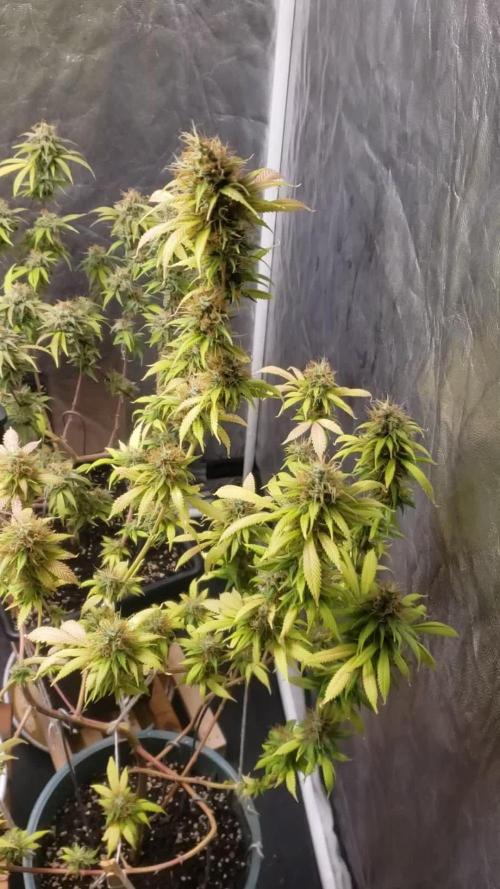
Hola a todos, esta semana he regado solo con agua, hice un pequeño lavado de raiz y la próxima semana continuare de la misma forma.
Los tricomas están lechoso al 100% esperare que se pongan algunos de color ambar, para cosechar 🤪🤪


Likes
26
Share


@MiyaguiOkPolilla
Follow
Esta cepa es fenomenal, la saqué a exterior en la última semana y media para aumentar sus terpenos y minimizar la degradación con solo 3 horas de luz directa, 7° C noches y días de 15° C ; me recuerda mucho a Critical Bilbo, un aroma dulce, intenso y muchísimas ventajas de parte de la genética: Resistencia a plagas, podas violentas y entrenamientos de cualquier tipo. Fácil de obtener esquejes y mucha producción de resina 🤤💐.
Me encanta esta cepa en exteriores pero en interior ha mostrado ser más que apta, sólo al final de su etapa ha mostrado algunas flores macho pero creo que es causa del estrés por las bajas temperaturas en sus últimas 2 semanas.
Saludos a todos y muchas gracias por pasar a ver los diarios ☺️

Likes
6
Share


@MissSolasolita
Follow
End of week 4 of flower
Looking very healthy
She is so sticky and smells amazing
One in shared pot exactly the same
Roll on next 4 weeks
STAY SAFE EVERYONE!

Likes
56
Share


@Wastent91
Follow
Eccoci! Prima settimana di questa esperienza idroponica, sembra che nonostante i primi giorni abbia avuto alcuni problemi ad iniziare a sviluppare le radici, ora sembra che tutto stia andando per il meglio e le piccoline hanno iniziato a svilupparsi molto bene, spero che grazie a questo sistema DWC di Mars Hydro sono sicuro che avrò successo, e anche soprattutto ad i nutrienti di qualità di Terra Aquatica che mi hanno già dato risultati fenomenali in terra ma sono sicuro che in idroponica me ne daranno molti di più, spero di continuare la collaborazione con loro e che mi diano altri nutrienti poiché sto iniziando a finire le bottiglie con i loro stupendi prodotti, tutto questo grazie a tutti voi che mi sostenete e mi seguite! Grazie vi adoro questa comunità di Grow Diaries è davvero la cosa migliore che mi sia mai capitata in questo periodo della mia vita! Un buon 420 a tutti voi! 💪😸👌🌱🌿🧑🌾🤞😺💖
Likes
9
Share


@wheedtobeus420
Follow
Day 32 she’s exploded and the lady I was most excited to get going. I mean who doesn’t love a Russian 👌🏻 Can’t wait to watch her grow. She took very well to the leaf tucking and loving touches.
Likes
1
Share

@Naujas
Follow
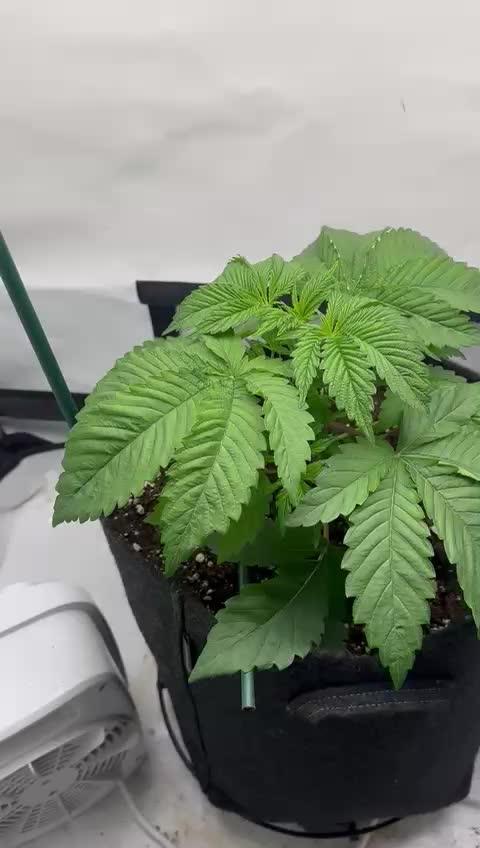
Praėjo 28 dienos, nors dabar nesu su ja, tiek nuotraukų pavyko padaryti :) 27 diena - ji miegojo ;) ir trūksta 28 dienų :) bet daugiau nieko, kitą savaitę vėl pas ją būsiu, ir treniruosiuosi LST ;).