


Likes
Comments
Share


@Organic473
Follow
Her finally week looking forward to harvest…she emails incredible

Processing
Likes
12
Share


@Tazard
Follow
These are clones that I managed to take from my summer garden that became a disaster due to a heat wave that we had breaking 100 year records. I expect everything to be 48” in height at maturity.

Likes
109
Share


@MadeInGermany
Follow
Welcome to the
Green House Seeds Company Cup 🏆.
Today is day 48 since the time change to 12/12.
Hi everything 🤗.
I can't describe how good it smells this week .
You have to try them yourself 👌.
There is nothing wrong with this genetic 😎.
The growth, the color, the smell and the buds, everything is perfect.
I can't wait to try it for the first time 😃.
This week she will be flushed, so that after the flush she still has 10 - 13 days to utilize the remaining energy.
Until then, I wish you a lot of fun with the new update, stay healthy 🙏🏻 and let it grow 🌱🍀
You can buy this Strain and Nutrients at :
https://greenhouseseeds.nl/
☝️🏼☝️🏼☝️🏼☝️🏼☝️🏼☝️🏼☝️🏼☝️🏼☝️🏼☝️🏼☝️🏼☝️🏼
Green House Seeds Company Cup 🏆
Type:
Wonder Pie
☝️🏼
Genetics:
Wedding Cake x OG Kush
👍😍
Vega lamp: 2 x Todogrow Led
Quantum Board 100 W
💡
Flower Lamp : 2 x Todogrow Led
Cxb 3590 COB 3500 K 205 W
💡💡☝️🏼
Earth: Canna Bio
☝️🏼
Fertilizer: Bio Grow Feeding ( GHSC ) , Enhancer ( GHSC ) , Bio Bloom ( GHSC)
☝️🏼🌱
Water: Osmosis water mixed with normal water (24 hours stale that the chlorine evaporates) to 0.2 EC. Add Cal / Mag to 0.4 Ec Ph with Organic Ph - to 6.0

Processing
Likes
23
Share

@MadeInGermany
Follow
Day 6 since the time change to 12/12 hrs.
Hey everyone 😃.
The stretch by moving into the flower tent has started 🤗.
It develops beautifully and makes beautiful stable Shoots from 👌.
Since I unfortunately ran out of Grow Liquid, it is already getting full bloom Liquid.
Which is unfortunately not perfect, but there is no other way in this situation :-(.
I hope that you will still do a nice stretch.
I wish you a lot of fun with the update, stay healthy 🙏🏻👌 and let it grow 😎
You can buy this Strain at
https://thecaliconnection.com/seeds/girls-scout-cookies-34.html
You can buy the fertilizer at
https://www.greenbuzzliquids.com/
Type:
Girls Scout Cookies
☝️🏼
Genetics:
GSC Tint Mint
👍
Vega lamp:
2 x Todogrow Led
Quantum Board 100 W
💡
Bloom Lamp :
2 x Todogrow Led
Cxb 3590 COB 3500 K 205W
💡💡☝️🏼
Soil :
Canna Coco Professional +
☝️🏼
Fertilizer:
Green Buzz Liquids :
Organic Grow Liquid
Organic Bloom Liquid
Organic more PK
More Roots
Fast Buds
Humic Acid Plus
Growzyme Big Fruits
Clean Fruits
Cal / Mag
Organic Ph - Pulver
☝️🏼🌱
Water:
Osmosis water mixed with normal water (24 hours stale that the chlorine evaporates) to 0.2 - 0.4 EC. Add Cal / Mag 2 ml per l water every 2 waterings . Ph with Organic Ph - Pulver to 5.8 .

Likes
61
Share


@Natrona
Follow
Auto Opium week 8 8/11-17
For my outside ladies, Opium, Auto Opium, Fractal, and Lemon Cake not much changed. They continue lovin life outside. These ladies are maturing as many fans are yellowing and falling off.
Temps are comfortable following Storm Debbie., in the 80 with low humidity Auto Opium is thin and spindly, branches continue to bend so I added hoop supports. I sure hope she makes it to the end in one piece. If necessary, I remove the colas and chuck into the freezer.. Buds are fattening up, trichomes are minimal at this time but some fragrance is starting to be noticed.
Thank you @DivineSeeds
Thanks for the visits, likes and comments, I appreciate all the plant love💚.
Have fun & love what you grow 💚
Sending you good vibes of love, light, and healing 💫
💫Natrona 💫


Likes
26
Share


@Reyden
Follow
LSD-25 mostra già qualche peletto è questo è un ottimo segno, la ragazza sembra crescere veramente alla grande con rami che cercano la luce, ora vedrò se tagliare le foglie a ventaglio che coprono i rami che non riescono ad emergere, penso che dalla prossima settimana andranno già in fioritura le due auto anche la CBD avrà bisogno di più tempo per svilupparsi…ho delle belle aspettative per queste bellezze 👌💯🔥
Likes
Comments
Share

@sunshinegroww
Follow
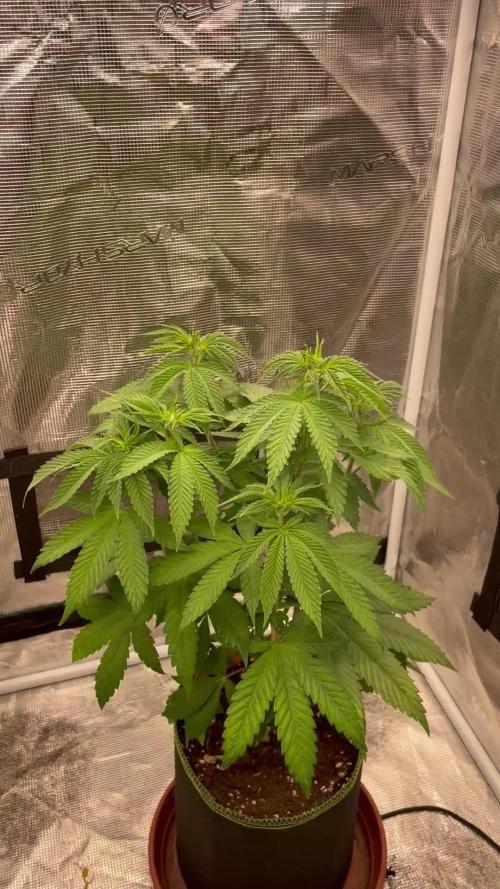
Well here we go into week 2 not a lot to say she is just fine and doing her thing she is happy and stretch its on the cards
Likes
125
Share


@Hologram
Follow
Auto Opium is doing great and is loving the warm, sunny weekend we are having right now 👍
She is smellls like skunky berries 😎 👌
would be fun if she 'defeats' Northern lights in her yield, but its hard to tell (but it seems she is trying!👊)
i havent topped her so she looks totally diffrent 😁
Does not even matter.. bc Auto Opium is real medicinal :" A great painkiller and sedative agent, Auto Opium can be prescribed against chronic pains, nausea and appetite loss, headaches, muscle spasms and cramps, seizures, panic attacks and hysteria"(source: Divineseeds.com)
So i think she can support me real good in handling MS attacks and chronic pain.. so im just happy and gratefull with what she will give me 😇👊
happy growing for all✊
Likes
22
Share


@RDWCGrowing
Follow
12/25/2023-Germination Day 1
Merry X-mas 2023 I decided to start a run of SolFIre Gardens Hoodz Candyz S1. I am going to do a cup filled with RO water a touch of Hydrogen peroxide and let it sit for 24-48 hours until I see tap root then I am going to put it into a rapid rooter.. Tap root Down and put it about 1/4 of the say down the Rapid rooter.
I made some modifications to my basket on this run.. I have taken a few Pods that I use for my cloning machine and decided that I am going to try and use them as sure plants, so that I can take my water right up to the bottom of the basket this time and see if these can make my planting more consistent.
12/26/2023-Germination Day 2
Tap root achieved Planting Commencing
12/27/2023-Germination Day 3
Misted the dome lightly misted the rapid rooter and added a little water to the bottom of the pan to encourage root growth to the pan.
12/28/2023-Germination Day 4
Ground Hogs day
12/29/2023- Germination Day 5
She is up, she has broken surface, I misted the root riot, and around the bottom of the tray to try and entice root growth down rapidly.
12/31/2023- Germination Day 6
Ground Hogs Day
1/1/2024-Germination Day 7
HAPPY NEW YEARS!!.. I did it I planned it out so my planting day would fall on New Years and it worked.. Yay!!!
1/2/2024- Germination Day 8
Since the roots are not to the water yet, I am pouring one cup of water lightly on the hydroton around the lady to try and encourage root growth down to the water..
1/3/2024- Germination Day 9
Ground Hogs day, will continue until roots hit the water.
1/4/2024- Germination Day 10
Ground Hogs day, will continue until roots hit the water. I will just continue to top feed until roots are in the water.. Shouldn't be more than a few more days.
1/5/2024- Germination Day 11
Ground Hogs day, will continue until roots hit the water. I am going to change the water Sunday and kick off Week 1, I will just continue to top feed until roots are in the water.. Shouldn't be more than a few more days.
1/6/2024- Germination Day 12
Ground Hogs day, will continue until roots hit the water. I will just continue to top feed until roots are in the water.. Shouldn't be more than a few more days.
1/6/2024- Germination Day 13
Ground Hogs day, will continue until roots hit the water.
1/7/2024- Germination Day 14
Ground Hogs day, will continue until roots hit the water.


Likes
64
Share


@PoppaMac
Follow
Smooth week for the girls. Not much stretching left on her and the flowers are packing on more weight. Trichs are starting to pack on there and some pistols are showing some orange colors. Smell is definitely starting to strengthen too.


Likes
12
Share


@DoDrugs420
Follow
This is a giant autoflower that reaches 150cm and produces massive yields of up to 600gr/m2, a modern Cali strain that offers what a top-quality Indica-dominant hybrid should; nugs capped in resin with the density you would expect from Indica-dominant strains and that bag appeal that will surprise even the most experienced growers. Expect beautiful purple and magenta hues that come along with a sweet almost pastry-like taste and, thanks to the 24% THC, a very pleasant and potent effect that surprisingly starts as a motivating high and in no time relaxes you completely, taking a bit of the energetic edge off.
Tech Specs
Taste
Blueberry Muffins, Cherry, Spicy
THC
Up to 24%
CBD
< 1%
Size
XXL
Height
90 – 150 cm
Flowering
9 weeks
Genes
Sativa 15%/Indica 85%
---------------------------------------------------------------------------------------------------------------
Grow Sponsored by MARSHYDRO
HIGH EFFICIENCY WHITE LED LIGHT: Newest SMD LED technology provide highest PAR/LUMEN output(743umol@18"), designed to replace a single-ended 250watt HPS; MARS HYDRO TS 1000W Plants Growing lamp makes you get 30% higher yield compare OLD blurple led lights, Max 2.0g yield per wattage (power draw)
LOW ENERGY CONSUMPTION GROW LIGHTING : Consuming only 150W with 342 LEDS! It saves up to 50% energy than other led grow lights. Perfect for 2.5x2.5ft,Max coverage 3x3ft. Over 90% light energy can be absorbed by plants; higher intensity and more even coverage in a MARS HYDRO grow tent, reflective area, or by crossing over using multiple TS1000
SUNLIKE FULL SPECTRUM LED INDOOR GROWING: 660-665nm Red IR/3200-4200Knm/5200-6800Knm, infinite close to natural light, best for all plants all stages growing, rapid plant response from seed to flower and increase yield & crop quality
HIGH REFLECTIVE & NOISE FREE-Fanless LED GROW SYSTEM design will make your growing life easy and quiet, quickly heat dispersing material aluminum reducing light lost to aisles and walls, increase the light intensity up to 20%, allowing your plants receive more energy and without burning your plants for maximum headroom
Get your own at https://www.amazon.de/dp/B07ZVFBR34
Likes
4
Share

@Shivashamboom1
Follow
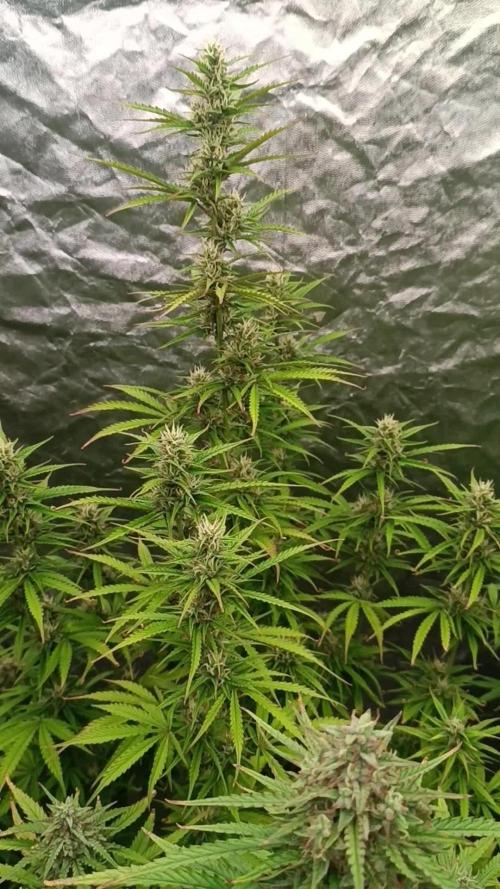
4 settimana di belli fiori 😉😂 le fragranze si iniziano a sentire .,....
Likes
144
Share


@TOTEM
Follow
She’s still stretching!
This week I removed Voodoo Juice, Tarantula and Piranha, and added B-52 and Bud Factor X (never tried this one before). Since the princess loves this 2ml/L dosage for NPK nutes, I’ll not be touching that for the moment. That seems to be the optimal dosage for a sativa like this. Very nice!

Likes
Comments
Share


@Cannabisii
Follow
The GG#4 is in a 5 gallon pot while the GSC are in 3 gallons. All of them are looking great! The GSC look super healthy compared to the first round.

Likes
12
Share


@QueenBZA
Follow
She was big but not nearly big enough needless to say we won't be growing her again
