Likes
13
Share
@PPFDaddy
Follow
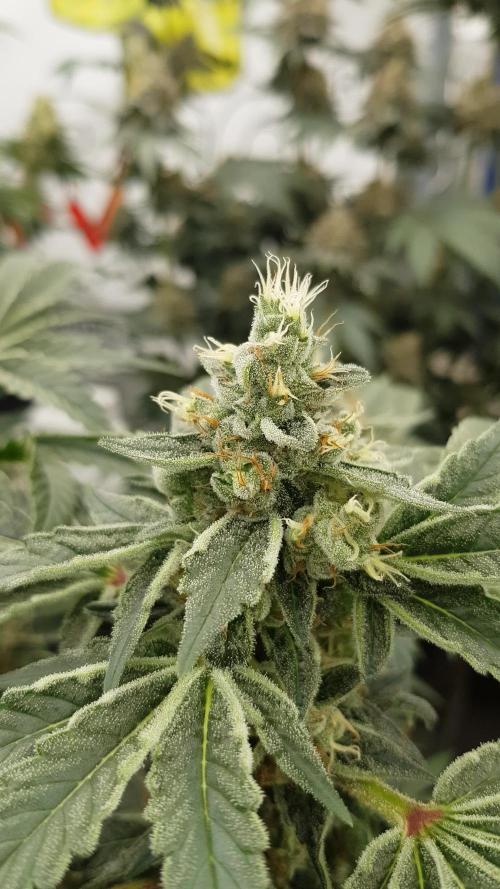
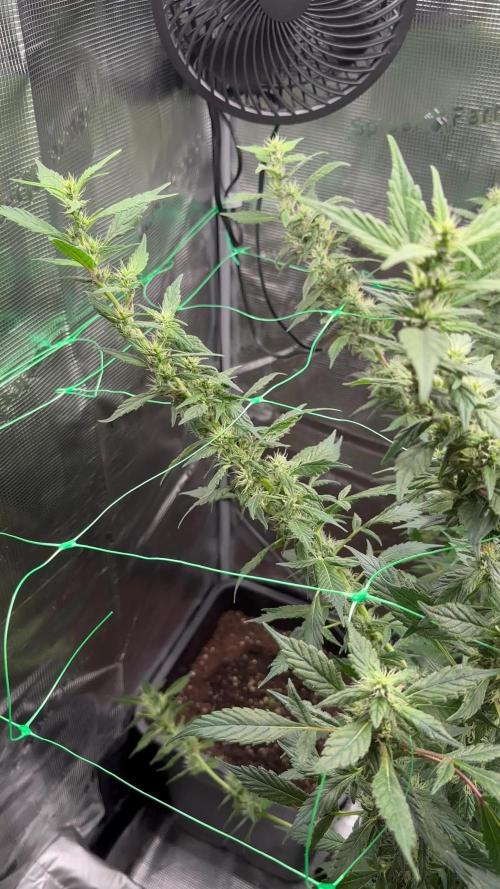
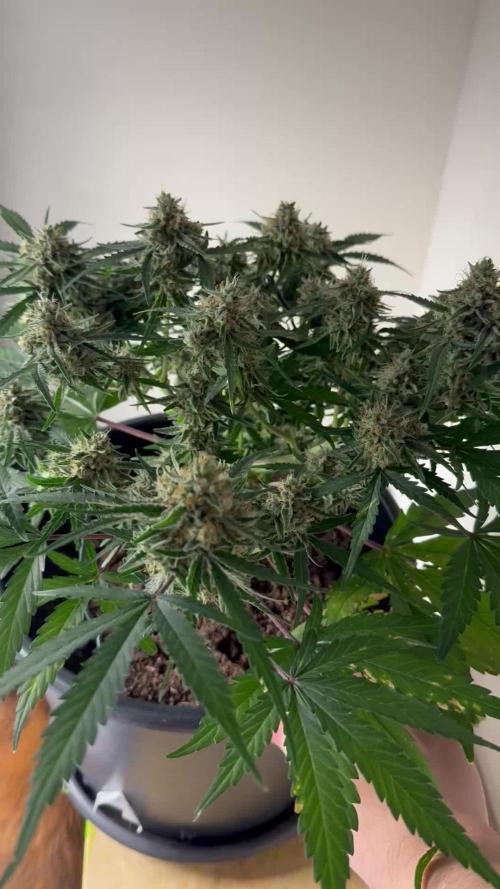
Another week down, smooth… mostly. I wasn’t ready for how savage these autos would get. Not “plant problems” just pure speed. One Hyperion got out of hand and is now over 100cm, basically taking up half the tent. Sounds like a win… until you remember there are 3 other plants in here and height is limited. Every time I think she’s done stretching, she’s somehow closer to the light again. Like she’s trying to merge with the fixture. To manage it, I hung a small plastic “shade” right above the tallest top to bring intensity back into a sane range. It was reading around 90k lux at the tip, now it’s closer to 56k in that hot spot. Overall the girls are happy. The one that started flowering first is setting big expectations — the leaves around the buds are already frosting up with trichomes, and I’ve honestly never seen that much this early. Hope she keeps that energy and the others follow. The only “plot twist”: the one still lagging behind is the Ranz. While everyone else is walking into flower, Ranz is still stretching like “nah, I’m good, I’ll clock in later.” Since they all share the same drip system + one reservoir, it slightly annoys the control freak in me I can’t dial the feed perfectly when one plant is on a different chapter than the rest. Fingers crossed she finishes the stretch soon and joins the flower party. Good luck to all growers and see you next week!
Likes
5
Share
Bien aquí esta el día esperado la cosecha, es mi primer cultivo y considero que lo logre. En muchos medios de lectura y en especial en vídeos mencionan que no puedes esperar mucho es tu primer cultivo. En mi caso es falso y lo demuestro ya que si aprendes, investigas por cuenta y lees lo suficiente, obtendrás un alto porcentaje de que los resultados se den. Muy contento con mi plantas y sus tonos morados. Puntos a mejorar tener una carpa de cultivo y por su puesto un extractor de humedad para que baje la humedad preferiblemente a 45 grados Vendrán mejores contenidos y cosechas mas abundantes. Gracias a todos por su vistas y comentarios. Saludos y bendiciones!
Likes
37
Share
Week 07 and the heat wave is behind us. Didn’t update last week but not much to report. Some serious damage was a result of the heat, causing the lights and everything else to become too much for the girls. #2 took it the best and is still growing nicely packing on weight and some serious frost! Finishing much faster then the others. I might re veg her the smell is so nice. The two larger #1 & 4 have been hungry forever awhile and I never applied anymore Gaia:(
Likes
1
Share
Un verdadero pastel, es una variedad con un excelente aroma, con notas bien marcadas a un dulzor que te vuela la cabeza, excelente apariencia de las flores, se ven realmente compactas y cubiertas de resina que te volara la cabeza!
Likes
11
Share
Here we go the big girl its on fire so far so good big leafes happy times just doing her things
Likes
4
Share
@AustinRon
Follow
OG 4Q24 Flower Week 6 Orangegasm (Fem) [ IRIE Genetics ] 12/12 @ Bolt (Day 21) Germination: 20 November 2024 #3A Earliest Harvest Date: 9 February 2025 #3B Latest Harvest Date: 19 February 2025 _________________________________________ Start of Week: [Wed Jan 15, 2024 CR2 4Q24 36:F:5:1] End of Week: [Tue Jan 21, 2024 CR2 4Q24 42:F:5:7] OrangeGasm Fertigation: - MAX: EC: [ 2.7, mS] - LightIntensity MAX: [ 850, µMol/m2/s] ______________________________________ Evaluating Runoff EC vs CHOSEN EC: - IDEAL: Within 200 ppm, ≤ 0.4, mS/cm - Acceptable: 200 - 300 ppm, ≤ 0.4 - 0.6 mS/cm. - CAUTION: 300 - 400 ppm, ≤ 0.6 - 0.8 mS/cm - DANGER: 400 ppm, 0.8 mS/cm __ Wed Jan 15, 2025 OG 4Q24 36:F:5:1 Runoff - Amount: [ 1, gal] - EC: [ 4.0, mS/cm] - EC∆: [ 1.3, mS/cm] # CAUTION Refresh Res - 2 Gal Filtered Tap - EC: 0.3 - pH: 9.1 - Remediated - 1 ml/ pH Down/gal - pH: 7.4 - EC: 2.7 __ Thu Jan 16, 2025 OG 4Q24 37:F:5:2 Runoff - Amount: [ 0.25, gal] - EC: [ 3.9, mS/cm] - EC∆: [ 1.2, mS/cm] # CAUTION Increased FERTIGATION Duration to 50 Seconds. - #5’s POT is LIGHT, NO Heft: Watered in 500 ml over surface. This plant is SUCKING all the moisture, and is yet as happy as can be.  Runoff EC Remains High. - [x] R&R Manifold Filter - Minimal (but present) bio film - significant reaction with H2O2 __ Fri Jan 17, 2025 OG 4Q24 38:F:5:3 - [x] Pick up 8 Gallons of RO (HEB ‘Distilled’) Refresh Reservoir - Amount: [ 4, gal] - PrimerA&B: [ 81, ml] - SLF-100: [ 20, ml] __ Sat Jan 18, 2025 OG 4Q24 39:F:5:4 UFC 311 - Was Really Good    __ Sun Jan 19, 2025 OG 4Q24 40:F:5:5 - [x] R&R Manifold Filter (Replace w/ NEW 200 Mesh Filter) Harvest Dehu - [x] Amount: [ 2.5, gal] Refresh Res - [x] Amount: [ 2, gal] - [x] Primer A&B: [ 40, ml] - [x] SLF-100: [ 10, ml] - [x] EC: [ 2.7, mS/cm] Runoff - [x] Amount: [ 750, ml] - [x] EC: [ 4.1, mS/cm] - [x] EC∆: [ 1.4, mS/cm] # REMEDIATE Not a lot to do except - [x] Maintain Environment - [x] Maintain Reservoir Hydro Only  FULL Chart (16, 8, 8, 6, 6, 6, 6)  HYRDRO Chart NER Nutrient Element Ratios ppm mS/cm NER N 295 0.6 21.8% P205 161 0.3 11.9% K20 536 1.1 39.7% Ca 241 0.5 17.9% Mg 54 0.1 4.0% S 64 0.1 4.8% Si 0 0.0 0.0% C 375 TOTAL 1725 2.7 100.0% Full Chart NER Nutrient Element Ratios ppm mS/cm NER N 241 0.5 17.8% P205 184 0.4 13.6% K20 522 1.0 38.7% Ca 245 0.5 18.1% Mg 49 0.1 3.6% S 44 0.1 3.3% Si 65 0.1 4.8% C 1147 TOTAL 2497 2.7 100.0%  - [x] Handwater - [x] Mix 12 ml Photosynthesis Plus - [x] Mix 1/4 tsp Quillaja Mix and Feed 400 ml/Plant - [x] Mix up 1 Gal Hydro w/ Silica (16, 16, 16) ml, EC: 2.7 mS/cm, Refrigerate - [x] Apply when sol’n 60°F __ Mon Jan 20, 2025 OG 4Q24 41:F:5:6 AM: Outer Room RH: [ 38, %] Runoff - Amount: [ 1, gal]. # This is about TWICE the amount I HANDWATERED last night. - EC: [ 3.9, mS/cm] - EC∆: [ 1.2 , mS/cm] # DANGER! Reclaim Dehu - Amount: [ tbd, gal] Just Remembered still have 1/2 a gal of Fertigation w/ Silica - - [x] APPLY __ Tue Jan 21, 2025 OG 4Q24 42:F:5:7 Runoff - Amount: [ 1.9, l] - EC: [ 3.8, mS/cm] - EC∆: [ 1.1, mS/cm] # DANGER Refresh Reservoir - Amount: [ 2, gal] - PrimerA&B @ 2.7 mS/cm: [ 40, ml] - SLF-100: [ 10, ml]
Likes
12
Share
Week 2: Trying to be anal about VPD. Feeding nutrients every watering, PPFD/DLI is not dialed in just following the manuals recommended light distance. Humidifier on the outside of the lower right vent and AC Infinity helps maintain RH %.
Likes
120
Share
Welcome to Week 17 of our epic Lego Ninja Tropical Tangie Run! This week, the garden symphony hits a crescendo as we approach harvest day. The trichomes, those tiny crystal sentinels, stand guard over buds that have matured into a sight to behold. Reflecting on this journey, from seed to the imminent harvest, is like revisiting chapters of a captivating story. Our Tangie, a botanical warrior, weathered every stage with grace. From the early days of nurturing to the defiant stretch of vegetation, she embraced the scorching sun and danced under the grow lights. The art of defoliation sculpted her canopy, and the scrog net became a stage for her floral performance. As she enters the final act, the trichomes, like miniature crystal cities from heaven, sparkle with the promise of potent delights. The ninja buddies and I share a moment of anticipation, knowing that soon, the harvest symphony will commence. In the midst of this, I offer you a teaser timelapse, a sneak peek into the visual poetry that will unfold in the full 8 minutes version (if grow diaries gives e that honour as at the moment cant upload anything over 100 megas with is kind a small file for videos)—capturing the essence of a Lego Ninja Tangie's journey from a tiny seed to a bountiful harvest. Join me in this reflection, a pause to appreciate the magic in each leaf, bud, and trichome. This journey has been a testament to the harmony between nature, science, and a touch of Lego Ninja magic. As I prepare for the final curtain call, I extend my deepest gratitude to @DutchPassion_Official for their stellar genetics, Aptus Holland for being the backbone of my nutrient regimen, and Grow Diaries for providing the canvas to paint this green masterpiece. Stay tuned for the grand finale, where we'll witness the Timber Symphony as each branch meets its destiny. Until then, keep the ninja spirit alive, and may your gardens be evergreen! As always thank you all for stopping by, for the love and for it all , this journey of mine wold just not be the same without you guys, the love and support is very much appreciated and i fell honored and blessed with you all in my life<3 <3 <3 #aptus #aptusplanttech #aptusgang #aptusfamily #aptustrueplantscience #inbalancewithnature #trueplantscience With true love comes happiness <3 <3 <3 Always believe in your self and always do things expecting nothing and with an open heart , be a giver and the universe will give back to you in ways you could not even imagine so <3 <3 <3 Friendly reminder all you see here is pure research and for educational purposes only <3 <3 <3 Growers Love To you All <3 <3 <3 P.S- I must extend my sincerest apologies for the missing video reports. Regrettably, Grow Diaries is still facing some technical issues that are preventing me from uploading them. Rest assured, as soon as the situation is resolved, I'll share those videos to give you an even closer look at this fascinating journey. or in my case apparently GD dont let me do uploads over 100mb with is super small file if you working and editing videos .
Processing
Likes
5
Share
@Dunk_Junk
Follow
Another 11cm grown this week. She seems very short and bushy. No idea why, not sure if I've done something wrong along the way.
Likes
11
Share
Likes
1
Share
📆 Semana 13 La A5 Chaze alcanza el final de su ciclo en plena madurez. Los tricomas se muestran mayoritariamente lechosos con ámbar bien presente en puntas, la resina es abundante y pegajosa, y el perfil terroso–especiado se expresa limpio y profundo. La cola principal mantiene su porte clásico, mientras las secundarias llegan compactas y bien cerradas. Corte realizado sin forzar, en el punto justo.
Likes
17
Share
Can’t believe I got 78g of bud of her! That’s nearly double what I usually get of 1 plant 😂 maybe it was due to giving her 7 weeks of veg, rather than the usual 4 weeks!? Either way I’m buzzing She’s coated in sugar and stinks!! The high is strong giving a massive couchlock and the munchies! She smelt and tasted like usual cheese but obviously much nicer and stronger 😌
Likes
7
Share
@Dunk_Junk
Follow
WOW!! She is a stonking little plant!!!!!!!! Grown another 17cm this week..... Now over a meter tall from a 1 Litre airpot!!!!!!!!!
Processing
Likes
63
Share
@AsNoriu
Follow
Day 65. Girls are okish, calmag mini def is still after me, now even Gorillas show off some reddish leaves stems, hope they just cant keep up with speed and amount... In flowering its bad to have unhealthy plants, so CalMag today and full bloom tommorrow eve. Girls started to drink really fast. Control garden is my joy now, Outside Cookie is a pity tho.... We shall see.... In plans to raise lights back to 60 cm from canopy, girls stretched a bit, need to adjust and i just cant wait couple more weeks till first round of defoliation :))) hope to do it on day 18 of flower latest.. Canopy is too packed, need better air and light. Thinking to get heavy artillery out, epsom salt dresing :)) thats my last hope to fight that reddish-violet and make it green again. It takes two weeks to kick inn, but works always for me... Day 66. Girls are happy, hungry and in full blast. Control garden has such healthy green its hard to describe... Cookies on other hand streched as f@%k, will have to lolitop them really high, so no proper grow and small harvest, taste is the only thing that can save them... Worthless for now.... All girls streched like 5 cm in one day, they loved CalMag. Lights been raised like 7 cm. Lets see... Day 68. Changed plans a bit, girls got silica acid with plain water and they loved it! They are happy campers and grow really fast, now only to have patience till defoliation. Girls are super packed, will have to care about them 2x more than avarage, thinking to plug in conditioner, but its still coldish weather outside, so hope to last two more weeks without that beast, no tv or orher aplaincies while this beast runs :)))) Day 68, evening. First time checked my girls after light switch to flower and i am lost, will they make it? Canopy height is like 30-35 cm, they had small lolitopings on lower levels during vegetation ( see week 8 first video just mute it, they where striped like this on week 5 as well) in video its even hard to see, but its jungles!!!! Have one fresh air fan, double fan set with carbon out, inside two standing fans and powerful conditioner, will i make it with only defoliation or should i clear them hard aswell? Never growed such low and dence plants before. Please advice or show diary to read. Plus a 30 days old Incredible Bulk, almost no feed, no germination or transplanting, straight to soil and no direct light above. Hope you will see this same strain grower :) Peace.
Likes
9
Share
Sono arrivate le belle giornate e queste varietà ha risposto con una crescita rapida e abbondante, hanno già più di 3 internodi alcune anche 4 internodi, si avvicinano tutte già ai 50 centimetri di altezza e sono sempre più evidenti le diramazioni in formazione. Se non fosse per la differenza di varietà mi sembrano tutte eccezionali sia la Dutchpassion seeds come sempre varietà impeccabili, idem sweet seeds che da anni ogni volta che coltivo varietà loro rimango a bocca aperta, lo stesso le varietà 420FastBuds molto abbondanti e rapide come sempre, Humboldt seeds lo stesso ho avuto sempre esperienze positive in passato. Attualmente vi faccio i complimenti a tutte le banche semi che ho scelto, alla fiera canapa mundi ho ricevuto dei regali preziosi cioè semi di qualità come sempre! Abbiamo usato un po' di olio di piretro ad azione rapida per proteggere le bellissime varietà da parassiti tipo afidi. Tra una settimana abbondante iniziamo con qualche nutriente per la fioritura. Per adesso procedono meravigliosamente e si sono già adattate al clima del centro Italia. Si procede felicemente spero soltanto che arrivi definitivamente l' estate!
Likes
2
Share
Topped once, turned off IR @ nights, slowed vertical growth back down, and took off both of the very lowest internodes on each plant. Eisenia fetida Stratiolaelaps scimitus Armadillidium vulgare Red wigglers (Eisenia fetida) are highly beneficial. They are considered an ideal choice for "no-till" or container-based organic growing because they live in the upper layers of soil, feeding on organic mulch rather than the plant's root system. Red wigglers accelerate the breakdown of organic amendments and produce high-quality, nutrient-dense worm castings directly in the root zone. Clover is another exceptional component of an organic rhizosphere, offering a sustainable, self-sustaining alternative to synthetic nitrogen fertilizers produced via the energy-intensive Haber-Bosch process. By forming a symbiotic relationship with Rhizobia bacteria, clover converts atmospheric nitrogen N2 into ammonium NH4, providing a steady, slow-release nutrient source that enhances soil health and reduces environmental impacts. Red clover offers superior nitrogen fixation and biomass production compared to white or yellow clover, making it the premier choice for maximum soil vitality, particularly for improving soil structure and providing a high-volume nitrogen credit for subsequent crops. If it is fully functional and efficient soil, the rhizophagy cycle is superior long-term than any synthetic delivery when it comes to preventing deficiencies, not because it's "better," per se. The medium will require a very high CEC to make it to harvest without re-fertilization. The rhizosphere acts as a dynamic, interactive exchange where plants and soil microbes trade resources based on immediate needs. When a plant lacks a specific nutrient, it changes its physiology and releases specialized chemical cocktails—root exudates—into the surrounding soil. These exudates, which include sugars, amino acids, and organic acids, serve as a "shopping list" to attract specific microorganisms, which in turn return higher levels of desired nutrients. There is nothing in comparison when using synthetic delivery, which can cause plants to stop producing exudates, effectively "starving" the beneficial soil life, over time turning the soil barren and void of microbial life. Responsible use, applying the right amount at the right time, can minimize these negative effects. Relying solely on synthetic fertilizers without replenishing organic matter is what typically leads to exhausted soil. The use of synthetic fertilizers can utilize the Cation Exchange Capacity (CEC) of the soil, but without a robust rhizosphere and active microorganisms, the efficiency of this process is significantly reduced. This makes synthetic growing more difficult to prevent deficiencies overall compared to an efficient organic living soil with a robust rhizophagy cycle, as there is no "one size, fits all" when it comes to different nutrient profiles of strains/genetics, making it trickier to "guess" and prevent creeping deficiencies. CEC does not contribute towards EC. Add more CEC using biochar, problem solved. If you keep pH between 6.3 and 6.7, hydrogen is exudated to cycle the medium's CEC for its needs. Keeping the pH between 6.3 and 6.7 creates an environment where plants release H+ to displace positively charged nutrients (like Ca2+, Mg2+, K+ held on soil particles or within artificial media this cycle through nutrients via the medium's Cation Exchange Capacity (CEC) Microorganisms generate a stable potential of approximately 0.5 V EC. The rhizosphere creates its own food, similarly to chelation, using 1000's of varying combinations to create its own food. Start to finish, just add water. Eventually, more materials will need to be added at the beginning of each new grow, but very attainable to go from seed to harvest without ever fertilizing. ATP is important when it comes to biomass accumulation. Cellular root respiration and cellular respiration are essentially the same biological process, the breakdown of glucose to create usable energy (ATP) in the presence of oxygen, just taking place in different parts of the plant. Synthetic (salt-based) grows have significantly lower levels of total rhizosphere respiration, often referred to as root-zone activity, compared to organic living soil grows. While the plant roots themselves may respire in both systems, the surrounding soil ecosystem in a living soil setup is vastly more active, teeming with bacteria, fungi, and beneficial microorganisms. 2 pools of ATP, it won't double in growth buuuut, but improving root respiration by ensuring high oxygen in the soil is crucial. Good aeration ensures roots can fully utilize glucose to generate the ATP necessary for nutrient uptake, leading to healthier and more productive plants, even if growth isn't exactly doubled. The ATP created using root respiration is dedicated to rootzone growth; the ATP created using regular cellular respiration in a synthetic system would have to dedicate a lot of ATP to the roots when there is little or no root respiration. It's true that there is less of an initial ATP cost in breakdown when nutrients are already in their final form (synthetic), but you lose a solid chunk of ATP when the entire plant is reliant on cellular respiration alone; a large portion of ATP is dedicated to root zones for "forced" nutrient uptake rather than traded. Making it overall less efficient, even if the initial cost of breakdown is higher. Not sure if I butchered that but one can hope It makes sense. Oxygen is of critical importance when growing in living soil compared to synthetic soil because it supports the metabolic needs of the microbial, fungal, and insect ecosystem, rather than just the root respiration required by the plant itself. While synthetic grows can survive in lower-oxygen environments with precise mineral feeding, living soil systems rely on aerobic microbes to decompose organic matter (microbial mineralization) to create plant-available nutrients, which is an oxygen-intensive process. While a specific fair percentage is difficult to guess, my experience points to a massive, compound difference between the two methods and the amount of oxygen required. All the ATP spared is used on more biomass, not only that, but the extra root respiration can achieve a much higher CO2 compensation point naturally than you could with synthetic and atmospheric CO2 alone. As a plant grows faster and increases in size, its demand for nutrients to support that growth increases, requiring a higher rate of nutrient uptake. As plants enter phases of rapid vegetative/floral growth, their metabolic demand for nutrients increases exponentially. Without a robust buffer zone—whether in the soil (cation exchange capacity) or in a hydroponic reservoir—deficiencies will occur rapidly because the instantaneous demand for specific nutrients can quickly exceed the rate of supply. A growing body of evidence suggests that organic living soil provides superior long-term soil health and environmental benefits compared to synthetic fertilizers, which are often criticized for promoting a cycle of dependency and degradation. While synthetic fertilizers offer short-term convenience and high yields, they often come at the expense of long-term soil health, sustainability, and increased corporate control over growers/ farmers. Organic living soil, while slower and requiring more care to establish, creates a sustainable, resilient, and, ultimately, more fertile environment. We don't really grow; we facilitate energy conversions, and energy is just numbers. Because the universe works the same way today as it did yesterday, there is a single, fundamental mathematical quantity that remains constant. We call this quantity energy. You cannot put "energy" under a microscope. You observe matter and forces (like heat, motion, or light), but energy is just a scalar number calculated to help predict how these things will change and interact. When an object falls, or when a battery powers your phone, matter shifts and changes form. Through it all, the universe ensures the "total score" of the numbers remains exactly the same. Once all water is removed, approximately 95% to 97% of a plant’s dry matter consists of carbon, oxygen, and hydrogen. These three elements form the structural backbone of all plants. NPK & all the rest 3-5%. Indigenous Amazonians created, or at least significantly enhanced, the fertile, dark soil known as Terra Preta de Índio (Portuguese for "Indian Black Earth") by incorporating biochar and other organic materials into the soil. This anthropogenic (human-made) soil technique, which dates back roughly 2,500 to 8,000 years, allowed ancient civilizations to flourish in regions with naturally poor, acidic, and nutrient-poor tropical soils.
Likes
5
Share
@Kinghaze
Follow
Unfortunately, I don't have pictures of the buds when they were dried and cut. But I can tell you they looked very nice The taste and high were very good. Verry potent ! Really liked this strain. Unfortunately, 1 of the 2 blue zushi had become a mutant. I made some very nice fresh frozen bubble hash out of it. The dry weight was : Blue zushi 1# 96 gram And from the mutant i made 15 gram of fresh frozen bubble hash, wich was very nice.