




Likes
12
Share


@HIAZ_urbanbudfarmer
Follow
These girls are getting close to harvest.
Calyx closed & swelling up, most of the pistills turned orange/brown & are starting to curl in. Waiting on delivery of a new 60× microscope to check the trichomes , buds are very frosty.
Have stopped feeding nutrients & have started flushing with plain ph'd water.
Then reduced watering to twice a day so there not taking in as much moisture before harvest. Probably starve them of water completely for a couple of days to bring out more moisture, & apparently THC.
A lot of smell about them. Very sticky!

Likes
8
Share

@MrWeeedWorld
Follow
Mango Cherry Runtz Automatic | RDWC | Plagron Hydro
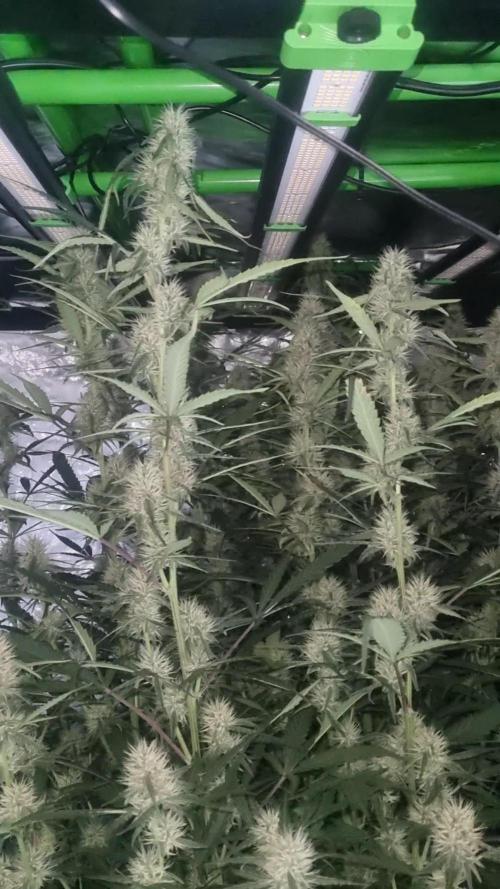
Wenn die Lemon Cherry Sundae in dieser Woche mit ihrer kompakten Blütenentwicklung überzeugt, dann übernimmt die Mango Cherry Runtz die Rolle des absoluten Giganten im Growraum. Ihr enormes Höhenwachstum hat sich auch in dieser Woche fortgesetzt und sie dominiert das gesamte RDWC-System mit ihrer beeindruckenden Erscheinung.
Die Pflanze hat mittlerweile eine außergewöhnliche Struktur entwickelt. Lange, kräftige Haupttriebe strecken sich bis dicht unter die Beleuchtung und tragen entlang ihrer gesamten Länge unzählige gleichmäßig verteilte Blütenansätze. Durch den großen Abstand zwischen den Nodien wirkt die Pflanze sehr offen, wodurch Licht und Luft nahezu jeden Bereich der Krone problemlos erreichen können.
Trotz ihrer enormen Größe präsentiert sich die Mango Cherry Runtz erstaunlich vital. Die Triebe sind stabil, die Blattfarbe wirkt gesund und selbst bei dieser extremen Höhe zeigt die Pflanze weiterhin eine ausgezeichnete Entwicklung. Besonders beeindruckend ist, dass nahezu jeder Seitentrieb produktiv geworden ist und mittlerweile eigene Blütenstände ausbildet.
Auch die Blütenentwicklung schreitet sichtbar voran. Die weißen Blütenfäden bedecken inzwischen nahezu jede Cola und beginnen sich langsam miteinander zu verbinden. Gleichzeitig setzt bereits die erste deutliche Harzproduktion ein, wodurch einzelne Sugar Leaves schon jetzt einen feinen frostigen Glanz zeigen.
Gerade im RDWC-System zeigt sich hier eindrucksvoll das enorme Wachstumspotenzial dieser Genetik. Während viele Pflanzen ihre Energie früh in kompakte Blüten investieren, baut die Mango Cherry Runtz zunächst eine riesige Pflanzenstruktur auf, die nun nach und nach in unzählige Blüten umgewandelt wird.
Die kommenden Wochen dürften besonders spannend werden. Mit ihrer offenen Architektur besitzt sie das Potenzial, außergewöhnlich lange Colas auszubilden, die sich Stück für Stück schließen und zu beeindruckenden Blütenketten entwickeln werden. Schon jetzt wirkt sie wie eine Pflanze, die eher an eine photoperiodische XXL-Sativa erinnert als an eine Autoflower.
--------------------------------------------------------------------------------------------------------------------------------------------------------------------
Mango Cherry Runtz Automatic | RDWC | Plagron Hydro
While the Lemon Cherry Sundae impresses with her compact flower development this week, the Mango Cherry Runtz takes center stage as the true giant of the grow room. Her explosive vertical growth continues to dominate the entire RDWC system, creating an incredibly impressive plant structure.
She has developed into an exceptionally tall and elegant plant. Long, sturdy main branches stretch almost all the way to the light while producing countless evenly spaced flower sites from top to bottom. Thanks to the wide internodal spacing, the canopy remains open, allowing excellent light penetration and airflow throughout the entire plant.
Despite her enormous size, plant health remains outstanding. The stems are strong, foliage still looks healthy, and the overall vigor is remarkable considering her height. Nearly every side branch has become productive and is now building its own flower clusters.
Flower production is progressing beautifully as well. Bright white pistils now cover almost every branch, gradually stacking into longer flowering columns. At the same time, the first noticeable layer of resin is beginning to coat the flowers and nearby sugar leaves, giving them an early frosty appearance.
This plant perfectly showcases the incredible growth potential that RDWC can unlock. Rather than rushing into dense flowers, the Mango Cherry Runtz first invested heavily in building an enormous framework, which is now transforming into hundreds of developing bud sites.
The next few weeks should be especially exciting. With her open architecture and exceptional height, she has the potential to produce incredibly long colas that gradually fill in and become impressive flower spears. At this stage she resembles a massive photoperiod sativa far more than a typical autoflower—making her one of the most fascinating plants of the entire project. 🌱🔥


Likes
2
Share


@BigHorn
Follow
Growth has been steady I'm going to start budding coming week 7. I think I'm going to run out of tent room might be a lil late but it is what it is.

Likes
4
Share


@Bear_Grows_Green
Follow
Chopped her down this morning got her having in about 63degress and 59% humidity with a little fan running on the floor. Stinking up the whole house since the drying closet has no filtration.

Likes
7
Share


@Posted
Follow
Well I was 2 behind!
Things have been super busy here at the place!
I’ve been waiting on some nutrients but there has been some delays but have been doing what I can! The reason I got a few deficiencies!
But it’s all good we got the feed going now but lost some leaf color! 🤷♂️🏽
My buddy grew some good B+ and all this talk about Burning Man, we got out there while watering!🤪
Some might say it was excessive!
Likes
15
Share

@eldruida_lamota
Follow
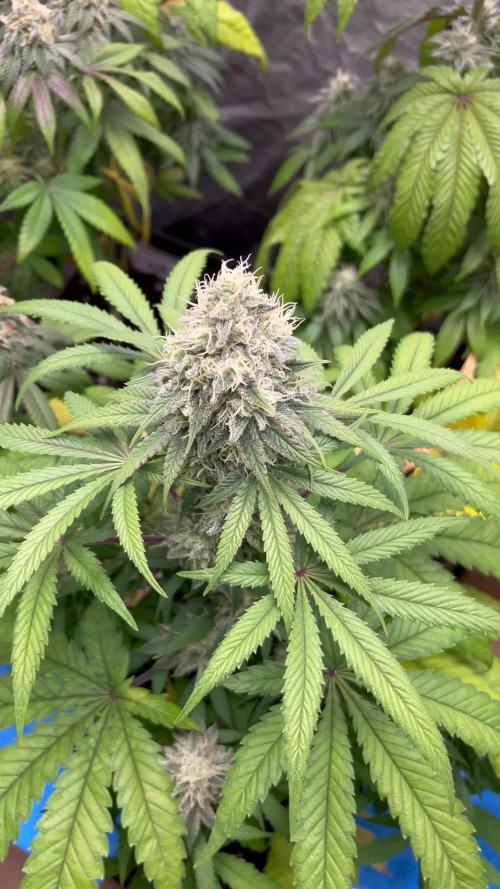
Que pasa familia, vamos con la sexta semana de floración de estas Gomu Gomu Mango feminizadas de HighBreed.
Vamos al lío ,se colocaron en macetas de 7 litros definitivamente.
El ph se controla en 6.0 , la temperatura la tenemos entre 24/20 grados y la humedad ronda el 50%.
El ciclo de Floración puse 12 horas de luz, el foco está al 100% de potencia.
De momento va creciendo, tiene buen color, van progresando y engordando guay
Comentar que superaron el estrés hídrico porque subí par de grados por la noche y va volvió a comer normal .
Gracias a Agrobeta por el kit para la temporada, unos jefes, siempre apoyando 💪.
- os dejo por aquí un CÓDIGO: Eldruida
Descuento para la tienda de MARS HYDRO.
https://www.mars-hydro.com
Hasta aquí todo, Buenos humos 💨💨💨
Likes
11
Share


Likes
13
Share


@Drawer
Follow
Removed some buds that weren't getting any light, I ran into some issues regarding mold and that is most likely due to the fact that the RH % of my tent goes up to 70/80% at night.
I've removed all mold I could see (2 branches) and I am keeping a close eye on them, I've placed a new tower fan and another small adjustable fan in the tent for more airflow, my dehumidifier is coming in 2 weeks (around the time this grow is finished..)

Likes
2
Share

@DogDoctorOfficial
Follow
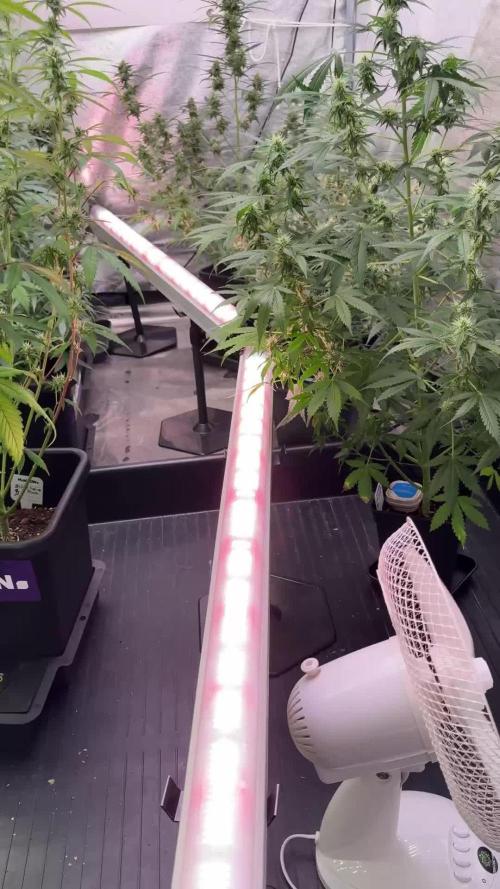
🌸 Week 9 – Opening the Door for the Flowers
Blueberry Muffin has always had an interesting personality in this tent.
She's not the tallest plant.
She's not the largest plant.
But she's been quietly building herself into a compact flowering machine.
And that's exactly why I decided that a little selective defoliation was appropriate this week.
We're not trying to strip her.
We're not trying to make her naked.
We're simply opening some space.
A few leaves here.
A little overlap there.
Removing foliage that is no longer helping the structure we're trying to maintain.
The goal is simple:
More breathing room.
Better light movement.
Better airflow.
Less unnecessary congestion.
And when you have twelve different plants sharing the same room, sometimes opening one plant slightly also helps the environment around her.
That's the beauty of working with the whole garden rather than looking at each plant in isolation.
✂️ Defoliation – It's About Purpose, Not Punishment
I've talked about this before, but this week is a perfect opportunity to repeat it.
Defoliation isn't about removing leaves because leaves are somehow "bad."
They're not.
Healthy leaves are incredibly valuable.
They're photosynthetic organs.
They're producing the energy the plant uses to grow and develop.
So when I remove a leaf, I want to have a reason.
Maybe it's heavily overlapping another leaf.
Maybe it's sitting inside an increasingly congested section of the canopy.
Maybe it's shading a developing flower while contributing relatively little to the structure.
Maybe removing it creates a much better pathway for air.
And sometimes...
it's simply part of cleaning the plant.
That's the approach we're taking with Blueberry Muffin.
Selective. Intentional. Moderate.
We're not trying to win a defoliation competition.
We're trying to create a healthier, more manageable flowering plant.
💨 Airflow Becomes More Important as Flowers Develop
This is where the timing becomes particularly interesting.
As the plant gets deeper into flower, the canopy naturally becomes more complicated.
Flowers get larger.
Leaves overlap.
Branches carry more biomass.
And spaces that were wide open earlier in the grow can gradually become pockets of dense vegetation.
That's not automatically a problem.
But it's something worth managing.
One of the reasons I wanted to open Blueberry Muffin a little more this week was simply to maintain air movement through the plant.
Good airflow doesn't mean blasting the flowers with a hurricane.
It means avoiding stagnant pockets of humid air trapped inside dense vegetation.
And as we move further into flowering, that's increasingly important.
Because nobody wants to discover a problem after flowers have already become dense.
Prevention is much easier than trying to fix a problem later.
💧 Helping the Room Breathe
There's another interesting side effect to opening the canopy.
The plants are collectively producing and moving a lot of moisture through transpiration.
When twelve plants are sharing a relatively enclosed environment, the canopy itself becomes a major part of the room's microclimate.
Opening congested areas gives moving air more pathways through the plants.
That can help reduce pockets of trapped humidity around the foliage.
And when the canopy breathes better, the whole room benefits.
Again, this isn't about expecting defoliation to magically control room humidity.
The ventilation system is still doing the heavy lifting.
But good canopy management can make the environment easier to manage.
And that's exactly what we're looking for.
💡 Every Photon Has Somewhere to Go
Blueberry Muffin is also at an interesting size.
She's approximately 75 cm tall.
That's not a huge plant.
And because she's relatively compact, I want to make sure the available light isn't unnecessarily intercepted by layers of foliage sitting on top of other foliage.
Yes, she has support from the under-canopy and inner-canopy lighting strategy.
And that's fantastic.
But additional lighting doesn't mean we should deliberately create unnecessary barriers between the light and the flowers.
If we can open a section naturally and allow more photons to travel through the canopy, why not?
We're not trying to expose every square centimetre of the plant.
We're simply making the canopy a little more efficient.
Sometimes the best lighting upgrade is simply...
removing something that doesn't need to be in the way.
🌸 The Flowers Are Taking Over Now
And this is where the photographs become particularly exciting.
The flowers are becoming increasingly obvious throughout the plant.
The white pistils are still doing a lot of the visual talking, but the individual flowering sites are gaining structure and substance.
She's moving away from that early-flower appearance where everything is basically a collection of little pistil-covered points.
Now we're beginning to see the plant building actual floral mass.
The branches are carrying their flowers with confidence.
The canopy has become more compact.
And the whole plant feels like she's entering another chapter.
This is the stage where I stop being interested in how much she's going to stretch...
and become much more interested in how much she's going to stack.
? The Blueberry Muffin Personality
One thing I really appreciate about this phenotype is how different she looks when compared with some of the other genetics in the tent.
She's not trying to dominate.
She isn't the tallest.
She doesn't have the most dramatic structure.
But she's developing her own little architecture.
And that's what this entire 8×8 Adventure is about.
Twelve genetics.
One room.
One general environment.
And twelve completely different answers.
Blueberry Muffin's answer seems to be:
"Give me some time."
And now she's starting to show us why.
💚 Nutrition – Staying the Course
There's no reason to reinvent the feeding programme this week.
We're keeping nutrition essentially unchanged.
Current feeding remains:
Terra Bloom — 2.2 ml/L
Pure Zym — 1 ml/L
Power Buds — 1 ml/L
Sugar Royal — 1 ml/L
pH Plus / Lemon Kick — as required
The plant continues receiving the same flowering nutrition rather than reacting to every small visual change with another adjustment.
That's important.
We made a structural intervention this week.
We don't need to simultaneously start changing everything else.
One change at a time makes the plant much easier to read.
🌡️ The Room Has Changed
And this week we do have a small but interesting environmental change.
The daytime temperature remains around:
29°C
But the night temperature is now approximately:
26°C
Last week we were around 25.6°C, so the difference isn't dramatic, but the overall night temperature is slightly warmer.
That means our day/night temperature differential is now smaller.
We're also sitting around:
RH: 60%
Solution temperature: 25°C
Root-zone/substrate temperature: 25°C
CO₂: ~693 ppm
Light schedule: 12/12
Watering: ~1.3 L per plant / 24h
Container: 15 L
And I actually like observing these little changes.
The room doesn't have to remain frozen in time.
What matters is understanding what changed and watching how the plants respond.
At this stage, with flowers getting denser, keeping the canopy open and maintaining good air movement becomes even more valuable.
🌙 Day vs Night – The Difference Matters
One of the things I enjoy about documenting these numbers is that they tell us more than a single temperature reading.
We're running approximately:
29°C during the day → 26°C at night.
That's only about a 3°C difference.
Earlier in the run, the difference was a little larger.
As the room changes, so does the relationship between temperature, humidity, transpiration and plant development.
And this is why I don't like looking at temperature or humidity as isolated numbers.
The plant doesn't experience "29°C."
It experiences:
temperature + humidity + light + airflow + root-zone conditions + CO₂ + time of day.
Everything interacts.
And right now, I'm happy with what the room is showing us.
We're watching it.
We're measuring it.
And we're adjusting when necessary rather than reacting to every little fluctuation.
🔬 One More Reason I Like This Defoliation
There's something else happening here that I think is easy to overlook.
Cleaning the plant isn't only about what remains.
It's also about what we can see afterward.
Once some of the unnecessary foliage is removed, I can see the flowering structure much more clearly.
I can see which branches are developing strongly.
I can see where flowers are stacking.
I can see where the canopy remains dense.
And I can see what might need attention later.
In other words...
defoliation also improves observation.
And for this project, observation is half the fun.
🔮 Looking Ahead
From here, I want to keep things relatively simple.
No unnecessary training.
No dramatic interventions.
No chasing numbers just because they're numbers.
We'll continue watching the flowers develop, monitoring the canopy and paying attention to how she responds to the cleanup.
The next stage should increasingly be about:
🌸 flower stacking
🌸 calyx development
🌸 increasing resin production
🌸 increasing flower density
🌸 maintaining airflow
🌸 keeping the environment stable
The framework is already there.
Now we're entering the part of the journey where patience becomes more important than intervention.
We've done our job.
Now...
let Blueberry Muffin do hers.
💭 Final Thoughts – Making Space for What's Coming
I think this week is a really good example of how I like to grow.
We didn't defoliate because someone told us:
"Week 9 means defoliation."
We did it because the plant changed.
She's becoming more compact.
She's developing more flowers.
The canopy is getting denser.
She isn't a particularly tall plant, so making the available photons work efficiently matters.
And with twelve plants sharing the same room, keeping air moving through the garden matters too.
So we opened her up.
Not dramatically.
Not aggressively.
Just enough.
And now she looks cleaner, more open and easier to read.
That's what I wanted.
Not a naked plant.
A better-organised plant.
And honestly...
she looks fantastic.
Blueberry Muffin may not have started this journey as the plant that immediately grabbed everyone's attention.
But she's slowly becoming one of those phenotypes where you look back at the earlier photographs and think:
"Oh... now I see what she was doing."
She's been building toward this.
And now she's starting to show it.
?🌸🔥
🙏 Thank You
A huge thank you once again to Zamnesia for giving us the opportunity to explore these genetics, Plagron for supporting the garden throughout the journey, Future of Grow for providing the light that powers this experiment, Lumiflora for bringing additional light into the inner and lower canopy, TrolMaster for helping maintain environmental stability, and of course everyone following this 8×8 Adventure on GrowDiaries.
Every week gives us another little lesson.
Sometimes it's about nutrition.
Sometimes it's about environment.
Sometimes it's about genetics.
And sometimes...
it's simply about knowing when to take a few leaves away and give the plant a little more room to breathe.
Blueberry Muffin is entering another chapter now.
The canopy is open.
The flowers are developing.
The room is stable.
And there's still plenty of story left to write.
Until next week...
Growers Love and happy growing! 🌱💚?
Likes
33
Share


@Viridios
Follow
Nothing much to report..except..These plant's are amazing !!! 😁😁🔥🔥. Looks like someone thru a bag of suger over them, really strong sweet smells, flowers starting to swell nicely.
I'm very happy so far...it's gona be danky dank...💚💚😁

Likes
10
Share


@MrJones
Follow
White Chrystal Meth Auto
🔸🔸🔸🔸🔸🔸🔸🔸🔸🔸
~~~~04.20.23~~~~
“DAY 72 Above Ground”
📝Sunday 07.02.23 - This lady has lagged behind the others who started at the same time, they are in their projected harvest window, but feel they need another few weeks.
📝Wednesday 06.28.23 - The buds continue to pack on weight and ripen, the smell in the tent is amazing, fed with a Mayan tea from Humbolt Nutrients, loved the way it looked, they have great products.
~~~~~~~~~~~~~~~~~~
🔸🔸🔸🔸🔸🔸🔸🔸🔸🔸
🌱White Chrystal Meth Auto
👨🌾🏽Grown By: MrJones
🔆@medicgrow420
@originalsensibleseeds



Likes
75
Share


@Pungolian
Follow
Letting mother nature do her thing, lol. Im learning a lot . Got my pots tied down to the deck and supported with other dirt pots and water jugs, lol. I wonder how big they would be if I planted them in the ground! Going to half to hire help come harvest time lol


Likes
3
Share


Likes
21
Share


@Salokin
Follow
Week 6 Flower | GMO × Triangle Mints BX
Week 13 overall, and the ladies are firmly in ripening mode now. The transition is visible — bud density is increasing week on week, trichome coverage is building across every surface, and the natural senescence is beginning to show on some of the fan leaves. Nitrogen is being drawn down, temperatures are running cooler, and the plant is doing exactly what it should at this stage of the game. Nothing to chase, nothing to fix — just letting the genetics do their thing.
This was the last week of base nutrients. From next week, Athena Fade takes over for the final three weeks — a deliberate choice to manage the finish cleanly and let the plant draw down its reserves on its own terms rather than pushing nutrients all the way to the end.
The ladies are drinking hard — watering jumped to 6L per plant per 24h this week, a clear signal that the root zone is active and the canopy is working at full capacity. pH holding at 6.2, EC brought back to 1.8 mS/cm as the feed profile shifts toward the finish. Humidity holding at 50%, day temp pulled down to 25°C, nights at 23°C — the cooler environment is intentional, encouraging resin production and supporting the natural fade without stressing the buds.
PK 13/14 is out — fully replaced by Plagron Green Sensation now running at 1 ml/l. The rest of the stack: Canna CalMag Agent 1.1 ml/l, CANNA Aqua Flores A+B at 4 ml/l each, Aptus Regulator 0.1 ml/l, Green Planet Rezin 1 ml/l. Feed rotation stays unchanged — two full feeds, third is 50/50 osmosis and tap, pH’d, carrying only CalMag.
Smell is at another level this week — an intense, room-filling candy gas that hits you the moment you open the tent. The GMO × Triangle Mints BX is leaving absolutely no doubt about what it is.
Next update Sunday. Stay tuned.
Likes
27
Share


@adam_pawloski87
Follow
First off I just want to say for some reason it’s not letting me change the right temperatures on my diaries ! Each time when I put it in they stay at 50. My day air stays 75 degrees an , night degrees is 70 !
Today is day 58 for all these ladies! This week has been really great ! Girls really progressed a lot , especially for one the Forbiddin Runtz, looks like is gonna finish up in a week or 2 ! Other then that they are coming along well! Keep those eyes peeled for next week! Cheers😶🌫️💨💨💨💨
Likes
2
Share


@smokeycropping
Follow
- LAS PLANTAS SIGUEN CON EL MISMO PLAN NUTRICIONAL
- NO SE VEN CARENCIAS NI EXCESOS
- el hps de 600 MANTIENE MI AMBIENTE SIN MAYORES INCONVENIENTES
-NO SE VEN PLAGAS NI MAYORES PROBLEMAS


