


Likes
Comments
Share


Likes
11
Share


@Socal6pak
Follow
this grow has not been good. but its ok. all part of the process. leaves are not as green as i liked. i see leaf edges burned. so most likely just too much nute in soil? i did lost one. but its ok. she didn't do well from the beginning. maybe soil was just too hot and heavy?

Likes
46
Share


@Juschiln420
Follow
They are still not too happy with me... Not liking the nutrient strength I choose again.. So after 24hrs of just ph water and 1/4 strength hydroguard. No change I thought they would appreciate just water and a root stimulate. But no change in root or plant mass. Looking like they are very stunted from nutrient burn.
So moving forward I went with same strength as the 1st feeding that they liked. But I did it in a hurry before work and realized after the fact that I put that same amount I put before but didn't account for lowering the water level to 3.5 gal from 4gal. So end up being slightly stronger then before. I did add 0.5ml of hydroguard to each bucket. Also added 0.5 of bud candy to each bucket. But hoping they work with me fingers crossed.
4/12/2023 5.8/72°F/221(Left rear) 5.8/72°F/227(Middle front) 5.8/72°F/214(right rear)
No sign of transitioning to flower yet.
4/14/23 Colorado Cookies recovered and jumped like a inch looking alot better! Overall Height 3.5"
And I noticed that there was some growth in the root zone. But noticed there is something going on with the upper leafs.
Runtz Seems to be recovering but still a little rough. Overall Height 2" But I did notice the roots mass did not change and they still appear to have the brown tint and seems to have gotten slightly worse toward the bottom of 6"net basket. I believe that's contributing to the slow recovery. Still looking alot better tho.
Banana Purple Punch seems to have bearly changed at all. There's very slight growth in center. No change to root mass at all. Overall Height 1.5"
Found some very helpful information on measuring EC instead of ppm and how to monitor EC and Ph. So will be doing this moving forward. I'm going to redo Banana's bucket to exactly what I gave the 1st time she was happy but this time accounting for the .5 gal change in water level. I'm also looking into if I can use the hydroguard at full strength on nutrient burned autos since its not a nutrient for the plant. But I need to fight the brown roots in runtz tonight. See if I can't get all three happy! And save this grow to a more acceptable outcome.
Stats 4/14/2023 6.25Ph/72°F/222ppm(runtz) 6.33Ph/72°F/218ppm(banana) 6.28Ph/72°F/215ppm Cookies
I added 1ml total hydroguard to all and added .05 total calmag to all and ph to 5.8
4/15 I changed the water on all buckets. raised the water level back to 4 gal on Banana since it has the smallest root mass. And put full strength hydroguard and full strength rapid start in all buckets amd ph to 5.8 and left it for 24 hrs. I made a floral spray of armor si at 0.33ml to full spray bottle. Wet em down good. Twice today.
4/16 I noticed Banana's leaf tips began to droup a little. So lowered water back to 3.5 gal and mixed the nutrients for 3 gal to be safe and leave ppm for cal mag and bud candy without nutrient burn. Added 0.5 cal mag and 0.5 bud candy. I trimmed all the burned leaf tips off, so I can see if and when it burns again. And since it was the best my test has looked yet I took a video and some pictures. But still need to figure out whats going on with Colorado cookies. Has spotty yellowing. Thought maybe light burn. So checked and raised like a inch or so. But there leafs below that are almost fully yellow. Like nutrient deficiency. Trying to read her but not getting it yet. gavw them a spray of armor si.
4/17 ph to 5.8 bucket stats. Sprayed with armor si
6.1/74°F/200ppm/425uscm/0.85EC(Runtz) 6.3/72°F/207ppm/440uscm/0.88EC(Banana) 6.0/74°F/210ppm/446uscm/0.89EC(cookies)
Thinking about LST cookies and pull top down. But want to address the yellowing 1st.
4/18 I changed the water in buckets to just water with 50ml hydrogen peroxide 3% to 3.5 gal water and left it for 3 hrs. During this 3 hrs I turned both fans off and made a foliar spray with 0.30 ml gh flora trio and 0.25 cal mag and sprayed them down and turned the light off for 3 hrs.
So after the 3 hrs peroxide treatment. I changed water out with fresh water and did my nutrient differently.
I got the EC of my tap water whixh was between 0.19 and 0.23 between the buckets. Then I added cal mag to 0.5EC
And added nutrients base and additions to a EC of 1.0. Then I added 4ml hydroguard to 3.5gal. And ph to 5.8
Banana
0.19EC
3.5ml cal mag
3ml GH Flora Trio
1.5ml Bud Candy
1.5ml Rapid Start
0.25ml GH Flora Macro
4ml Hydroguard
7.4ph
242ppm 517uscm 1.0 EC
Cookies
0.23 EC
3.1ml cal mag
3.1ml GH Flora Trio
1.5ml Bud Candy
1.5ml Rapid Start
0.40ml GH Flora Macro
0.42ml GH Flora Gro
0.25ml GH Bloom
4ml Hydroguard
Ph 7.3
235ppm 500uscm 1.0EC
Runtz
0.22EC
3.2ml Cal mag
3ml GH Flora Trio
1.5ml Bud Candy
1.5ml Rapid Start
0.25ml GH Flora Macro
0.40ml GH Flora Gro
0.25ml GH Flora Bloom
4ml Hydroguard
7.4ph
235ppm 500uscm
Ph all to 5.8
That was last night at 11:30pm
This morning at 5:20am stats
4/19/2023 5.9/74°F/238ppm/506uscm/1.0 EC(Runtz) 5.9/73°F/232ppm/493uscm/0.98 EC(Banana) 6.0/74°F/232ppm/493uscm/0.98EC(Cookies)
Ph To 5.8


Likes
5
Share


@GrowFunMD
Follow
What a world of difference a week can make when growing auto-flowers. I did a lot of maintenance on these girls the last couple of days. See pics and videos. Two of the plants have stretched out nicely. The other three are falling behind, but looking very nice. There is a strong citrus smell happening right now. Smells like I have a tent full of fresh lemons. Started using Big Bud and Bud Candy this past week. Tent 2as getting quite crowded, so I also moved the water reservoir on the outside of the tent. It was very hard to cut a lot of those beautiful buds off the plants, but I think it will pay off. I also got the new Vivosun Grow Cams, so far I like them, but I do have some feed back.

Likes
5
Share
@Chrisandweed
Follow
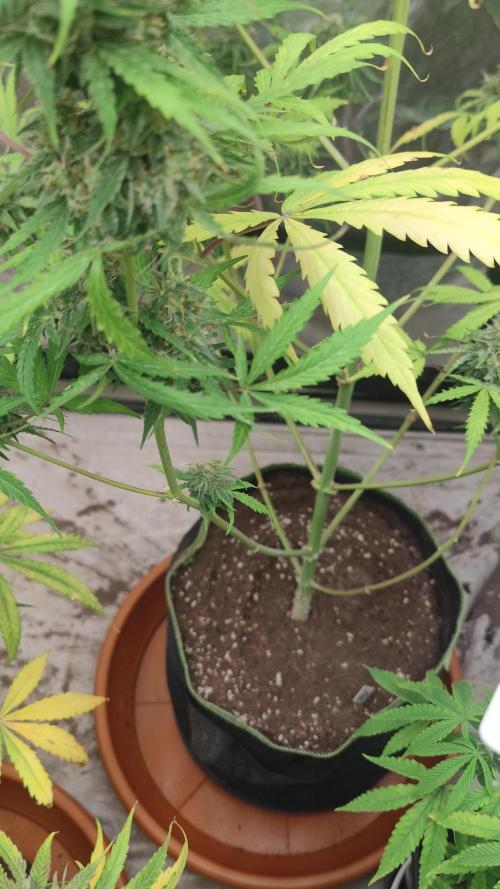
A ver, la planta va muy bien, crece muy bien, tragando agua sigue igual, al mismo ritmo, cada 2 o 2 dias y medio le hecho sus 3 litros, y a veces riego con 7 para que drene algo. Ahora bien, el amarillo... ¿Porque está tan amarilla!?
-Puede ser por haber pecado de ir flojo con los nutrientes. Falta de potasio.
-Puede ser por bloqueo por PH o por sales.
-Puede ser un hongo.
-O puede ser, y es aquí mi teoría jajajaja, que dado que esta planta ya la he cultivado dos veces mas antes, la primera vez, fue bastante mejor que la segunda y pude asegurar el lavado y llegar bien a sus últimas fases y tal (se cagó en el secado que duró 4 dias jajajaja pero bueno, de todo se aprende) y lo curioso, es que en ese primer cultivo, me amarilleo también muuy pronto, con las mismas manchas y de aquí mi teoria: este genotipo alarga el uso del nitrogeno hasta fases avanzadas de floracion y además empieza a tirar de reservas antes de lo habitual (lo cual explicaría que esta es una de esas plantas que en una semana ha madurado y no te das cuenta) y dado que en floracion el ph se baja, yo lo fui bajando conforme arrancó el stretching por lo que le fui limitando las reservas de nitrogeno antes de lo que ESTE GENOTIPO pide, y de ahí el amarillenteo de la mayoria de las hojas.
Como tengo todavía varias semillas mas de esta, seguiré plantándola a ver hasta donde podemos llevarla y gracias a cosas como estas, ir aprendiendo por el proceso.
PD: tengo ramas atadas o apoyadas a la pared por que se caen del peso xD

Processing
Likes
57
Share


@Silverback_Guerilla
Follow
1/11:
Fed today, but had no time for a photo sesh.
All good. Systems nominal.
1/15:
Was gonna feed today, but had no time...
1/16:
Fed today...they were very thirsty...
Took a few photos. Zenzations will be the first to finish..they are both senescing and smell great. Prolly another 14 days or so for them. Black Jacks and Gorilla Girls still have 3-4 weeks left to go.

Likes
14
Share


@DrJoint
Follow
I was not expecting to harvest that much as she was a tiny and quite slow girl, but the final yeld was very good! It was exciting to grow and finally harvest this amazing strain :)


Likes
8
Share


@I_Identify_As_A_Dan
Follow
Let her go her full 9 weeks as recommended.
Will update again on smoke report, but for now shes really a beautiful plant. 😎

Likes
6
Share


@Krissci
Follow
Day 3-4 I lost a main stem on GR1 and broke another stem but it will recover.. GR2 all stems are fine
Day 6 - light LST on main nodes....very long stems and internodal spacing.


Likes
12
Share


@Amboss
Follow
Am Samstag direkt in die Erde gesteckt.
Mit der Blumat Classic Bewässerung und etwas zusätzliches bewässern der Topfe durch ne Gießkanne, von oben nur mit Wasser.
In den Blumat Tanks sind die Nutrients.
Nach 5 Tagen kamen die ersten 2/6.
Nach der Pause waren dann alle 6/6 von da.
Voller Erfolg.
Processing
Likes
7
Share


@Dairon
Follow
En esta ocasión voy a cultivar unas semillas de Critical X Widow de Terra Grow ( https://www.instagram.com/terragrow/?hl=es ) germinadas todas en menos de 24 h, pasaré a macetero de 0.6l con sustrato light mix de biobizz
Likes
18
Share


@Roberts
Follow
Zealix is growing well. She got some lst and defoliation today. Everything is looking good as she is progressing in vegging. Nothing new to report beyond that. Thank you Medic Grow, and Terpyz mutant Genetics. 🤜🏻🤛🏻🌱🌱🌱
Thank you grow diaries community for the 👇likes👇, follows, comments, and subscriptions on my YouTube channel👇.
❄️🌱🍻 Happy Growing 🌱🌱🌱
https://youtube.com/channel/UCAhN7yRzWLpcaRHhMIQ7X4g.

Likes
7
Share

@DeepRootsGrowTrees
Follow
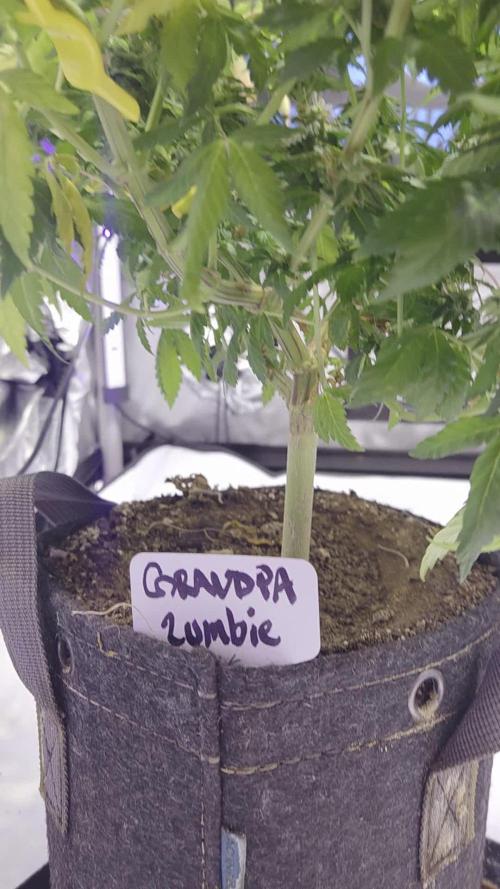
GRANDPA ZOMBIE 🧟♂️ / IZI SEEDS WEEK #15 OVERALL
WEEK #9 FLOWER
This week she's looking beautiful she's got all the fall colors going on. Her buds are are continuing to gain weight and density she's sticky to the touch and smells great 👍, you can't go wrong with this strain!! She's checking most the boxes!! STAY GROWING MY FRIENDS 🧡!!
THANK YOU 😊 FOR STOPPING BY AND TAKING A 👀 IT'S MUCH APPRECIATED!!
THANK YOU 😊 IZI SEEDS!!
GRANDPA ZOMBIE 🧟♂️ / IZI SEEDS

Likes
23
Share


@Cannabar
Follow
Great week, more growth and the girl scout cookies is looking f*cking frosty! The Purple Lemonade is packing on the weight. The Zkittlez is almost ready and the Orange Sherbet is definitely getting there slowly.
Zkittlez - Flushed for the last 2 days and will be for the rest of the week
Purple Lemonade - Flushed for the last 2 days and will be for the rest of the week
Orange Sherbet - Usual feed (still a couple more weeks to go)
Girl Scout Cookies - Usual feed (still a couple more weeks to go)
I will update weights, pics, reports for the two I harvest sometime in the next couple of weeks.
Onto next week!
25.01.21 - UPDATE
The Zkittlez got the chop on Saturday evening (23.01.21). Currently drying in another tent.
The Purple Lemonade was chopped earlier tonight.
Also bought a Mars Hydro TS1000 on Saturday for the next grow 😁 can't wait to use it!!! Still deciding which strains to grow next 🤔
Likes
10
Share


@SelfCultivationGrower
Follow
I was on 14 vacation and my tent went crazy. Didn‘t expect that the Stretch will be so strong. I have to defoliate

Processing
Likes
Comments
Share


@Amiro0o
Follow
Grows very fast in compare to other special queen's that i started 2 weeks earlier.
Its 25 days from seed.and much bigger than the others..
Im going to try low stress training but i dont know if its a right time or not.
It s my first grow indoor And i will be happy with some help from old Growers..
Likes
Comments
Share


@Dankmark420
Follow
All 5 seeds germinated nicely🙏🏼
This is our first grow so we are really excited🙌🏼

Likes
3
Share


@Ninjabuds
Follow
Week 6I wish they didn't make me do this to get a smileI wish they didn't make me do this to get a smileI wish they didn't make me do this to get a smileI wish they didn't make me do this to get a smileI wish they didn't make me do this to get a smileI wish they didn't make me do this to get a smileI wish they didn't make me do this to get a smileI wish they didn't make me do this to get a smileI wish they didn't make me do this to get a smileI wish they didn't make me do this to get a smileI wish they didn't make me do this to get a smileI wish they didn't make me do this to get a smile

Likes
8
Share


@Ginger_gnome
Follow
Buds are starting to really stack up. Especially on the blue Cookies. The zombie kush plants are also looking really good but the size and also the color isn't as nice. The one blue Cookies plant that is turning purple tho is throwing me off because the blue Cookies plant doesn't turn purple. From what I can see from crop king is that platinum cookies and purple kush are the only ones that turn purple like this so I'm not sure if it's just a genetic freak or a different strain. The platinum og plants tho still look worse for wear and not getting much better. Hopefully they end with something tho.
Well that's all for now so happy growing.
