The Grow Awards 2026 🏆
Likes
Comments
Share
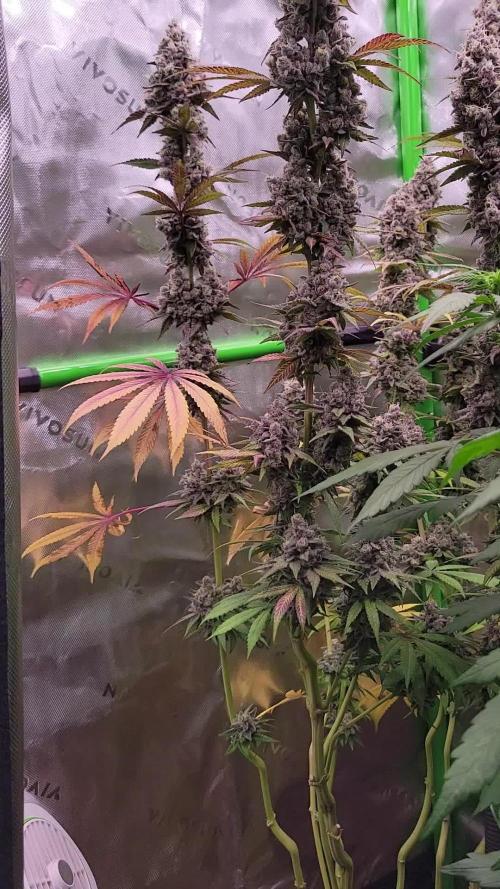
Buenas a tod@s... Bueno otra semanita más de estas hermosas nenas, ya más grandes y empezando a desarrollar sus frutos, la verdad q están creciendo muy bien, sin problemas, aunq hay veces q la temperatura este un poco alta las voy controlando y van muy bien, este cultivo yo creo q promete para bien... Me gusta ver buenos resultados cada vez q empiezo un cultivo nuevo, super contento y las niñas tanbm... 🙌🏻🙏🏻💀😎💪🏻 Buenos humos para tod@s...🔥🔥💨💨 🇦🇷🤝🏻🇪🇦
Likes
6
Share
Привет садоводы Кажется цветок вырос отличный, просто красавица и наверно он уже готов еще несколько дней после полива и финиш
Likes
22
Share
I'm very satisfied. 402 grams of wet buds. That could be over 100 grams dry. I have 4 plants in my 0,64 m² tent, it only had 0,16 m² space for its own. The result will come in about 2 weeks.
Likes
4
Share
Hacemos domingo 4 mayo te aireado y echamos 22 gr de top dress
Likes
52
Share
Lacewings seemed to have mostly killed themselves by flying into hot light fixtures. I may have left the UV on which was smart of me :) Done very little to combat if anything but make a sea of carcasses, on the bright side its good nutrition for the soil. Made a concoction of ethanol 70%, equal parts water, and cayenne pepper with a couple of squirts of dish soap. Took around an hour of good scrubbing the entire canopy. Worked a lot more effectively and way cheaper. Scorched earth right now, but it seems to have wiped them out almost entirely very pleased. Attempted a "Fudge I Missed" for the topping. So just time to wait and see how it goes. Question? If I attached a plant to two separate pots but it was connected by rootzone, one has a pH of 7.5 ish the other has 4.5. Would the Intelligence of the plant able to dictate each pot separately to uptake the nutrients best suited to pH or would it still try to draw nitrogen from a pot with a pH where nitrogen struggles to uptake? Food for stoner thought experiments! Another was on my mind. What happens when a plant gets too much light? Well, it burns and curls up leaves. That's the heat radiation, let's remove excess heat, now what? I've always read it's just bad, or not good, but when I look for an explanation on a deeper level it's just bad and you shouldn't do it. So I did. How much can a cannabis plant absorb, 40 moles in a day, ok I'll give it 60 moles. 80 nothing bad ever happened. The answer, finally. Oh great........more questions........ Reactive oxygen species (ROS) are molecules capable of independent existence, containing at least one oxygen atom and one or more unpaired electrons. "Sunlight is the essential source of energy for most photosynthetic organisms, yet sunlight in excess of the organism’s photosynthetic capacity can generate reactive oxygen species (ROS) that lead to cellular damage. To avoid damage, plants respond to high light (HL) by activating photophysical pathways that safely convert excess energy to heat, which is known as nonphotochemical quenching (NPQ) (Rochaix, 2014). While NPQ allows for healthy growth, it also limits the overall photosynthetic efficiency under many conditions. If NPQ were optimized for biomass, yields would improve dramatically, potentially by up to 30% (Kromdijk et al., 2016; Zhu et al., 2010). However, critical information to guide optimization is still lacking, including the molecular origin of NPQ and the mechanism of regulation." What I found most interesting was research pointing out that pH is linked to this defense mechanism. The organism can better facilitate "quenching" when oversaturated with light in a low pH. Now I Know during photosynthesis plants naturally produce exudates (chemicals that are secreted through their roots). Do they have the ability to alter pH themselves using these excretions? Or is that done by the beneficial bacteria? If I can prevent reactive oxygen species from causing damage by "too much light". The extra water needed to keep this level of burn cooled though, I must learn to crawl before I can run. Reactive oxygen species (ROS) are key signaling molecules that enable cells to rapidly respond to different stimuli. In plants, ROS plays a crucial role in abiotic and biotic stress sensing, integration of different environmental signals, and activation of stress-response networks, thus contributing to the establishment of defense mechanisms and plant resilience. Recent advances in the study of ROS signaling in plants include the identification of ROS receptors and key regulatory hubs that connect ROS signaling with other important stress-response signal transduction pathways and hormones, as well as new roles for ROS in organelle-to-organelle and cell-to-cell signaling. Our understanding of how ROS are regulated in cells by balancing production, scavenging, and transport has also increased. In this Review, we discuss these promising developments and how they might be used to increase plant resilience to environmental stress. Temperature stress is one of the major abiotic stresses that adversely affect agricultural productivity worldwide. Temperatures beyond a plant's physiological optimum can trigger significant physiological and biochemical perturbations, reducing plant growth and tolerance to stress. Improving a plant's tolerance to these temperature fluctuations requires a deep understanding of its responses to environmental change. To adapt to temperature fluctuations, plants tailor their acclimatory signal transduction events, specifically, cellular redox state, that are governed by plant hormones, reactive oxygen species (ROS) regulatory systems, and other molecular components. The role of ROS in plants as important signaling molecules during stress acclimation has recently been established. Here, hormone-triggered ROS produced by NADPH oxidases, feedback regulation, and integrated signaling events during temperature stress activate stress-response pathways and induce acclimation or defense mechanisms. At the other extreme, excess ROS accumulation, following temperature-induced oxidative stress, can have negative consequences on plant growth and stress acclimation. The excessive ROS is regulated by the ROS scavenging system, which subsequently promotes plant tolerance. All these signaling events, including crosstalk between hormones and ROS, modify the plant's transcriptomic, metabolomic, and biochemical states and promote plant acclimation, tolerance, and survival. Here, we provide a comprehensive review of the ROS, hormones, and their joint role in shaping a plant's responses to high and low temperatures, and we conclude by outlining hormone/ROS-regulated plant-responsive strategies for developing stress-tolerant crops to combat temperature changes. Onward upward for now. Next! Adenosine triphosphate (ATP) is an energy-carrying molecule known as "the energy currency of life" or "the fuel of life," because it's the universal energy source for all living cells.1 Every living organism consists of cells that rely on ATP for their energy needs. ATP is made by converting the food we eat into energy. It's an essential building block for all life forms. Without ATP, cells wouldn't have the fuel or power to perform functions necessary to stay alive, and they would eventually die. All forms of life rely on ATP to do the things they must do to survive.2 ATP is made of a nitrogen base (adenine) and a sugar molecule (ribose), which create adenosine, plus three phosphate molecules. If adenosine only has one phosphate molecule, it’s called adenosine monophosphate (AMP). If it has two phosphates, it’s called adenosine diphosphate (ADP). Although adenosine is a fundamental part of ATP, when it comes to providing energy to a cell and fueling cellular processes, the phosphate molecules are what really matter. The most energy-loaded composition for adenosine is ATP, which has three phosphates.3 ATP was first discovered in the 1920s. In 1929, Karl Lohmann—a German chemist studying muscle contractions—isolated what we now call adenosine triphosphate in a laboratory. At the time, Lohmann called ATP by a different name. It wasn't until a decade later, in 1939, that Nobel Prize–-winner Fritz Lipmann established that ATP is the universal carrier of energy in all living cells and coined the term "energy-rich phosphate bonds."45 Lipmann focused on phosphate bonds as the key to ATP being the universal energy source for all living cells, because adenosine triphosphate releases energy when one of its three phosphate bonds breaks off to form ADP. ATP is a high-energy molecule with three phosphate bonds; ADP is low-energy with only two phosphate bonds. The Twos and Threes of ATP and ADP Adenosine triphosphate (ATP) becomes adenosine diphosphate (ADP) when one of its three phosphate molecules breaks free and releases energy (“tri” means “three,” while “di” means “two”). Conversely, ADP becomes ATP when a phosphate molecule is added. As part of an ongoing energy cycle, ADP is constantly recycled back into ATP.3 Much like a rechargeable battery with a fluctuating state of charge, ATP represents a fully charged battery, and ADP represents a "low-power mode." Every time a fully charged ATP molecule loses a phosphate bond, it becomes ADP; energy is released via the process of ATP becoming ADP. On the flip side, when a phosphate bond is added, ADP becomes ATP. When ADP becomes ATP, what was previously a low-charged energy adenosine molecule (ADP) becomes fully charged ATP. This energy-creation and energy-depletion cycle happens time and time again, much like your smartphone battery can be recharged countless times during its lifespan. The human body uses molecules held in the fats, proteins, and carbohydrates we eat or drink as sources of energy to make ATP. This happens through a process called hydrolysis . After food is digested, it's synthesized into glucose, which is a form of sugar. Glucose is the main source of fuel that our cells' mitochondria use to convert caloric energy from food into ATP, which is an energy form that can be used by cells. ATP is made via a process called cellular respiration that occurs in the mitochondria of a cell. Mitochondria are tiny subunits within a cell that specialize in extracting energy from the foods we eat and converting it into ATP. Mitochondria can convert glucose into ATP via two different types of cellular respiration: Aerobic (with oxygen) Anaerobic (without oxygen) Aerobic cellular respiration transforms glucose into ATP in a three-step process, as follows: Step 1: Glycolysis Step 2: The Krebs cycle (also called the citric acid cycle) Step 3: Electron transport chain During glycolysis, glucose (i.e., sugar) from food sources is broken down into pyruvate molecules. This is followed by the Krebs cycle, which is an aerobic process that uses oxygen to finish breaking down sugar and harnesses energy into electron carriers that fuel the synthesis of ATP. Lastly, the electron transport chain (ETC) pumps positively charged protons that drive ATP production throughout the mitochondria’s inner membrane.2 ATP can also be produced without oxygen (i.e., anaerobic), which is something plants, algae, and some bacteria do by converting the energy held in sunlight into energy that can be used by a cell via photosynthesis. Anaerobic exercise means that your body is working out "without oxygen." Anaerobic glycolysis occurs in human cells when there isn't enough oxygen available during an anaerobic workout. If no oxygen is present during cellular respiration, pyruvate can't enter the Krebs cycle and is oxidized into lactic acid. In the absence of oxygen, lactic acid fermentation makes ATP anaerobically. The burning sensation you feel in your muscles when you're huffing and puffing during anaerobic high-intensity interval training (HIIT) that maxes out your aerobic capacity or during a strenuous weight-lifting workout is lactic acid, which is used to make ATP via anaerobic glycolysis. During aerobic exercise, mitochondria have enough oxygen to make ATP aerobically. However, when you're out of breath and your cells don’t have enough oxygen to perform cellular respiration aerobically, the process can still happen anaerobically, but it creates a temporary burning sensation in your skeletal muscles. Why ATP Is So Important? ATP is essential for life and makes it possible for us to do the things we do. Without ATP, cells wouldn't be able to use the energy held in food to fuel cellular processes, and an organism couldn't stay alive. As a real-world example, when a car runs out of gas and is parked on the side of the road, the only thing that will make the car drivable again is putting some gasoline back in the tank. For all living cells, ATP is like the gas in a car's fuel tank. Without ATP, cells wouldn't have a source of usable energy, and the organism would die. Eating a well-balanced diet and staying hydrated should give your body all the resources it needs to produce plenty of ATP. Although some athletes may slightly improve their performance by taking supplements or ergonomic aids designed to increase ATP production, it's debatable that oral adenosine triphosphate supplementation actually increases energy. An average cell in the human body uses about 10 million ATP molecules per second and can recycle all of its ATP in less than a minute. Over 24 hours, the human body turns over its weight in ATP. You can last weeks without food. You can last days without water. You can last minutes without oxygen. You can last 16 seconds at most without ATP. Food amounts to one-third of ATP production within the human body.
Likes
Comments
Share
Welcome to Week 4! November 3 All is well, I see a little discoloration so I’m just keeping an eye on them. Watered today - 7.5g Grow/gallon November 4 Rearranged and increased lux to 30,000
Likes
14
Share
Que pasa familia, vamos con la sexta semana de floración de estas Gorilla Zkittlez Auto de FastBuds. La tierra que utilizamos que está en la publicación anterior es top crop all mix, aparte alimentamos nuestras plantas con Agrobeta. Por supuesto el ph se mide en cada riego y se mantiene en 6.2, regando cada 48/72 horas e intentando mantener la humedad un poco alta al principio. Se ven bien sanas tienen buen color , ya empiezan asomar aromas y el tamaño bueno no puedo quejarme, estas semanas vemos como maduran las flores. Agrobeta: https://www.agrobeta.com/agrobetatiendaonline/36-abonos-canamo Hasta aquí todo, Buenos humos 💨💨
Processing
Likes
2
Share
@MephodMan
Follow
Tap root issues - too long in jiffy block Still working on dialling in VPD
Likes
28
Share
@FarmZOG
Follow
Week 7 Day 42 our VPD is getting higher day to day, we in the 1.2 - 1.4 range hard week of defoliation this past week and its not over Day49 we had good development but we still fighting environmental conditions all over the place We need environment concistency and we're not getting it 💚
Likes
4
Share
@pzwags420
Follow
Week 7 is going smoothly so far. The flooding issue has subsided and the clones seem to be really taking off now. I'm excited to get back from vacation and really see my girls and my reservoir conditions after a 2 week hiatus.
Likes
9
Share
@Headies
Follow
So I had a little less nutrient last week then i needed. Def a calcium deficiency. I think it's clearing up but this plant has spot all over it. I changed the water, gave it the right amount of nutrients and a little exra hydrated lime for calcium. Hydro is hard. I hoping It's not sick. I hope It doesn't get the other plants sick. Just a few weeks left.
Likes
43
Share
Questa settimana flush!! ..abbiamo fatto girare l'impianto con solo acqua osmotica a ph 6.2, siamo giunti al termine di questo ciclo, tra qualche giorno raccogliamo e attendiamo la fase di seccatura delle cime per gustare finalmente il prodotto e stabilire la qualità il risultato finale!
Likes
10
Share
Prepare for a third eye-opening experience, like staring into a hypnosis wheel. Our Ice Eyes Auto cannabis strain will take hold of you and stimulate your senses. A delicious, and at the same time evenly-balanced hybrid Diesel cross with up to 22% THC is ready for harvest in around 9 weeks from germination. This strain is perfect for those looking for a potent and quick cultivar that’s easy to grow. It provides a hefty harvest of intoxicating buds. Tech Specs Gender Feminized THC 17%-22% CBD 1.40% Flavor Bittersweet, Floral, Pungent, Spruce Type 45% Indica / 55% Sativa Flowering 8-9 Weeks From Germination Indoor Yield 450-550 G/m2 Outdoor Yield 45-155 G/plant Height 60-120 Cm Effect Active, Cerebral, Energy, Sociable, Stimulation Genetics Diesel X Autoflowering --------------------------------------------------------------------------------------------------------------- Grow Sponsored by MARSHYDRO HIGH EFFICIENCY WHITE LED LIGHT: Newest SMD LED technology provide highest PAR/LUMEN output(743umol@18"), designed to replace a single-ended 250watt HPS; MARS HYDRO TS 1000W Plants Growing lamp makes you get 30% higher yield compare OLD blurple led lights, Max 2.0g yield per wattage (power draw) LOW ENERGY CONSUMPTION GROW LIGHTING : Consuming only 150W with 342 LEDS! It saves up to 50% energy than other led grow lights. Perfect for 2.5x2.5ft,Max coverage 3x3ft. Over 90% light energy can be absorbed by plants; higher intensity and more even coverage in a MARS HYDRO grow tent, reflective area, or by crossing over using multiple TS1000 SUNLIKE FULL SPECTRUM LED INDOOR GROWING: 660-665nm Red IR/3200-4200Knm/5200-6800Knm, infinite close to natural light, best for all plants all stages growing, rapid plant response from seed to flower and increase yield & crop quality‎ HIGH REFLECTIVE & NOISE FREE-Fanless LED GROW SYSTEM design will make your growing life easy and quiet, quickly heat dispersing material aluminum reducing light lost to aisles and walls, increase the light intensity up to 20%, allowing your plants receive more energy and without burning your plants for maximum headroom Get your own at https://www.amazon.de/dp/B07ZVFBR34
Likes
2
Share
@Ninjabuds
Follow
Ive got two Skunk Apple Runz plants(tossed 1 when I repotted the plants) with exotic-looking leaves and some great genetics. These are seeds I made and both the parents were top notch. They're both about five inches tall and growing strong they both seem to have the growth strength from the ricky bobby Unfortunately, one of them might not make it because of some damage or mutation im not sure, it just seems to have stop growing upward correctly but the other one's looking really healthy. Happy late turkey day grow diaries world!!!! It's now day 24 from seed for all the seedlings I have going. The past few days the plants have really started to take off. There roots have really started to dig in. Every other water I am still giving 2ml per gal of fox farm grow big. I keep having to tell myself not to add any more nutes other than that. I don't want to fry my plants but I also want they to start jumping. I'm quite excited for the coming week, I think the next 7 days or so is when the plant really starts to transform and look more like a pot plant than just some random little green thing. A few days ago I decided to move the plants from under my 55w cheep amazon light to under my spider farmer 100w newer version light with the good leds in it. The plants will hopefully be ready to up pot them here soon and get them in the large tent. Sometimes when growing multiple different strains it can be really hard to balance giving to much or to little light. You don't want the faster growing plants to get to stretched out waiting on the slower plants to catch up I spend Thanksgiving day morning transplanting the plants into 2gal pots. I am useing spme promix potting soil it's my 1st time tring this soil. It is actually doing really well the roots were all white and nice looking. I think next time I'm going to add some worm casting, kelp, granular mycos, and a little bit extra perlite. I just didn't have the money with christmas coming to splurge for all the extra stuff. I got rid of 2 plants 1 of the bubble og and 1 skunk apple runtz. There is only room for 10 pots in the 2x4 tent. I will peob only bring 8 of them to flower, always good to have back ups. Yesterday I also stuck the plants back under the 500w medicgrow mini sun 2 in my 2x4 tent. They did great under it the 2nd half the day I was happy they didn't get stressed. I had put them under that light a little early about 10 days ago or so. I am expecting in a week these plants will ge going crazy with growth
Likes
26
Share
Gracias al equipo de Seedsman y XpertNutrients sin ellos esto no sería posible. 💐🍁 Bubba Cheescake: Bubba Cheesecake es un cruce de Bubba Kush anterior al 98 con Cheese Cake (Wedding Cake x Exodus Cheese). Se trata de un híbrido 70% índica con muy buenos rendimientos, alto en THC y bajo en CBD. Bubba Cheesecake prospera en interiores y exteriores. En interior se aconseja un corto periodo de crecimiento vegetativo debido a la cantidad de estiramiento que presentan las plantas. Las plantas pueden crecer hasta una altura de 250 a 350 cm. cuando se deja crecer naturalmente al aire libre. En interior, la floración dura entre 60 y 65 días, con rendimientos entre buenos y altos, de 400 a 550 gr/m2. Las plantas de exterior son capaces de producir entre 700 - 800 gr. peso seco. En las latitudes norteñas, en exterior, los productores pueden esperar cosechar a principios de octubre. Los cogollos son grandes y duros como piedras. Las plantas maduras muestran atractivos colores púrpuras y azules y brillan con una resina pegajosa que cubrirá las manos del cultivador si no tiene cuidado. El componente Wedding Cake agrega dulzura al sabor del regaliz y el aroma es terroso y musgoso. La producción de THC es muy alta con un nivel bajo de CBD. El efecto es intensamente narcótico, fuerte y duradero. 🌻🚀 Consigue aqui tus semillas: 🍣🍦🌴 Xpert Nutrients es una empresa especializada en la producción y comercialización de fertilizantes líquidos y tierras, que garantizan excelentes cosechas y un crecimiento activo para sus plantas durante todas las fases de cultivo. Consigue aqui tus Nutrientes: https://xpertnutrients.com/es/shop/ 📆 Semana 2: Fantástica semana, estan creciendo de una forma espectacular gracias a la ayuda de @marshydro, @xpertnutrients y @trolmaster. Se puede apreciar un tercer nudo y se ven aparecer las primeras futuras ramas, espero que todo siga asi. Saldrá al exterior cuando amaine este temporal. Dia 16: Se planta en su lugar definitivo, ahora si comienza la aventura 💃💃💃. Potencia de la lámpara: 50%
Likes
10
Share
@Pechu420
Follow
she develops very well. I can't wait to harvest it. the smell is very pleasant. No problems so far, or at least nothing visible. Next week, let's see how it performs, these buds are already beautiful and big, high expectations for it if the high humidity here doesn't get in the way!
Likes
12
Share
This girl is lookin great. She's speeding toward the finish with some of her pistils already ambering up. Smells wonderful.
Likes
74
Share
@BigCough
Follow
Hello! First and foremost.. thanks for stopping by! After many years and dreams of growing I'm finally giving it a go. I will update this "diary" every Sunday with the previous weeks progress. All feedback is welcome as long as it's done in a constructive manner. Please keep in mind this is my first grow and will be learning and making adjustments as I go. I am growing in tent indoors in the Midwest. STRAINS: 7 Super Skunk 1 Tahoe OG Possible HiFi 4g & Slurricane clone EQUIPMENT: 5x5 Vivosun grow tent 1 ViparSpectra P2000 LED (additional LED will be added in 2 weeks.. next payday 🤪) AC Infinty 6 inch Carbon Filter AC infinity cloudline T6 fan 3 gallon smart pots Two 11 inch honeywell "desktop" fans Vivosun Seedling heat mat Seed Sarting station InkBird humidity Controller 8 socket surge protector with built in timer Ducting Metal grating Rope hangers Zip ties Solo Cup Fine mist spray bottle SOIL/NUTRIENTS Fox Farms Light Warrior seedling starter soil Roots Organic Original Soil Distilled water (room temp with Avg PH 6.3) Coconut water 50ml/gallon Roots Organic dry fertilizer lineup January 11th - ordered 20 Super Skunk feminized seeds from ILGM.com. the order process and payment was easy and intuitive. Was updated by email every step of the way. I did not pay the extra $25 for the ability to track my package, however ILGM did email me once product was shipped as well as when product was out for delivery. January 25th- Seeds delivered. Pkg was discreet. I would have like to see some type of pkg that took into account the cold weather, however I was home to pick up pkg so it wouldn't sit out in cold. January 26th- today is the day I attempt my first germination. I decided to germinate 6 seeds using the direct in soil method. Soil I am using for germination is Fox Farms Light Warrior. Watered with distilled water that was at room temperature with an avg PH of 6.2. Germinating in a seed starter tray using a seed heat mat. January 27th - Watered as needed January 28th- First seed sprouted. Germaninated an additional 6 feminized super skunk seeds using same method as above. Watered as needed. Recieved two tahoe OG seedlings from a friend. They are roughly a week ahead of mine. Both seedlings have a little yellowing on leaves. Both seedlings were transplanted into FF light warrior soil. Watered as needed. Placed in tent under ViparSpectra P2000 LED at 25% power 30 inches above. Tent at 71° F 65% Humidity at 18/6 light cycle. January 29th- two additional seeds sprouted. One seed from first batch pushed itself out from soil and tap root was exposed. Gently placed back in soil. (No change since) Second seed sprouted was from second batch germinated. Watered as needed using coconut water at 50ml/gallon. January 30th- Two additional seeds sprouted. Both are from second batch. Watered as needed. Added 10inch fan into grow tent set on low. January 31st- These two as well as sprout from yesterday were transplanted into Solo cups with FF light Warrior soil and moved into tent with same parameters as above except LED was moved to 40% power. Watered as needed. Feb 1st - started germanting 3 more SS seeds. Dug up the 4 seeds that had not germinated and trying a second time. No water for other seedlings today. Feb 2nd- no water Feb 3rd- 1 seedling emerged from the soil!! Watered with coconut water 💧 End of the week thoughts: I believe I watered both the seeds and the sprouts way too much. Backing off water until soil is dry. In the future I would like to try germinating in water and paper towel. I like this idea as I know whether or not the tap root pops... currently I'm left wondering 😔 Questions: At what point are the plants in VEG? Is it as soon as they sprout? Any idea why some leaves on the Tahoe OG are yellow? Some new sprouts are also more like green than others.. thoughts? 18/6 or 24 for veg.. thoughts?
Likes
47
Share
👇 This week: --- Watering 1l-1.5l every day. PPFD at canopy height approximately 900 (increase slowly), VPD ~1.3 Big defoliation, lollipopped some plants at day 21, will wait for the last 2 till day 28 Ladys got 500ml compost tea each (biotabs recipe from kees) from now on every week - Recipe: 15gr compost PK/L, 5ml orgatrex/L, 1gr bactrex/L - brew for 24-36h) --- Happy growing and thanks for checking out my report! I really appreciate you! 😁💪🙏