Likes
5
Share
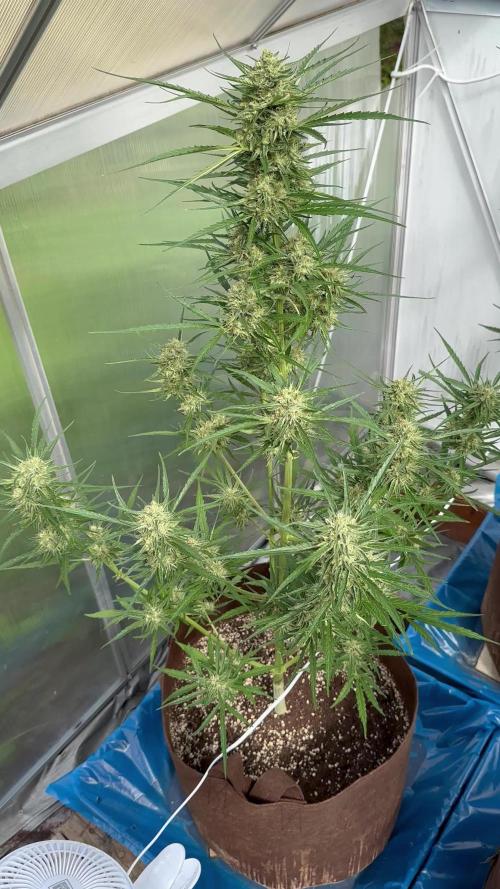
Herbst! 🍂 Seit einigen Tagen gieße ich nur noch Wasser, werde demnächst Trichome kontrollieren und die Ernte in 7-10 Tagen einleiten. Aber den richtigen Zeitpunkt wissen nur die Trichome 😇
Likes
27
Share
Welcome to my Frosted Guava Auto Diary Sponsored by Zamneisa & Mars-Hydro. FREAK RESULTS. "HAS STARTED GROWING UP AND THROUGH OUT A LOAD OF NEW WHITE PISTILS" Flower Day 5-20 Days 50-63 7cm put on in the last few days of wk 9 roughly day 59-63 So, not bothering to measure my plant as I thought it had stopped at 68cm and didn't budge for a wk. Been I flushed her and restarted her on plagron/atami/terpinator she decided hey. Let's put on another 7cm and throw out a bunch of new white pistils. Never had this with an auto before. Very strange. I seen her develop the past 15 days. Very slowly. And well. She's not great bud wise. She's a runt that's extremely largy with a very hign leaf-calyex ratio, I've seen other FGA and some killer bud. The leafs are mainly singled fingered leafs that appeared late into her process. And I just can't reach the stems proper and would cause more harm than good. I was hoping she'd get super frosty and I'd be able to make some bubble hash or something. She is at to throw out a whole new load of white pistils. I decided hey, why not throw her under something a little more powerful. At this stage in an auto grow. I really wouldn't bother, as her bud making energy should be mainly spent and at this stage I'd be if anything reducing light % or rasing my light by 5-10cm for ripening. I'm curious to see what will happen. She is drinking a lot more. So I've upped her PK and added some Atami products and will wait to see what happens. I'm not mad about the way she is. I'm holding out hope this is a freak of nature (with autos you really can never make a grow plan). Even if she does put on some mass it'll still be sparce and far apart. And very high leaf ratio. And it's only been the last few days she started growing up again. I only noticed cause the top was closer to the light, and after looking closer. I see new pistils and bud forming lightly. Will be a nightmare to trim. I hope she puts on frost during ripening.... only more time will tell. I'd of been better off with the fem version. She'll easily go into 12 weeks. Diet/Defoliation Was stuffed switched to plagron. Jungle juice did take her a long way. And truly happy with the results. But, I want to try new things and added Plagron Green Sensation and a few others. And Atami Bloom boosters 390-400ppm feed needed to be PH'ed from 7.9 to 6.5 2x a week. Alga Bloom feeds with Green Sensation is 6-630ppm with Silic Rock & pure Zym, 2x a wk. Terpinator feeds are 350ppm 6.1ph and once a wk. (Ambient tap ppm/ph 105-110ppm 6.75-6.7ph). Defoliation was done at the end of wk 8. She was 68cm for 10 days. And took her height on day 60 she she was 71 now she's 75cm tall. Her leaf ratio is very high. And very poor bud sites. More like larf lights. But, I've got a glimmer of hope. I've introduced new bloom boosters and upped the ppfd to 1000ppfd from 850-900ppfd. Lights SF/P1000s were used up until yday where I then put it under my SP3000 at a 14-10 maybe if I'm bothered ill put it back under the 2x100watts if I feel like it. Most days though I reckon I'll leave them under the SP. Co2 Co2 was shockingly high at 1150 in my tents with the exhaust on. But with no high temp it's useless. And has little to no affect. You need 29-31c. It's a fine balance. Cause when your LVPD Leaf VPD hits 32c your stomata stops and the tiny pores close. I've learnt so much about co2 growing. Now I've the right equipment. And with the summer coming in. I should be able to meet the temp/co2 level with exhausts on and been able to use my Dehumidifier in a sealed grow room. When it gets to winter. I think I'll pack it in. I'm just not getting caught out last summer with the heat. I may aswel take full advantage of the high temps and not having a sealed tent and keep exhausts on, just keep RH down. It should be a lot easier. If I like co2, I'll get a controller for fans/temp/ lights & co2. My one now can only control co2ppm and light. I'll get pic readings later. I haven't got it hooked up fully as no way am I using co2 without any alarms. Thanks to my sponsors from Zamneisa & Mars-Hydro for their products and support. Much appreciated to all who viewed, liked &/R commented. Look forward to seen your diaries. Either way thanks for dropping by.
Likes
13
Share
Week 9 day 1 video pheno. Gonna chop this week Week 9 day 7 well chop this weekend so on week 10 Day 1-2. Just waiting on a light to reveg one. Everything is magic
Likes
3
Share
@Trichoma
Follow
@1.5 kPa Partially harvested, waiting a week or mby 2 for the rest to ripen a bit more.
Likes
Comments
Share
No huge changes. GPA Cookies are still growing albeit slowly due to the cold. I hope it starts picking up soon. HUGE defoliation on the Chocolate Skunk clone. This girl is responding very well. Money Maker is just doing its thing! I didn’t expect much from this plant, but that just means it has no pressure and can take its time!
Likes
2
Share
@PalmaGrow
Follow
No se cómo expresar mi felicidad después de casi 3 años sin poder cultivar consecutivamente he podido cosechar esta belleza gracias a @blacktunaco por la K.O una genética llena de resina con flores compactas. Cometiendo errores desde el principio se pudo obtener una excelente planta corrigiendo todo para así mejorar el aprendizaje continuo. Se dieron 12 días de lavado de raíz y 3 de estos estuvo expuesto a lluvia constante durante los 3 días por tal razón se decidió cosechar para evitar dañar las flores
Likes
21
Share
@NSABND
Follow
Hi there start of week 11 today 😏 today (Day 78) the weather is cold and very high humidity because of rain 😲😩😕 Day 79 same shit weather then yesterday with very high humidity and rain 😵😲😵😲😵 Day 80 autumn has arrived 😱😨😰 cold with rain and high humidity 😲😵😭 Day 82 there are no Updates sorry 😵
Likes
18
Share
Prima settimana di fioritura . tutto ok .ma con qualche altra iniziano a spuntare sorprese inaspettate....beh questa è la natura 🤷😂💪👍🙏
Likes
7
Share
Sorry guys 🤦‍♂️🏾 I do have a daytime job/career and due to a busy few weeks, updating this didn’t make my list of priorities. However, maintaining my babies did and I am happy to say that although you had to wait it was not for nothing as this lady is looking lovely and actually going in to Week 11. I will start back updating and posting. I do have pictures from prior weeks and they will be posted to my IG. Thanks for following and keep growing !
Likes
45
Share
So meine Pflanzen Freunde es ist soweit dieses ist mein letzter Eintrag für diesen Strain. Die Blüten haben sich sehr gut entwickelt manche Buds sind in der Struktur rund, fest und dicht andere wiederum sind nicht so dicht bewachsen sondern ein bisschen fluffig. Die #1 und #4 waren von allen als erstes fertig, hier habe ich darauf geachtet das die Trichome schön wolkig sind ich wollte die Pflanzen auf dem Höchsten THC Stand ernten. Anschließend kam die #2 und die #3 hat von allen am längsten gedauert. #1, #2 und #4 wurden am Tag:74 gehackt, #3 hat am längsten gebraucht ganze 7 Tage am Tag:81 wurde diese außergewöhnliche Schönheit gehackt sie hat auch die meisten Knospen getragen. In der letzten Woche ist alles ruhig verlaufen als nächstes kommt der Smoke Bericht und das endgültige Wieg Ergebnis , leider habe ich doofi vergessen das nass Gewicht zu notieren zum Glück habe ich ein zwei nass Ergebnisse somit kann ich um den Daumen peilen was raus kommt.
Likes
24
Share
Gained some height since last week, bud sites everywhere. Defoliatated a few leaves to allow light in as its really bushy. Upped the nutrients and shes drinking alot more now. Hopefully see some trichromes popping up soon and they fatten up
Likes
22
Share
Topped this little herercane on day 11 and she is starting to grow some little branches. I upped the maxigro to .5 tsp per gallon. Other than that just playing the waiting game....
Likes
16
Share
Seedling managing 93F 30%RH, around 20 DLI. Vpd is in the 3's. No I don't recommend. Signum Magnum. "A great sign appeared in the sky a woman clothed with the sun with the moon under her feet and on her head a crown of twelve stars. Sing ye to the Lord a new canticle: because He has done wonderful things. Glory to the Father, and to the Son, and to the Holy Spirit As it was in the beginning, and now, and ever shall be, world without end." The plant nutrient nitrogen exists in forms with both positive and negative charges. Ammonium (NH4+)(immobile in soil)(Cation) has a positive charge, while nitrate (NO3-) (highly mobile in soil)(Anion)has a negative charge. Nitrogen is unique among plant nutrients in that it can exist in both positively charged (ammonium, NH₄⁺) and negatively charged (nitrate, NO₃⁻) forms in the soil. This makes it a special nutrient. In that it is responsible for providing balance for reactionary trade offs when it comes to ph. Because ph itself in the medium will always slowly drift towards acidicity, such is nature. 80% of nitrogen should be nitrate and no more than 20% ammoniacal nitrogen. Ca, mg, and K are the big 3 cations related to soil composition, pH & base saturation. When nitrogen is in the form of ammonium, it can compete with calcium, magnesium, and potassium for absorption sites in the plant root. This competition can lead to a reduction in the uptake of these other essential nutrients. Nitrogen, particularly in its nitrate form (NO3-), can increase soil acidity, which can also affect the availability of calcium, magnesium, and potassium. The form of nitrogen applied (ammonium vs. nitrate) can influence its interactions with other nutrients. Ammonium nitrogen can have a more pronounced negative effect on the uptake of calcium, magnesium, and potassium compared to nitrate nitrogen. Common forms of ammonium nitrogen include ammonium ion (NH4+), urea, and ammonium compounds like ammonium nitrate, ammonium sulfate, and ammonium phosphate. Common forms of nitrate nitrogen include potassium nitrate (KNO3), sodium nitrate (NaNO3), calcium nitrate (Ca(NO3)2), and ammonium nitrate (NH4NO3). Phosphorus is an essential plant nutrient, and its availability in the soil is strongly linked to the presence of oxygen. Plants primarily absorb phosphorus as phosphate (PO4), and oxygen is a key component of this molecule. Furthermore, the availability of phosphorus in the soil can be impacted by factors like soil aeration and temperature, which in turn affect the oxygen supply to the roots. Phosphorus uptake in plants is most critical during the early stages of growth, particularly within the first few weeks of plant development. Young plants actively growing tissues have a high demand for phosphorus. They may absorb up to 75% of their total phosphorus requirements within the first few weeks of vegetative growth, with up to 51% of uptake happening overnight, primarily in the first few hours or early nightfall. ⑨Anaerobic root respiration, or respiration without oxygen, is detrimental to plants because it's less efficient and produces toxic byproducts, leading to reduced energy production, nutrient uptake issues, and ultimately, root damage and plant stress. ⑨Anaerobic respiration, unlike aerobic respiration, doesn't utilize oxygen as the final electron acceptor in the electron transport chain. This results in a significant drop in the amount of energy (ATP) produced, which is necessary for various plant functions, including growth, nutrient uptake, and maintenance of cellular processes. ⑨In the absence of oxygen, plants produce byproducts like ethanol and lactic acid during anaerobic fermentation. These byproducts can be toxic to the roots and inhibit their function, ⑨When oxygen is depleted in a medium, the pH tends to decrease (become more acidic) due to the production of metabolic byproducts. This is particularly relevant in biological systems where aerobic respiration relies on oxygen as the final electron acceptor. ⑨When oxygen is scarce, plants may switch to anaerobic respiration. This process produces carbon dioxide (CO2) as a byproduct. ⑨CO2 dissolves in water to form carbonic acid (H2CO3). This acid lowers the pH of the medium, making it more acidic. ⑨Anaerobic conditions can impair a plant's ability to regulate its internal pH, leading to a drop in cytoplasmic pH and potentially cellular acidosis. ⑨The change in pH can also affect the availability of certain nutrients to the plant, as pH influences the solubility of micronutrients like iron, manganese, zinc, copper, and boron. ⑨The lack of oxygen in the plant medium leads to a decrease in pH due to the production of carbon dioxide during anaerobic respiration and impaired pH regulation within the plant. In plant cells, cellular acidosis, a drop in the internal pH of the cytosol, is a significant stress response, particularly during conditions like flooding or hypoxia. This acidification can be triggered by a decrease in oxygen levels, leading to the production of metabolic byproducts like lactic acid and CO2. The plant's ability to tolerate and recover from these conditions depends on its cellular mechanisms to regulate pH and mitigate the effects of acidosis. When plants are subjected to low oxygen environments, such as those experienced during flooding, anaerobic metabolism, which produces lactic acid and ethanol, becomes the primary source of energy. This can lead to a build-up of these acidic metabolites in the cytosol, causing a drop in pH. OXYGEN Atomic oxygen (single oxygen atom, O) is the lightest form of oxygen, as it has the lowest mass of the oxygen molecules. Oxygen also exists as a diatomic molecule (O2) and an allotrope called ozone (O3), which have higher masses due to the number of oxygen atoms combined. Atomic Oxygen (O): This refers to a single oxygen atom, which is the most fundamental form of oxygen. Molecular Oxygen (O2): This is the common form of oxygen we breathe, consisting of two oxygen atoms bonded together. Ozone (O3): This is an allotrope of oxygen, meaning it's a different form of the same element, consisting of three oxygen atoms bonded together. Since atomic oxygen has the fewest oxygen atoms, it naturally has the lowest mass compared to O2 or O3. Ozone (O3) Lifespan: Ozone has a relatively long lifespan in the stratosphere, particularly at lower altitudes. For example, at 32 km in the middle latitudes during spring, ozone has a lifetime of about 2 months. Oxygen (O) Lifespan: Atomic oxygen, on the other hand, has a much shorter lifespan. At the same altitude, its lifetime is about 4/100ths of a second. Ozone-Oxygen Cycle: The ozone-oxygen cycle involves the rapid exchange between atomic oxygen (O) and ozone (O3). UV radiation can split molecular oxygen (O2) into atomic oxygen (O), which then reacts with O2 to form ozone (O3). Ozone can also be photolyzed by UV radiation, creating atomic oxygen again, which can then react with O3 to reform O2. Dominant Form: The partitioning of odd oxygen (Ox) between ozone and atomic oxygen favors ozone in the lower stratosphere. This means that a much larger proportion of odd oxygen exists as ozone than as atomic oxygen, especially in the lower stratosphere. Recombination: Atomic oxygen has a high energy and reactivity. When it encounters another oxygen atom, they can combine to form O2. This process releases energy, contributing to the heating of the atmosphere. Ozone Formation: Atomic oxygen can also react with molecular oxygen (O2) to form ozone (O3). Ozone plays a significant role in absorbing harmful UV radiation. Other Reactions: Atomic oxygen can react with various other molecules in the atmosphere, like nitrogen (N2), water (H2O), and carbon dioxide (CO2), forming different compounds. UV light below 240nm (peak 185nm) creates ozone (O₃) through a process called photolysis, where UV light breaks down dioxygen molecules (O₂) into single atomic oxygen atoms (O). These single oxygen atoms then react with other oxygen molecules to form ozone (O₃). Specifically, UV-C light with wavelengths shorter than 240 nm can cause this photolysis. UV light with wavelengths between 240-280 nm, (peak 254 nm) breaks down ozone (O₃) into dioxygen molecules (O₂) and atomic oxygen atoms (O). 280nm does not have the energy potential to break apart the stable bond of (O₂) into enough (O) to make (O₃) At ground level, atomic oxygen (single oxygen atoms) has a very short lifespan. This is because it's highly reactive and quickly combines with other molecules to form stable diatomic oxygen (O2) or other compounds. While the exact timeframe varies depending on the specific circumstances, its lifespan is typically measured in nanoseconds or picoseconds.
Likes
18
Share
@Stonyways
Follow
175w just over 80 on dimmer cfm kit added from Gorilla Grow and it is impressive.... its the little things.. plants are looking decent will up the watts later just a couple quick product reviews SPIDER FARMER SF2000. YES YES YES THE SEED PHARM, 3 OG Kush fem seeds down and I have 3 OG Kush in flower and they ARE females. Everything's looking great here!!! Secret jardin oscilating monkey fans...Happy when I found em, but the noise... nothing secret about them...SQUEAK, whirl, whirl, SQUEAK forget about 2 of them! Jiffy peat pellets ...DON'T DO IT.... Gorilla Grow CFM kit YES! Fox Farms Nutrients....plants seem to like it so.... Mars Hydro 2x4 tent ... nope, there seems too be 2 types of grow tents, cheap and expensive. ill buy a Gorilla Grow Tent (expensive) for my next grow but for now ALL TENTS LEAK LIGHT, so just grab a tent that is sturdy, has vents in place for your grow space and is safe for you and the plants.
Likes
9
Share
Trichomes are everywhere around this 2 purple punch. The middle plant is more frosty due to the nutrient feeding stress( bat guano powder topdressed). Most of the fan leaves have burnt off crispy but the sugar leaves are not disturbed. I will be watering plain PH water once a week to stimulate draught and humidity and temperature down. I noticed that when the plant is in stress mode during mid flowering, trichomes tend to form fast i guess it is the defence mechanism. The genetics from my local nation is top notch. The centre plant i am keeping a 2week time frame to harvest if the sugar leaves yellow soon.
Likes
65
Share
@Dendegrow
Follow
Welcome to week six! 🌱 Week five was a complete success – all parameters are perfectly aligned. I’ve increased the water conductivity to a solid 3000 and bumped the CO2 level up to 1200 🌿. Light intensity is now set at 1400 µmol in the center and 1000 at the edges, which will keep the plants strong in their generative state 🌞. I’ll maintain these levels until the end of the third week and then start slowly removing the large fan leaves to ensure the buds get plenty of light 💡✨. I’m also trying something new to activate the “Emerson effect” 🌄: I’m running the deep red lights for 5 minutes before sunset and for another 5 minutes after the day ends. This should give the plants a final boost in photosynthesis, helping to maximize their growth potential! Everything’s looking fantastic so far! The Black Cherry has rooted well across different experimental setups, and at the end of the grow, I’ll provide a full report on the best care techniques for both strains 🌺👌. Willkommen in Woche sechs! 🌱 Die fünfte Woche lief perfekt – alle Parameter stimmen. Ich habe die Leitfähigkeit des Wassers auf satte 3000 erhöht und den CO2-Gehalt auf 1200 angehoben 🌿. Die Lichtstärke beträgt jetzt 1400 µmol in der Mitte und 1000 am Rand, was dafür sorgen wird, dass die Pflanzen stark im generativen Zustand bleiben 🌞. Ich werde diese Werte bis Ende der dritten Woche beibehalten und dann langsam damit beginnen, die großen Sonnensegel zu entfernen, damit die Blüten ordentlich Licht abkriegen 💡✨. Zusätzlich probiere ich etwas Neues aus, um den „Emerson-Effekt“ zu aktivieren 🌄: Ich lasse das tiefrote Licht 5 Minuten vor Sonnenuntergang und 5 Minuten nach dem Ende des Tages weiterlaufen. Das sollte der Photosynthese einen letzten Schub geben und das Wachstum der Pflanzen maximal fördern! Bis jetzt sieht alles fantastisch aus! Die Black Cherry ist in verschiedenen Versuchsreihen gut angewachsen, und am Ende des Grows werde ich einen ausführlichen Bericht darüber abgeben, wie sich die beiden Sorten am besten pflegen lassen 🌺👌.
Likes
3
Share
@No_Clout
Follow
I definitely will be growing this again but I’ll make sure my humiditys on point so I never have to be in this situation again, I’d recommend this strain to anyone novice or expert. I did nothing to these plants dident top them, defoliate or LST I let them grow all natural. I’ve heard glueberry O.G. is a squirter when put in a rosin press so I’ll update everyone on that once flowers are dry.0
Likes
3
Share
@SrRote
Follow
Día 73 4 días antes del corte. Día 77 Corte ✂️ Estoy realmente contento con todo el resultado salieron unas flores bien compactas y densas con mucho aroma. Este ya sido un excelente ciclo, donde aprendí un montón y mejore mucho mi cultivo arreglando cosas muy sencillas, como usar el ph correcto, la buena electro conductividad y un ambiente siempre controlado con buena humedad y temperatura.
Likes
19
Share
@HeavyHead
Follow
Off to a good start. Starting to look slightly hungry for more nutes ,going to increase concentration slightly and continuing to bottom feed for a few more days.