





@Michijardinero
Follow
Bueno familia hoy damos fin a la 2° semana y damos comienzo a la 3° en esta semana han dado un estirón importante casi 25 cm la punta más alta esta entre 94-95 cm ya están empezando a mostrar sus cogollitos en el siguiente riego empezaré a ponerle big boom para darles más cuerpo e intentar sacar el máximo posible de momento estoy contento por como esta saliendo todo espero seguir así como siempre familia cualquier crítica comentario o Consejo bienvenidos son un abrazo y buenos humos familia paz


@Wackytabacky_420
Follow
🚨 Durbin Thai/Cinderella 99 week 6 update 🚨
🚨 week 7 of veg!! 55 days old!! 🚨
So this is a clone I received on Jan 31st. She has been transplanted from a solo cup 2 a 5 gal pot. She had 2 be topped in her second week of rooting do 2 the top frying from to much light in young clone stage. Since the topping this lady has come 2 life!! She has been defoliated 4 times! Most recent defoliation 3/27! She spent her first month feeding just off nutrients in fox farm soil. On 3/2/22 I gave her her first Gaia Green trio feeding!! She has exploded with growth since!! This Saturday coming up she will get her 2nd Gaia Green feeding.
💡 Grow Sponsor💡
@marshydro_amazonled
@marsnier
#marshydro
#TSW2000
Marshydro equipment--
Marshydro- 4x4 grow tent
Marshydro- Tsw2000
Marshydro- 6" inline exhaust fan with digital temp and humidity sensor
Marshydro- 6" carbon filter
Marshydro- 6" Black duct line
Other companies in this grow-
@foxfarmsoilandfertilizer - 100% ffof
@gaiagreenorganics - Organic fertilizer
@inkbirdofficial - WiFi temp control
@madmanplant- 6" Tent shelves
@levoit.id - WiFi humidifier
Thanks for checking out my grow!! See u next week!! Best of luck and Happy Growing!!🌱💚💨🔥🔥🔥🙏🏻🤟🏻💪🏻


@NorthernMonkeyzInc
Follow
Im finding these great fun to grow, training is very easy to do considering it the first time ive trained any plants


@gr3g4l
Follow
Con 22 dias, pasados 7 de la última poda de hojas y 22 del cambio de fotoperiodo me decidí por hacerles una nueva poda, esta algo más severa . Yemas, hojas y chupópteros de bajos. A partir de entonces solo se irán quitando muy de vez en cuando alguna hoja o algun brote o yema que pueda salir por ahí que no me guste, muy poca cosa.
Me deshice de la malla, harto me tenia. La quité para la poda y luego me hizo mucha pereza volver ponerla. Prefiero menos cantidad.
Esta semana explosión de tricomas



@GrowBro1981
Follow
Diese Woche stand die Ernte an 🎉🎉
Dieses einmalige Gefühl, wenn man für seine harte Arbeit belohnt wird💞💞💞 folgt mir auf Facebook für bessere Bilder und Videos 🤗 🤗 🤗
"Green Room Anbau und Austausch" Ihr seid alle herzlichst eingeladen


@crystal_garden_0
Follow
End of week 5. Plants are healthy and buds have definitely started to develop nicely. Short thick plants, smells amazing already. Thirsty plants. Lights and genetics working great


@GreeneScene
Follow
So I’ve got a fungus gnats problem. Humidity is under control finally. One of the girls is being flushed currently I ran 15g through her 5g pot .
Two other girls are close to where I want them to before I flush I’m waiting for the buds to become dense still.
3 of the girls are finally fattening up the additional liquid amendments I’ve started feeding have certainly helped . I’m still racing against time in one way or the other but I have gained a wealth of experience & have formulated new methods to try in order to get the best results from my style of growing .
The liquid amendments I’m feeding are indeed organic still so no worries 😉 there .
I’m waiting for my yellow sticky traps & rounding out this grow in these next few weeks .
Depending on how long this first girl takes to flush I’ll begin by harvesting 2 plant in a week or 2.
I’m kind of tapped out on this whole posting thing I really was tempted to wait until harvest to do an update . But this is a good journal for me just the same as it is for anywho who stops by so for that reason I’m going to try to stay with it until the end .
Another week on the GreeneScene in the books 📚 rounded out .


@Ganjagrandaddy
Follow
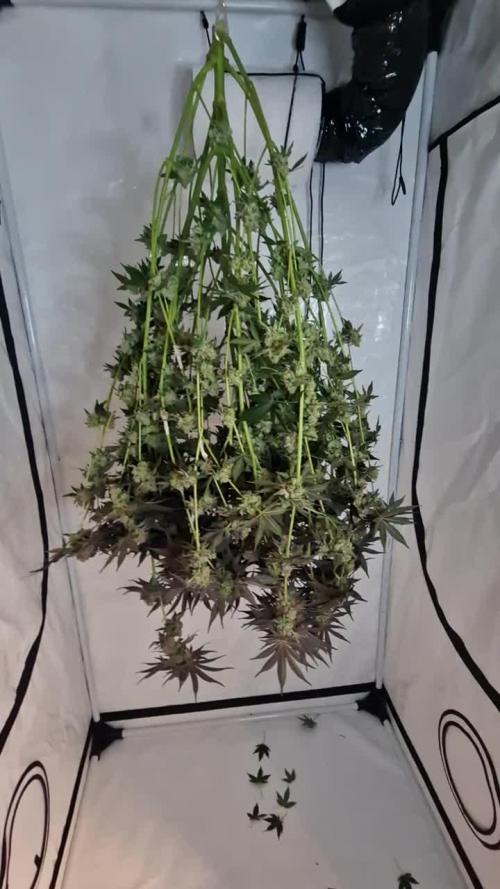
Day 69 flowering: The Peyote Critical is dry and ready to trim for her harvest Tonight. She smells very fruit punchy and a sample bud nearly gave me a " whitey" as i overdid it with the dosage. lol.
I have taken the Hulkberry out too for drying ( has her own diary) and also the RQS Critical( 60g dried bud). This made space to move the other ladies around and under the full working light. I took the Liberty haze out today at 69 Days from flower start ( not flip!). She was definitely ready to come out and her colours up close are so beautiful
She is huge and has at least 30 decent bud sites. I struggled to get photos of her in such a small space so had to hang her just to get her all in a shot. Her colas are big too , hopefully she will topple my biggest yielded plant at over 10oz.
The utopia has all been moved under the stronger bulb now so hopefully will finish this week better. They are very oily and smell of diesel oil and fruit. Not sure they will yield too much thanks to duff bulb but they look amazing and i cannot wait to try a bud of it.
The Laughing buddha's are finishing up nicely now. Sadly the stunted one wont yield much at all but smells so pineapple. Her bug sis in growcaps soil is a monster like the liberty Haze so with only 1 week odd left. she is right under the 600w duff bulb close. Fingers crossed all will be done by next week and harvest reports can begin.





@Growfather1
Follow
Hello everyone!
Welcome to week 5 of the MAC1 F1 hybrid clone saga (Part 3).
She is doing incredibly well and reaching some major milestones. We officially have a root poking its head out from the underside of the pot! It is not a massive root system yet, but she is definitely getting there and establishing her foundation.
Because my bottle of Rhizotonic is running dangerously low, I am being extra careful with my supply. This week, we are skipping all additives and running a stripped-down, baseline menu to stretch out what is left.
Environmental Metrics & Diet
Nutrients CANNA Coco A & B at 2 ml per liter (No additives this week)
Feeding Frequency Every 2 days
Humidity Consistently above 60% (Thanks to the humidifier)
Temperature Swinging gently between 20°C and 25°C
Training & Upcoming Plans
I have already topped her twice and done some light defoliation to clean things up. Next week, the real evaluation begins. I will be checking to see which branches are strong enough to make it to the top of the canopy. For the lower branches, there is a very strong possibility they are getting the chop. I want to focus all her energy on continuous topping at the upper side because this plant has the potential to become an absolute monster. Frankly, I’m starting to sleep with one eye open just in case she decides to uproot herself and take over the living room.
Nothing much else to report on this front, everything is tracking perfectly!
Thank you for stopping by and have a nice day.
Best regards,
Growfather


@MadeInGermany
Follow
Harvest day 67
since time switch
to 12 / 12 h
Hey guys :-)
Finally it's time 💚
The lady is done the large leaves have been removed and hung upside down to dry in the dark drying room.
You can now stay there for 13-15 days at a temperature of 16-18 degrees and 55-59% humidity.
After 13-15 days it is neatly trimmed by hand and placed in jars with boveda packs 62.
After 4 weeks Boveda 58% come in and are ready for testing ;-).
After everything has been cut cleanly, the last update comes with the smoke report and the finished pictures.
Let's get to the plant 💚.
Unfortunately, the rating system at Growdiaries is a bit strange because I have to give the stars before the Smoke Report and in the end it might have led to more stars in terms of taste.
. The smell is great I'm curious about the taste 💚
Have fun and stay healthy 💚🙏🏻
👇🏼👇🏼👇🏼👇🏼👇🏼👇🏼👇🏼👇🏼👇🏼👇🏼👇🏼👇🏼
‘Powered by GreenHouse Feeding’
Copy the link for 10% off all Nutrients 👇🏼
http://shop.greenhousefeeding.com/
affiliate/madelngermany_passiongrower/
👇🏼👇🏼👇🏼👇🏼👇🏼👇🏼👇🏼👇🏼👇🏼👇🏼👇🏼👇🏼
Water 💧 💧💧
Osmosis water mixed with Cal/Mag (24 hours stale that the chlorine evaporates) to 290 ppm and Ph with Ph- to 5.8 - 6.4
MadeInGermany


@GrowerGaz
Follow
Just water and some KNF inputs in the water tank would once. Really beasting now so happy with the lumatek attis.
Really starting to stink now
Kmintz kushy and sweet earthy
Mr X Kush is sweet and gassy
Papaya x THC bomb strange fruit
Monster Zkittles grapefruit
OGKZ kushy and fruity
Cuppa T - sweet


shorts_status_processing


@PussyWagon6969
Follow
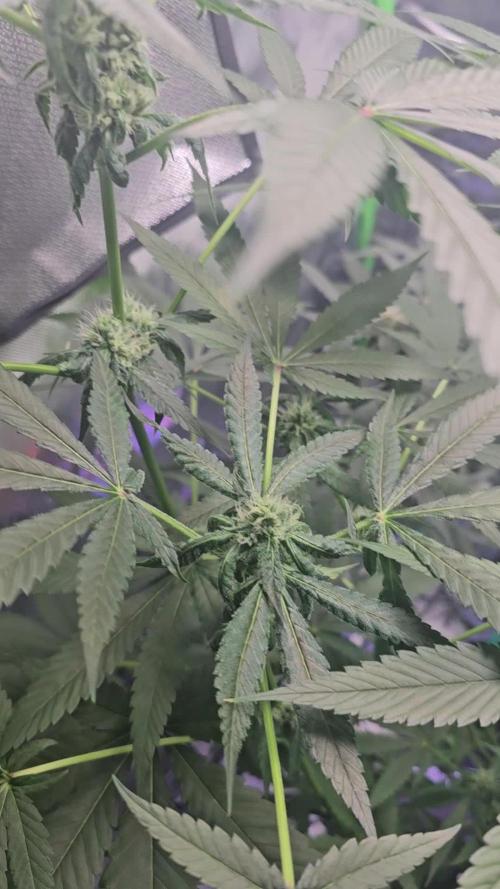
Looks like they've recovered from the topping and transplant last week and are beginning to grow new nodes with haste!
I'll start with a light 1/4 strength dose of veg nutes once the new growth gets to 3 nodes (at 1.5 nodes now).



@K0KA420
Follow
The height growth on Kings Juice had stopped from past week and half but the buds are looking good with quite amount of tricomes. Lemon orange is a giant now with some good strong bud growth. im only afraid its close to the light approx. 10 inches; so far the bud feels good and firm. Also been adjusting the water PH time to time and doing top of water with gallon and half for both DWC with the strong mix mentioned, as well as PPM balance between 850-900 for both.
Lemon Orange so big and fat, I cant even access Kings Orange!!! I want to fix them but removing trellis net with LST cable tied to them is a freaking NIGHTMARE!


@JackSkellington
Follow
😫PRIMO OVERFERT SENZA AVER DATO NULLA ASSURDO...solo acqua e sono cariche scure ora sono palesemente in over...
procederò ancora per altri 10 giorni di acqua
il topping a funzionato bene da come si vede nel video ora faro riposare per 15 giorni e poi lancio in flow
14/05/2021
la jungla sembra crescere ora dovrò fare un pò di pulizia defogliare dalle foglie piu grandi e lollipoppare per bene....
sono solo un pauroso di togliere le foglie grandi (foglie primarie)
al momento zero fertilizzanti ancora troppo scure
18/05/2021
la sera del 18 a un giorno da un mese di vegetazione in growbox ho lollipoppato e potato i rami i inutili....
ho dovuto anche fare una rotazione di piante in quanto non sono uniformi nel crescere....
ho riempito il bidone da 30 litri e mi sono accorto che le baby ora bevono molto
pur troppo sono ancora in forte stress e overfert non capisco da cosa provenga in quanto non ho usato nei fertillizzzante....
vedremo oggi 21 come staranno ora posto le foto del 19 maggio giorno in cui fanno un mese e sono ancora 40cm aime qualcosa sta rallentando la crescita
e arrivato il filtro a carboni e pesessantissimo speriamo che la mia box lo regge




@All_about_420
Follow
Das Topping hat sie sehr gut vertragen.
Ich hab ihr eine kleine Erholungsphase gegönnt,
bevor ich sie dann in den Endtopf umgetopft habe.
Auch hier lasse ich ihr ein paar Tage um in ihrem neuen Zuhause anzukommen,
um sie dann in ein paar Tagen nochmals zu toppen und mit dem ersten LST zu starten.


@Andres2pistilos
Follow
Día 17/11 se hace el cambio del fotoperiodo a 12 horas de luz
Este día también regué con EC de 2.0 y pH ajustado a 5.8 en esta oportunidad agrege un poco de Pro Silocate de grotek que tenis guardado. Se mantiene el uso de cloro a razón de 0.2 ml x 4 litros de agua.
Baje la luz a 60 cm de la planta más alta del cultivo y se mantiene a 100% de potencia
23/11/24: Realicé defoliacion, mantengo el foco a 60 centímetros.
EC se mantiene en 2.0 - pH 5.8



@NSABND
Follow
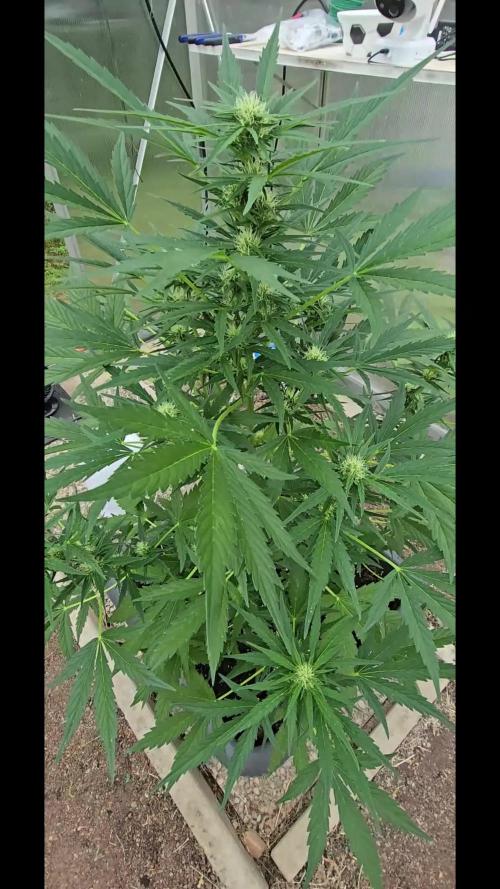
Let´s start Day 43 😎 some sun and cloudy with rain again 😳
Day44 cloudy and rain and cold 😡
Day45 rain and cloudy 😡 temp 16C/60F .. WTF it´s summer 😡😖😱



@Ultraviolet_
Follow
We become aware at such times of man's wonderful ability to bring seemingly unrelated elements into harmonic balance, and receive a glimpse into a world where everything exists in conscious sympathetic attunement to everything else. When we listen to a piece of music that seems to strike a beautiful chord somewhere inside us, or view a painting that simply glows with harmonic awareness well executed, we probably do not spare much time to contemplate the wonderfully intricate combination of vibrations that our sensors make it possible for us to perceive. We tend to appreciate the relationship between the parts of something by an awareness of the harmony or dissonance of the whole. This ability enables us to say "what a beautiful house!" instead of "analysis has proven that this collection of building materials exhibits certain elements of harmonic proportion." While this ability to instinctively appreciate the beauty of true harmony has an important role to play in evolution, a more analytical understanding of the laws involved can be most useful. This is especially so if we wish to create works of art where each part exists in true harmony, not only with the other part of that particular whole, but with the universe within which the creator and the created exist.
Everything vibrates. From the most dense matter to the most subtle cosmic rays, everything which our senses allow our thoughts to become aware of, can be specified in terms of wavelength or frequency of vibration. These two terms define the same thing, but from different points of view.
The following are the approximate wavelengths of various energy carriers:
Cosmic rays 0.000,000,001 mm
Gamma rays 0.000,000,1 mm
X rays 0.000,500 mm
Ultraviolet rays 0.003 mm
Visible light 0.006 mm
Infrared 0.01 mm
Sound waves 1 meter
Radio waves 300 meters
Violet light 400 nm to 450 nm
Blue light 450 nm to 500 nm
Green light 500 nm to 570 nm
Yellow light 570 nm to 590 nm
Orange light 590 nm to 610 nm
Red light 610 to 700 nm
1 nanometer (nm) = 0.000,000,1 cm = 1/10,000,000 cm
If a guitar string is plucked and we hear a sound, it is not too difficult for the human mind to associate this sound with the vibration of the guitar string. With color it is quite different. It is difficult for us to conceive that the color of a substance is not an inherent property of the substance itself, but an indication picked up by our senses of that substance's ability to absorb or reflect the light which happens to be shining on it at that moment. Neither the matter nor the light is colored. What happens is that the brain learns to differentiate between the frequencies reflected or transmitted by the substance the eyes are focused on. The same thing happens with sound. When we say "Oh! Listen, they're playing my favorite song," what we really mean is: "My brain has stored within it a particular pattern of frequencies. I have compared the new information being received with this stored pattern and have deduced the answer that the two patterns are similar within certain specified tolerances." The 'pleasure' involved could have something to do with our running the pre-recorded pattern at the same time, in 'sympathy' with the new pattern as it is received.
The word sympathy describes very well our ability to appreciate color and sound. It also describes the reason behind certain elements of harmony. For instance, if a substance vibrating at 100 cycles per second (tone 1) is in the proximity of another substance vibrating at 200 cycles per second (tone 2), we could perceive, if we had the right equipment, a certain sympathetic relationship between the two.
We will see from this that there is a uniform doubling of the first tone seen in the second. At various points along the waves, the two are the same in amplitude. At other points, they are at opposite poles to each other. This doubled frequency has more points of similarity to the original than any other frequency except the original itself. If the equipment we had available for measuring these two frequencies was a soundboard amplifier and a pair of ears, then we would hear what would sound to us like one tone. If we had the opportunity to hear one at a time, we would hear that although they sound the same, one is higher in pitch than the other. This characteristic of 'the same but different in pitch', musicians have called the octave. Any two tones produced where one has exactly doubled the frequency of the other is called an octave. Speaking in ratios, an octave would appear then as the ratio 2:1 or 1:2, depending on whether we are talking of an octave up or down.
A single note produced by almost any instrument will contain more than one wavelength or frequency. It will have a dominant frequency, the wavelength of which we would call the note's 'fundamental' or 1st harmonic. It will also have a varying number of upper harmonics, gradually fading in intensity into infinity or silence.
Natural harmonics always have the same pattern of intervals between them. The interval between the 1st and 2nd harmonic is a perfect octave; between the 2nd and 3rd a perfect fifth; between the 3rd and 4th a perfect 4th; and so on, the intervals becoming smaller and smaller until they lose any relationship with the western 12 tone scale as it exists at the moment. Just as an octave has certain elements of sympathy with its fundamental, so some intervals have been noted to be more perfectly in sympathy with the fundamental than others. The ratio of the 'perfect 5th' or interval of 7 semitones, as it occurs in the harmonic series, is 3:2 or 2:3, while that of the 'perfect fourth" is 4:3 or 3:4. All the tones in the western 12 tone scale can be expressed in terms of the ratio between the upper tone and its fundamental. This would seem to be an ideal way of generating a scale from any given fundamental and several attempts have been made to do this, the Pythagorean system being probably the most well known. Although when working with a single tone instrument playing on its own, the Pythagorean formula works wonderfully well, if we had several instruments tuned this way together and asked them to play almost any western music, we would find that at times they sounded quite out of tune to each other.
The lack of flexibility of the various scale systems based on the harmonic series has led to what is known as the 'tempered' scale. This uses as its primary unit of interval the ratio of the octave or 2:1. It then proceeds to divide the interval between any fundamental and its upper octave into 12 smaller intervals by applying the ratio: two to the one-twelfth power, to one (21/12:1). This equals 1.059463094, so by multiplying any frequency by this number, we will obtain the tempered semitone next up from our fundamental. We will also find that any tone twelve semitones up from any other tone, in a scale generated in this way, will have exactly double the frequency.
If we took the note middle C on a piano and halved the wavelength, we would have the note C one octave above. If we halved this, we would have the C above, and so on. However, within about 6 octaves, we would find that although a 'sound' was being produced, no human ear could perceive it. If we kept on going, halving and producing upper octaves of our fundamental C, we would proceed through the infrared band, into the visible light spectrum. If we happened to be outside during the day, we would, for one octave only, see the note C with our eyes. The next octave above would already be in the ultraviolet band, and outside the eye's sensitivity range. If we can think of color as being an indication of a substance's vibratory rate or wavelength, we may begin to see a relationship that could exist between the color and sound spectrums.
The logical extension of what has so far been said is that there exists a scale in the color spectrum that corresponds exactly to the scale in the sound spectrum, each color tone being an octave of the equivalent note in the sound range.
This is not the end of the story but only the beginning. If we can for the moment accept that any wavelength in one band has upper and lower octave stretching out to infinity, then the next question is 'fine, but what shall we use as our fundamental? A particular color? A particular sound frequency?' The musicians among us will probably say 'A 440'. This means that the note A should vibrate at 440 Hertz, or 440 times per second. They would tell us that this is standard pitch has been adopted by most orchestras around the world; pianos are tuned to it, instruments are constructed to formulas based on it, and so to them it would probably seem the most appropriate place to begin. Some of these musicians may know of the battle that is still raging with regards to this being the standard, but few would know why A = 440 Hz was chosen except that it worked when it was set to be a suitable compromise between the many different pitches in use at the time.
432 Hz is said to be mathematically consistent with the patterns of the universe. Studies reveal that 432 Hz tuning vibrates with the universe’s golden mean PHI and unifies the properties of light, time, space, matter, gravity, and magnetism with biology, the DNA code, and consciousness. When our atoms and DNA start to resonate in harmony with the spiraling pattern of nature, our sense of connection to nature is said to be magnified.
Another interesting factor to consider is that the A=432 Hz tuning correlates with the color spectrum, while the A=440 Hz is off. Audiophiles have also stated that A = 432 Hz music seems to be non-local and can fill an entire room, whereas A=440 Hz can be perceived as directional or linear in sound propagation.
Once you adopt the idea that sound (or vibration in general) can have an equalizing and harmonizing effect (as well as a disturbing effect), the science of harmony can be applied to bring greater harmony into one's life or tune to specific energies. There is a form of absolute and relative harmony. Absolute harmony can, for example, be determined by the tuning of an instrument. The ancients tuned their instruments at an A of 432 Hz instead of 440 Hz - and for a good reason. There are plenty of music examples on the internet that you can listen to in order to establish the difference for yourself.
Attuning the instrument to 432 Hz results in a more relaxing sound, while 440 Hz slightly tenses up the body. This is because 440 Hz is out of tune with both macro and micro cosmos. On the contrary, 432 Hz is in tune. To give an example of how this is manifested microcosmically: our breath (0,3 Hz) and our pulse (1,2 Hz) relate to the frequency of the lower octave of an A of 432 Hz (108 Hz) as 1:360 and 1:90.
It is interesting to note that 432 Hz was the standard pitch of many old instruments and that it was only recently (19th and 20th century) the standard pitch was increased. This was done in order to be able to play for bigger audiences. Bigger audiences (more bodies) absorb more of the lower frequencies, so the higher pitch was more likely to “cut through”. One of the oldest instruments of the world is the bell ensemble of Yi Zeng (dated 423 BC), tuned to a standard F4 of 345 Hz, which gives an A= 432 Hz. The frequency of 345 Hz is that of the platonic year! Similarly, many old organs are tuned in A=432 as well; for example, St. Peter’s Capella Gregoriana, St. Peter’s Capella Giulia, S. Maria Maggiore in Rome.
Maria Renold’s book “Intervals Scales Tones and the Concert Pitch C=128 Hz” claims conclusive evidence that 440 Hz and raising concert pitch above scientific “C” Prime=128 Hz (Concert A=432 Hz) disassociates the connection of consciousness to the body and creates anti-social conditions in humanity.
The difference between concert pitch A=440 Hz and Concert A=432 Hz is only 8 cycles per second, but it is a perceptible difference of awareness in the human consciousness experience of the dream we share called existence.