







Likes
4
Share


@Fortunato
Follow
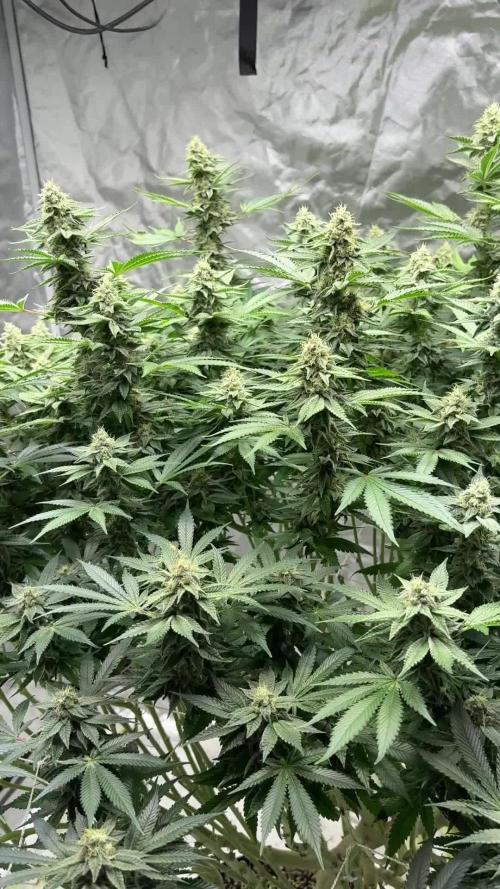
Very happy with the plants growth I think now I have figured the watering and feeding cycles and it shows. I could’ve stayed in the vegetative state for a couple more weeks, but I was afraid of the restrictions of my tent. plants seem to have overcome nutrient deficiency I was seeing last week. I took care of all the light leaks prior to shifting to 12/12. Some leaves were removed for better sir circulation and light penetration.

Likes
567
Share


@Rock_n_Roll_Randy
Follow
We are at 27 days of flowering now and they are starting to change colors now. The gorilla is really turning yellow. I could of gave her a bit of nitrogen but this is just a practice run with my custom bred seeds so I'm letting it go. Alot of frost showing now. They are loving the new fc4800 and 8x8 Grow Tent for sure🤘 another couple weeks and I should know more about the smell of them. Right now they smell more like the nuken but they are slowly changing to have their own unique smell. None of them smell like what the parents did. Except at the beginning of getting frosty they all kinda smelt like nuken. Like marshmallows. The monkey dough nuken smells like fruit loops and the gorilla smells like skittles. More than the original skittles does👍
WWW.MARS-HYDRO.COM
PROMO CODE: rocknroll
Instagram: @marshydropenny
Shout out and thanks to:
https://greenbuzzliquids.com/
#greenbuzzliquids
@GreenBuzzLiquids
Hers more information on the mars hydro products:
GET THE MAX FROM MARS👍: Welcome one of the newest members of the Mars Hydro family🤜🤛🤘. The Mars Hydro FC 4800 480W LED Grow Light can accommodate up to a 4' x 4' area for flowering. It has OVER 2000 LED chips consisting of the best selling Samsung LM301B diodes which has a Luminous Efficacy of: 220 lm/W
0.2 W, 3 V mid power,
Osram 660nm Diodes, Infrared light and UV LIGHT👍. It boasts the incredible efficiency of 2.8 µmol/J, maximum 2.5gram yield per watt with 30% higher Average PPFD. This High-intensity spectrum is beneficial for plants at all stages - from veg to bloom, and creates Big dense Buds👍. achieve 50% higher yields & quality compared with the old lights! Only consumes 480W for 4x4ft personal grows, and 3x3ft for commerical grow. It comes with a dimmer and daisy chain function with a maximum of up to 15 lights, the master light controls the rest👍. Wide 6-bar design offers even & wide canopy coverage and can maximizes your grow space. slim 180° FOLDABLE DESIGN... YES I SAID FOLDABLE🤘🤣 , making it compact and easy to install, it's IP65 WATERPROOF and will give you no worries while growing in a humid environment and makes it a flexible high performance commercial grow light for enormous SUPER FROSTY yields.😛😛😛. MARS GETS EM FROSTY BOYS👍
AWESOME HEAT DISSIPATION: The Low energy consumption FC4800 growing light has 6 passive-cooled bars and an aluminum heat-sink a removable driver you can upgrade later or have it outside your tent. with zero noise you can save up to 50% in your electricity bill compared to HID's or HPS lights!
It also has a removable driver so you can upgrade it in the future or have it outside your grow space for better heat control in your growroom👍
UPGRADED FULL SPECTRUM: Yield Max Spectrum with enhanced red (Top-Bin Samsung 3000k-5000knm, Osram 660nm Deep Red), speed up blooming & fruiting, perfectly suited for full-cycle growing. The FC4800 LED grow lamp was born for Big Buds, perfect for commercial, grow tent, grow room, hydroponics, and all soil grows.👍
THE BEST SAMSUNG DIODES: THE FC4800 has Top Bin genuine Samsung Osram Diodes, combined with remarkable 2.8 µmol/J Efficacy, 30% higher Average PPFD, 50% less energy consumption, to maximize your yields. They give you a TRUSTED 3 years warranty 100% Satisfactory guaranteed!!!
The MARS HYDRO 8x8 Grow Tent interior is made of a unique diamond design mylar which is highly reflective. (Other companies mylar and reflective rate is as low as 50%, and it won't provide efficient light. They use thick 1680D oxford canvas, and being double stitched, it is tear proof and perfect for locking in the light. Their grow tent keeps 100% of the light inside the tent and helps your plants absorb more light. EXTRA-THICK material means No light leaks or rips at all.👍
Strong Stable metal corner adapters and poles are the trustful supporters of the tent. It's very sturdy, neither rusting or paint flaking off. quick and easy tool-free setup. They use heavy-duty metal zippers, with double layer black lining, by far the best on the market which creates a light-proof seal.
The Easy observation windows are made by double layers of cloth. Observe the growing conditions of your plants without opening the tent and avoid disturbing your plants. The observation windows also serves to dissipate heat and ventilate the air.
The tent includes 2 removable waterproof floor trays to hold soil and water. The removable tray can be taken out to wash easily.
They guarantee the grow tents are easy to install even if you've never done something like this before. Clear Instructions and no tools needed! They also offer 30-day unconditional refunds for quality problems. Just contact their friendly 24 hours customer service 👍
WWW.mars-hydro.com
PROMO CODE:rocknroll
Instagram: @marshydropenny
https://greenbuzzliquids.com/
#greenbuzzliquids
@GreenBuzzLiquids
Please check out my YouTube👍
Like and subscribe right Now!!! LoL
Processing
Likes
5
Share


@PETEROG
Follow
Hey everyone at week 4 know and wow have these girls grown early this week I applied some LST and all took really well to say it was my first time trying this
Likes
22
Share


@daggaDNA
Follow
Welcome to the first week of flowering in this run with BIG BLOCK by Cannabis Brothers. 7 days ago I took cuts and now I'm happy to show you the first shots of roots and also the amazing green canopy which I'm truly proud of.
Each plant is marked as pheno 1, 2, 3, ...and here is a cut of pheno #9 showing the great success. Soon others will follow and then we will see after 3 weeks how many males or females we have and then we can have a first selection of potential keepers. For now I'd keep them all as they grow all equally good but time will tell how many ladies we actually have.
Likes
6
Share


Processing
Likes
33
Share


@Crazyweedpt
Follow
Start of 10th week and i decided to flush given almost 45L of clean water & been carefull with temperature of water! the laddies are looking well faded, and i hope to get a super clean medicine :) made some trim also on fan leaves to have better light penetration on lower canopy! Buds are looking dense, frosty & smelly!

Likes
21
Share


@GRow_M8s
Follow
* Starting this week with a final 🍃 defoliation, the plants responded really great after every training (LST, defoliation, lollipoping), eating and drinking like real champs 🏋️♀️ 🧗♂️.
* Humidifier 🌪️ makes a real difference, through low humidity (40%-50%) we achieved better VPD -> more transpiration -> faster growth, the plants enjoying it.
* Gemma's crystalize NPK for bloom, collaborates with the others boosters with no problem (reccomend separate mixtures when feeding).
ℹ️ You can see the response on the plants after one day --> updated photos
ℹ️ Later this week : The plants eating like beasts, watering almost every day,
Buds progressing smoothly, Smells too and the canopy is pretty good in this (0.80m ×0.80m ×1.60m tent size) we are impressed with transpiration rate, game changer the humidifier present.

Likes
1
Share


@PalmaGrow
Follow
19 - 25 noviembre
Se realiza amarre en brazos más altos poda de bajos y hojas al igual dóblanos estás dos ranas para generar estrés y emparejar con las demás

Likes
12
Share


@Growing_Spartan
Follow
This is my second run with actual results and I’m pleased to say 420 FASTBUDS has great genetics and is a brand I’d love to utilize when practicing my craft. The purple plant
Likes
23
Share


@SonomaSungrown
Follow
Fungus gnats were in full effect here due to the Down-to-Earth potting mix. That stuff doesn't drain worth a damn!
I had just sprayed the plants with neem oil and soap in this video... and needless to say that didn't turn out well (more to follow)
In other news, the French Macaron roots were growing like crazy at this point.


Likes
152
Share


@EBxAH
Follow
Well, I made it through another week, lol. Just your typical boring week. The weather is cooling down now and the humidity has been decent. Another great transition week. Week 14 and 4th week of flower starts today, 9/5. There's this one cola on Bruce that's really scratching my brain to bend over, lol. They're all looking great though, still responding well to the Schwazz! Time to apply some booster and hopefully watch them fatten up from here on our. I'm actually quite impressed with most of the clones, they should fill out nicely! That's pretty much it. Feeling good, feeling good 😁
Happy growing everyone ✌️🍀✌️
UPDATE: 9/8 I uploaded a video and everything is looking good. I started some booster for the clones and next feed for the mothers I'll do the same. The flowers are finally starting to grow with copious amounts of pistols!!! Only a slight smell during the day but definitely stronger at night. I'm still very excited and very fortunate to have gotten this far 🙏
Happy growing everyone ✌️🍀✌️

Likes
8
Share

@803FireGrower
Follow
All steady except for some minor tucking and defoliation. Cut nitrogen altogether this week and depending how she responds will continue without but if they need a lil kick I’ll go to .25 tsp per gallon but seeing how I’m in the home stretch I may just go for a good flush

Likes
2
Share


@CannaIGrow
Follow
Plant is looking good. Probably the best looking in the grow so far IMO. Can’t wait to see her grow out!
Likes
92
Share


@DogDoctorOfficial
Follow
Week 7 Veg Report 🌿✨
Hey Grow Fam! 🌱 Week 7 of veg is here, and let me tell you, the grow room is buzzing with life! Each of the girls is showing off her unique personality, and I’m especially stoked about the Papaya Zoap—she’s really coming into her own! The scrog net is nearly filled out just how I wanted it, and I can feel we’re so close to flipping to flower. The anticipation is real! 😁
But before we get to flowering, let’s take a dive into something that makes this grow so smooth—ThinkGrow LED drivers and cables.
ThinkGrow LED Drivers – Plugging Into Success 💡🔗
This week, I had a chance to work deeper with the ThinkGrow LED system, and honestly, it’s like a dream come true for efficiency. I’ve been using the TLD-4 Four Spectrum Control Channels Model One LED Driver, and let me break down how it works. The drivers attach directly to the bars—super sleek and no extra bulk. And, the connections? It’s a matter of matching the male and female connectors on the TDC-2 Daisy Chain Cord. It’s like a simple puzzle that snaps together perfectly. The TDC-4 cord takes it to the next level, connecting the top bars to the ICL-300 Inner-Canopy LED Bar, giving complete control and balance across every layer of my canopy.
Why is this important?
The driver-to-bar connection ensures that each LED bar is operating optimally, and the daisy-chain system makes it effortless to manage multiple bars without a ton of wires everywhere. It’s neat, efficient, and delivers even light distribution, which my plants are loving! 🌞
Are My Girls Ready for Flower? 🌸
When I look at the plants up close, it’s like they’re whispering, “Flip me to flower already!” 😆 Their growth has been so vigorous, each filling out the space with character, and that scrog net is almost fully covered. So, I’m thinking we’re super close to the big switch. Each plant has its own pace, but as a whole, the grow is looking fantastic!
Room Stats – Tuning Into the Environment 🌡️
The TrolMaster system is still killing it with data and control, making it easier for me to keep everything balanced. Here’s a quick breakdown of the week’s environmental numbers, and a few jokes along the way! 😜
• Room Temps: Max 25.5°C | Min 24.4°C (Keeping it cool but not too chill!)
• RH: Max 76.4% | Min 67.1% (Humidity stays right where it needs to be.)
• CO2: Max 832 ppm | Min 420 ppm (Shout out to that magical 420! 🌬️😂)
• VPD: Max 1.06 kPa | Min 0.64 kPa (All dialed in for peak veg mode.)
Light Levels – All in the Details 💡
• Max PPFD: 506 | Min 0 (because, you know, when the lights are off, it’s dark! 🌚😆)
Keeping the light intensity balanced, and using the ThinkGrow LED system to spread that goodness across the entire canopy, I’m seeing explosive growth. Those PPFD levels are perfect for this stage!
Water & Nutrients – The Lifeline 💧
• Solution pH: Max 6.32 | Min 5.78 (Keeping it in the perfect range.)
• TDS: 355 ppm steady (Every drop counts, right?)
• Solution Temp: Max 23.5°C | Min 22.3°C (Keeping things cool, just like the grow!)
And medium moisture? It’s a solid 100% thanks to my AutoPots and the genius of the AquaValve system. No electricity needed—just gravity doing its magic. It makes my life so much easier, and the girls are loving the consistent hydration! No more worrying about under- or over-watering.
Why I’m Obsessed with TrolMaster 📱
I can’t talk about this grow without shouting out the TrolMaster system. Every bit of data—whether it’s temperature, RH, VPD, CO2, light intensity, or pH—gets tracked and displayed in real-time on my app. It’s like having a grow assistant in my pocket, making sure I can monitor and adjust at any moment. The level of control I get with TrolMaster is out of this world, and it’s helping me keep everything dialed in perfectly.
Ready to Flip Soon 🌸
With the Papaya Zoap filling out so nicely and the rest of the plants following suit, I feel like we’re right on the edge of flipping to flower. It’s going to be a smooth transition, and I can’t wait to see these beauties bloom!
Stay tuned for next week, where we might just make that flip! 😉
Environment Stats Recap 📊
• Room Temp: Max 25.5°C | Min 24.4°C
• RH: Max 76.4% | Min 67.1%
• CO2: Max 832 ppm | Min 420 ppm (Seriously, shoutout to 420 again! 😂)
• VPD: Max 1.06 kPa | Min 0.64 kPa
• Light PPFD: Max 506 | Min 0 (obviously, when the lights are off! 😜)
• Solution pH: Max 6.32 | Min 5.78
• Solution Temp: Max 23.5°C | Min 22.3°C
• Medium TDS: Max 430 | Min 420 (I can’t get enough of these 420 jokes! 😆)
Final Thoughts 💚
This week has been a blast! Between the ThinkGrow LED system and the TrolMaster gear, I feel like I’m pushing the limits of what’s possible in indoor horticulture. Everything is dialed in, the plants are healthy, and the data just keeps showing that we’re right on track.
Shout Outs!
As always, huge thanks to TrolMaster and ThinkGrow LED for the amazing gear, to Aptus Holland for their top-notch nutrients and Pro-Mix for the best soil i have used so far. Big love to the seed banks, the amazing Grow Diaries community, and all my followers—you guys make this journey so much more exciting. Don’t forget to catch up on my social media, Instagram, and YouTube for real-time updates and exclusive content!
Stay tuned for more—next week is going to be epic!
DogDoctorOfficial Discount Codes so you can save big on your next check out 💚💚💚
Kannabia - DOGDOCTOR 30% off
SeedsmanSeeds - DOGDOCTOR 10% off
CannaKan- DOGDOCTOR 15% off
terpyz.eu - DOCTOR 15% off
The Neutralizer - PORKIT5-DOG 15% off
As always thank you all for stopping by, for the love and for it all , this journey of mine wold just not be the same without you guys, the love and support is very much appreciated and i fell honored and so joyful with you all in my life 🙏
With true love comes happiness 💚🙏 Always believe in your self and always do things expecting nothing and with an open heart , be a giver and the universe will give back to you in ways you could not even imagine so 💚
Friendly reminder all you see here is pure research and for educational purposes only
Growers Love to you all 💚💚💚


Likes
247
Share


@PremiumBudsEU
Follow
Hello growmies
Buds start fatten up and we like it 👆😎
This week the buds have started gaining weight.
I think it's exactly the right time because I still have a few weeks to go.
From this point on I try to keep the PK content at the same level for the next 2 weeks, then I will increase the fertilizer dose a bit and fertilize like this for another 2 weeks until flowering week 8.
What I noticed with my plants up to now is that they are very sensitive to light and that over 1000 ppfd is not possible without an additional co2 supply.
Otherwise I have only good things to say, they smell delicious, they have a very good defense against pests and mold. Sometimes the humidity was over 70 at night.
I am very excited about the result, the effect and the taste 🙂
I will post a video tomorrow
I wish my Growers Family and Sponsors a pleasant weekend without stress and hectic. Stay healthy 🙏🙏🍀

Likes
30
Share


@ChitownCannaChica
Follow
I hope these seeds are worth it! Just started today on 10/30- 24 hours in water then 3-6 days in paper towel! I had to trade a half a pack of Exotic Genetix with my brother in law to score these seeds just to enter the contest!!! 🤪😆
