The Grow Awards 2026 🏆 










Likes
11
Share
@Bread_n_Buds
Follow
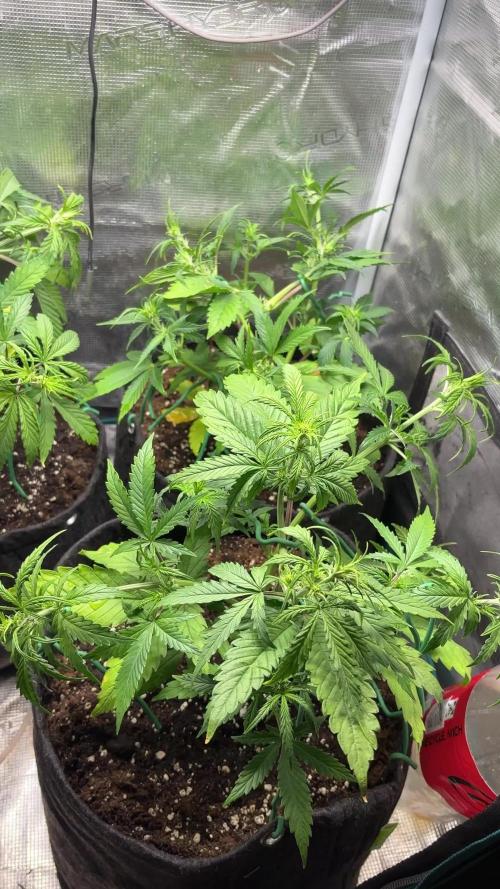
Here we are, ready, after a week of really fruitful germination we have 20 beautiful plants all marked with the Z of Zamnesia.
They are a strain in test. Super secret because from the start it seems explosive, but we are only on day nine and we are not used to talking too early, so we keep quiet and work hard we have learned to enjoy the results at the end, only when they are obtained.
---- New Home - The ladies have almost all been transplanted into 11-liter pots which is my favorite size to get the best ratio presence of plants in the grow box / yield. Especially if you do not have to do exaggerated topping or you have to grow the plants straight with main cola as I do for catalog needs as I do, 11 liters guarantees you to make excellent plants. Topping with 11 pots is recommended up to a maximum of 16 tops (4 main crops) - The pots are square plastic and canvas pots branded Zamnesia - The soil used is Plagron Promix with peat and worm castings but not fertilized -
--- Start feeding program - A very serious feeding program branded Plagron has begun. We have created our own personalized table based on the chosen soil (Plagron Promix 100% organic) that you can all do at the link https://plagron.com/en/tools/grow-schedule-calculator and I started to give:
- Power Roots - 1ml/l
- Alga Grow - 2 ml/l
- Pure Zym - 1 ml/l
- Sugar Royal - 1ml/l
- Vita Race - 1 ml/l
- The 100% Organic pack by Plagron can be found on Zamnesia at the link:
https://www.zamnesia.io/it/11457-plagron-easy-pack-natural.html
We are giving a lot of humidity with a humidifier and we oscillate between 65% and 70%.
// Strain Description // New Strain testing coming soon... -
- Get a seed of this fantastic strain --- new strain coming soon get some others on - https://www.zamnesia.io/
- Soil and Fertilizers entirely organic --- https://plagron.com/en buy on www.zamnesia.io
- Growbox and air sistem --- https://www.secretjardin.com/
- Light - Sp3000 --- https://marshydro.eu/
- Music and sound --- I made my girls listen to 432hz frequencies and music from www.radionula.com
- Z --- You can find these seeds, much more from the world of cannabis, mushrooms and an incredible series of accessories and gadgets on the reference site not only mine but of many growers ---- https://www.zamnesia.io
Likes
56
Share
@Ultraviolet
Follow
What's in the soil? What's not in the soil would be an easier question to answer. 16-18 DLI @ the minute. +++ as she grows.
Probably not recommended, but to get to where it needs to be, I need to start now.
Vegetative @1400ppm 0.8–1.2 kPa 80–86°F (26.7–30°C) 65–75%, LST Day 10, Fim'd Day 11
CEC (Cation Exchange Capacity):
This is a measure of a soil's ability to hold and exchange positively charged nutrients, like calcium, magnesium, and potassium. Soils with high CEC (more clay and organic matter) have more negative charges that attract and hold these essential nutrients, preventing them from leaching away.
Biochar is highly efficient at increasing cation exchange capacity (CEC) compared to many other amendments. Biochar's high CEC potential stems from its negatively charged functional groups, and studies show it can increase CEC by over 90%. Amendments like compost also increase CEC but are often more prone to rapid biodegradation, which can make biochar's effect more long-lasting. biochar acts as a long-lasting Cation Exchange Capacity (CEC) enhancer because its porous, carbon-rich structure provides sites for nutrients to bind to, effectively improving nutrient retention in soil without relying on the short-term benefits of fresh organic matter like compost or manure. Biochar's stability means these benefits last much longer than those from traditional organic amendments, making it a sustainable way to improve soil fertility, water retention, and structure over time. Needs to be charged first, similar to Coco, or it will immobilize cations, but at a much higher ratio.
a high cation exchange capacity (CEC) results in a high buffer protection, meaning the soil can better resist changes in pH and nutrient availability. This is because a high CEC soil has more negatively charged sites to hold onto essential positively charged nutrients, like calcium and magnesium, and to buffer against acid ions, such as hydrogen.
EC (Electrical Conductivity):
This measures the amount of soluble salts in the soil. High EC levels indicate a high concentration of dissolved salts and can be a sign of potential salinity issues that can harm plants.
The stored cations associated with a medium's cation exchange capacity (CEC) do not directly contribute to a real-time electrical conductivity (EC) reading. A real-time EC measurement reflects only the concentration of free, dissolved salt ions in the water solution within the medium.
98% of a plants nutrients comes directly from the water solution.
2% come directly from soil particles.
CEC is a mediums storage capacity for cations. These stored cations do not contribute to a mediums EC directly.
Electrical Conductivity (EC) does not measure salt ions adsorbed (stored) onto a Cation Exchange Capacity (CEC) site, as EC measures the conductivity of ions in solution within a soil or water sample, not those held on soil particles.
A medium releases stored cations to water by ion exchange, where a new, more desirable ion from the water solution temporarily displaces the stored cation from the medium's surface, a process also seen in plants absorbing nutrients via mass flow. For example, in water softeners, sodium ions are released from resin beads to bond with the medium's surface, displacing calcium and magnesium ions which then enter the water. This same principle applies when plants take up nutrients from the soil solution: the cations are released from the soil particles into the water in response to a concentration equilibrium, and then moved to the root surface via mass flow.
An example of ion exchange within the context of Cation Exchange Capacity (CEC) is a soil particle with a negative charge attracting and holding positively charged nutrient ions, like potassium (K+) or calcium (Ca2+), and then exchanging them for other positive ions present in the soil solution. For instance, a negatively charged clay particle in soil can hold a K+ ion and later release it to a plant's roots when a different cation, such as calcium (Ca2+), is abundant and replaces the potassium. This process of holding and swapping positively charged ions is fundamental to soil fertility, as it provides plants with essential nutrients.
Negative charges on soil particles: Soil particles, particularly clay and organic matter, have negatively charged surfaces due to their chemical structure.
Attraction of cations: These negative charges attract and hold positively charged ions, or cations, such as:
Potassium (K+)
Calcium (Ca2+)
Magnesium (Mg2+)
Sodium (Na+)
Ammonium (NH4+)
Plant roots excrete hydrogen ions (H+) through the action of proton pumps embedded in the root cell membranes, which use ATP (energy) to actively transport H+ ions from inside the root cell into the surrounding soil. This process lowers the pH of the soil, which helps to make certain mineral nutrients, such as iron, more available for uptake by the plant.
Mechanism of H+ Excretion
Proton Pumps: Root cells contain specialized proteins called proton pumps (H+-ATPases) in their cell membranes.
Active Transport: These proton pumps use energy from ATP to actively move H+ ions from the cytoplasm of the root cell into the soil, against their concentration gradient.
Role in pH Regulation: This active excretion of H+ is a major way plants regulate their internal cytoplasmic pH.
Nutrient Availability: The resulting decrease in soil pH makes certain essential mineral nutrients, like iron, more soluble and available for the root cells to absorb.
Ion Exchange: The H+ ions also displace positively charged mineral cations from the soil particles, making them available for uptake.
Iron Uptake: In response to iron deficiency stress, plants enhance H+ excretion and reductant release to lower the pH and convert Fe3+ to the more available form Fe2+. The altered pH can influence the activity and composition of beneficial microbes in the soil. The H+ gradient created by the proton pumps can also be used for other vital cell functions, such as ATP synthesis and the transport of other solutes. The hydrogen ions (H+) excreted during photosynthesis come from the splitting of water molecules. This splitting, called photolysis, occurs in Photosystem II to replace the electrons used in the light-dependent reactions. The released hydrogen ions are then pumped into the thylakoid lumen, creating a proton gradient that drives ATP synthesis.
Plants release hydrogen ions (H+) from their roots into the soil, a process that occurs in conjunction with nutrient uptake and photosynthesis. These H+ ions compete with mineral cations for the negatively charged sites on soil particles, a phenomenon known as cation exchange. By displacing beneficial mineral cations, the excreted H+ ions make these nutrients available for the plant to absorb, which can also lower the soil pH and indirectly affect its Cation Exchange Capacity (CEC) by altering the pool of exchangeable cations in the soil solution.
Plants use proton (H+) exudation, driven by the H+-ATPase enzyme, to release H+ ions into the soil, creating a more acidic rhizosphere, which enhances nutrient availability and influences nutrient cycling processes. This acidification mobilizes insoluble nutrients like iron (Fe) by breaking them down, while also facilitating the activity of beneficial microbes involved in the nutrient cycle. Therefore, H+ exudation is a critical plant strategy for nutrient acquisition and management, allowing plants to improve their access to essential elements from the soil.
A lack of water splitting during photosynthesis can affect iron uptake because the resulting energy imbalance disrupts the plant's ability to produce ATP and NADPH, which are crucial for overall photosynthetic energy conversion and can trigger a deficiency in iron homeostasis pathways. While photosynthesis uses hydrogen ions produced from water splitting for the Calvin cycle, not to create a hydrogen gas deficiency, the overall process is sensitive to nutrient availability, and iron is essential for chloroplast function.
In photosynthesis, water is split to provide electrons to replace those lost in Photosystem II, which is triggered by light absorption. These electrons then travel along a transport chain to generate ATP (energy currency) and NADPH (reducing power). Carbon Fixation: The generated ATP and NADPH are then used to convert carbon dioxide into carbohydrates in the Calvin cycle. Impaired water splitting (via water in or out) breaks the chain reaction of photosynthesis. This leads to an imbalance in ATP and NADPH levels, which disrupts the Calvin cycle and overall energy production in the plant. Plants require a sufficient supply of essential mineral elements like iron for photosynthesis. Iron is vital for chlorophyll formation and plays a crucial role in electron transport within the chloroplasts. The complex relationship between nutrient status and photosynthesis is evident when iron deficiency can be reverted by depleting other micronutrients like manganese. This highlights how nutrient homeostasis influences photosynthetic function. A lack of adequate energy and reducing power from photosynthesis, which is directly linked to water splitting, can trigger complex adaptive responses in the plant's iron uptake and distribution systems.
Plants possess receptors called transceptors that can directly detect specific nutrient concentrations in the soil or within the plant's tissues. These receptors trigger signaling pathways, sometimes involving calcium influx or changes in protein complex activity, that then influence nutrient uptake by the roots. Plants use this information to make long-term adjustments, such as Increasing root biomass to explore more soil for nutrients. Modifying metabolic pathways to make better use of available resources. Adjusting the rate of nutrient transport into the roots. That's why I keep a high EC. Abundance resonates Abundance.
Likes
9
Share
@Plebsi710
Follow
Harvest day for 2 plants , I forgot to take a picture of the 1st plant when pre trimmed , both are pretty huge , the 1st plant I expected her to be a lot smaller than what I got in my hand once cut down, the second plant was huge from the start , there is still a monster finishing her buds in the tent left so I I left this grow unfinished due to that for the moment


Likes
9
Share
@RSAFirstOrganicGrow
Follow
I think this is the part where patience is truly tested, so far she’s doing fine I believe! Last few weeks of flowering ahead I presume?
Past week has been cloudy so I’m just hoping for a bit more sun coming week!

Likes
37
Share
@420DeepGrow
Follow
Día 8: 🔹Descanso 😴
Día 9: 🔹Trasplante a macetas de 1litro (en los siguientes cultivos pondré directamente en macetas de 1litro).
🔹 Riego con una solución de 2ml/l de acti-vera de BioBizz Ec: 600 y pH a 5.9. Siempre en base a un Ec de agua de 400
🔹Abono foliarmente con una solución de acti-vera de Bio Buzz unas 2, 3 veces al día.
🔹 Aplico tierra de Diatomeas sobre el sustrato, media cucharadita de café por cada maceta de 1litro para el control de plagas.
Día 10: 🔹Abono foliarmente 2,3 veces al día con acti-vera de Bio Bizz
Día 11:. 🔹Abono foliarmente 2,3 veces al día con Rootbastic 1ml/l.
Día 12: 🔹 Aplico foliarmente 1ml/l Acti-vera BioBizz + 0.1ml/l y pH a 6.0.
🔹Remuevo la tierra para por encima con unas pinzas para airear el sustrato.
Día 13: 🔹Riego con 0.2ml/l Acti-vera y 0.01 Rootbastic, Ec 1000 y PH 5.9
🔹Pongo unas guías de madera para una mejor estabilidad y desarrollo de la planta.
Día 14: 🔹Aplico foliarmente 1ml/l Acti-vera BioBizz + 0.1ml/l y pH a 6.0.

Likes
3
Share
@Krautbauern
Follow
On some pics you can see the orange trichomes so its getting time for the harvest soon.
At D45 we stop fertilizing, now they will only get tap water (-pH) for the last 5 days, after that they will get 2 days of darkness

Likes
Comments
Share
@ChewiesGrow420
Follow
I had originally planted 2 purple kush and 2 fucking incredible autoflower seeds by crop king seeds. 1 purple kush never sprouted. So I planted in its place a white widow.

Likes
16
Share
@NMGDOC
Follow
Semana del 12 al 18 de abril
Cada día más bonitas. Estoy feliz porque como hay menos humedad ambiental, hay menos humedad en el indoor. Incluso llegando a 43% de humedad, así que me confirmo. La temperatura suele andar por 24-26 grados Celsius así que bien.
Tenía unas 10 hojas dañadas por la mosca negra, así que el 12 de abril apliqué el insecticida tec fort (foto del producto en la semana anterior). Lo apliqué a las 17:00 hrs y a las 22:30 del mismo día no vi ningún bicho. Dentro de 5-6 días volveré a aplicarlo igualmente (1ml por cada litro).
Al menos dos de las cuatro plantas están tomando otro color, así que me conformo.

Likes
11
Share
@NoTraceJamaica
Follow
Busy times as i prepare for outdoor growing this summer, but these autos are progressing nicely, the uploaded photos document week 5 (+1day) of growth, forgot to group the Purple Punch Autos together for a group photo 😖, heavy defoliation of fan leaves were done as well as some more LST.


Likes
9
Share
@Bread_n_Buds
Follow
And it starts like this. an official collaboration starts with the friends of Zamnesia, from today I will only grow, grow and flower Zamnesia Seeds plants and I really like it.
We are close to a flowering in the extreme heat and therefore we opted to start with 4 very fast F1s, they are not joking guys when they tell you that they are made to be more resistant, stable and fast they are not telling you something false. The girls are super fast, even those from other brands tried in the past are excellent and a sliver and this one from Zamnesia have all it takes to be the best autoflowering on the market.
The Pineapple Express F1s were also born at the speed of light, 22 hours in water, 36 on land and we were already born, both of them.
Oh yes, a lot of research is being done on autoflowering plants, you have all noticed monstrous improvements compared to Low Rider and subsequent derivatives.
Whoever works best wins and from what I have been able to see so far Zamnesia is working very well. I know, there is a group of sceptics, friends I'm here on purpose, give me a couple of months and we'll see.
Zamnesia is the best online shop in the situation, you can find everything from seeds, to mushroom kits, through vaporizers and a thousand other things https://www.zamnesia.io
Pineapple Express F1 seeds specifically
https://www.zamnesia.com/10681-zamnesia-seeds-pineapple-express-f1-automatic.html
Site Description
ZAMNESIA SEEDS - PINEAPPLE EXPRESS F1 HYBRID AUTOMATIC: FRUITY FLAVORS AND ENERGETIC EFFECTS
Combining Trainwreck with Hawaiian, Pineapple Express F1 Hybrid Automatic brings a beloved strain to new heights. This autoflowering F1 hybrid cultivar ensures exceptional uniformity, reliability, and stability, making it well-suited to growers of all experience levels. If you've not checked out Pineapple Express F1 hybrid Automatic for yourself just yet, now is the time.
GROWING PINEAPPLE EXPRESS F1 HYBRID AUTOMATIC
All it takes is 8–9 weeks from germination before Pineapple Express F1 hybrid Automatic is ready to harvest. Thankfully, very little effort is required throughout the growing process, aside from a bit of maintenance, to ensure ample, high-quality harvests. Thanks to its F1 genetics, Pineapple Express F1 Automatic offers superb resilience and uniformity, meaning all plants will have a similar height and appearance, and will churn out comparably large yields. Reaching heights of 50–70cm, Pineapple Express F1 Automatic is not an overbearing plant and can effortlessly slot into any setup. Once ready to yield, growers can see a return in the region of 400–550g/m² indoors and up to 200g/plant outdoors.
AROMAS, FLAVORS, AND EFFECTS OF PINEAPPLE EXPRESS F1 HYBRID AUTOMATIC
Just one hit of Pineapple Express F1 hybrid Automatic treats users to a rich assortment of flavors and aromas. This strain offers strong pineapple notes alongside moments of citrus, spice, and pine, making for a mouth-watering blend that's extremely moreish. Bolstered by 21% THC and an array of cannabinoids, Pineapple Express F1 Automatic showcases an energetic and uplifting high that will have you feeling chatty in no time. So if you've been looking for a strain to enjoy with friends, Pineapple Express F1 Automatic could be just the thing.
Likes
142
Share
@MadeInGermany
Follow
Hi all 🤗 Everything grows very well and healthy 😇
The stragglers were repotted this week. I also have to give the grown-ups at least 3-4 weeks vegi, because there is still no space in the bloom chamber 😂
But it gets exciting too, 5 topping bushes and 6 normal ones, unfortunately I can't top the 6 normal ones because of space constraints 🙈.
If you have any questions please ask ;-) otherwise all the best for everyone and let it grow 😎


Processing
Likes
18
Share
@TOTEM
Follow
This is a very interesting week!
After mainlining, I transplanted the lady into a 3L AirPot, adding 3 spoons of Mykos by Xtreme Gardening, 45g of BioMagno Algae and 5g of BioMagno Neem Flour. I uploaded a time-lapse video that shows the process.
Then I fed her with the nutes you see above this comment, in 1L of water (actually, 750ml would be better).
I hope you liked this week content!
Day 28 (May 7, 2019): 0.5L of tap water with Activator @ 0.5ml/L and Rizostimo @ 1ml/L.

Likes
9
Share
@Doctor_Gonzo
Follow
-6/11/23 Start of Week
--Week 12/Flower 6
-6/17/23 (Day 91/Flower 43)
--Observations: starting to get the classic cannabis scent, there is a lot going on under what is seeable from the top, leaf tips nutrient burnt
--Changes: increased amount of water per day, stopped giving nutrients during the week, removed more of the lemon basil, upped the intensity of the light (62%)
--Comments: started giving more water at the beginning of this week (about 22 oz daily) but had to stop adding nutrients every time because leaf tips started getting burnt. removed more of the lemon basil because it had started growing over the purple lemonade, the basil is growing like crazy. finally got a closer look at the inner growth of the purple lemonade and there is far more going on than I originally thought, looking like this might be the best grow I have done so far. purple lemonade scent is starting to intensify and gain the classic cannabis smell but still has the lemon citrus scent. decided to increase light intensity instead of lowering height from plant, light is now at about 62%.
-6/17/23 End of Week
-Post-Week note: decided to put the actual height of the top of the colas instead of the distance from the base to the top of the main stem, past weeks have also been updated.

Likes
112
Share
@Dunk_Junk
Follow
This week she grew 23cm taller! I have been doing experiments through the week FIMing various upper growth sites. We will see what effects this will have in the weeks to come.. I've also been seeing upper leaf tips going a very light green. Is it nutrient burn? Light burn?
Nutrients used this week: 20 grams 20-20-20 powder mixed with 10 litres of water + 40ml of Cannazym = ~1470ppm
Timelapse sequence is:
Auto Jack
*** Pineapple express ***
CBD Lime
Blue Dream
Auto Jack
*** Pineapple Express ***
CBD Lime
Blue Dream
Likes
24
Share
@BB_UK
Follow
Ever since I turned to mars hydro I have double sometimes nearly quadrupled my yields I first had with eBay lights (meh) I have never looked back since and gained so much respect from the community and the breeders too! And to hold the sponsors I do shows me that I am doing something right and I show appreciation to all who support! And that’s why I take a different effort to be fair and document you all! Even though I’m aware your businesses I just can’t be bias when it comes to the greatest I think you all are! Thank you for choosing me! (No I’m not the only one) just showing the love back as best as I can! 💚💚💚💚💚 thank you

Likes
4
Share
@ojulhao
Follow
This week I started training them, maybe too late. I see that one branch on one of the plants broke a little (I think it tried to grow and snapped), but it looks like it managed to form a new connection. It’s a bit weak, though. As you can see in the pictures, I made some strange training while trying to arrange the branches in a better position. I feel I should have done the topping one week earlier and started training before, as it would make it easier and probably lead to better results. Let’s see what happens.
Likes
21
Share
@RussianGrower
Follow
The first experiment I decided to do on the mother plant is a two-tiered pot. I cut the Cup and put it in a plastic plastic canister, wrapped with tape the upper tier of the pot, so that the light does not interfere with the roots, but the lower tier I left open, to nablidat for the development of the root system and show you. I also cut the four lower large vegetative leaves so that they do not interfere with the access of light to the side branches. Now the plant is 2 weeks old, it has been living in a new house for 3 days and has already adapted and taken new roots.

Likes
10
Share
@ZweetZkittlez
Follow
Activaron 24hs en un vaso de agua sin cloro. Luego al tupper con papel (rollo de cocina).
Luego de 3 / 4 días ya se pasaron a tierra.
En los primeros días y luego, en toda la etapa vegetativa vamos a usar un humidificador para tener una humedad entre el 70% y 80%


Processing
Likes
5
Share
