


Likes
Comments
Share


@Kirsten
Follow
This week, the plant is feeding heavily and has grown well.
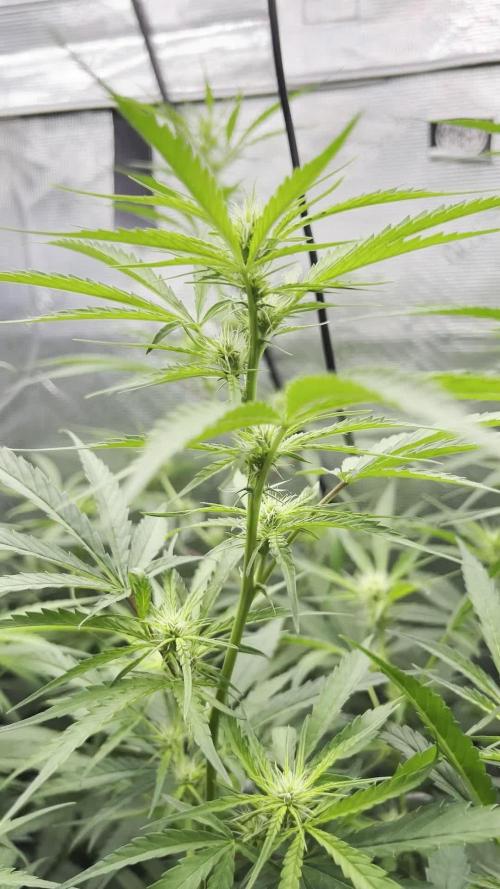
I super cropped the main stem to help with the plant becoming too tall, afterwards I made some scaffolding and a sling to hold the break and prevent it from snapping. It has taken very well.
Before the training I performed, I used 4 bamboo canes to stake the base. The plant had become very top heavy so this has really helped.
The plant was becoming very tall so I thought this would be something to try out.
Here's what I did this week.
18.7.25:
I watered with 2ltrs of dechlorinated water PH'd to 6.4, containing the following nutrients;
💜 2ml Ecothrive Trace
PH: 6.4
PPM: 365
22.7.25:
I watered with 3ltrs of dechlorinated water PH'd to 6.6 with;
💜 1 TSP Sea K
PH: 6.6
PPM: 485
25.7.25:
I watered with 2ltrs of dechlorinated water PH'd to 6.5, containing the following nutrients;
💜 2ml Ecothrive Trace
💜 1/4 TSP Ecothrive Biosys
PH: 6.5
PPM: 361
28.7.25:
I watered with 6.5ltrs of dechlorinated water PH'd to 6.0 with;
💜 7ml Trace
💜 1.5 TSP Ecothrive Biosys
PH: 6.0
PPM: 351
Thank you for checking in this week and hanging out in the comments 😁💚✌️🌱🙌

Likes
5
Share


@Bread_n_Buds
Follow
Our King Louis Automatic are truly those plants with a great desire to grow, the one in main lining is perfect.
Remember that we are growing 1 Plant worked with the techniques and one left to grow without cutting techniques to preserve its speed.
In this diary we find the plant that is growing normally, nice and straight just with a little cleaning and LST at the bottom only on the branches and not on the main stem. The plant had a moment of over at the end of the vegetative phase when it was time to move into flowering it had a manifestation of rusty spots on the sunbathing leaves but now at the beginning of flowering everything seems fixed. In my opinion it is a lack of K but yes
The comparison is the salt of the experience so the plant in the other diary will be worked very differently go and see it to compare them.
We have started the Plagron fertilization program, we are in 100% organic configuration, the soil is recycled Promix + 1/3 fresh soil + 10% Perlite + RQS Mycorrhiza Mix (4 g in the mix, 1 g under the small fiber pot).
We are administering // 1 ml/l Power Roots - 1 ml/l Pure Zym - 1 ml/l Sugar Royal - 3 ml/l Alga Grow
We have sprayed Vita Race Foliare 3 ml/l.
https://plagron.com/en
The doubts about the compatibility between Pure Zym and mycorrhizae have been dispelled, they can get along according to Plagron experts. If someone tells you that enzymes eat mycorrhizae, which in principle may seem possible, explain to them that it is not true.
https://www.royalqueenseeds.it/growing/452-easy-roots-mix-di-micorrhize.html
Love this strain perfect for main lining! ---- https://www.zamnesia.io/it/11238-zamnesia-seeds-king-louis-automatic.html
Brief description of Zamnesia // Say hello to true royalty with King Louis Auto, an autoflowering version of the original King Louis. Bred from OG Kush, LA Confidential and a premium ruderalis cutting, King Louis Auto delivers premium bud fit for a king just a few weeks after germination. As if that wasn't enough, her small size and vigor make her great for almost any grow environment. Incredibly efficient
King Louis Auto has inherited the best traits of her photoperiod cousin, all wrapped up in a fast and easy-to-grow seed. With good soil and adequate watering, King Louis Auto seeds will quickly grow into robust and vigorous plants. Once fully mature, these plants will not exceed 80cm indoors, meaning they can easily fit into even the smallest of grow spaces. Likewise, outdoor plants will only reach 100cm, making this strain ideal for guerrilla grows or other environments where discretion is key. And if that wasn't enough, King Louis Auto only takes 9–10 weeks from germination to harvest, after which she'll reward you with yields of up to 300g/m² indoors and 150g/plant outdoors. With its pungent terpenes and high THC levels, King Louis Auto offers a fragrant and relaxing experience. When you open your jars of buds, you'll immediately notice intense scents of pine, damp earth and fragrant wood. After inhaling her equally complex smoke or vapor, you'll be hit with a deep, relaxing body stone that's perfect for those moments of well-earned rest and relaxation. With 24% THC, King Louis Auto hits hard and takes effect within minutes, working every muscle in your body to relax. Perfect for evenings, weekends or any time you want to unwind. Buy your seeds now and experience the king of sweet strains.
You can find the entire world of growing on Zamnesia and more, just take a look at the site and you will find "all the best that nature has to offer" in various shapes and colors.
The new strains are fantastic and the old ones are no exception...
--- // www.zamnesia.com

Likes
Comments
Share


@BenDidKnEe
Follow
The clones are doing ok. I might have the humidity to high because they haven’t had water this week, the soil is still moist from the transplant. Once the roots hit the bottoms of the pots they should spread out causing the foliage to explode. In week 8 I’ll come back and edit and tell myself I told me so. Happy growing folks

Likes
9
Share


@Weeder_am_Start
Follow
In dieser Woche geht es ein letztes mal in die Breite.
Die abgebrochenen Triebe haben aujjf der einen Seite ein ganz schönes Loch hinterlassen.
Das wird sich hoffentlich in dieser Woche noch schließen. Ich habe alles wieder etwa auf eine Höhe gebracht und lasse der Lady jetzt noch ein paar tage ihre Erholung, bevor es dann endlich in den 12:12 Zyklus geht.
Näheres dazu in meinen Vegi Woche 6 Video auf Youtube:
Coming this afternoon
Link zur Lampe (Mars Hydro FC3000-Evo:
https://marshydro.eu/products/mars-hydro-smart-fc-3000-evo/?ref=docgreenthumb
Gutscheincode für Mars Hydro (3% Rabatt): docgreenthumb

Likes
15
Share


@Rinna
Follow
Ladies are doing great, finally fixed the pH problem, so the lockout should be fixed. Great growth, amazingly icy buds, especially pheno #1 is looking incredible. Smells of sour cherry candy with some hints of that gelato too.

Likes
23
Share


@adam_pawloski87
Follow
This grow was pretty simple ! They went a total of 103 days from seed! Very trichomy dense buds with the smell of Berries vanilla and skunk ! This is a must try for you all Fastbuds has the greats!!!


Likes
19
Share


@Paultemp
Follow
Hi all! 👊😊
Another week started ohh yeaahhh
I do foliar 3 times this week and i see pistil white change in orange
Smell very good pine and citrus :)


Likes
102
Share


@love_2_grow
Follow
D13 - BOOM! The new #1 had made her modest appearance. Only the top of the seed is visible so far, but it's a start. :)
#2 is moving along nicely, quietly doing her thing.
D14 - #1 is still shy and hasn't fully emerged yet, but she is at least poking up more than yesterday, so there's progress at least.
#2 is doing great, and I like her structure. Short and stout with large leaves and very short internodal spacing. She is 7 cm tall but already 11 cm wide.
I also cut back the cover crop as it was getting a bit wild and partly overshadowed the girls.
Since starting the grow, I have yet to water the girls properly, but they did get a little bit a couple of days ago when I had some extra after watering nematodes (against fungus gnats) to our regular houseplants. Better to be proactive than reactive ;)
D15 - I started a simple compost tea consisting of worm casting, rock dust, algal limestone, bentonite, biochar, and molasses. I'll leave it brewing overnight, and then it's watering/feeding time tomorrow.
D17 - No idea what is going on with the first girl, but it sure isn't much. The seed has maybe emerged for another two millimeters from the soil, but that is it. The seed hasn't cracked, and no leaves are visible. Hell, I can hardly see the stem.
Yesterday, I gave each girl about one liter of the compost tea that I started a couple of days ago. Let's see if that helps, although, at this point, I kind of doubt it.
As always, I completely forgot to check the pH of the tea. I have no idea why I keep forgetting that with my teas when I have no problem checking the pH when I use plain water. Oh well. Not the end of the world but something I need to keep in mind for the next tea in a couple of weeks.
The second girl looks great, though, so that's something at least.
D20 - Alright, it is official. The third girl died as well. The seed never cracked, and the stem went limp. I have no idea why this happened, and now I'm out of Colorado Cookies seeds, so that's that.
I have already planted another seed to see if the problem persists with another strain. I will make a separate diary for that one, though.
On the positive side is that the remaining girl looks strong and healthy. She is now 9 cm tall and 18 cm wide on this last day in week two of veg. Upwards and onwards!

Likes
6
Share


@rvabudman
Follow
The plant is just "keep on keeping on". Looks beautiful and is nearing the scrog. It is also nearing time for a second round of topping. I plan on keeping the Gold Leaf in veg for a while as the auto is running on 24, so trying to get close as possible to harvest for the auto before I flip the lights. Aiming for an xmas yield for the gold leaf.
I also performed some super cropping this week. Wish i had take close up photos on the branches, it work like a charm. The plant growth really took off. In some of the photos you can see the branches are a bit twist and recovering from the super cropping.

Likes
80
Share


@Roberts
Follow
AK 2.0 XL Autoflower has some big saggy buds on her. She grew great through the grow. Minor issues with ph here, and there. I have tried growing with low tds, and high tds in DWC. I prefer High TDS to help control ph level better. Plus plant gets much bigger. From my experiments. This plant is a fine example. Heavy yield, and full of frost. Strong aroma of citrus and a earthy fruity smell. She grew really well under the Mars Hydro FC4800. I will upload a harvest video if it let's me. If not it can be found on my YouTube channel. Link will be below. Thank you Mars Hydro, and Ganja Farmer. 🤜🤛🌱🌱🌱
Thank you grow diaries community for the 👇likes👇, follows, comments, and subscriptions on my YouTube channel👇. ❄️🌱🍻
Happy Growing 🌱🌱🌱
https://youtube.com/channel/UCAhN7yRzWLpcaRHhMIQ7X4g

Likes
7
Share


@spankyxvi
Follow
Not much different, buds seem more dense and more resin.
Her leaf looks dry and crispy.


Processing
Likes
42
Share


@MadeInGermany
Follow
Hey everyone 😀.
This week both Phenos continued to grow super 🙂.
They were also sprayed again with neem oil, which is why they look so dark and shine :-).
All trips are apparently gone, but safety first 🙂👍.
The week I will apply topping again, that it will be real bushes 😅.
I wish you all a lot of fun with the update, and let it grow 👍
You can buy this Strain at :
https://sweetseeds.es/de/cream-caramel/
Type:
Cream Caramel
☝️🏼
Genetics:
Blue Black
x
Maple Leaf Indica
x
White Rhino
👍
Vega lamp:
2 x Todogrow Led
Quantum Board 100 W
💡
Bloom Lamp :
2 x Todogrow Led
Cxb 3590 COB 3500 K 205W
💡💡☝️🏼
Soil :
Canna Coco Professional +
☝️🏼
Fertilizer:
Green House Powder Feeding
☝️🏼🌱
Water:
Osmosis water mixed with normal water (24 hours stale that the chlorine evaporates) to 0.2 EC. Add Cal / Mag to 0.4 Ec Ph with Organic Ph - to 5.5 - 5.8 .


Likes
1
Share


@Gumbassman
Follow
Just began flower, smells a little, but coming along, also with hips of bud sites. Some buns from net nut mix.
Likes
2
Share


@High_Grade_Dadli
Follow
Growth has been great so far the main crown end up breaking .....see pic nxt week
Likes
27
Share


@MoneyMorris
Follow
I’ve been flushing the plants for a week now. The colas have definitely gotten fatter from last week. It’s looking like I’ll be harvesting in 1 more week. Pretty much all the trichomes are milky and I’m starting to get amber ones.

Likes
5
Share

@AustinRon
Follow
TH 1Q2025 - Week 7 - Flower 4
(ON Haze X Original Haze) X Northern Lights #2
“Todd’s Haze”
Objective
- 8 Female Plants, Topped ONCE @ Flip, 12” when topped
- Modified Sea of Green
Seeds Wet: 1139PM, 28.2.2025
Germinated: 2.3.2025
Flip: 21.3.2025
Harvest: 77 Days, DATE: 6.6.2025
_________________________________________
Initiate Auto-Fertigation
LightDistance: [ 19.5, in] # We’re in STRETCH, ~1.5”/day!
11” Top Canopy
- [ ] TM-7: [ 0.125, g] # Prep
- [ ] Fertigation: [12, 12, 6] # [Primer A, Primer B, Silica Skin], Dilute to EC
- [ ] Photosynthesis Plus: [ 6, ml]
__
Fri Apr 18, 2025
TH 1Q25 29:F:4:1
__
Sat Apr 19, 2025
TH 1Q25 30:F:4:2
2000 Watering w/ PCAL 1660
Fertigation: [ 1, gal]
RLA: [ 8.5, 4.2, 3.4]
PCAL 1660: [ 2.5, ml] # Micronized Powder
__
Sun Apr 20, 2025
TH 1Q25 31:F:4:3
Light Distance[TOP]: [ 11, in] # Still Stretching
LightIntensity[TOP]: [ 925, µ], [ 40, mol/day]
LightIntensity[Main]: [ 801, µ], [ 34.6, mol/day]
We’ll Raise EC by 0.1 mS/cm/day till we’re comfortably ~ 2.4 (IFF They’re happy) …
Would like to see overall GREEN both darkening & evening out . . .
Defoliation
- [x] Remove Fan Leaves below Node 7 # Preparation for Understory Lighting
- [x] Remove Branches with TOPS bottom 25% of canopy
Auto-Fertigation Today
- [x] CLEAN Chiller
- [x] Vinegar
- [x] H202
- [x] High Throughput (Blast the interior AFTER Vinegar & H202)
Initial Reservoir Fill: EC: [ 2.0, mS/cm]
- [x] 4 Gallons (Dehu, RO, or Distilled)
- [x] Primer A & B: [ 54, ml]
- [x] Silica Skin GEN 3: [ 27, ml]
- [x] Photosynthesis Plus: [ 24, ml]
While configuring - Ran 2 Gallons of Feed Before UNPLUGGING. ;-}
__
Mon Apr 21, 2025
TH 1Q25 32:F:4:4
- [x] Light Distance[TOP]: [ 9, in] # Still Stretching 1.5 - 2”/Day
Reservoir Fill: EC: [ 2.1, mS/cm]
- [x] 4 Gallons (Dehu, RO, or Distilled)
- [x] Primer A & B: [ 54, ml]
- [x] Silica Skin GEN 3: [ 27, ml]
- [x] Photosynthesis Plus: [ 24, ml]
- [x] SLF-100: [ 20, ml]
We’ll take EC to 2.4 mS/cm (Relatively Heavy) IFF They’re all happy with the ‘upgrade’. ;-}
Picked up 8 gallons of Distilled from HEB. Used for to refresh tank after last nights flush.
Going for NO MORE than 2 Gal/Day.
We’ll feed MORE than necessary to get DOWN TO Optimal delivery.
Irrigation Timer is set to Every 3 Hours, 1 min flow, four times a light period.
__
Tue Apr 22, 2025
TH 1Q25 33:F:4:5
Observation
Vibrant, Uplifted, Rockin’ - 1250 runoff, Grew TWO MORE INCHES, Light Distance 6”
1900: Measure Runoff
- Amount: [ 1250 , ml]
- EC: [ 2.1, mS/cm]
- [x] Harvest Dehu
- [x] Refresh Reservoir - 2 Gallons
- [x] EC: 2.1
- [x] Primer A & B: [ 27, ml]
- [x] Silica Skin GEN 3: [ 14, ml]
- [x] Photosynthesis Plus: [ 12, ml]
- [x] SLF-100: [ 10, ml]
__
Wed Apr 23, 2025
TH 1Q25 34:F:4:6

Plants Look GREAT!
Plants stretched 2 - 3” last night. If we don’t stop, we’ll need to supercrop the Exceptions.
Cleaned MANIFOLD FILTER - Had GRANULAR feel, on top of a little slime. Will check Thursday.
Doubled IRRIGATION TIME from one to two minutes x 5 Irrigations. We had negligible runoff last night.
1900: Measure Runoff
- Amount: [ negligible, ml]
- EC: [ ? , mS/cm]
- [x] Harvest Dehu
__
Thu Apr 24, 2025
TH 1Q25 35:F:4:7
- [x] Harvest Dehu
- [x] Refresh Reservoir - 2 Gallons
- [x] EC: 2.3
- [x] Primer A & B: [ 31, ml]
- [x] Silica Skin GEN 3: [ 16, ml]
- [x] Photosynthesis Plus: [ 12, ml]
- [x] SLF-100: [ 10, ml]
