Likes
Comments
Share
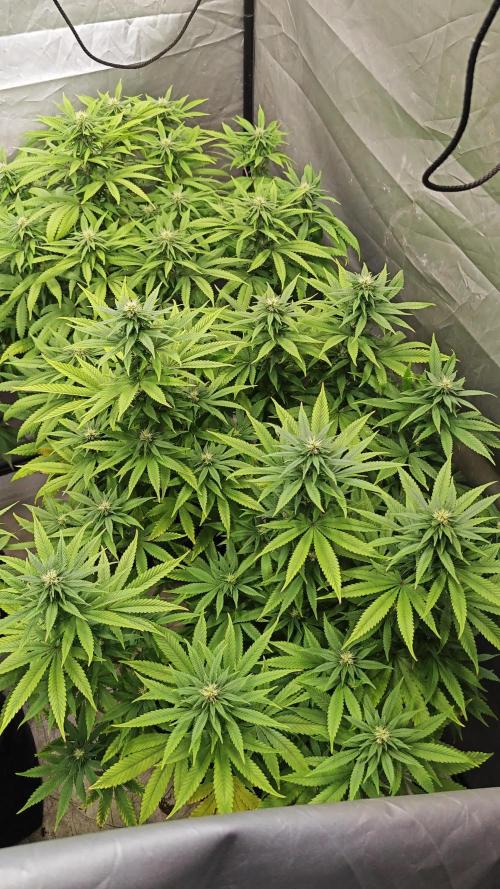
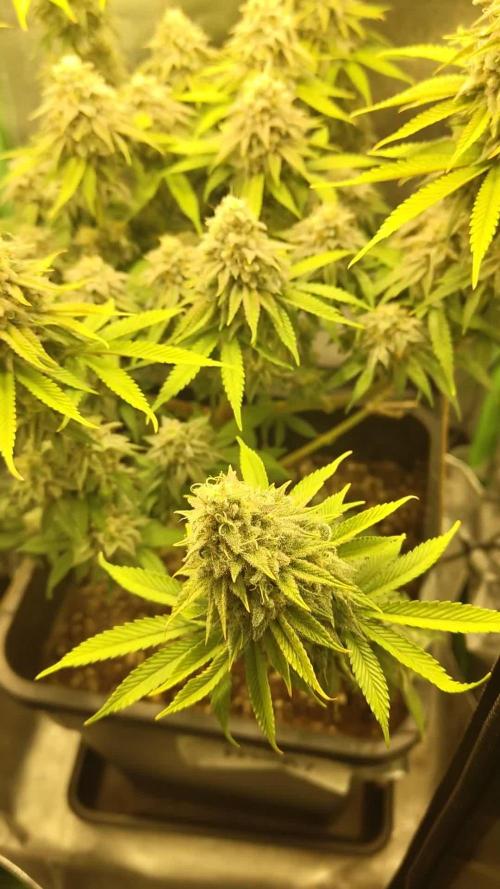
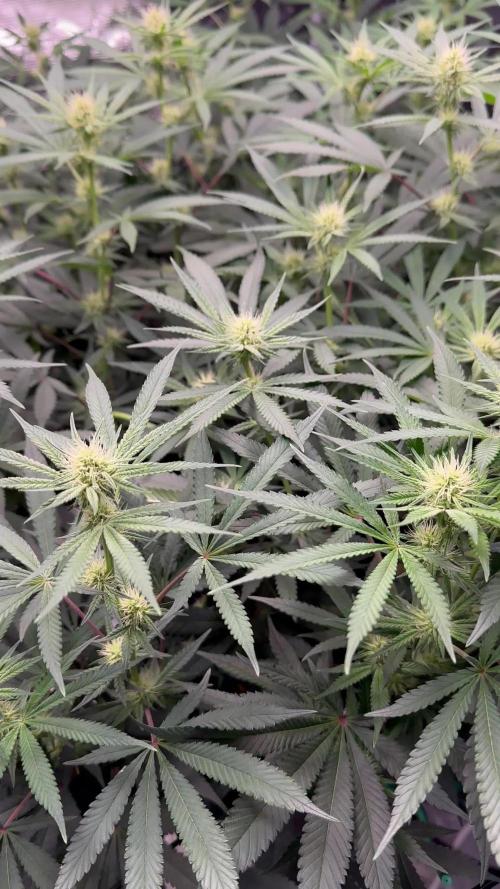
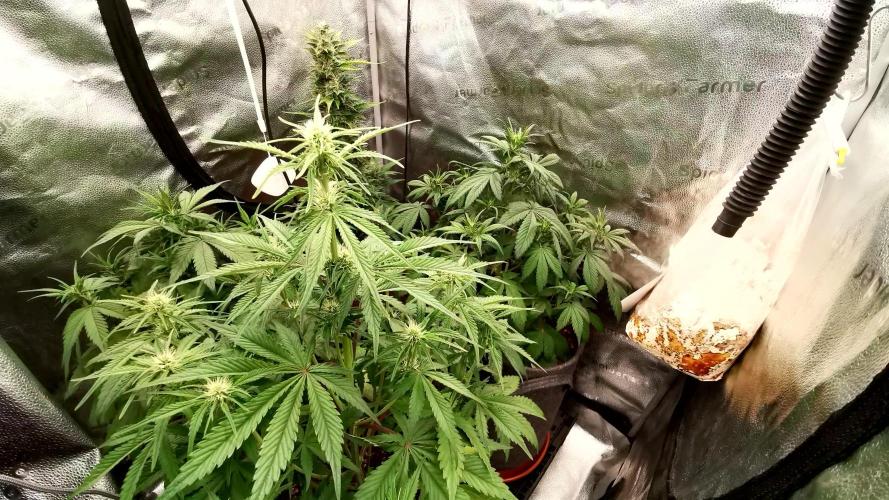
Another week for this one, fighting the summer heat in a grow room without AC but she is staying strong !
Likes
55
Share
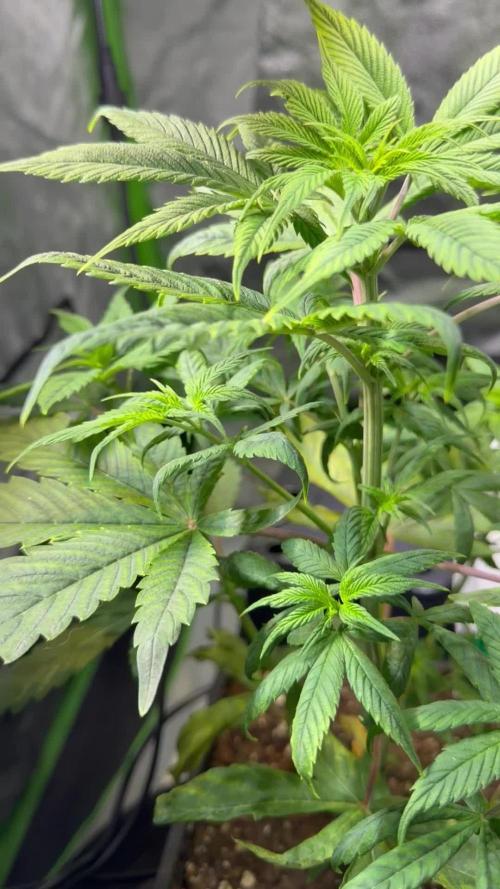
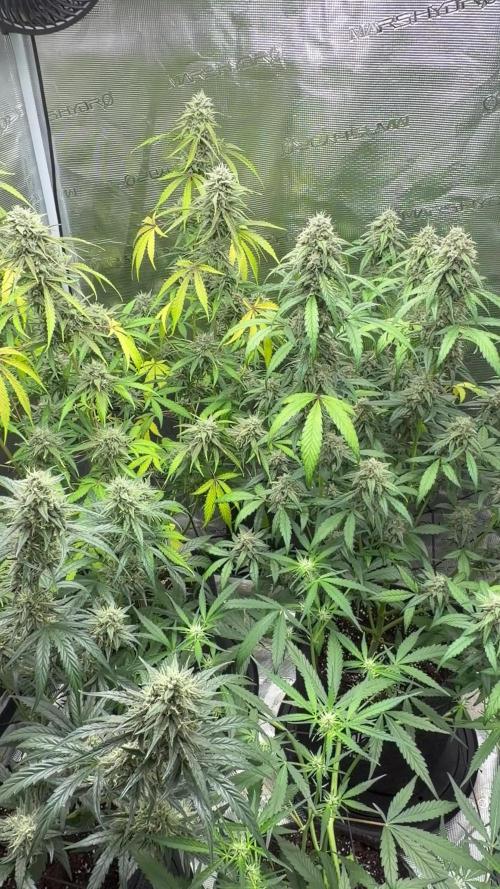
2nd net is up. Early bud formations are promising. holding up to the extremes pretty well, some leaves taking minor damage, but overall, she is holding up, gave her 1 night at 50F see how she would react, stressful. Not advised as it messes with her metabolism, but I want to see if it triggers any anthocyanin response. Love to see her purp up but no signs yet. Remember, For every molecule of glucose produced during photosynthesis, a plant needs to split six molecules of water. This process provides the hydrogen needed for synthesizing glucose and other organic compounds, while oxygen is released as a byproduct. Homework. If Rubisco activity is impaired and it cannot properly function or regenerate its substrate, the plant's leaves are likely to turn a pale green or lime green, a condition known as chlorosis. Essentially, Rubisco activity is highly regulated and susceptible to various environmental and metabolic factors that can cause it to become inhibited, leading to an apparent failure in RuBP regeneration due to a lack of consumption. Rubisco regeneration is intrinsically linked to nitrogen supply because Rubisco is a major sink for nitrogen in plants, typically accounting for 15% to over 25% of total leaf nitrogen. The regeneration phase itself consumes nitrogen through the synthesis of the Rubisco enzyme and associated proteins (like Rubisco activase), and overall nitrogen status heavily influences the efficiency of RuBP regeneration. RuBisCO is a very large enzyme that constitutes a significant proportion (up to 50%) of leaf soluble protein and requires large investments in nitrogen. Insufficient nitrogen supply limits the plant's ability to produce adequate amounts of RuBisCO, thereby limiting the overall capacity for photosynthesis and carbon fixation. Maintaining the optimal, slightly alkaline pH is crucial for the proper function and regeneration of Rubisco. Deviations in either direction (too high or too low) disrupt the enzyme's structure, activation state, and interaction with its substrates, leading to decreased activity and impaired RuBP regeneration. (Lime/yellowing) Structural Component: Nitrogen is an essential building block for all proteins, and the sheer abundance of the Rubisco protein makes it the single largest storage of nitrogen in the leaf. Synthesis and Activity: Adequate nitrogen supply is crucial for the synthesis and maintenance of sufficient Rubisco enzyme and Rubisco activase (Rca), the regulatory protein responsible for maintaining Rubisco's active state. Nitrogen deficiency leads to a decrease in the content and activity of both Rubisco and Rca, which in turn limits the maximum carboxylation rate, Vmax, and the rate of RuBP regeneration Jmax, thus reducing overall photosynthetic capacity. Nitrogen Storage and Remobilization: Rubisco can act as a temporary nitrogen storage protein, which is degraded to remobilize nitrogen to other growing parts of the plant, especially under conditions of nitrogen deficiency or senescence. Nitrogen Use Efficiency (NUE): The allocation of nitrogen to Rubisco is a key determinant of a plant's photosynthetic nitrogen use efficiency (PNUE). In high-nitrogen conditions, plants may accumulate a surplus of Rubisco, which may not be fully activated, leading to a lower PNUE. Optimizing the amount and activity of Rubisco relative to nitrogen availability is a target for improving crop NUE. Photorespiration and Nitrogen Metabolism: Nitrogen metabolism is also linked to the photorespiration pathway (which competes with carboxylation at the Rubisco active site), particularly in the reassimilation of ammonia released during the process. To increase RuBisCO regeneration, which refers to the process of forming the CO2 acceptor molecule Ribulose-1,5-bisphosphate (RuBP) during photosynthesis, the primary methods involve optimizing the levels and activity of Rubisco activase (Rca) and enhancing the performance of other Calvin-Benson-Bassham (CBB) cycle enzymes. Biochemical and Environmental Approaches: Optimize Rubisco Activase (Rca) activity: Rca is a crucial chaperone protein that removes inhibitory sugar phosphates, such as CA1P (2-carboxy-D-arabinitol 1-phosphate), from the Rubisco active site, thus maintaining its catalytic competence. •Ensure optimal light conditions: Rca is light-activated via the chloroplast's redox status. Adequate light intensity ensures Rca can effectively maintain Rubisco in its active, carbamylated state. •Maintain optimal temperature: Rca is highly temperature-sensitive and can become unstable at moderately high temperatures (e.g., above 35°C/95F° in many C3 plants), which decreases its ability to activate Rubisco. Maintaining temperatures within the optimal range for a specific plant species is important. •Optimize Mg2+ concentration: Mg2+ is a key cofactor for both Rubisco carbamylation and Rca activity. In the light, Mg2+ concentration in the chloroplast stroma increases, promoting activation. •Manage ATP/ADP ratio: Rca activity depends on ATP hydrolysis and is inhibited by ADP. Conditions that maintain a high ATP/ADP ratio in the chloroplast stroma favor Rca activity. Enhance Calvin-Benson-Bassham (CBB) cycle enzyme activity: The overall rate of RuBP regeneration can be limited by other enzymes in the cycle. •Increase SBPase activity: Sedoheptulose-1,7-bisphosphatase (SBPase) is a key regulatory enzyme in the regeneration pathway, and increasing its activity can enhance RuBP regeneration and overall photosynthesis. •Optimize other enzymes: Overexpression of other CBB cycle enzymes such as fructose-1,6-bisphosphate aldolase (FBA) and triose phosphate isomerase (TPI) can also help to balance the metabolic flux and improve RuBP regeneration capacity. Magnesium ions, Mg2+, are specifically required for Rubisco activation because the cation plays a critical structural and chemical role in forming the active site: A specific lysine residue in the active site must be carbamylated by a CO2 molecule to activate the enzyme. The resulting negatively charged carbamyl group then facilitates the binding of the positively charged Mg2+ion. While other divalent metal ions like Mn2+ can bind to Rubisco, they alter the enzyme's substrate specificity and lead to dramatically lower activity or a higher rate of the non-productive oxygenation reaction compared to Mg2+, making them biologically unfavorable in the context of efficient carbon fixation. The concentration of Mg2+ in the chloroplast stroma naturally increases in the light due to ion potential balancing during ATP synthesis, providing a physiological mechanism to ensure the enzyme is activated when photosynthesis is possible. At the center of the porphyrin ring, nestled within its nitrogen atoms, is a Magnesium ion (Mg2+). This magnesium ion is crucial for the function of chlorophyll, and without it, the pigment cannot effectively capture and transfer light energy. Mg acts as a cofactor: Mg2+ binds to Rubisco after an activator CO2 molecule, forming a catalytically competent complex (Enzyme-CO2-Mg2+). High light + CO2) increases demand: Under high light (60 DLI is a very high intensity, potentially saturating) and high CO2, the plant's capacity for photosynthesis is high, and thus the demand for activated Rubisco and the necessary Mg2+ cofactor increases. Mg deficiency becomes limiting: If Mg2+ is deficient under these conditions, the higher levels of Rubisco and Rubisco activase produced cannot be fully activated, leading to lower photosynthetic rates and potential photo-oxidative damage. Optimal range: Studies show that adequate Mg2+ application can enhance Rubisco activation and stabilize net photosynthetic rates under stress conditions, but the required concentration is specific to the experimental setup. Monitoring is key: The most effective approach in a controlled environment is to monitor the plant's physiological responses e.g., leaf Mg2+ concentration, photosynthetic rate, Rubisco activation state, and adjust the nutrient solution/fertilizer to maintain adequate levels, rather than supplementing a fixed "extra" amount. In practice, this means ensuring that Mg2+ is not a limiting factor in the plant's standard nutrient solution when pushing the limits with high light and CO2. Applying Mg2+ through foliar spray is beneficial to Rubisco regeneration, particularly in alleviating the negative effects of magnesium (Mg) deficiency and high-temperature stress (HTS). While Mg can be leached from soil, within the plant it is considered a mobile nutrient, particularly in the phloem. Foliar-applied Mg is quickly absorbed by the leaves and can be translocate to other plant parts, including new growth and sink organs. Foliar application of: NATURES VERY OWN MgSO4 @ 15.0g L-1 in a spray bottle. For those high-intensity workouts when 1 meal a day is just not enough! Foliar sprays are often recommended as a rapid rescue measure for existing deficiencies or as a supplement during critical growth stages, when demand for Mg is high. Application in the early morning or late evening can improve absorption and prevent leaf burn. The plant was getting a little limey yellow in the centre. Shortly thereafter, she was back in business, green mostly regenerated. The starting point [of creativity] is curiosity: pondering why the default exists in the first place. We’re driven to question defaults when we experience vuja de, the opposite of déjà vu. Déjà vu occurs when we encounter something new, but it feels as if we’ve seen it before. Vuja de is the reverse—we face something familiar, but we see it with a fresh perspective that enables us to gain new insights into old problems. Confidence is evidence... nothing more. You are confident because you have driven 10,000 times, you are confident because you have spoken 10,000 times. People think confidence is a feeling, but it's not. If you want more confidence, then you need to create evidence, take more shots, collect more data, build more experiences, take more risks; fail, confidence doesn't come first; it is the reward you get for doing the work. no one else wants to do.
Likes
57
Share
@Kmikaz420
Follow
Et voici le reste du jardin (sans la cherry cola qui sèche deja;) Rien à signaler à part les 2 monstre dans la tante qui n arrêtent pas de grandir ;) j ai fais une defoliation aux 2 ainsi qu aux dos i dos (qui produisent pas mal de feuilles à enlever;) Mais autrement elle aussi évolue bien . Demain la 2eme cherry cola va être recolter ainsi que la gorrilla x purple punch , et le reste du jardin ça continuer sont chemin encore une semaine avec nutriment puis on passera au flusch voilà voilà on y arrive tous doucement à cette douce et tendre recolte;) En espérant que se que vous voyez vous plaît ;) Bon dimanche à toute et tous je profite de vous postez quelque photo du jardin presque au complet (vue que j vais couper la cherry cola 2 ..et la gorrilla x purple punch Mention spécial à la dos i dos de barney qui m étonne de jour en jour plus une odeur folle de kusch ,des têtes dur comme la pierre, et pour une plante de 40cm elle va faire une bonne recolte !! (A voir d ici une semaine voir 2 ) et j ai dans les dos i dos comme pour les strawberry x gorrilla 2 pheno différent Un des pheno de strawberry prend 2 voir 3 semaine de plus à finir (j avais se pheno à mon premier journal de strawberry x gg4.. Dommage car l autre pheno est juste magnifique avec des têtes énormes (c celle de droite ) et elle fini bien plus tôt que l autre.. bon c été à peut près tout j voulais juste mettre quelque souvenirs en plus de ces magnifiques ladys 😀
Likes
8
Share
Processing
Likes
29
Share
11/2: The Starcandy x Gelato and the Starcandy x Strawberry Cheesecake both show signs of N deficiency, so I'm gonna feed tomorrow. 11/3: I fed today and started foliar feeding with kelp and fish emulsion every time I check on them. 11/4: They're looking a little better today, but still not 100%... Skunk is kinda mutated..a little wonky looking and slow, but maybe she's just a slow starter.. Strawberry Pie is catching up despite being a few days behind. 11/7: no time to comment
Likes
7
Share
She is a very beautiful baby. The Purple Lemonade is growing regular, she is very topping reactive and new brunches go fast. In this case the first top was not so perfect and a central brunche is reborn and i fimmed it. The first buds "peluria" is visible.
Likes
4
Share
Prima settimana di fioritura...questa creamzilla promette bene....sta crescendo ben forte e robusta 💪💪💪💚💛❤️
Likes
15
Share
6/12 - 6/18 👉👊 ------------------- 6/14 AM - (G)(Y) 1 Gal. 6.7. Cal-Mag 2.5. Micro 3, Gro 0 Bloom 5 *Forgot to jump to 6*, Easy Weed .25 tsp 6/14 - (Y)(G) are sharing 1 Optic XL. The other plant is under it's own Optic XL. *Lazy training! They got too big.* 6/16 AM - (Y) 1 Gal 6.7 pH Cal-Mag 2.5, Micro 3, Gro 0, Bloom 6, TErp 6, Recharge .5 6/16 PM - (G) (Y) 1 Gal 6.8 pH 2.5 Cal-Mag+, 3 Micro, 0 Gro, 6 Bloom, 3 Fish Shit *Yes, (Y) 2 gallons in a 24 hr period! 6/18 - (Y) 1 Gal. pH 6.7. 2.5 Cal-Mag+, 3 Micro, 0 Gro, 6 Bloom, .25 tsp Easy Weed ------------------------- Green Clips - No Terpenez (G) Yellow Clips - Using Terpenez (Y) ------------------------- 3 Gallon Fabric Pots 40% FoxFarm Happy Frog 40% Cana-Coco 20% Perlite ------------------------- Veg & Bloom Tent: 2’x4’x5’ Green Architecture Tent 600D 2’x4’x5’ CoolGrows Tent 600D Optic 1 54w COB 3500K (Seedling, Early Veg) 18/6 Optic 1 XL100w COB 3500k (Late Veg, Bloom) 18/6 Optic 1 XL100w COB 3500k Dimming (Late Veg, Bloom) 18/6 1 Gal Humidifier 2x 6” Clip Fan 2x 28” Oscillating Fan 2x 4” Carbon Filter with 2x 200 CFM
Likes
9
Share
Venga familia, que actualizo la 8 semana de floración de estas Kritical. Ya se ven en la recta final , falta madurar un poco más, yo creo que con 10,14 días estarían ya apañadas pero decir es aproximar. Ya se realizó el lavado de raíces, y aparte llevan una semana ya solo con agua. La verdad que hasta aquí estoy contento con el resultado hasta ahora. Agrobeta: https://www.agrobeta.com/agrobetatiendaonline/36-abonos-canamo Mars hydro: Code discount: EL420 https://www.mars-hydro.com/ Las maximas de temperatura no superan los 26 grados y las mínimas no bajan 20, así que no me puedo quejar. Los niveles de humedad también son los correctos van entre 45%/55% de humedad relativa. Por supuesto el Ph lo estamos dejando alrededor de 6. Hasta aquí es todo, buenos humos 💨💨💨.
Likes
66
Share
@mulch
Follow
8/14/17 Sorry for lack of updates. Been feeding the new flowering schedule. It will modify slightly every week, most likely. FloraMicro 4ml gal FloraGrow 1.25ml gal FloraBloom 8ml gal SM-90 2.5ml gal Cannazym 2.5ml Gal Ful-Potential 2.5ml gal Liquid Koolbloom 2ml gal Floralicious Plus 1ml gal ArmorSI 1.5ml gal Florablend 2.5ml gal CaliMagic 3.75ml gal (1 plant started showing def again) FloraNectar 2.5ml gal Drip Clean 0.4ml gal A few things were added, the Photosynthesis Plus and roots excelerator have been removed, Florablend is out next week. It sure is crowded in that tent. Humidity is now being lowered to 45% during lights out as it was spiking during that time. Dehumidifier is on it's own timer and runs during lights out taking a liter or so water out a night. With the canopy that thick for a couple feet vertically and all the way horizontally, i do not want to take any chances with either stagnant or damp air now that most of the girls are actively flowering. They missed a transition week, but they were suffering deficiencies so I had to quickly get them on flowering nutes. All seems good so far except for the very crowded workspace when I do anything in there. I think I am going to drop grow. I REALLY didn't expect them to pass 3 feet but the danger is real. I have just over a foot of space to move my light up, so now seems like a good time to drop FloraGrow
Processing
Likes
11
Share
Solo pequeños cambios no muy notorios, espero que ya vaya tomando mas velocidad a medida que termina la semana.
Likes
1
Share
In a 3 gallon container, I mixed - pro mix organic vegetable + Worm casting + Sea compost + 450 ml ollas (blue one)
Likes
105
Share
Commencing Week 9 - 1st week of flowering - Day 57 from germination - Day 6 of 12/12 on December 19th All is well. Much has happened. Clones and bonsai training. 818 already has pungent, awesome scent. GZ are still beasts. RD & BH have fantastic natural shape. D.61t/10f RDs Sativa growth is showing off now and stretching out as expected. looking beautiful. what she lacks in Veg State growth is definitely made up during bloom. hoping she fills in the holes of the canopy
Likes
30
Share
Quite a few are finishing up I’m gonna start the flush in around a week then harvest few days after that, incredible thc on this strain and buds are really dense I couldn’t recommend a better autoflower then this is best I’ve ever done 💪🌱😜
Likes
71
Share
@Roberts
Follow
I have not done much, but change the solution. I plan to switch to flowering hours next update. She is in a New Level Hydro bucket, under a Spider Farmer SE5000 light at 50 percent. Thank you Spider Farmer, Amsterdam Marijuana Seeds, and New Level Hydro. 🌱🤜🤛🌱 Http://amsterdammarijuanaseeds.com Thank you grow diaries community for the 👇likes👇, follows, comments, and subscriptions on my YouTube channel👇. ❄️🌱🍻 Happy Growing 🌱🌱🌱 https://youtube.com/channel/UCAhN7yRzWLpcaRHhMIQ7X4g SE5000 https://amzn.to/3qFpAML Spider Farmer Official Website Links: US&Worldwide: https://www.spider-farmer.com UK: https://spiderfarmer.co.uk CA: https://spiderfarmer.ca EU: https://spiderfarmer.eu AU: https://spiderfarmer.com.au Coupon Code: saveurcash Www.newlevelhydro.com Www.hygrozyme.com