Likes
Comments
Share
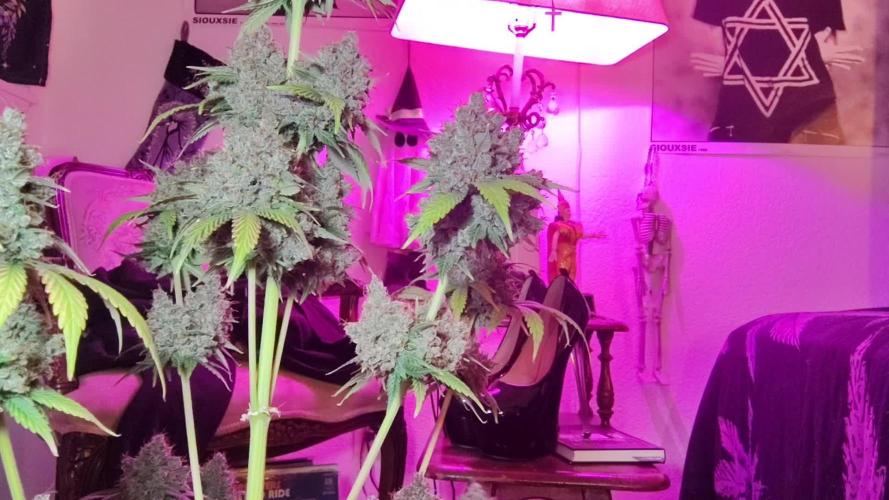
📅 Week 13 | Days 92–98 📅 🌼🌸🌺 Flowering Phase 🌼🌸🌺 Day 98 🌞 – Oreoz 🔸 Oreoz is looking like an absolute showstopper this week. The buds are incredibly dense and completely frosted with thick, glistening trichomes – it almost looks like they’ve been dusted with snow. Resin production is off the charts, especially on the top colas. Trichomes: Mostly milky with some still clear – no ambers yet. She's not quite ready, but getting close. 🔸 Climate control has improved. Humidity started the week at 63%, but with the dehumidifier now running and all clip fans at full power, it's being maintained steadily between 50–60%. That little climate shift is definitely helping – the buds are chunking up without any signs of stress. The slight 2–3°C increase in tent temperature is worth it. 🔸 Nutrients: 1 week of Overdrive (Advanced Nutrients) before the flush phase. Water intake has already slowed down noticeably – another good sign that the end is near. 📈 Current Conditions 🌡️🔆 = 27°C 🌡️🌜 = 20°C 💨 VPD Target = 1.4 - 1.6 💨 Humidity = 63% → Target: below 60% 🔦 PPFD = 900 µmol (12/12) 🔦⌚ DLI = ~38 🛠️ Setup (unchanged) 💡 Lights: 2 x Sanlight Evo 4-120 @ 90% ⛺ Tent: 120 x 120 x 180 🍯 Pot Size: 18 liters 🌱 Medium: Bio-Bizz Light Mix 💊 Nutrients: Advanced Nutrients 💧 Water: Tap water (EC 0.5)
Processing
Likes
14
Share
Sloooooow going. My temps are fine if not ideal, humidity is steadily above 40%. Yet these plants still look weeks behind. If you are reading this and my parameters and see any glaring mistakes please feel free to drop a comment. I am definitely new to organic growing andI just don't know what to do. I started PHing organically this week. I ordered a water conditioner from Microbe life. It's not here yet, but soon. And if my video uploaded you'll see a product from Microbe Lift that will hopefully kill any fungus gnat larvae in the soil. Beyond that adding Armor Si back into my nutrient schedule is the only other thing I can think to snap these plants out of their funk. Good luck everybody else!
Likes
43
Share
@Coopmc
Follow
Oh Ya looking good smelling stinky Got some lowers for Fresh Frozen Nug Rince
Likes
38
Share
11 weeks completed! The plants seem healthy and doing their thing. I will be harvesting this week. There is definitely some amber in the trichomes. I gave them a tiny feed mid week since they had seemed to be a little stalled out (first feed in 1.5 weeks). I watered them last night. I'll check the trichomes when I but them to bed in 2 days and see if that is when I'll leave them in the dark for 48 hours and then harvest. If they are still not ready then... I'll water again when I wake them up and then I'll check them 2-3 days after that! Either way, I cannot see this not happening in the next 4-5 days!! Looking forward to harvest!! Plans are already underway for my next grow. Probably going with Seedsman's Strawberry Auto Cheesecake.
Likes
4
Share
@Playse
Follow
Der Samen hat eine ganze Weile gebraucht bis er eine Wurzel ausbildete. Ich habe ihn 3 Tage der „Papertowel“ Methode gehabt, anschließend ein paar Stunden ins Wasserglas gelegt und danach wieder zwischen zwei kleine Teller in nasses Papier. Es dauerte 4 Tage bis ich ihn einpflanzen konnte. 2 Tage später hat sie das Licht der Welt erblickt. Dieses besteht aus einem der beiden Panels der 240 Watt Kingbrite LED Lampe. Anfangs auf einen PPFD Wert von 150-200, habe ich es jetzt nach einer Woche auf 600 erhöht, um zu schauen, wie sie darauf reagiert. Die meisten Autoflowers sehen nach einer Woche weiter aus und diese hier fing ziemlich an zu spargeln, daher probiere ich mit dem Licht noch etwas herum. Das ist mein erster Grow mit den Green House Feeding Bio Düngern. Ich habe einen Coco + Perlite Mix verwendet und die Düngerangaben halbiert. Green House Feeding empfiehlt 3 gr/Liter Medium BioGrow bei 8 Wochen Wachstum. BioBloom soll eigentlich kurz vor der Blüte oben in die Erde eingearbeitet werden. Ich habe beide Varianten mit je 1,5 gr/Liter von Anfang ins Medium gemischt, da Barney‘s Farm den Zyklus für die Runtz Auto mit ca. 70 Tagen angibt. Ich rechne mit ca. 20 Tagen Wachstumsphase und anschließend Blütezeit. Ob das die richtige Entscheidung war, wird sich zeigen. Ich hoffe einfach, dass sich die Nährstoffe langsam freisetzen und zur richtigen Zeit verfügbar sind, ohne zu überdüngen. Als Bewässerung kommt eine 12V Pumpe mit 7 l/Min. zum Einsatz. Hinter dieser ist ein Y-Ventil verbaut, um die Mengen zu kontrollieren. Auch hier probiere ich noch etwas. Kokos soll eigentlich nicht austrocknen. In dieser frühen Phase aber 2 Mal am Tag zu gießen, fühlt sich auch nicht richtig an. Das Wasser ist ständig in Bewegung und wird vor dem Gießen auf pH 5,8 eingepegelt. Bei der Bewässerung gibt es noch Potenzial zur Optimierung, da sich das Wasser nicht im ganzen Topf verteilen lässt. Hier werde ich wohl auf die anderen Optionen von Floraflex zurückgreifen. Für den Anfang reicht es jedoch. Mal sehen, wie sie sich entwickelt. Danke für die Aufmerksamkeit.
Likes
2
Share
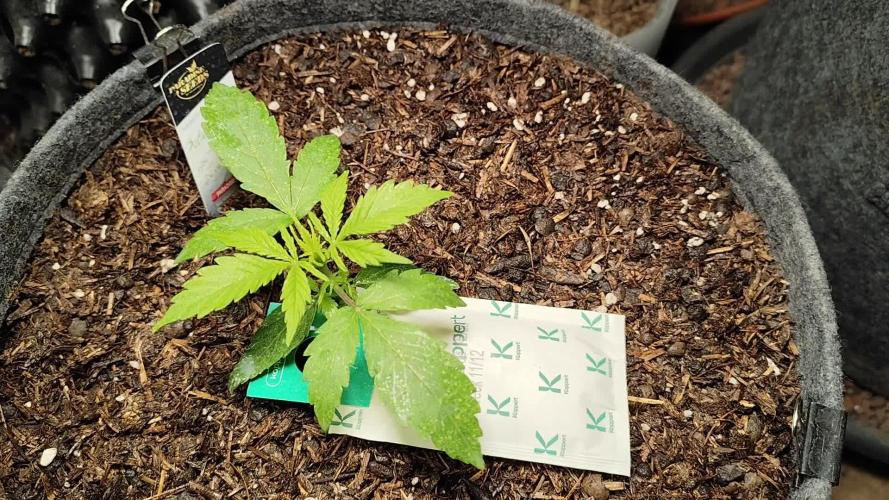
Transplant week! Some of the girls in the tent started to droop but this one didn’t! She’s looking pretty good to me Come hang out with us in the discord!
Likes
2
Share
@StonedBay
Follow
So 2 week update since last. They were transplanted on week 4. Then Ive been still playing around and dialing in the calmag portion of the nutrients. They seem to be responding well. got the net installed today and theyre already stretching. First grow in coco please dont come at me im learning. hoping to have it dialed in within a week or 2 since I need to flip soon.
Likes
36
Share
The flush week! Seemed ok - def had nitrogen toxicity in one purple berry kush - maybe too much ripener before. But we’re here - will give them the 24 now and chop. We’re out of time on this run. 90^% of the crop are where I want them to be however I thought I would have more droopy leaves. Will do the harvests on Monday anyways. Have a great week. Tried to edit best j could to do them justice. We were taking pics for the v1 so I brought them all out for a dance. Aroma strong 😂. Take care everyone. Just keep going and keep on bloomin
Likes
18
Share
@Luca90
Follow
Week four was definitely the week when the plants started to really grow bigger, I started some LST at my way cause even if I check thousands of videos I end it up doing what I thought was better for my plants, I perhaps was a bit late so it wasn’t stretching as I thought it would have, maybe I shouldn’t have wait this long, but again first time learning a lots.. I let the plant grow with LST only in week 4 in week 5 I introduced a scrog I made myself cause I thought that I couldn’t keep doing lst because I started too late
Likes
68
Share
@greenAF
Follow
Start of week 7, nothing really new, they are bouncing back well after dealing with issues I set in motion early on, by over watering, over feeding, and too much light early on. Seem to be getting better, due to advice from my resident experts! You know who you are. 😁 I'll have a bigger better update in a few days when they get there first full meal. Well wrap up off week all seems fine, #1 is really getting frosty now 😁🌱🌱🌱. #2 just hitting her flowering groove, this next week she should fill out her dress.💃💃💃 Mid week had to up calmag looking ok, big one getting chunky...
Likes
7
Share
@frogDUDE
Follow
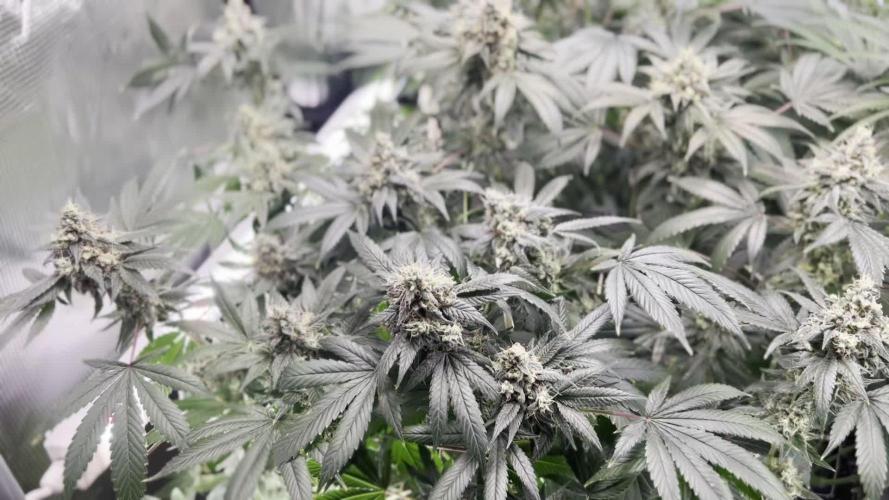
Sooo much Frost! Still smells very sweet - like fresh fig newtons. Very low pungency compared to other strains. Growing fast still with no sign of slowing down
Likes
Comments
Share
@Drtomb
Follow
Im experimenting a little with this grow. The plants at the front of the grow have been completely deleafed of all fan leaves not attached to bud sites. I did this about a week ago. The remaining plants will be left to the normal pruning.
Likes
3
Share
@CoC407
Follow
We add some Hesi Coco now they going to explode ! :D
Likes
48
Share
@Theia
Follow
Not much to say this week. Back on trak with feeding,colour is coming back and flowers are filling up. Chiba 1 flowers are huge domes,really round and fat. I hope they just grow up and out some more. Number 2 is also pushing some great flower with 2 main colas and loads of little node growth underneath, also 2 clones are well into flower and are doing great, Love this plant. Feeding is up to 1.7 every other feed is nutes and water inbetween. Thanks for looking. Stay safe and happy growing.
Likes
36
Share
Loved growing this. Sang its praises rhe whole way through because it just looked like a beast. I like the pretty Cali strains but I always find the yields are close to frustrating for abilities not up up there. Overall the strain helped me take chances that paid off so I really enjoyed it. Will grow again. Threnneighbors should smell this on the balcony this summer 😂💚🙏🏼
Likes
41
Share
So we have reached the end of Week 6 from and I am flipping the the ladies to flower. I have uploaded a video along with pictures..... Hope it plays. Stay Safe guys and Happy Growing, any questions just ask away 👍🏾💚
Likes
56
Share
Once again she passes my expectations, late to the show with trichome production. I'm surprised there is purple on the bud, maybe Purpinator does work. I thought I could see hints under the grow lights and thought my eyes were deceiving me, I was just being hopeful. But nah 2 of the 3(under the UV) have developed a beautiful tone of purple. I was never going to bother with a deep freeze but maybe the whole bud will change given conditions, that would be something, fingers crossed. 🤔 was a little skeptical that reducing temps humidity would change density, but it does, buds are solid something I've not been able to achieve before. Rule of thumb is never to surpass 60% RH in the flowering phase and try to progressively reduce it down to 40% in the last 2–3 weeks before harvest. The plant will react as it seeks to protect its flowers, responding by producing denser buds and a higher concentration of resin. Cannabis plants are sensitive to sudden temperature changes, especially in the flowering stage. Extreme heat or cold can impact bud density and overall yields. In nature as a defense mechanism from cold, the plant sensing sudden dips in temperature will attempt to remove the pockets of air within the bud, it achieves this by compacting itself in doing so to better protect itself from cold snaps which are normally indicators in nature that worse weather is on the way. Terpene levels are the highest just before the sun comes out. Ideally, you want as many terpenes present in your plants as possible when you harvest. Cannabis plants soak up the sun during the day and produce resin and other goodies at night. The plant is at its emptiest from "harvest undesirables," so to speak,k right before the lights come on. Freshly cut buds are greener than dried buds because they still contain loads of chlorophyll. However, when rushed through the drying process, the buds dry but retain some chlorophyll, and when you smoke it, you will taste it. Chlorophyll-filled buds are smokable, but they aren’t clean. Slow drying gives the buds enough time and favorable conditions to lose the chlorophyll and sugars, giving you a smoother smoke. How the plant disposes of the chlorophyll and sugars by a process of chemically breaking them down and attaching the decomposed matter once small enough to water molecules, which then evaporate back into the ether. Time must be given to the process to break down the chlorophyll and sugars. Think of it like optimizing the environment for decay. Plant growth and geographic distribution (where the plant can grow) are greatly affected by the environment. If any environmental factor is less than ideal, it limits a plant's growth and/or distribution. For example, only plants adapted to limited amounts of water can live in deserts. Either directly or indirectly, most plant problems are caused by environmental stress. In some cases, poor environmental conditions (e.g., too little water) damage a plant directly. In other cases, environmental stress weakens a plant and makes it more susceptible to disease or insect attack. Environmental factors that affect plant growth include light, temperature, water, humidity, and nutrition. It's important to understand how these factors affect plant growth and development. With a basic understanding of these factors, you may be able to manipulate plants to meet your needs, whether for increased leaf, flower, or fruit production. By recognizing the roles of these factors, you'll also be better able to diagnose plant problems caused by environmental stress. Water and humidity *Most growing plants contain about 90 percent water. Water plays many roles in plants. It is:* A primary component in photosynthesis and respiration Responsible for turgor pressure in cells (Like the air in an inflated balloon, water is responsible for the fullness and firmness of plant tissue. Turgor is needed to maintain cell shape and ensure cell growth.) A solvent for minerals and carbohydrates moving through the plant Responsible for cooling leaves as it evaporates from leaf tissue during transpiration A regulator of stomatal opening and closing, thus controlling transpiration and, to some degree, photosynthesis The source of pressure to move roots through the soil The medium in which most biochemical reactions take place Relative humidity is the ratio of water vapor in the air to the amount of water the air could hold at the current temperature and pressure. Warm air can hold more water vapor than cold air. Relative humidity (RH) is expressed by the following equation: RH = water in air ÷ water air could hold (at constant temperature and pressure) The relative humidity is given as a percent. For example, if a pound of air at 75°F could hold 4 grams of water vapor, and there are only 3 grams of water in the air, then the relative humidity (RH) is: 3 ÷ 4 = 0.75 = 75% Water vapor moves from an area of high relative humidity to one of low relative humidity. The greater the difference in humidity, the faster water moves. This factor is important because the rate of water movement directly affects a plant's transpiration rate. The relative humidity in the air spaces between leaf cells approaches 100 percent. When a stoma opens, water vapor inside the leaf rushes out into the surrounding air (Figure 2), and a bubble of high humidity forms around the stoma. By saturating this small area of air, the bubble reduces the difference in relative humidity between the air spaces within the leaf and the air adjacent to the leaf. As a result, transpiration slows down. If the wind blows the humidity bubble away, however, transpiration increases. Thus, transpiration usually is at its peak on hot, dry, windy days. On the other hand, transpiration generally is quite slow when temperatures are cool, humidity is high, and there is no wind. Hot, dry conditions generally occur during the summer, which partially explains why plants wilt quickly in the summer. If a constant supply of water is not available to be absorbed by the roots and moved to the leaves, turgor pressure is lost and leaves go limp. Plant Nutrition Plant nutrition often is confused with fertilization. Plant nutrition refers to a plant's need for and use of basic chemical elements. Fertilization is the term used when these materials are added to the environment around a plant. A lot must happen before a chemical element in a fertilizer can be used by a plant. Plants need 17 elements for normal growth. Three of them--carbon, hydrogen, and oxygen--are found in air and water. The rest are found in the soil. Six soil elements are called macronutrients because they are used in relatively large amounts by plants. They are nitrogen, potassium, magnesium, calcium, phosphorus, and sulfur. Eight other soil elements are used in much smaller amounts and are called micronutrients or trace elements. They are iron, zinc, molybdenum, manganese, boron, copper, cobalt, and chlorine. They make up less than 1% of total but are none the less vital. Most of the nutrients a plant needs are dissolved in water and then absorbed by its roots. In fact, 98 percent are absorbed from the soil-water solution, and only about 2 percent are actually extracted from soil particles. Fertilizers Fertilizers are materials containing plant nutrients that are added to the environment around a plant. Generally, they are added to the water or soil, but some can be sprayed on leaves. This method is called foliar fertilization. It should be done carefully with a dilute solution because a high fertilizer concentration can injure leaf cells. The nutrient, however, does need to pass through the thin layer of wax (cutin) on the leaf surface. It is to be noted applying a immobile nutrient via foliar application it will remain immobile within the leaf it was absorbed through. Fertilizers are not plant food! Plants produce their own food from water, carbon dioxide, and solar energy through photosynthesis. This food (sugars and carbohydrates) is combined with plant nutrients to produce proteins, enzymes, vitamins, and other elements essential to growth. Nutrient absorption Anything that reduces or stops sugar production in leaves can lower nutrient absorption. Thus, if a plant is under stress because of low light or extreme temperatures, nutrient deficiency may develop. A plant's developmental stage or rate of growth also may affect the amount of nutrients absorbed. Many plants have a rest (dormant) period during part of the year. During this time, few nutrients are absorbed. Plants also may absorb different nutrients as flower buds begin to develop than they do during periods of rapid vegetative growth.
Likes
2
Share
@gr3g4l
Follow
Esta semana tocó la poda de los apicales y primer nudo dejando solo 4 nudos por planta. Por lo que parece tienden a grandes hojas e internodos cortos. Esta semana también aumenté la potencia del lumatex hasta el 75% unos 220W. Empecé con 100 W luego fueron 150 y ahora 220 , así hasta cambiar el fotoperiodo a 12/12h. Entonces al 100%, 300W. Con 26 dias de vida ya tenian suficientes nudos, ramas y tocó hacer el apical y la poda del primer nudo a todas dejando 4 nudos por planta, 8 ramas secundarias. Terminamos la semana con la nº5 con manchas en las hojas muy feas. Entiendo que tengo que tratarla diferente al resto por lo que la regaré menos y dejaré secar más entre riegos al menos un par de veces.
Likes
2
Share
Day 43: (Mon)Small plant is in week 2 of flowering. Fade already stated before buds have matured. Think I should have given more nutrients. Clipped a few leaves off big plant near the tops. Watered both plants with nutrients 1ml B, 1ml SR and the small plant also got 0.5ml GS Day 45: Watered small plant with same nutrients Day 46:(Thursday) Watered big plant with 2ml B and 1ml SR Day 47: Watered small plant with just ph’d water Day 49: Watered big plant with 2ml B, 1ml SR and 1ml GS. Watered small plant with half dose.