


Likes
Comments
Share

@FijiS
Follow
Week5 D1
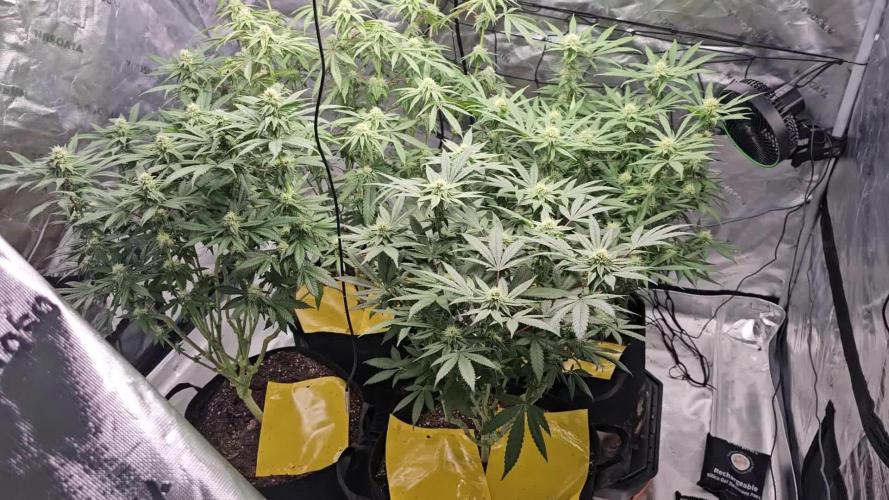
Start of week 5 we stay the course. Rainbow belts is showing some issues- a little bit of nutrient burn as well as light burn but she is actually stacking and swelling more than the other girls.
Next feeding the other girls will get recharge and fish sh for 1.5g each and for safe measure I will flush rainbow belts with 2g 6.5ph dechlorinated tap water.
Week5 D2
All the girls are showing color either oranges browns or pink/purple. The burn hasn't progressed and I think they are about to start bulking- tomorrow I will partial flush with recharge and fish sh!t and then in 5 days I'll top dress them with seabird guano and langbeinite
Hope it works out.
Week5 D3
Opened the tent to see some major deficiency with rainbow belts. Pictures of the leaves attached. I am thinking she has a salt build up and we will go with a partial flush for all 4 girls today with 2 gallons of water. Enough to hopefully get off some excess salt and it will make sure the other girls are ready for another feeding in the 4 days. I may just do a half feed for rainbow belts when I do a full for the other girls.
Wish me luck.
Week5 D4
Post flush- all are responding well but rainbow still had some more leaves curl- will let roots dry and breathe a bit and will assess throughout the next 4 days. Crumble also has slight tip burn but that may be from flushing excess salts.
Week5 D5
2 days past flush and they are all responding well. Rainbow Belts is starting to throw some serious color. I'll wait til the end of grow to give a review on her but damn if she wasn't such a damn diva she would be an amazing full grow! Everything else is looking good so next water we will recharge the microbiology with some recharge and fish sh!t but let's see how it does these next few days.
Week5 D
Issue returned with a vengeance- will let it dry out and then water with water at 6.3ph and cal mag and then im just gonna let it run its course.



Likes
8
Share


@Garbagegrower
Follow
First time growing inside. I always just throw my seeds in the spil when I grow outside told myself to do the same here.
Put the seeds maybe 1 to 1.5 inches into the soil and put 1.5 ozs of water on and around the seed. Also had domes on my 1/2 gallon pots to keep humidity high.
Had my lamp at around 12 inches from the pots. Once they sprouted they stretched a bit so I out my lamp down to 8 inch and they stopped growing. I'll probabky stsrt at 6 to 8 inches next time and see what happens.


Likes
28
Share


@GIR139
Follow
Well, I've almost made it to the finish line. Finally brought down the two KTs. Was A LOT more work than I anticipated and the magic wore off quickly! After hours and hours of trimming and some easy drying at about 73 F and 63 RH. About 8 days for the KTs, then another trim and jarred them up. Scale was acting up a bit but my count is 10.4 ounces dry between 2 plants. Happy with the yield. Am currently a little concerned that it doesn't smell like much. Didn't over dry, didn't quickly dry. In jars the RH is showing 61 or 62. Really hoping some individual character comes back to them!
Will return to update smoke report.
OG and Blueberry still drying.

Likes
38
Share


@OutForReal
Follow
Monday
It’s beginning of week 4 and they are doing pretty well. The main stems are hard and strong and it’s impossible to bend them at that point.
I am practicing a very light hand LST everyday like I am showing in the video.
Tuesday
Watering for both of them , you can follow the (simple) process in the videos. The plants are doing great except for a little issue on one of them that I will show you tomorrow.
Topping or not ? May be beneficial so I’m about to do it. Fiming maybe ?
Thursday
Topping on video ! Simple method

Likes
98
Share


@SlowpokeFuegobud
Follow
I'm happy. I wish the weed would last forever. 🍊
Thank you, @DutchPassion_Official for the opportunity, I'm definitely a fan from now on! ❤️

Likes
13
Share


@Alpha_Green
Follow
Some of you may have wondered:
Why do I use CO2 at average 950 ppfd μmol/m2/s (moral flow)?
The answer is quite simple. Because of lack of space in some regions of my cultivation area, I simply cannot keep the ideal distance to my Sanlight high-performance lamp, due to some height growth of various strains. And so some of the main colas have ppfd values of 1250 μmol/m2/s and even more...
So this is how I manage to achieve and compensate for such high radiation levels even with a CO 2 balance. And I have to say, my strategy to avoid various light stress symptoms works just fabulously. In combination with CO 2 implementation, my babies are simply unbeatably insensitive to light. Thats it!
Beginning of 3rd week flowering:
Again feeding my babies by 36 hours fermented potions of Bio Tabs Kompost Tea PK-Booster (15 g pro Liter) and added:
5ml Orgatrex/Liter
1 Spoon of Bactrex
1 Spoon of Mycotrex
1 Spoon of Mycco-Vital
1 Spoon of Dynomyco
A little tip for those who are interested in small modifications that have a big difference or influence - on the result - effect - beauty - health - taste! Before adding microorganisms or beneficial bacteria or Mycorrizae and Trichodermas, please use oxygen-saturated water. On the one hand, unwanted chlorine gases evaporate and the small world of the microbiome becomes even faster and more rewarding in compost tea to sprout.
Last but not least for this week, I would like to introduce my reasons, why I prefer growing biologically and sustainably.
First of all, it’s something which suits very well in these times/days we are living now. Sustainability is a big need and task for our planet. 🌎 Nature means life. Our home, the air we breathe and everything that surrounds us. Not just today. Hopefully tomorrow as well.
Maybe I'm starting to protect our environment on a small scale, but maybe I can also make a big difference at all.
If you change the way you look at things, the things you look at change...
I thought about what’s the difference, between Mineral Feeding and Super Soil Feeding.
It’s very easy. Biologically Growing is a similar process than the natural soil activities out there in the lap of nature’s. So plants has to work and interact with the microorganisms and microbiomic communities in the soil. So the plants will never get lazy like the lazy ones of mineral feeding growers.
If you grow biologically, you will feed the soil first and the microorganisms will support every parameter next to your plant conditions. And that will generate an unbelievable spectrum of Terpenes and Trichomes you will never forget.
It’s the same comparison, when you daily visit McDonalds and you eat only fast food. How does your body and mind react on this shit for money?!?!
May I invite you to think about it…
See you next week dear Growmies! Have a nice Weekend and take care…
Peace out!
Addendum for Day 53:
At the moment we unfortunately have another winter onset here in Germany. This means that I am forced to take additional heating measures due to structural facts in order to be able to keep the temperatures constant. After all, just tonight the thermometer climbs again to -1 degree Celsius.
In addition, my exhaust air system runs out of my bedroom terrace and I therefore grow winter and summer with the patio door open. Well, sometimes I experience real weather-related challenges. But all in all, no problem...
"Where there's a will, there's a way."
Addendum to pouring out the fermented PK tea: I always administer half a liter of lukewarm aerated water with 3.5 ml of cannazyme per liter to each plant. This means that the "root machine" is not supplied with supplies unprepared and the nutrient solution can thus also be better distributed in the soil. Since I also work with cloth shoes, I spray them evenly moistened everywhere with water that is also warm before pouring them out from the outside. This has the advantage that the moisture stays where it should: in the pot!
... I did the math today ;-) We are still in week 7 until this Friday. And week 8 starts on Friday! OMG... still so much time yeahh!
Today my Fast Buds Sour Jealousy and Sweet Seeds Big Devil and Dark Devil Automatics arrived. I'm looking forward to it.
This time Fast Buds next Time Sweet Seeds. Love them too. Very beautiful genetics.
Today a review video of the beginning of week 3.
At the time of the pictures, I had minor signs of nitrogen excess. (Light peaks first at the crown of the roof and then slightly continuing to the middle section.) I then painstakingly racked my brains as to why this could be. I found that very slight dry spots had formed and therefore the root found small accumulations of nitrogen that caused its problems. But then, when I carefully homogeneously checked the moisture content in the substrate, the problem evaporated again. However, they had not shown any loss of growth rate during this time. Nevertheless, they developed as expected.
They Strawnanas had no problem with that.
In the end, I always have a hard time killing them. But I guess that's the way things go.
We live and die.
We come and go.
But it's not there yet. ;-)
Tomorrow is day 56.
Tomorrow’s updating day!
Can't wait to see their progress.
Have a good time and see you tomorrow… 🏽🕊️
🏽 ☮️🕊️
Likes
2
Share


@TTerpz
Follow
Buds starting to form!!!!
Day 2 of week 8
4/3/25 UPDATE:
Flushed with Fox farm sledgehammer ph’d at 6.8
Soils were low at 5.8
4/5/25 update: fed with nutes
4/7/25: watered with plain water ph’d at 6.5
4/8/25: did a slight heavy defoliation to get ready for week 9!


Likes
7
Share


@Adam22
Follow
Day 28 week 4 of flower plants looking good I dropped a 3L water bottle on a string which snapped a whole branch from the bottom 😳 on right plant 😭
Likes
21
Share


@Mr_Motalovah
Follow
Hello Growers and Tokers! 👋 👩🌾 🧑🌾.🔥💨
Sorry for the delay on the weekly updates, had some things I had to attend but I'm back and at it!
21-day defoliation has come..
These pictures were taken on day 20 of flower
As you can see in the pictures I did a little defoliation of the bigger fan leaves.
She's pretty advanced compared to the other ladies. Buds sites are formed, strong aroma going.
Her structure looks like a straight up garden bush. Took the LST great ended up with a nice open, spread canopy.
With the defoliation done, buds will be getting much more light exposure and grow a bit more before gaining weight.
Really happy with the results so far with this strain.
That's it for this week
One love!


Likes
17
Share


@MoneyGrowup
Follow
Things are looking good, started with some lst with my hands at first now I've secured them with ties. The gelato looks like it finally want to start its growth due to whatever stress it was going through. Happy with how things are picking up

Likes
69
Share


@Teamdirtbag2
Follow
She is now a skinny 17 inches tall. Defoleated all the bottom crap and cleaned her up. A little newt burn last week at 600 ppm. I have raised ppm to 680 so she may not be happy come the end of the week. She will have to get use to it. I'm sure she will be fine. Added second light, so it should get interesting.


Likes
7
Share


@BeMedicated
Follow
It rained regularly this week and I was away from home a lot. And forgot to keep them dry with the heavy rain sometimes.
So this week they had almost only rain.
I gave them 1 time 0.5L tapwater with nutrients each.
And less nutrients because I'm scared it will have an impact on the taste
Processing
Likes
5
Share


@Darkshaman
Follow
This week is been great. I started with high ppm on the 2nd week for the nutrient kick , now just a low dose of growth enhancer. Good roots system. Topped them just 1 time and cleaning them from useless leafs.
Using reverse osmosis water (15ppm)


Likes
4
Share

@Olduffybastard88
Follow
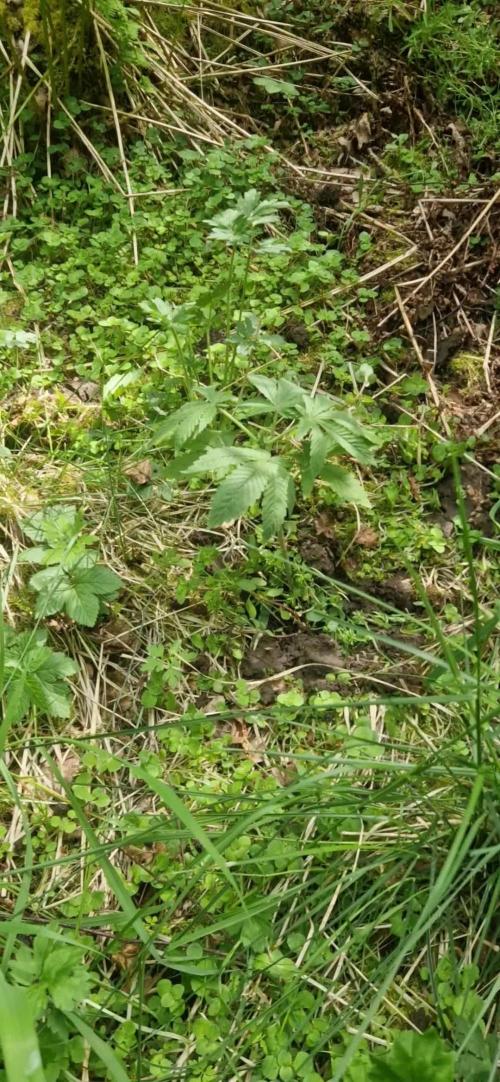
Loving there new homes after a week being transplanted time to leaves these girls to veg the summer away if they keep up at this rate going to have very large and stalk plants

Likes
7
Share


@Nikkov
Follow
Well, another week has passed and the end of the second week has come and the pistils have already shown themselves and I continue watering with top crop bloom, first time testing this fertilizer and I'm only using two of them, top veg and top bloom, next cycle I'm going to use General Hydroponics fertilizers because I have a friend who uses them and he's having great results, I still want to talk to my friends about this strain because I think it hasn't grown as it should, but anyway we're studying to improve ourselves for the next ones, the rest is all experience for the next ones it grows. =D

