Likes
Comments
Share
@Kaya666
Follow
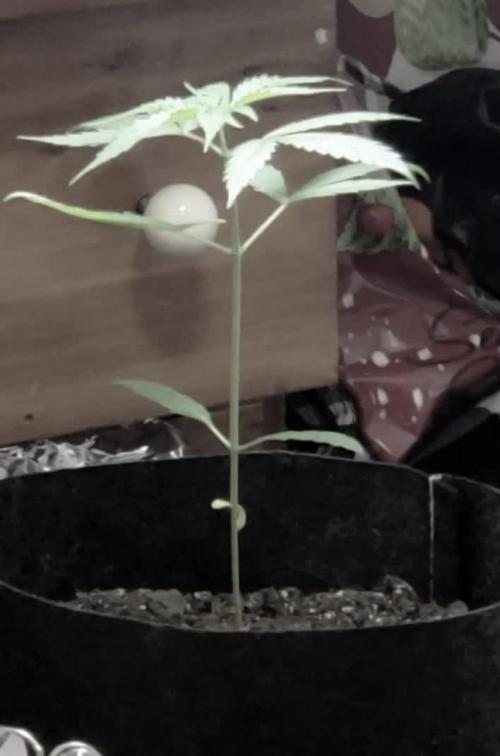
Last week of actual veg! I plan to stick to the same old lighting and watering schedule this week but am gonna experiment with a foliar feed of the potassium humates to see how she likes it. I figure it's better to test things like that now than in flowering. She's beginning to develop something between the nodes, though it's still too early to tell for sure if she's a girl. (It was a feminized seed so I certainly HOPE so!) This plant has given me absolutely zero problems despite being in the most maligned soil under a weak-ass CFL bulb AND transplanted, which is supposed to be a no-no for autos. It def looks unmistakably like pot now lol so I've gotta figure out where to hide it should the landlord come in. (Legal state, illegal building). Hoping this Ona Pro Gel will be sufficient to offset the stench once she starts reeking. 😁 So my 1st attempt with the humates was a fail. I for some reason thought the pH was too high so I sprayed some white vinegar into the mix to bring it down, which it did. But then I read that you're NOT supposed to mix the two, plus I'd possibly made the solution way too strong by using online "recipes" vs. what the package said: 1 tsp per gallon water. YIKES. I'd used 0.7 grams in 2 liters the 1st time. 🤦🏻‍ Thankfully I only sprayed that mix on the two bottom leaves before realizing what I'd done, so I sopped it up, poured out the rest and made a more dilute mixture without the vinegar this time. I used my little 8 Fl. oz spray bottle to mist the plant from a healthy distance before her brief dark period, which is where she's at now. Did a 2nd foliar feed the following day and she's looking just dandy! (Aside from the twisty taco leaves at the top lol). After watering, she was incredibly bloated with leaves curling downward in that tell-tale "over watered" claw. How this is possible when I water only 1x every 7 days, grow in a fabric pot, keep fans on her at all times and am using moisture control soil is beyond me, but it would appear this plant HATES water. The soil was bone dry when I watered & I even pH'ed the water this time before giving her a drink.... no luck. Oh, and the H2O is room temperature every time. Same 16.9 FL oz. purified drinking water as last time... After some reading it looks like this strain is just highly finicky and somewhat harder to grow than other autos, though most people ended up happy with the results. This also explains why she's so tall with so few leaves/branches: they say Zkittlez Auto stretches like crazy. I'm gonna try to stop obsessing now. I added a 2nd CFL bulb (yellow) to see if it boosted her growth any, and sure enough, I got some noticeable and rapid change in her appearance after only one night. So that was a good thing. Next week will be when I switch to 20/4 light schedule and try a soil feed of the Potassium Humates with her once-weekly watering lol. Stay tuned. Final update for the week: I put pipe cleaners on the ends of her big branches to help open up the bud sites. It's too late for actual LST, plus she's so sensitive I doubt she'd like it. Don't wanna waste 1-3 days recovering from that. But I'll probably lop off 2, if not 4, leaves early next week. (1-2 sets total). She's not leafy enough to "leaf tuck" as planned but some of those bottom ones are def redundant.
Likes
81
Share
Hello there and welcome to week 12, or the beginning of it anyway. Week 11 is now complete so please check that out! We start the week with 5l fertigation and some nice photos. Now that Bertha is gone the tent smells Karenish. See you tomorrow! Day 78: Added several more carnivorous plants to the budding collection. Enjoy! Day 79: Fertigated 5l. She's starting to mature now. Frost developing slower, buds fattening and ripening faster. Were maybe two weeks away here. Night 80: Added tent photo and vid. Day 81 update later today. Day 81: Added a lot of media. Got a cheap digital microscope to try and get better micro shots. As you can see Karen is nowhere near yet. Day 82: Things are moving very fast, just look at the difference today. I am certain were with 2 weeks of harvest. Does anyone have advice on flushing/not watering. Fertigated 5l. Day 83: At the current rate of maturation I think the end of next week maybe be harvest time. Height 51cm Day 84: Karens smell is really strong now it washes across your face when you open the tent. End of week summary: A full week of nothing but bud swelling and maturation. I still think she needs another 2 weeks. Unfortunately my living situation has rather abruptly changed and now I have a tough choice to make: harvest/destroy or move plants. There is a strong chance I will chop Karen at the end of next week if she is ready or not.
Likes
6
Share
@xmackobox
Follow
Hola amigos arrancamos nuevo cultivito, por ahora os traigo los videos que subo a YT como ya sabéis le estoy dando caña al canal, buscarme allí, me llamo como aquí, xmackobox. Poco mas, se empezaron a germinar el día 14/02/24. Algunas se pasaron a maceta el día 16, otras en 17 y se terminaron de plantar en maceta definitiva de 11 L el día 18/02/24. Para la primera semana de crecimiento ya meto fotos detalle de todas. **ACTUALIZADO** 26/02/24 llevamos 12 días desde que se empezó a germinar, todas brotadas perfectas excepto 1 que como veis parece atrofiada o con algún problema, no desarrolla el ojo principal es decir su punta apical. Esperaremos a ver que hace esta plantita :D
Likes
147
Share
Hi all! now the moment has come when the buds began to grow in width! get fat and become covered with trichomes. the smell is magnificent, sweet fruity. the plant eats a lot. 5 liters of fertilizer per day. no wonder she started to get fat!)))
Processing
Likes
7
Share
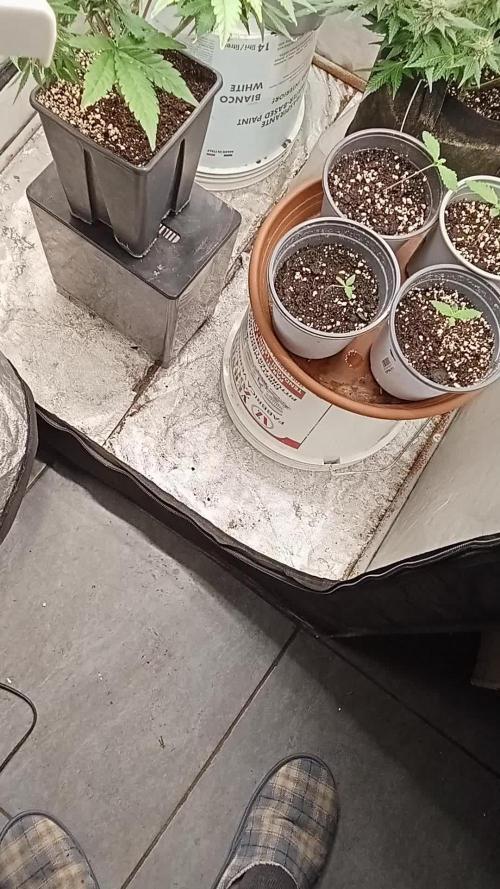
Beautiful looking seedling, very healthy and developing at a fair pace, let's see what awaits us in this diary!! She's developing super fast each day just like her sisters in this run, let's see how she keeps developing! I only use pure water and watch them grow thanks to the amazing living soil blend that I'm working with called FLO Living soil blend, very recomended to all the organic gardeners out there!! I have Transplanted this big girl after just 17 days since she was planted, she is very well developed and so ai took the decision to transplant her and all her sisters in this run, let's see how she performs! 💚❤️💛👨‍🌾🔝
Likes
3
Share
@AustinRon
Follow
Week 15 - Flower Week 11 Lemon Jeffrey by IRIE Genetics (14 Starts for 8 Finishers) 63-70 Days Flower (9 - 10 Weeks) Weeks Observations: - Our light leak on July 6th through July 31 ‘cost’ us ~ 21 Days. Extending Harvest to account for 21 day light leak. New Harvest Date 12 Sep 2023, Plant Day 121, Flower Day 86 Seeds Wet: Monday 14 May 2023 Harvest Date Range: [ 2023-08-11, 2024-08-21] Start of week: - Dates: [2023-08-27: LJ2Q 106:F:11:1, 
 2023-09-03: LJ2Q 112:F:11:7 ] End of Week: - Plant Height Range: [46, in] - Water/Day/Plant: [935, ml] EnvironmentalCurrent: - Scotoperiod: [ 11, hrs] # 1900 - 0600 + 24 - LightIntensityPeak: [ 1000, µMol/m2/s ] - DailyLightIntegral: [ 42.1, Mol/m2] # Target: < [ 40, Mol/m2/day] - LightDistance: [ 6, in] # 3.5” LESS than Optimal for SP3000 - TempAvg: [79.1 , °F] - RH: [ 68, %] - VPD: [ 1.10, kPa] - 230*4*11/8 - FeedwaterPerPlantPerDay: [ 1265, ml] - Feedwater: [ 10.12, l] - EC: [ 2.0, mS] Environment NOTES: - RULE - CLOSE Room Airflow during LOW TEMP periods(2030 - 0700) - OPEN during HIGH TEMP Period (0700 - 2030) SOP: - WEAR CLEAN GLOVES FOR ALL SEED OPERATIONS - CLEAN All Instruments before use - Light Strengthvegetation := 100 + (#nodes * 100) - Light Strengthflower := [ 1000, 600, µMol/m2/s] - Scotoperiodvegetation := [ 1300, 1900, 6, hr] - Scotoperiodflower := [ 0600-1900, 13, hr] Environment - Late Flower (Week 10-14) (F5-F10) - Temp: 78-80°F - VPD: 1.2 ± 0.2 - Photoperiod: 11/13 - Light Strength: [930, 850, µMol/m2/s] - EC: 2.3 # Week F5-F8 - EC: 1.8 # Week F9 - EC: 1.1 # Week F10 - Finish (Week 14) ( F10) - Temp: 78°F - VPD: 1.3 ± 0.2 PPFD: 750 peak - Resin Bloom ONLY - EC: 0.8 _______________________ Base Application for 10 Gal: - [x] Primer A: [ 100, ml] - [x] Primer B: [ 100, ml] - [x] Silica Skin: [ 35, mll] # Reduce to reduce/eliminate Sediment - [x] SLF-100 (Enzymatic Root Cleaner): [ 50, ml] - [x] King Crab (Biology): [ 5, ml] __________________________________________ - @ EC: 1.7 Supplement: [ Application Rate], [ Total Delivery for 2 Gal Solution] - [ ] Primer A: [ 10, ml, gal], [ 12.5, ml] - [ ] Primer B: [ 10, ml, gal], [ 12.5, ml] - [ ] Silica Skin: [ 4, ml, gal], [ 5, ml] - [ ] CalMag Fuel: [ 4, ml, gal], [ 5, ml] - [ ] Peak Bloom: [ 4, ml, gal], [ 5, ml] - [ ] Resin Bloom: [ 4, ml, gal], [ 5, ml] - [ ] SLF-100: [ 5, ml, gal], [ 10, ml] - [ ] King Crab: [ 0.5, ml, gal], [ 1, ml] - [ ] EC: [ 1.7, mS] 85 ml/plant X 11, : 935 ml/plant/day, 2.4x of field capacity Meaning ALL Fertigation through pot is Refreshed 2.4 times per day with this schedule. ____________________________________ Mon 28 Aug 2023 # End of Harvest ORIGINAL Window , before discovering light leak LJ2Q 106:F:11:1 - [x] Will scope trichomes by hand, and set a chop date today. - Some are ready today, Some look to need 10 - 14 days. This has been an interesting grow - the extra stretch munged the SOG Strategy - with severe Chiropractics I still have >±12” of height per plant. We should be harvesting today . . . - We could conceivably take the grow as far as Day 139, if we calculate a 4 week light leak forward. That would make LATEST DATE 24 SEPTEMBER - - IF We go more than this week - Week 15 Nutes (Mixed Daily) - Mon - Wed: ONE SHOT, EC: 1.7 - Thus - Sun: ONE SHOT, EC: 1.4 - NEXT WEEK - Mon: Resin Bloom: EC: 1.1 - Tuesday - Harvest: Resin Bloom: EC: 0.8 - ELSE if we take them down next Sunday: - [ ] Been feeding The Rooted Leaf Hydro schedule, Base Nutes plus Silicon. Need to move to harvest nutes, potassium (+Resin Bloom/+Peak Bloom) at - [ ] Monday:+Resin Bloom/+Peak Bloom: EC: 1.7 - [ ] Tuesday: EC: 1.4, (+Resin Bloom) - [ ] Wednesday: EC: 1.1, (+Resin Bloom) - [ ] Thursday EC: 0.8 (Resin Bloom Only) - [ ] Friday EC: 0.8 (Resin Bloom Only) - [ ] Saturday EC: 0.8 (Resin Bloom Only) - [ ] Sunday - Harvest Growtek Mod - 170 ml/event per emitter -> 2 Gallons Input - ___ EC: [ 2.0, mS] Tue 29 Aug 2023 LJ2Q 107:F:11:2 EC 1.6+ - Defoliated (final) blocking and unviable fans. Looks better - clearer airflow Wed 30 Aug 2023 LJ2Q 108:F:11:3 EC: 1.6 For 2 Gal (ml’s) RLA Minerals 14.0 Primer A 14.0 Primer B 7.0 Silica Skin 10.5 Peak Bloom South Cascade Organics - [x] SLF-100: [ 5, ml, gal], [ 10, ml] ___ Plant Success (Beneficial Bacteria, Crab ‘Frass’) - [ ] Sunday - Harvest? - [x] King Crab: [ 0.5, ml, gal], [ 1, ml] Thu 31 Aug 2023 LJ2Q 109:F:11:4 EC 1.4 For 2 Gal (ml’s) RLA Minerals 12.3 Primer A 12.3 Primer B 9.2 Peak Bloom Required 1 qt to bring down from 1.6 to 1.4 Friday 01 Sep Jul 2023 LJ2Q 110:F:11:5 EC 1.1 For 2 Gal (ml’s) RLA Minerals 7.6 Primer A 7.6 Primer B 5.7 Peak Bloom Sat 02 Sep 2023 LJ2Q 111:F:11:6 EC: 1.4 Peak Bloom as Needed for Dilution - [ ] Scope Trichomes Last Time With a 21 day light leak, we’ll extend harvest to Day 118, Flower Day 90 - or 69 Unleaked Light Days . . . Through End of Harvest, Daily Daily Feed through Harvest Day -2 Per TWO Gallons: EC 1.4 - [x] Primer A: [ 12, ml, gal] - [x] Primer B: [ 12, ml, gal] - [x] CalMag Fuel: [ 4, ml, gal] - [x] Silica Skin: [ 4, ml, gal] - [x] Peak Bloom: [ 4, ml, gal] - [x] Resin Bloom: [ 8, ml, gal] - [x] King Crab: [ 0.5, ml, gal] - [ ] SLF-100: [ 5, ml, gal] - [ ] Reduce to EC 1.1 on Harvest Day -2 - [ ] Reduce to Resin Bloom Only, EC: 0.8 Pre Harvest Day DECISION - We’ll take the girls down Flower Day 83, Nominal Day 62 assuming 21 Day push for light leak. It’s not in practice3 that long - we should be good, if not - latest day 90 (Nominal 69) ____ Sun 03 Sep 2023 # Flower Day 77 LJ2Q 112:F:11:7 EC 1.4 - [x] Dismantle And Clean Res, Pump, Chiller, Lines - [x] Clean Res - [x] Clean Pump - [x] Load Res with a a gallon of HOT tap water, a cup of 30% Vinegar - [x] Run Pump for :30 - [x] After 30: Reverse Lines - [x] Run Pump for :30 - [x] Stop pump - [x] remove tubing from pump and chiller - [x] Remove pump, reclean - [x] Clean Chiller Tubes - [x] Rinse with 30% Vinegar - [x] When Dry: Reassemble & Replace
Likes
2
Share
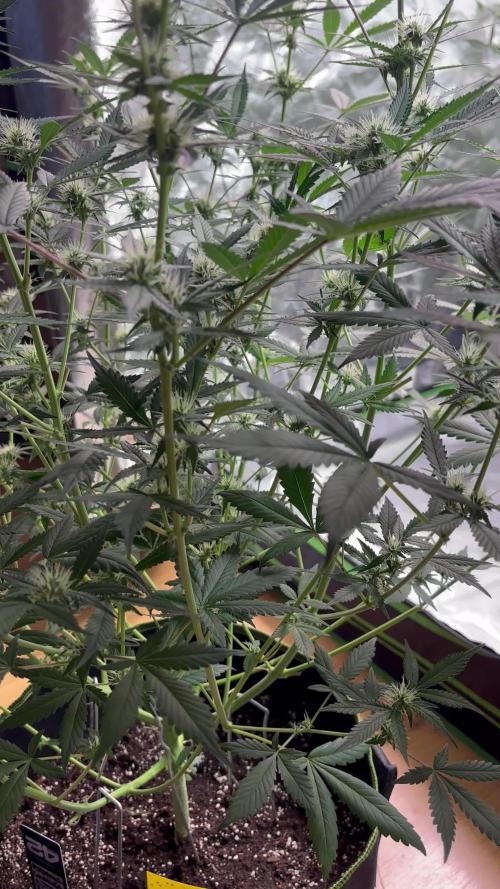
Been on the Spananbis so I wasnt able to check on them but they did really good the last few days. Put a net on them to spread them out a bit cause im scared of not enough airflow between the plants
Likes
47
Share
What's in the soil? What's not in the soil would be an easier question to answer. 16-18 DLI @ the minute. +++ as she grows. Probably not recommended, but to get to where it needs to be, I need to start now. Vegetative @1400ppm 0.8–1.2 kPa 80–86°F (26.7–30°C) 65–75%, LST Day 10, Fim'd Day 11 CEC (Cation Exchange Capacity): This is a measure of a soil's ability to hold and exchange positively charged nutrients, like calcium, magnesium, and potassium. Soils with high CEC (more clay and organic matter) have more negative charges that attract and hold these essential nutrients, preventing them from leaching away. Biochar is highly efficient at increasing cation exchange capacity (CEC) compared to many other amendments. Biochar's high CEC potential stems from its negatively charged functional groups, and studies show it can increase CEC by over 90%. Amendments like compost also increase CEC but are often more prone to rapid biodegradation, which can make biochar's effect more long-lasting. biochar acts as a long-lasting Cation Exchange Capacity (CEC) enhancer because its porous, carbon-rich structure provides sites for nutrients to bind to, effectively improving nutrient retention in soil without relying on the short-term benefits of fresh organic matter like compost or manure. Biochar's stability means these benefits last much longer than those from traditional organic amendments, making it a sustainable way to improve soil fertility, water retention, and structure over time. Needs to be charged first, similar to Coco, or it will immobilize cations, but at a much higher ratio. a high cation exchange capacity (CEC) results in a high buffer protection, meaning the soil can better resist changes in pH and nutrient availability. This is because a high CEC soil has more negatively charged sites to hold onto essential positively charged nutrients, like calcium and magnesium, and to buffer against acid ions, such as hydrogen. EC (Electrical Conductivity): This measures the amount of soluble salts in the soil. High EC levels indicate a high concentration of dissolved salts and can be a sign of potential salinity issues that can harm plants. The stored cations associated with a medium's cation exchange capacity (CEC) do not directly contribute to a real-time electrical conductivity (EC) reading. A real-time EC measurement reflects only the concentration of free, dissolved salt ions in the water solution within the medium. 98% of a plants nutrients comes directly from the water solution. 2% come directly from soil particles. CEC is a mediums storage capacity for cations. These stored cations do not contribute to a mediums EC directly. Electrical Conductivity (EC) does not measure salt ions adsorbed (stored) onto a Cation Exchange Capacity (CEC) site, as EC measures the conductivity of ions in solution within a soil or water sample, not those held on soil particles. A medium releases stored cations to water by ion exchange, where a new, more desirable ion from the water solution temporarily displaces the stored cation from the medium's surface, a process also seen in plants absorbing nutrients via mass flow. For example, in water softeners, sodium ions are released from resin beads to bond with the medium's surface, displacing calcium and magnesium ions which then enter the water. This same principle applies when plants take up nutrients from the soil solution: the cations are released from the soil particles into the water in response to a concentration equilibrium, and then moved to the root surface via mass flow. An example of ion exchange within the context of Cation Exchange Capacity (CEC) is a soil particle with a negative charge attracting and holding positively charged nutrient ions, like potassium (K+) or calcium (Ca2+), and then exchanging them for other positive ions present in the soil solution. For instance, a negatively charged clay particle in soil can hold a K+ ion and later release it to a plant's roots when a different cation, such as calcium (Ca2+), is abundant and replaces the potassium. This process of holding and swapping positively charged ions is fundamental to soil fertility, as it provides plants with essential nutrients. Negative charges on soil particles: Soil particles, particularly clay and organic matter, have negatively charged surfaces due to their chemical structure. Attraction of cations: These negative charges attract and hold positively charged ions, or cations, such as: Potassium (K+) Calcium (Ca2+) Magnesium (Mg2+) Sodium (Na+) Ammonium (NH4+) Plant roots excrete hydrogen ions (H+) through the action of proton pumps embedded in the root cell membranes, which use ATP (energy) to actively transport H+ ions from inside the root cell into the surrounding soil. This process lowers the pH of the soil, which helps to make certain mineral nutrients, such as iron, more available for uptake by the plant. Mechanism of H+ Excretion Proton Pumps: Root cells contain specialized proteins called proton pumps (H+-ATPases) in their cell membranes. Active Transport: These proton pumps use energy from ATP to actively move H+ ions from the cytoplasm of the root cell into the soil, against their concentration gradient. Role in pH Regulation: This active excretion of H+ is a major way plants regulate their internal cytoplasmic pH. Nutrient Availability: The resulting decrease in soil pH makes certain essential mineral nutrients, like iron, more soluble and available for the root cells to absorb. Ion Exchange: The H+ ions also displace positively charged mineral cations from the soil particles, making them available for uptake. Iron Uptake: In response to iron deficiency stress, plants enhance H+ excretion and reductant release to lower the pH and convert Fe3+ to the more available form Fe2+. The altered pH can influence the activity and composition of beneficial microbes in the soil. The H+ gradient created by the proton pumps can also be used for other vital cell functions, such as ATP synthesis and the transport of other solutes. The hydrogen ions (H+) excreted during photosynthesis come from the splitting of water molecules. This splitting, called photolysis, occurs in Photosystem II to replace the electrons used in the light-dependent reactions. The released hydrogen ions are then pumped into the thylakoid lumen, creating a proton gradient that drives ATP synthesis. Plants release hydrogen ions (H+) from their roots into the soil, a process that occurs in conjunction with nutrient uptake and photosynthesis. These H+ ions compete with mineral cations for the negatively charged sites on soil particles, a phenomenon known as cation exchange. By displacing beneficial mineral cations, the excreted H+ ions make these nutrients available for the plant to absorb, which can also lower the soil pH and indirectly affect its Cation Exchange Capacity (CEC) by altering the pool of exchangeable cations in the soil solution. Plants use proton (H+) exudation, driven by the H+-ATPase enzyme, to release H+ ions into the soil, creating a more acidic rhizosphere, which enhances nutrient availability and influences nutrient cycling processes. This acidification mobilizes insoluble nutrients like iron (Fe) by breaking them down, while also facilitating the activity of beneficial microbes involved in the nutrient cycle. Therefore, H+ exudation is a critical plant strategy for nutrient acquisition and management, allowing plants to improve their access to essential elements from the soil. A lack of water splitting during photosynthesis can affect iron uptake because the resulting energy imbalance disrupts the plant's ability to produce ATP and NADPH, which are crucial for overall photosynthetic energy conversion and can trigger a deficiency in iron homeostasis pathways. While photosynthesis uses hydrogen ions produced from water splitting for the Calvin cycle, not to create a hydrogen gas deficiency, the overall process is sensitive to nutrient availability, and iron is essential for chloroplast function. In photosynthesis, water is split to provide electrons to replace those lost in Photosystem II, which is triggered by light absorption. These electrons then travel along a transport chain to generate ATP (energy currency) and NADPH (reducing power). Carbon Fixation: The generated ATP and NADPH are then used to convert carbon dioxide into carbohydrates in the Calvin cycle. Impaired water splitting (via water in or out) breaks the chain reaction of photosynthesis. This leads to an imbalance in ATP and NADPH levels, which disrupts the Calvin cycle and overall energy production in the plant. Plants require a sufficient supply of essential mineral elements like iron for photosynthesis. Iron is vital for chlorophyll formation and plays a crucial role in electron transport within the chloroplasts. The complex relationship between nutrient status and photosynthesis is evident when iron deficiency can be reverted by depleting other micronutrients like manganese. This highlights how nutrient homeostasis influences photosynthetic function. A lack of adequate energy and reducing power from photosynthesis, which is directly linked to water splitting, can trigger complex adaptive responses in the plant's iron uptake and distribution systems. Plants possess receptors called transceptors that can directly detect specific nutrient concentrations in the soil or within the plant's tissues. These receptors trigger signaling pathways, sometimes involving calcium influx or changes in protein complex activity, that then influence nutrient uptake by the roots. Plants use this information to make long-term adjustments, such as Increasing root biomass to explore more soil for nutrients. Modifying metabolic pathways to make better use of available resources. Adjusting the rate of nutrient transport into the roots. That's why I keep a high EC. Abundance resonates Abundance.
Likes
7
Share
Day 15: 👍🏾 Note: Plant closer to plant slower growth than the other. Day 18: 👍🏾 Day 21: 👍🏾 Note: Electric out for 2 days due to bad storm therefore plants are on balcony. They love their natural habitat.
Likes
9
Share
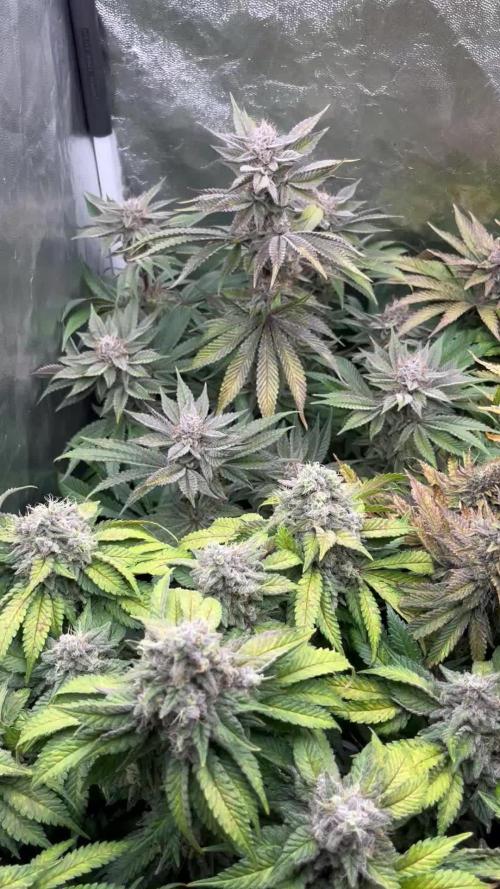
No purple yet kind of bummed out about that but we'll see what happens the buds are getting fatter so I'm happy about that nice and hard the smell is awesome can't wait to smoke this
Likes
78
Share
@Roberts
Follow
Pure Ice cream is doing great under the Spider Farmer G5000/UVR40 lights. She is bulking well. Smelling very sweet, and creamy. Everything is looking really good. Thank you Spider Farmer, Athena, and Pure Instinto Seeds. 🤜🏻🤛🏻🌱🌱🌱 Thank you grow diaries community for the 👇likes👇, follows, comments, and subscriptions on my YouTube channel👇. ❄️🌱🍻 Happy Growing 🌱🌱🌱 https://youtube.com/channel/UCAhN7yRzWLpcaRHhMIQ7X4g Spider Farmer Official Website Links: US&Worldwide: https://www.spider-farmer.com CA: https://spiderfarmer.ca UK: https://spiderfarmer.co.uk EU: https://spiderfarmer.eu AU: https://spiderfarmer.com.au G5000 Light Amazon Link: amzn.to/4643esa UVR 40: https://www.amazon.com/dp/B0BR7SGTHS Discount code: saveurcash (Stackable)
Likes
17
Share
@Aleks555
Follow
Gorilla Zkittlez Auto is a true work of art among autoflowers. With its powerful, dense buds literally dotted with 'sugar', each stage of growth of this plant is pure eye pleasure. The scent she exudes is as delicious as her taste-sweet, with fruity notes, promising an unforgettable delight. This beauty not only looks great, but also gives a strong, powerful effect that both relaxes and cheers up. Special thanks for this outstanding variety of 42Fast Buds, and, of course, Xpert Nutrients-your fertilizers made such impressive results possible. Each stage of growth was perfect thanks to this tandem. This variety is a real miracle for any grower! Xpert Nutrients is the fertilizer that truly makes a difference! 🌱 From the very start of our grow, Xpert Nutrients has proven itself to be exceptional. Every plant receiving this nourishment flourishes—from strong roots to dense, trichome-covered buds. With its balanced formula and ease of use, our beauties get everything they need for optimal growth and flowering. It’s a joy to see how the plants respond to this fertilizer! A huge thank you to Xpert Nutrients for your high-quality product and continuous support. Without your nutrients, our results wouldn't be as impressive! 🙌
Likes
Comments
Share
@Nftgrower
Follow
Total yield was 105 grams per plant
Likes
15
Share
Lately I've been obsessed with photoperiod plants and the topping technique all very nice but you can't forget the Fastbuds autoflowers either. The Cindarella was a very particular plant, it did not grow very tall but very plump and chubby and the particularity is a fantastic main cola (another thing I reluctantly give up if I do topping), it has two horns like a devil or rather three but two are predominant and are fantastic. really. top. Resin in rivers as usual. Smell like a Weed Spirit. Music of the Week - Gerorge Clinton to get crazy bud. Radio Nula from Slovenia the rest of the time. Light >> Marshydro SP3000 AT 90% of Power Tent >> Marshydro 120x60x180 Check IG >> https://www.instagram.com/marshydro_aliexpress2/ Buy >> marshydroled.aliexpress.com https://2fast4buds.com/
Likes
25
Share
@m0use
Follow
This was a fun week, the plants got their first feeding from the TripTonic line of nutrients. I did a light feeding and then had to readjust as the EC was a bit low considering the size of the plants. The runoff was a bit high and this maybe because of all the left over from the pro mix slow release, thought it would have been used up by now. They will get the same water as the rest of the plants on the deck for the remainder of the week. I don't know if the PH will get out of wack because of this, but given that it is mainly peat and it tends to be acidic I think I'm in the clear. The little video was fun to splice together too. Got a little package in the mail from a fellow grower. @GottaGrowSometime has shared some of their Fast Buds winnings and sent me some green crack cbd 1:1 and cbd 20:1, they also threw in seed of the cherry coke and a few extras. This is going to help me test out their CBD lineup and see if its worth growing out. Big shoutout to them for being a great community member. In return I will be sending them some of my backcrossed Dinamed CBD Kush Autoflower seeds I made, the testing is going well so best to see what it can do in other growers hands.
Likes
12
Share
Went crazy with LST as I'm anticipating that stretch as they decide to start flowering through the week! I'm so excited the 2 with the older soil happily took nutrients almost to the point I could have went even full strength. The grobiotics is a special formula I got a sample of from a close friend. It consists of canna leaf, organic molasses and lacto bacillus!!!! It was great for improving the life of my soil I look forward to buying it when it becomes available it's not really available yet as far as I know. It improved my microbial life 100% my soil is definetly living and these plants are super happy. I hope you guys are enjoying these diaries as much as I am. Check back next week to see just how fast they grow & remember its 4:20 somewhere!!!!!!!!
Likes
13
Share
I cut this Girl i have no space and i overfeeded the girl
Processing
Likes
10
Share
@TrimQueen
Follow
So, guys.. This is her first month blooming. 4 complete weeks has passed. Here we are for 2 more. Gave Her a super powerful egg shell fert (all powdered - Phosforium Whelthy.) 07/10/20 - We are in the middle of week 5. Thats the way they look like. For me a good number of buds and they are as dense as I thought they would be by this time. I think everything is under control despite some foxtails cuz the heat. Loving the experience.
Likes
2
Share
@Diaaz
Follow
This is last week before harvest. No fertilizer only water this week for flushing. The stems began to break, see you after next 2 weeks after drying :)