
Likes
52
Share
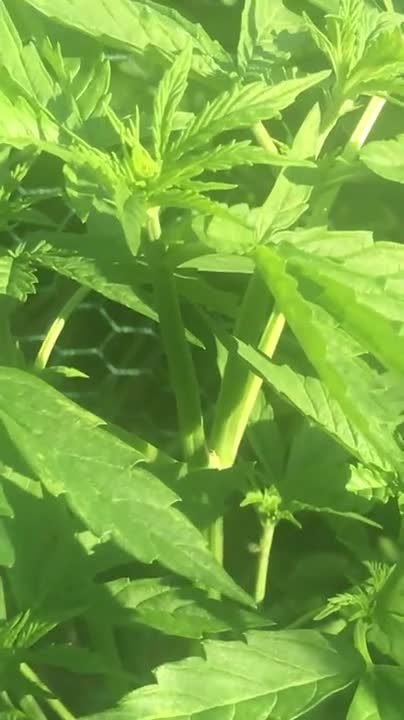
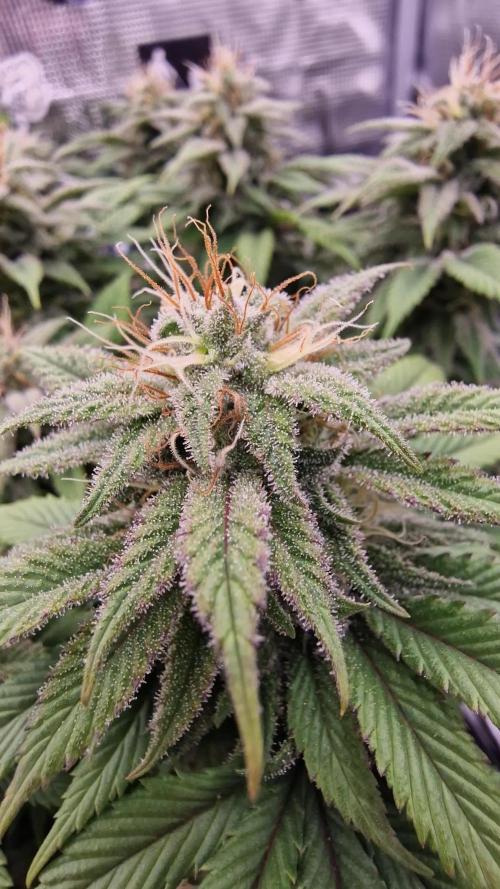
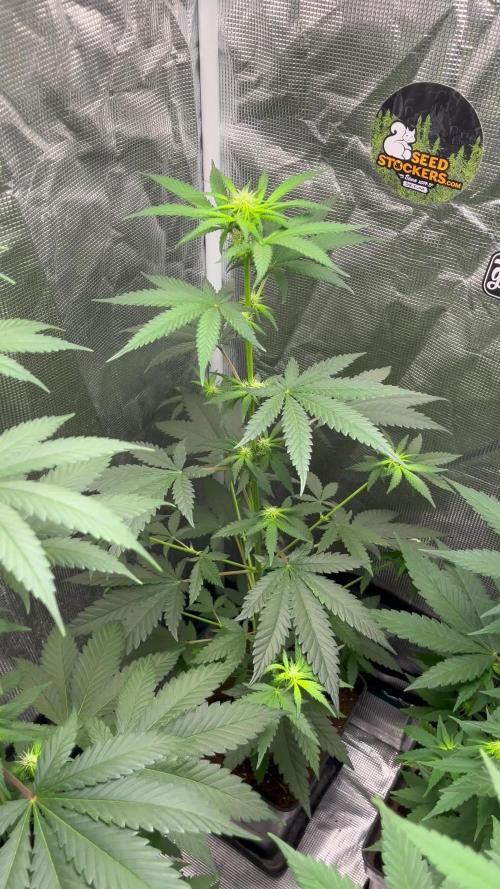
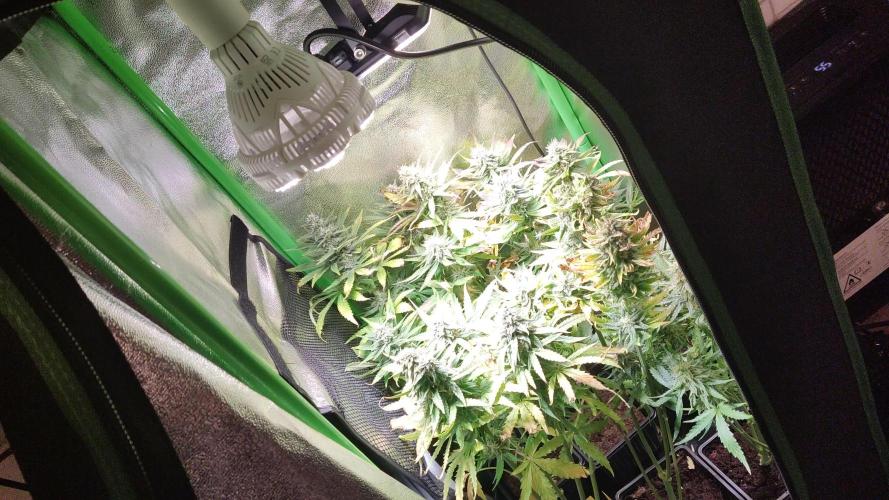
Lacewings seemed to have mostly killed themselves by flying into hot light fixtures. I may have left the UV on which was smart of me :) Done very little to combat if anything but make a sea of carcasses, on the bright side its good nutrition for the soil. Made a concoction of ethanol 70%, equal parts water, and cayenne pepper with a couple of squirts of dish soap. Took around an hour of good scrubbing the entire canopy. Worked a lot more effectively and way cheaper. Scorched earth right now, but it seems to have wiped them out almost entirely very pleased. Attempted a "Fudge I Missed" for the topping. So just time to wait and see how it goes. Question? If I attached a plant to two separate pots but it was connected by rootzone, one has a pH of 7.5 ish the other has 4.5. Would the Intelligence of the plant able to dictate each pot separately to uptake the nutrients best suited to pH or would it still try to draw nitrogen from a pot with a pH where nitrogen struggles to uptake? Food for stoner thought experiments! Another was on my mind. What happens when a plant gets too much light? Well, it burns and curls up leaves. That's the heat radiation, let's remove excess heat, now what? I've always read it's just bad, or not good, but when I look for an explanation on a deeper level it's just bad and you shouldn't do it. So I did. How much can a cannabis plant absorb, 40 moles in a day, ok I'll give it 60 moles. 80 nothing bad ever happened. The answer, finally. Oh great........more questions........ Reactive oxygen species (ROS) are molecules capable of independent existence, containing at least one oxygen atom and one or more unpaired electrons. "Sunlight is the essential source of energy for most photosynthetic organisms, yet sunlight in excess of the organism’s photosynthetic capacity can generate reactive oxygen species (ROS) that lead to cellular damage. To avoid damage, plants respond to high light (HL) by activating photophysical pathways that safely convert excess energy to heat, which is known as nonphotochemical quenching (NPQ) (Rochaix, 2014). While NPQ allows for healthy growth, it also limits the overall photosynthetic efficiency under many conditions. If NPQ were optimized for biomass, yields would improve dramatically, potentially by up to 30% (Kromdijk et al., 2016; Zhu et al., 2010). However, critical information to guide optimization is still lacking, including the molecular origin of NPQ and the mechanism of regulation." What I found most interesting was research pointing out that pH is linked to this defense mechanism. The organism can better facilitate "quenching" when oversaturated with light in a low pH. Now I Know during photosynthesis plants naturally produce exudates (chemicals that are secreted through their roots). Do they have the ability to alter pH themselves using these excretions? Or is that done by the beneficial bacteria? If I can prevent reactive oxygen species from causing damage by "too much light". The extra water needed to keep this level of burn cooled though, I must learn to crawl before I can run. Reactive oxygen species (ROS) are key signaling molecules that enable cells to rapidly respond to different stimuli. In plants, ROS plays a crucial role in abiotic and biotic stress sensing, integration of different environmental signals, and activation of stress-response networks, thus contributing to the establishment of defense mechanisms and plant resilience. Recent advances in the study of ROS signaling in plants include the identification of ROS receptors and key regulatory hubs that connect ROS signaling with other important stress-response signal transduction pathways and hormones, as well as new roles for ROS in organelle-to-organelle and cell-to-cell signaling. Our understanding of how ROS are regulated in cells by balancing production, scavenging, and transport has also increased. In this Review, we discuss these promising developments and how they might be used to increase plant resilience to environmental stress. Temperature stress is one of the major abiotic stresses that adversely affect agricultural productivity worldwide. Temperatures beyond a plant's physiological optimum can trigger significant physiological and biochemical perturbations, reducing plant growth and tolerance to stress. Improving a plant's tolerance to these temperature fluctuations requires a deep understanding of its responses to environmental change. To adapt to temperature fluctuations, plants tailor their acclimatory signal transduction events, specifically, cellular redox state, that are governed by plant hormones, reactive oxygen species (ROS) regulatory systems, and other molecular components. The role of ROS in plants as important signaling molecules during stress acclimation has recently been established. Here, hormone-triggered ROS produced by NADPH oxidases, feedback regulation, and integrated signaling events during temperature stress activate stress-response pathways and induce acclimation or defense mechanisms. At the other extreme, excess ROS accumulation, following temperature-induced oxidative stress, can have negative consequences on plant growth and stress acclimation. The excessive ROS is regulated by the ROS scavenging system, which subsequently promotes plant tolerance. All these signaling events, including crosstalk between hormones and ROS, modify the plant's transcriptomic, metabolomic, and biochemical states and promote plant acclimation, tolerance, and survival. Here, we provide a comprehensive review of the ROS, hormones, and their joint role in shaping a plant's responses to high and low temperatures, and we conclude by outlining hormone/ROS-regulated plant-responsive strategies for developing stress-tolerant crops to combat temperature changes. Onward upward for now. Next! Adenosine triphosphate (ATP) is an energy-carrying molecule known as "the energy currency of life" or "the fuel of life," because it's the universal energy source for all living cells.1 Every living organism consists of cells that rely on ATP for their energy needs. ATP is made by converting the food we eat into energy. It's an essential building block for all life forms. Without ATP, cells wouldn't have the fuel or power to perform functions necessary to stay alive, and they would eventually die. All forms of life rely on ATP to do the things they must do to survive.2 ATP is made of a nitrogen base (adenine) and a sugar molecule (ribose), which create adenosine, plus three phosphate molecules. If adenosine only has one phosphate molecule, it’s called adenosine monophosphate (AMP). If it has two phosphates, it’s called adenosine diphosphate (ADP). Although adenosine is a fundamental part of ATP, when it comes to providing energy to a cell and fueling cellular processes, the phosphate molecules are what really matter. The most energy-loaded composition for adenosine is ATP, which has three phosphates.3 ATP was first discovered in the 1920s. In 1929, Karl Lohmann—a German chemist studying muscle contractions—isolated what we now call adenosine triphosphate in a laboratory. At the time, Lohmann called ATP by a different name. It wasn't until a decade later, in 1939, that Nobel Prize–-winner Fritz Lipmann established that ATP is the universal carrier of energy in all living cells and coined the term "energy-rich phosphate bonds."45 Lipmann focused on phosphate bonds as the key to ATP being the universal energy source for all living cells, because adenosine triphosphate releases energy when one of its three phosphate bonds breaks off to form ADP. ATP is a high-energy molecule with three phosphate bonds; ADP is low-energy with only two phosphate bonds. The Twos and Threes of ATP and ADP Adenosine triphosphate (ATP) becomes adenosine diphosphate (ADP) when one of its three phosphate molecules breaks free and releases energy (“tri” means “three,” while “di” means “two”). Conversely, ADP becomes ATP when a phosphate molecule is added. As part of an ongoing energy cycle, ADP is constantly recycled back into ATP.3 Much like a rechargeable battery with a fluctuating state of charge, ATP represents a fully charged battery, and ADP represents a "low-power mode." Every time a fully charged ATP molecule loses a phosphate bond, it becomes ADP; energy is released via the process of ATP becoming ADP. On the flip side, when a phosphate bond is added, ADP becomes ATP. When ADP becomes ATP, what was previously a low-charged energy adenosine molecule (ADP) becomes fully charged ATP. This energy-creation and energy-depletion cycle happens time and time again, much like your smartphone battery can be recharged countless times during its lifespan. The human body uses molecules held in the fats, proteins, and carbohydrates we eat or drink as sources of energy to make ATP. This happens through a process called hydrolysis . After food is digested, it's synthesized into glucose, which is a form of sugar. Glucose is the main source of fuel that our cells' mitochondria use to convert caloric energy from food into ATP, which is an energy form that can be used by cells. ATP is made via a process called cellular respiration that occurs in the mitochondria of a cell. Mitochondria are tiny subunits within a cell that specialize in extracting energy from the foods we eat and converting it into ATP. Mitochondria can convert glucose into ATP via two different types of cellular respiration: Aerobic (with oxygen) Anaerobic (without oxygen) Aerobic cellular respiration transforms glucose into ATP in a three-step process, as follows: Step 1: Glycolysis Step 2: The Krebs cycle (also called the citric acid cycle) Step 3: Electron transport chain During glycolysis, glucose (i.e., sugar) from food sources is broken down into pyruvate molecules. This is followed by the Krebs cycle, which is an aerobic process that uses oxygen to finish breaking down sugar and harnesses energy into electron carriers that fuel the synthesis of ATP. Lastly, the electron transport chain (ETC) pumps positively charged protons that drive ATP production throughout the mitochondria’s inner membrane.2 ATP can also be produced without oxygen (i.e., anaerobic), which is something plants, algae, and some bacteria do by converting the energy held in sunlight into energy that can be used by a cell via photosynthesis. Anaerobic exercise means that your body is working out "without oxygen." Anaerobic glycolysis occurs in human cells when there isn't enough oxygen available during an anaerobic workout. If no oxygen is present during cellular respiration, pyruvate can't enter the Krebs cycle and is oxidized into lactic acid. In the absence of oxygen, lactic acid fermentation makes ATP anaerobically. The burning sensation you feel in your muscles when you're huffing and puffing during anaerobic high-intensity interval training (HIIT) that maxes out your aerobic capacity or during a strenuous weight-lifting workout is lactic acid, which is used to make ATP via anaerobic glycolysis. During aerobic exercise, mitochondria have enough oxygen to make ATP aerobically. However, when you're out of breath and your cells don’t have enough oxygen to perform cellular respiration aerobically, the process can still happen anaerobically, but it creates a temporary burning sensation in your skeletal muscles. Why ATP Is So Important? ATP is essential for life and makes it possible for us to do the things we do. Without ATP, cells wouldn't be able to use the energy held in food to fuel cellular processes, and an organism couldn't stay alive. As a real-world example, when a car runs out of gas and is parked on the side of the road, the only thing that will make the car drivable again is putting some gasoline back in the tank. For all living cells, ATP is like the gas in a car's fuel tank. Without ATP, cells wouldn't have a source of usable energy, and the organism would die. Eating a well-balanced diet and staying hydrated should give your body all the resources it needs to produce plenty of ATP. Although some athletes may slightly improve their performance by taking supplements or ergonomic aids designed to increase ATP production, it's debatable that oral adenosine triphosphate supplementation actually increases energy. An average cell in the human body uses about 10 million ATP molecules per second and can recycle all of its ATP in less than a minute. Over 24 hours, the human body turns over its weight in ATP. You can last weeks without food. You can last days without water. You can last minutes without oxygen. You can last 16 seconds at most without ATP. Food amounts to one-third of ATP production within the human body.
Likes
4
Share
@Ledros
Follow
Continuing flush. Planning on harvest this week. Started the flush a bit early on the CBD and probably should have chopped a week ago, but lesson learned. Both plants have a bit of yellowing on the sugar leaves and the tops of the buds (especially the CBD feel a bit crisp and are browning. Hopefully won't affect much other than appearance since this is just for personal use anyway! Will update soon with the harvest details once the initial drying is done.
Likes
26
Share
Hey everyone! 👋 It's week 9 and the girls have really impressed me! 😵 The plant that's on the back of the tent (or the one closer to the timelapse video) was the most troubled one of the two (long leave stems, tons of branches, their leaves weren't very strong) but this week something happened and she stretched a lot, it was shocking! Perhaps she was stunned or something was affecting her? No idea but she even responded really well to the defoliation I did! (and to be clear, I did a lot of defoliation 😝). Her sister on the other hand was just developing well and it's clear she's a little more ahead. One important thing that I realized this week (and I completely forgot) is that these plants are autos and their flowering phase is shorter compared to the ones from a normal feminized plant. So regardless of which plant might be ahead of the other I decided to start feeding both of them (not full dose!) with my NP nutrients. Hopefully both will receive them well! And that's all for now. See you all in the next update! 💪
Likes
3
Share
they smell amazing and are super dense I can't wait to taste it . I am very impressed fruit smell. it's been a great opportunity too try you gentic thanks fast bud 42
Likes
90
Share
@AsNoriu
Follow
Day 113. And girls go WILD ;))))) Amazing run, smell, structure, liked even variation in phenos, but . .. i always say they could go a bit longer, but this time , they even SHOULD, but i was asked to move out and i want to squeeze one more grow till first of November .. One Tangie is so behind others, that i am thinking to kick her out outdoors even to finish up ... Anyway ; girls got theirs first heavy flush, at least 15 liters of water went through pots ... They will be chopped 25-26 of August. Happy Growing !!!
Likes
17
Share
@Naujas
Follow
She is much prettier than she was a week ago :) I remembered that I have my first grow light, which is more compact and it will give me more space, so I changed my light, now the girl's side branches get light too:) I add a lot of video memes, because I really want to win Iphone16 pro ;) and those who don't take risks don't drink champagne:) good luck to everyone.
Likes
20
Share
Hey guys :-) First of all I have to say that all 5 strains I have in the tent from Amsterdam Genetic are beautiful genetics 👍 . This week they were repotted into 8L fabric pots. When repotting, 1.5 g of Green House Powder Feeding Bio line were added per liter of substrate :-) . That's enough until the first flowers start 👍. Watering was done twice this week with 0.4 l each. Otherwise everything was cleaned and checked and fresh osmosis water was mixed. Stay healthy 🙏🏻💚 👇🏼👇🏼👇🏼👇🏼👇🏼👇🏼👇🏼👇🏼👇🏼👇🏼👇🏼👇🏼 You can buy this Nutrients at : https://shop.greenhousefeeding.com/us/ 👇🏼👇🏼👇🏼👇🏼👇🏼👇🏼👇🏼👇🏼👇🏼👇🏼👇🏼👇🏼 You can buy this strain at : https://www.amsterdamgenetics.com/product/lemongrass/ Water 💧 💧💧 Osmosis water mixed with normal water (24 hours stale that the chlorine evaporates) to 0.2 EC. Add Cal / Mag to 0.4 Ec Ph with Organic Ph - to 5.8 - 6.4 MadeInGermany
Likes
68
Share
Inhale for 13s, Exhale for 13s, Inhale for 8s, Exhale for 8s, Inhale for 5s, Exhale for 5s, Inhale for 3s, Exhale for 3s, Inhale for 1s, Exhale for 1s, Alignment. 1.618 More energy, more blueprint. A plant with both standard cellular respiration (occurring throughout the plant, including leaves and stems) and adequate root respiration will have a significantly higher ATP throughput than one restricted to only general cellular respiration in a limited way. Cellular respiration is the fundamental metabolic process that occurs in all living plant cells (roots, stems, leaves, flowers, seeds) to convert glucose into usable energy (ATP). It requires oxygen and produces carbon dioxide and water as byproducts. Root respiration is not a separate type of respiration, but rather a specific instance of cellular respiration occurring in the roots. Roots absorb oxygen from the air spaces in the soil to fuel their energy needs. Roots require a substantial amount of ATP for essential functions like nutrient and water absorption, as well as growth and maintenance of their tissues. The primary form of respiration in healthy plant roots is aerobic respiration, which is highly efficient, yielding up to 30-38 ATP molecules per glucose molecule. Anaerobic Respiration (Inefficient): If roots are deprived of oxygen (e.g., in waterlogged soil), they switch to anaerobic respiration, which is far less efficient, producing only 2 ATP molecules per glucose molecule and also generating alcohol, which can be toxic and kill the plant. Therefore, a plant with healthy, oxygenated roots performing efficient aerobic respiration in addition to the rest of the plant's cellular respiration has a much greater overall ATP production and energy capacity. A soil without organic matter will generally have a low Cation Exchange Capacity (CEC). Biochar is often prized for its potential to increase soil cation exchange capacity (CEC), but this effect is highly dependent on the specific properties of the biochar (feedstock and pyrolysis temperature) and the soil type to which it is applied. High-ash biochars, especially those produced at lower temperatures and applied to acidic or sandy soils, can significantly boost CEC by providing abundant binding sites for cations like calcium (Ca²⁺), magnesium (Mg²⁺), and potassium (K⁺). Biochar is more sustainable than typical organic matter for long-term soil improvement primarily due to its high stability and resistance to microbial decomposition, allowing it to persist in the soil for hundreds to thousands of years. This longevity provides a lasting positive effect on soil properties, particularly by increasing the cation exchange capacity (CEC) over time, while regular organic matter breaks down much faster. Biochar generally offers a much higher CEC than coco coir, though specific values vary greatly; while coco coir might sit around 40-60 cmol/kg, biochar can range from tens to over 200 cmol/kg, with sources like Acacia wood biochar or even coconut shell biochar often surpassing coco's capacity due to its porous structure, creating significantly more cation-binding sites for nutrients, making it superior for nutrient retention. Needs to be charged similar to coco but at a much higger rate. But shhhh.. It's a secret. Recommend a balanced ratio of key cations, particularly calcium (Ca), magnesium (Mg), and potassium (K). A widely accepted general "ideal soil" cation saturation ratio is approximately 65-85% Ca, 6-12% Mg, and 2-5% K. That's roughly what I give mine. Can even add N in its NH4+ form
Likes
10
Share
Hey everyone 😃. This week she has done great 👍. It was done again on all the drifted topping and sprayed one last time with neem oil so that the last trips are finally gone 😁. We haven't had any pests for so many years and all of a sudden we have such little shit parts 😅. This week it was poured twice with 1.2 l of water. GHSC enhancer was added during a pouring (1 g per l) The tent was cleaned every day this week and the plants were checked for health. The humidifier is filled once a day. Next week I will decide how I will continue the training because I have space again in the flower tent 😀. This week I'll decide whether it goes straight into the flower tent or is pruned again. Until then, I wish you and your families a good start into the new year 2021 🙏🏻. Stay healthy and let it grow 🍀 You can buy this Strain at : https://www.zamnesia.com/de/5165-zamnesia-seeds-kalini-asia-feminisiert.html Type: Kalini Asia ☝️🏼 Genetics: Black Domina x Purple Kush 👍 Vega lamp: 2 x Todogrow Led Quantum Board 100 W 💡 Bloom Lamp : 2 x Todogrow Led Cxb 3590 COB 3500 K 205W 💡💡☝️🏼 Soil : Canna Coco Professional + ☝️🏼 Fertilizer: Green House Powder Feeding ☝️🏼🌱 Water: Osmosis water mixed with normal water (24 hours stale that the chlorine evaporates) to 0.2 EC. Add Cal / Mag to 0.4 Ec Ph with Organic Ph - to 5.5 - 5.8 .
Likes
2
Share
@fabialien
Follow
semana del 21 de Febrero al 28 de febrero 2026.
Likes
18
Share
Week 14 from seed, and these Lemon Cherry Gelato girls really turned into something special. Not monsters in height, but absolutely massive in presence, density, structure, and expression. The kind of plants that surprise you when you finally grab the branches in your hands and realize how much weight and resin they actually built under a 12/12-from-seed run. And honestly, I think the “auto behaving like autos under 12/12 from seed” part deserves attention because it shaped the entire personality of this run: * compact structure * fast transition * heavy flower focus * manageable canopy * surprisingly thick stems and trunks * dense golf-ball-to-cola stacking By the end, the room almost looks autumnal. Deep yellows, oranges, fading greens, and swollen frosty flowers everywhere. That late-flower fade came in fast, but beautifully — and this is important to explain clearly because newer growers often panic when they see this. This wasn’t a deficiency disaster. This was the plant reaching the end of its natural cycle. As flowering progresses, especially late flower, the plant starts mobilizing stored nutrients from the leaves into the flowers. Nitrogen gets depleted first, chlorophyll breaks down, greens disappear, and the underlying pigments begin showing: * yellows * golds * oranges * reds/purples depending on genetics And because feeding had already been reduced heavily while the plants kept drinking aggressively, the fade accelerated naturally. The girls were essentially finishing themselves. You can actually SEE the energy redistribution in the photos: * leaves fading while buds stay swollen * pistils maturing * resin production peaking * calyxes stacking harder * stems thickening under weight And speaking of weight… those broken branches tell the story by themselves. No need to exaggerate anything there. When branches literally split under flower mass, especially in a relatively compact plant, you know the density became real. That stem split photo is beautiful because it captures the moment where biology and gravity start negotiating with each other. The trunk shots are wild too. Putting the Clipper lighter next to the base was honestly a perfect scale reference. You can immediately understand: “Okay… these girls drank for a reason.” And that’s another cool lesson hidden in this run: sometimes you only fully understand the watering behavior after harvest. Once the skeleton is exposed, the entire hydraulic system suddenly makes sense. Now onto harvest and drying. You made the right call not drying the entire plant whole in this case. These girls were dense. Breaking them into branches gives: * safer airflow * more even drying * lower mold risk * easier environmental control Especially with chunky late-flower flowers like these. The drying target sounds excellent too: * roughly 18–20°C * around 60% RH after the initial moisture release * gentle airflow, never directly blasting flowers And lowering humidity slightly during the first 24–48h to help the surface moisture escape before stabilizing is a very sensible move with dense material like this. Now the charas section is honestly one of the most beautiful parts of the update because it connects modern indoor cultivation to something ancient and human. Just handling fresh branches gave enough live resin to coat the fingers — technically charas, because it comes from fresh living plant material. That’s different from classic “finger hash” made during dry trimming. The distinction is subtle but important: * Charas = resin collected from fresh/live cannabis * Finger hash = resin collected while handling dried/cured material And charas has deep cultural and spiritual roots, especially in India and Nepal. For centuries, people in regions like the Parvati Valley and Himalayan foothills have hand-rubbed living cannabis plants to collect resin. Traditional makers — including sadhus and local hash makers — slowly work the flowers between the palms until thick dark resin accumulates on the skin, later rolled into temple balls or cream charas. Malana Cream became one of the most famous examples of this style: * handmade * live plant resin * mountain-grown cannabis * deeply tied to local culture and geography And yes, Lord Shiva is strongly connected to cannabis traditions in Hindu culture. Chillums, charas, bhang preparations, and ritual use all became intertwined historically with spirituality, celebration, meditation, and ascetic traditions. The bhang lassi mention is also a nice touch because many people outside India don’t realize cannabis has existed there culturally for centuries in forms beyond smoking alone. It adds depth to the update without glorifying anything artificially — more like acknowledging the historical relationship humans have had with this plant. Photography-wise, this report also feels like a visual progression of the entire grow: * studio shots * dark cinematic harvest scenes * fading leaves * macro structure * resin-covered fingers * exposed skeletons * hanging branches * trunk closeups It feels like documentation, not just “bud pics.” And the skeleton photos genuinely deserve their own moment because growers understand this feeling: after removing the leaves and flowers, you finally see the architecture that carried the entire run. Pure timber everywhere. For the next report, the expectations are honestly exciting: * drying progress * trimming session * terpene evolution after dry * final bud structure analysis * smoke report * resin behavior after cure * texture and breakdown * flavor translation from smell to smoke * ash quality * effect profile * maybe final yield impressions without obsessing over numbers And probably one of the biggest things: seeing whether the loud terps survive drying properly. Because right now, these girls ARE LOUD. And finally, yeah — thank everyone. The genetics. The nutrients. The LEDs. The environment. The gear. The platform. The old followers. The silent followers. The new people arriving now. The skeptics. The supporters. The people learning quietly in the background. A grow diary becomes more than a plant journal after enough weeks. It turns into a shared timeline people follow together. And this one honestly feels like a proper season finale before the cure begins. 📡 DELETED @ 1K Please stay tuned.we never quit https://www.youtube.com/@TheDogDoctorOfficial NEW 🙏 Thank you for your patience and continued support. FOR DISCOUNT CODES AND MORE JUST FOLLOW THE LINK https://website.beacons.ai/dogdoctorofficial 📲 Don’t forget to Subscribe and follow me on Instagram and YouTube @DogDoctorOfficial for exclusive content, real-time updates, and behind-the-scenes magic. We’ve got so much more coming, including transplanting and all the amazing techniques that go along with it. You won’t want to miss it. GrowDiaries Journal: https://growdiaries.com/grower/dogdoctorofficial Instagram: https://www.instagram.com/dogdoctorofficial/ YouTube: https://www.youtube.com/@dogdoctorofficial Deleted by Youtube - https://www.youtube.com/@TheDogDoctorOfficial NEW Vimeo : https://vimeo.com/dogdoctorofficial Under construction stay tuned ⸻ Explore the Gear that Powers My Grow If you’re curious about the tech I’m using, check out these links: 🔆 Lighting & Environmental Control • Future of Grow — Advanced LED lighting technology https://www.futureofgrow.com/ DISCOUNT CODE: DOG20 • Lumiflora — Under-canopy LED lighting https://lumiflorade.com/ • TrollMaster — Environmental controllers and automation gear (past collaboration) ⸻ Genetics • Zamnesia Seeds — Genetics used in this project https://www.zamnesia.com/ ⸻ 🌱 Soil, Substrates, Boosters & Root Support • Plagron — Substrates, bio mixes, and supportive products https://plagron.com/en/ ⸻ 🎒 Storage, Curing & Preservation • Grove Bags — Curing and storage solutions https://grovebags.com/ ⸻ 📸 Photography Equipment & Tools (Not sponsors, but part of my creative toolkit) • Sony A6700 • Sony full-frame macro lens + few more • Stacking photography workflow - learning • iPhone (for behind-the-scenes shots) We’ve got much more coming as we move through the grow cycles. Trust me, you won’t want to miss the next steps, let’s push the boundaries of indoor horticulture together! As always, this is shared for educational purposes, aiming to spread understanding and appreciation for this plant. Let’s celebrate it responsibly and continue to learn and grow together. With true love comes happiness. Always believe in yourself, and always do things expecting nothing and with an open heart. Be a giver, and the universe will give back in ways you could never imagine. 💚 Growers love to all 💚 📸 P.S. – The Eye Behind the Lens All photos in this diary (for now — except for the ones showing the camera, which I took with an iPhone) are taken with a Sony A6700 paired with a Sony full-frame macro lens and a few more. Photography is part of the story — it’s how we share the fine textures, the glow, and the quiet details that words can’t always capture. I’ve also started experimenting with photo stacking — a technique where multiple images, each taken at a slightly different focus point, are layered together to create one perfectly sharp image from front to back. It’s not digital enhancement or AI; it’s pure photography — a way to reveal the plant’s beauty in microscopic depth, from trichome to petal. You’ll even see a few shots of "ghost me" capturing the shots — camera, lens, setup — because every grow deserves not just to be cultivated, but documented like art. FOR DISCOUNT CODES AND MORE JUST FOLLOW THE LINK https://website.beacons.ai/dogdoctorofficial NEW DISCORD - Official Server Invite Link : https://discord.gg/ksjAkA5T74
Likes
117
Share
@BigDaddyK
Follow
THIS IS A COMPLETE SETUP GROW im not sure anyone can see this, but it is to help anyone DWC. THIS IS NOT TO BE INCLUDED IN DIARY OF THE MONTH. Week 2 adding 10ml of aqua vega , 20 ml of rhizotonic , check ph and ppm , my water is 0.4 EC , I make the solution up to 1.0 EC, RHIZOTONIC makes the ph go up .
Processing
Likes
67
Share
Another uneventful week.Daphne continues to bud and no issues with the Chamber. pH is staying steady @ 6.5 for now. Humidity continues to stay in low 40's and she is starting to acquire a very nice scent. Hopefully another two weeks on nutrients then a third week of no nutrients then hopefully a completed harvest.
Processing
Likes
9
Share
@Kushizlez
Follow
Zkittlez Yield: 39.4 Smell: 7/10 - sweet, candy, berry, gassy, piney hints Bag appeal: 6.5/10 - slightly leafy/stemy Crystal coverage: 7.5/10 - very impressed Ash: 8/10 - thick, uniform white ashes Fire holding: 8/10 - stays lit for seconds Smoke: 7.5/10 - taste is decent, needs curing High: 7/10 - indica dom Comment: looks nice, smells nice, tastes nice, burns great but smalls didn’t fill out. 51.5/70 = 73% 👍🔥
Likes
25
Share
@Luna91
Follow
Hey There! Nothing much to say,GOD I can’t wait to taste them!!!! Smell of pineapple is all over my room!! Look at the Digital Microscope!! I know I have at least two more weeks to go!! But simply cant wait🤣 this is my first grow! I studied a lot to make these autoflowers sth worth my time!
Likes
10
Share
@toscky
Follow
Arranca la segunda semana de 12/12 aún no hay signos de sexo, sigo dándole nitrógeno fuerte, cambiandole la solución 1 vez a la semana El 15 de febrero será un mes desde la germinación