Likes
Comments
Share
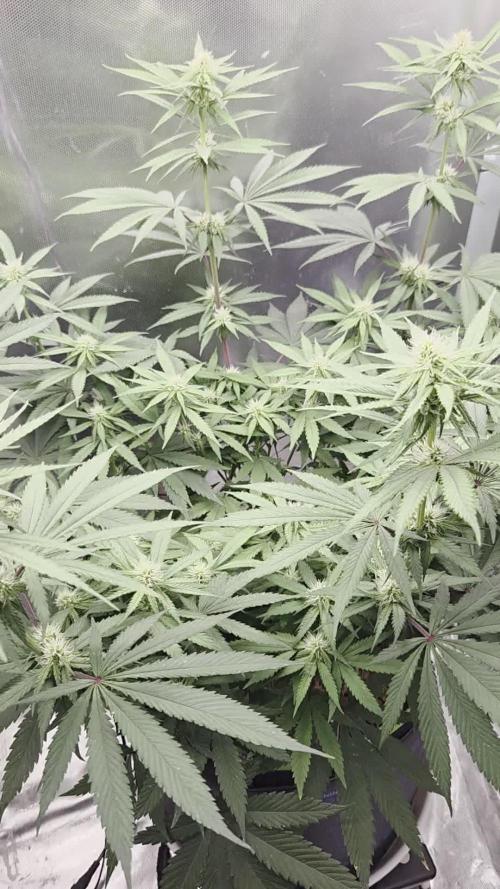
Not much to do except add water. Living soil is easy. This is a 10/10 plant. Can't wait for the first joint.

Likes
6
Share
Don't have a lot of time these days to take pics so I'll sum things up. CO2 got outta control and the plants took tf off literally. The video is around middle of week 3, I had to flip at week 4 BC I literally ran out of room and I had to constantly defoliate.
Likes
8
Share
This week went ok . I noticed there are Rust spots on the leaves that was due to I didn't have my carbon filter at the time but I do now and the plants have been treated today with the spray .but other then that thay ar doing well . Thank you for looking at my diary and always remember it's 420 somewhere 🌱👍
Processing
Likes
20
Share
Start of week 2 of flowering, both girls were drooping heavily and the medium was dry and pots were very light feeling. Removed the worst leaves from each plant and a few large fan leaves. Overall, I'm very happy with the weeks growth and development.
Likes
4
Share
Went from 450w to 150w blue for a week due to heat and too much height gain. Weather got cold so I put the 450w red back in as they seem to be thickening up. Feminising was very easy on the ones I chose, I chose only three that had thicker faster flowering and more THC but will cross with the more sativa dominant ones.
Likes
237
Share
June 27th - field checks for sure as the week progresses. Making sure outdoor plants get amended with updated feedings and Mtce. ~ 6 more weeks of Veg, thats all !!! - Southern Ontario gets just 14hrs of day-lite on Aug 13th. That is the first day of Flower for me. 28th - visited Congo #3 x Bangi Haze, Purple Dawn and Russian Tzar Bomba - top-dressed each 15 gal fabric pot - re-applied support bamboo and isolated stalk - great to see Lady Bugs on the plants. We could find no other insects or bite marks. LadyBugs are welcome anytime July 1/2 - cleaned the weeds around the plant bases / hillside of the LSD and Panama Red plants ( + purpsberry and Honduras x Panama) - noticed the wind had Split the FIM-site on the Panama Red. Being so fresh, duct-tape leaves no fear that the repaired-joint is exposed. “Are Toppings safer than FIMS, when exposed to outdoor Wind stresses ?” Maybe that little nuggett on top truly holds the joint together. The split on the Fim was about to go right down the plant. - soils amended towards 15gal pots, with fresh Fertilizer, compost, azomite, kelp meal - each plant given a gallon of nutrients on the first, ahead of a possible storm. No storm, plants fed 1.25 gallons of root boost ea., through Soil Amendment… today, the 2nd - next couple of waterings are Reduced strength but full spectrum Nutrients. - Panama Red is as wide as it is tall. With wispy branches that are full of tiny delicate leaves. I threw a quik video into the photos. Better effort next time. There is a Real lacey kind of branch network on this strain - LSD is a hardy stocky plant. Supernhealthy
Likes
18
Share
Green light is radiation with wavelengths between 520 and 560 nm and it affects photosynthesis, plant height, and flowering. Plants reflect green light and this is why they appear green to our eyes. As a result, some growers think that plants don’t use green wavelengths, but they actually do! In fact, only around 5 – 10% of green light is reflected from leaves and the rest (90 – 95 %) is absorbed or transmitted to lower leaves [1]. Green wavelengths get used in photosynthesis. Chlorophyll pigments absorb small amounts of green wavelengths. Light that doesn’t get absorbed is transmitted to leaves that are shaded out from direct light. This means that leaves at the bottom of the canopy get more green light than leaves at the top. A high proportion of green wavelengths compared to other colors tells lower leaves that they are being shaded out, so they are able to react accordingly. Lower leaves may react by opening or closing their stomata or growing longer stems that help the leaves reach brighter light [1, 2, 3]. When it comes to growing cannabis, many cultivators are interested in the quality of light used for the flowering stage. In many plants, flowering is regulated by two main photoreceptors: cryptochrome and phytochrome. Both photoreceptors primarily respond to blue light but can also respond to green, although to a lesser extent. Green can accelerate the start of flowering in several species (although cannabis has yet to be tested) [1, 4, 5]. However, once flowering has begun, it’s important to provide plants with a “full spectrum” light that has high amounts of blue and red light, and moderate amounts of green, in order for photosynthesis to be optimized. Green light mediates seed germination in some species. Seeds use green wavelengths to decide whether the environment is good for germination. Shade environments are enriched in green relative to red and blue light, so a plant can tell if it is shady or sunny. A seed that senses a shaded environment may stay dormant to avoid poor growing conditions [1]. Some examples of plant species where researchers have documented this response are: ryegrass (a grass that grows in tufts) and Chondrilla (a plant related to dandelion) [1, 6]. Although green wavelengths generally tell plants NOT to germinate, there are some exceptions! Surprisingly, green wavelengths can stimulate seed germination in some species like Aeschynomene, Tephrosia, Solidago, Cyrtopodium, and Atriplex [1, 6, 7]. Of course, light is not the only factor affecting seed germination – it’s a combination of many factors, such as soil moisture, soil type, temperature, photoperiod, and light quality. When combined with red and blue light, green can really enhance plant growth [1, 8]. However, too much green light (more than 50% of the total light) can actually reduce plant growth [8]. Based on the most current research, the ideal ratio of green, red, and blue light is thought to be around 1:2:1 for green:blue:red [9]. When choosing a horticultural light, choose one that has high amounts of blue and red light and moderate amounts of green and other colors of light. Not many studies can be found about the effect of green light on cannabis growth or metabolism. However, if one reads carefully, there are clues and data available even from the very early papers. Mahlberg and Hemphill (1983) used colored filters in their study to alter the sunlight spectrum and study green light among others. They concluded that the green filter, which makes the environment green by cutting other wavelengths out, reduced the THC concentration significantly compared to the daylight control treatment. It has been demonstrated that green color can reduce secondary metabolite activity with other species as well. For example, the addition of green to a light spectrum decreases anthocyanin concentration in lettuce (Zhang and Folta 2012). If green light only reverses the biosynthesis of some secondary metabolites, then why put green light into a growth spectrum at all? Well, there are a couple of good reasons. One is that green penetrates leaf layers effectively. Conversely red and blue light is almost completely absorbed by the first leaf layer. Green travels through the first, second, and even third layers effectively (Figure 2). Lower leaf layers can utilize green light in photosynthesis and therefore produce yields as well. Even though a green light-specific photoreceptor has not yet been found, it is known that green light has effects independent from the cryptochrome but then again, also cryptochrome-dependent ones, just like blue light. It is known that green light in low light intensity conditions can enhance far red stimulating secondary metabolite production in microgreens and then again, counteracts the production of these compounds in high-intensity light conditions (Kim et al. 2004). In many cases, green light promoted physiological changes in plants that are opposite to the actions of blue light. In the study by Kim et al. blue light-induced anthocyanin accumulation was inhibited by green light. In another study it has been found that blue light promotes stomatal opening whereas green light promotes stomatal closure (Frechilla et al. 2000). Blue light inhibits the early stem elongation in the seedling stage whereas green light promotes it (Folta 2004). Also, blue light results in flowering induction, and green light inhibits it (Banerjee et al., 2007). As you can see, green light works very closely with blue light, and therefore not only the amount of these two wavelengths separately is important but also the ratio (Blue: Green) between these two in the designed spectrum. Furthermore, green light has been found to affect the elongation of petioles and upward leaf reorientation with the model plant Arabidopsis thaliana both of which are a sign of shade avoidance symptoms (Zhang et al. 2011) and also gene expression in the same plant (Dhingra et al. 2006). As mentioned before, green light produces shade avoidance symptoms which are quite intuitive if you consider the natural conditions where the plants grow. Not all the green light is reflected from the highest canopy leaves in nature but a lot of it (50-90%) has been estimated to penetrate the upper leaves at the plant level ((Terashima et al., 2009; Nishio, 2000). For the plant growing in the understory of the forest green light is a signal for the plant of being in the shade of a bigger plant. Then again, the plants growing under unobstructed sunlight can take advantage of the green photons that can more easily penetrate the upper leaves than the red and blue photons. From the photosynthetic pigments in higher plants, chlorophyll is crucial for plant growth. Dissolved chlorophyll and absorb maximally in the red (λ600–700 nm) and blue (λ400–500 nm) regions of the spectrum and not as easily in the green (λ500–600 nm) regions. Up to 80% of all green light is thought to be transmitted through the chloroplast (Terashima et al., 2009) and this allows more green photons to pass deeper into the leaf mesophyll layer than red and blue photons. When the green light is scattered in the vertical leaf profile its journey is lengthened and therefore photons have a higher chance of hitting and being absorbed by chloroplasts on their passage through the leaf to the lower leaves of the plant. Photons of PPFD (photosynthetic photon flux density) are captured by chlorophyll causing an excitation of an electron to enter a higher energy state in which the energy is immediately passed on to the neighboring chlorophyll molecule by resonance transfer or released to the electron transport chain (PSII and PSI). Despite the low extinction coefficient of chlorophyll in the green 500–600 nm region it needs to be noted that the absorbance can be significant if the pigment (chlorophyll) concentration in the leaf is high enough. The research available clearly shows that plants use green wavelengths to promote higher biomass and yield (photosynthetic activity), and that it is a crucial signal for long-term developmental and short-term dynamic acclimation (Blue:Green ratio) to the environment. It should not be dismissed but studied more because it brings more opportunities to control plant gene expression and physiology in plant production. REFERENCES Banerjee R., Schleicher E., Meier S. Viana R. M., Pokorny R., Ahmad M., Bittl R., Batschauer. 2007. The signaling state of Arabidopsis cryptochrome 2 contains flavin semiquinone. The Journal of Biological Chemistry 282, 14916–14922. Dhingra, A., Bies, D. H., Lehner, K. R., and Folta, K. M. 2006. Green light adjusts the plastic transcriptome during early photomorphogenic development. Plant Physiol. 142, 1256-1266. Folta, K. M. 2004. Green light stimulates early stem elongation, antagonizing light-mediated growth inhibition. Plant Physiol. 135, 1407-1416. Frechilla, S., Talbott, L. D., Bogomolmi, R. A., and Zeiger, E. 2000. Reversal of blue light -stimulated stomatal opening by green light. Plant Cell Physiol. 41, 171-176. Kim, H.H., Goins, G. D., Wheeler, R. M., and Sager, J. C. 2004.Green-light supplementation for enhanced lettuce growth under red- and blue-light emitting diodes. HortScience 39, 1617-1622. Nishio, J.N. 2000. Why are higher plants green? Evolution of the higher plant photosynthetic pigment complement. Plant Cell and Environment 23, 539–548. Terashima I., Fujita T., Inoue T., Chow W.S., Oguchi R. 2009. Green light drives leaf photosynthesis more efficiently than red light in strong white light: revisiting the enigmatic question of why leaves are green. Plant & Cell Physiology 50, 684–697. Zhang, T., Maruhnich, S. A., and Folta, K. M. 2011. Green light induces shade avoidance symptoms. Plant Physiol. 157, 1528-156. Wang, Y. & Folta, K. M. Contributions of green light to plant growth and development. Am. J. Bot. 100, 70–78 (2013). Zhang, T. & Folta, K. M. Green light signaling and adaptive response. Plant Signal. Behav. 7, 75–78 (2012). Johkan, M. et al. Blue light-emitting diode light irradiation of seedlings improves seedling quality and growth after transplanting in red leaf lettuce. HortScience 45, 1809–1814 (2010). Kasajima, S., et al. Effect of Light Quality on Developmental Rate of Wheat under Continuous Light at a Constant Temperature. Plant Prod. Sci. 10, 286–291 (2007). Banerjee, R. et al. The signaling state of Arabidopsis cryptochrome 2 contains flavin semiquinone. J. Biol. Chem. 282, 14916–14922 (2007). Goggin, D. E. & Steadman, K. J. Blue and green are frequently seen: responses of seeds to short- and mid-wavelength light. Seed Sci. Res. 22, 27–35 (2012). Mandák, B. & Pyšek, P. The effects of light quality, nitrate concentration and presence of bracteoles on germination of different fruit types in the heterocarpous Atriplex sagittata. J. Ecol. 89, 149–158 (2001). Darko, E. et al. Photosynthesis under artificial light: the shift in primary and secondary metabolism. Philos. Trans. R. Soc. B Biol. Sci. 369 (2014). Lu, N. et al. Effects of Supplemental Lighting with Light-Emitting Diodes (LEDs) on Tomato Yield and Quality of Single-Truss Tomato Plants Grown at High Planting Density. Environ. Control Biol. 50, 63–74 (2012).
Likes
2
Share
Great week 4 for my 2 lovely Papaya Sherbet
Processing
Likes
18
Share
Just keeping on the same routine watered roughly 4 L 2 of 3 days
Likes
10
Share
@MG2009
Follow
08/27/2021 Been 7 days since last pictures. Pheno #4 was eliminated do to the fact she reversed (hermied) I believe that an outside light was at fault. ( lemon Thai) genetics maybe coming through. Others have not really been affected but pheno #2,3 may have been delayed a bit but no sign of hermies just not as developed as pheno #1(Hulk). Going to mix up a flowering tea (AACT) fungal dominant. Also topdress with Gypsum, and Diatomatious Earth before tea is applied. Gypsum Gypsum is calcium sulfate (CaSO4). Refined gypsum in the anhydrite form (no water) is 29.4 percent calcium (Ca) and 23.5 percent sulfur (S). Usually, gypsum has water associated in the molecular structure (CaSO4·2H2O) and is approximately 23.3 percent Ca and 18.5 percent S (plaster of paris). Diatomatious Earth Diatomaceous earth is a mineral-based pesticide and its composition is approximately 3 percent magnesium, 5 percent sodium, 2 percent iron, 19 percent calcium and 33 percent silicon, along with several other trace minerals 08/29/2021 Posted close ups of Hulk.
Likes
16
Share
@nonick123
Follow
Día 15 (27/01) Ha reaccionado bien al trasplante. A ver como se desarrolla en los siguientes días! Día 16 (28/01) Muestra un buen desarrollo con las primeras ramas formándose Día 17 (29/01) Subo a DLI 40 Muestra un color verde estupendo 😍 Día 18 (30/01) Tras subir el DLI la temperatura en el indoor ha subido a de 22ºC a 26 ºC, de modo que va a acelerar las necesidades hídricas Se sigue desarrollando estupendamente 😁 Día 19 (31/01) Seguimos a buen ritmo Creo que debería haber regado este día... (Visto como estaba de seca al día siguiente...) Día 20 (01/02) Elimino las ramas más inferiores (1er nudo) que siempre suelen quedar débiles en el stretch Riego con 350 ml H2O RO Día 21 (02/02) Empieza a estirarse! 😍 Está sedienta! Riego con 350 ml H2O En una semana a floración! FastBuds 15% DISCOUNT code "NONICK" 2fast4buds.com @fast_buds_official_ @fastbuds.official 💦 BioTabs 15% DISCOUNT code "GDBT420" biotabs.nl/en/shop/ @biotabs_official 🌱Substrate PRO-MIX HP BACILLUS + MYCORRHIZAE @promixmitch @promixgrowers_unfiltered 💡2 x Mars Hydro FC1500 EVO Led Grow Light (2024 NEW FC 1500-EVO Samsung LM301H 150W LED) - https://marshydro.eu/products/fc1500-evo-led-grow-lights/ - https://www.amazon.de/dp/B0CSSGN5D8?ref=myi_title_dp
Likes
13
Share
@goeser
Follow
just a wet papertowel in a plastic bag for one day then after one day into a germination type of thin from rqs 5x Fat banana Auto Left side 3x Bubble Kush Auto Right Side
Likes
5
Share
* Watering 2l every 3 days, no nutrients * Always tuck in the leaves to expose lower tops * Check the trichomes for amber
Likes
6
Share
Time to harvest or leave for longer. Maybe a few more days? Should I water on not now or just wait? Soil is dry. Please let me know your thoughts!
Likes
25
Share
@AsNoriu
Follow
Weather is sh!t ... they are not maturing at all ... hopefully inside girl will finish in 2-3 weeks and ill bump those in for last week or so, maybe it will help a bit, till then its only air and leaf .... BUT they smell so sweet and so berry ... inside not even close to that ... Girls don't drink, its too humid i guess and cold... Still gave like 2liters of 6.5 ph water, to moisture top lair. Its my first summer when i don't cover greenhouse from 8pm to 8 am. I started usually on August 1. Last year my landlord found like 30 "tomatoes" in greenhouse, can't do that trick anymore ... So its first greenhouse when i have anything else except cannabis ;))) That way just don't work or brings pity results ... Only autos in UK summers ... Will upload inside girl. Its beginning of week 6 for them by my accounts. I take my words back, she STINKS !!! Or smells ;))))) Strong, really berry and sweet. Girl is packing up and almost recovered from light shock, now those who stayed outside looks 2-3 weeks behind ... Happy Growing !
Likes
7
Share
Everything looks good. The glitter gas looks a little pale so I made sure the ph was above 6. I think it was a little low about 5.8 or nine. Increase light to 70% last week and started to notice some burnt tips so I took it back down 60%. Pretty excited about how these are gonna come out.
Likes
17
Share
Welcome back growfessors to another episode of growfessor theatre! 👽🌳💚 Week 8F begins for the ladies of the 4x8, last round of feeding before the flush. LSD has gone crazy over the last week, insane bulk-up in her buds, from top to bottom, in by the stock and out to the tips, she's just bulky, dense, sticky, frosty and incredible! By far, the best looking results from any of my LSD grows. Green Crack also looks incredible and the rest of the ladies, while doing awesome, will be their final grow in my garden. Thanks for stopping by growfessors, tune in next week for another episode! 👽🌳💚
Processing
Likes
5
Share
This week just Alexandra be her, no training, no stressing, just feeding and monitoring. Watching the developments through a jewelers loop.