


Likes
Comments
Share


Processing
Likes
12
Share


@Homegrown_Meds
Follow
This week I found a hermaphrodite amongst the ladies. I got rid of it but not before it dropped a little pollen 😭.. I,ve got my fingers crossed 🤞
Likes
99
Share


@420DeepGrow
Follow
Gracias al equipo de Anesia Seeds y al de MarshHydro, sin ellos no sería posible esta hazaña.
💐 🍁 Purple Boost Highness es una variedad híbrida sativa dominante (70% Sativa / 30% Indica) resultante del cruce de Dankberry y Star Pebbles, dos variedades extremadamente potentes y versátiles. En un proceso de selección de varias etapas, seleccionamos plantas que tienen un valor de THCV particularmente alto y al mismo tiempo un alto contenido de THC. Terminamos desarrollando una cepa que tenía todos los rasgos que queríamos: un nivel de THCV particularmente alto combinado con un sólido nivel de THC y una abundante producción de sabrosos cogollos.
Purple Boost Highness alcanza un nivel medio de THCV extremadamente alto del 5-12% y un nivel medio de THC del 28%. Esto la convierte en una cepa potente y especial que ofrece a los usuarios medicinales y recreativos muchos beneficios y un subidón excitante y versátil. El subidón tiene un componente calmante a la vez que energizante de principio a fin y lleno de claridad cerebral, motivación y concentración.
El subidón comienza en la cabeza con una elevada sensación de felicidad que te envuelve por completo, transportándote a un estado de pura serenidad mental y ligereza trae. Te libera de pensamientos negativos y deja que tu mente vuele cada vez más alto. Te llenarás de dicha y desarrollarás una creatividad desenfrenada. Tu cuerpo está relajado y ligero. A medida que aumenta el subidón te vuelves extremadamente sociable y hablador hasta que los efectos cerebrales se vuelven demasiado fuertes y te pierdes en tu propia mente. Purple Boost Highness es un gran expansor sensorial: los colores, los sonidos y la música adquieren una profundidad y versatilidad totalmente nuevas.
Los cogollos tienen un intenso aroma dulce y afrutado a bayas y uvas con un toque de limón. Los cogollos son extremadamente densos, grandes y cubiertos de una gruesa capa de tricomas cristalinos de color blanco dorado.
🌻 🚀 Consigue aquí tus semillas:
https://anesiaseeds.com/es/product/purple-boost-highness/
💡 Mars Hydro TS 3000, como la lámpara de cultivo LED más grande de la serie TS, ofrece suficiente cobertura para un área de 4 × 4 pies con un precio asequible y rendimientos de calidad; a cambio, se puede aplicar tanto al cultivo doméstico como al cultivo comercial.
Potencia - 450w
Cobertura Vegetal – 5×5 pies
Cobertura de flores - 4 × 4 pies
La opción abrumadora para la mayoría de los productores que la aplican en tiendas de campaña.
Consigue aqui tu lámpara:
https://marshydro.eu/products/mars-hydro-ts-3000-led-grow-light/
📆 Semana 8:
Finalizando la etapa de engorde, esto va que vuela 😍, la resina esta cada vez mas presente ❄️ , los cogollos empiezan a madurar
Esta semana seguirá el TS-3000 de MarshHydro al 100% y 30cm de distancia.
Se estan desarrollando mejor que nunca, con una floracion mucho mas rapida, noto una gran mejoria gracias al Marshydro TS-3000.
Continuo con defoliaciones
Aplico una solución con nutrientes EC 1500 y otra con agua del grifo reposada y PH 6.6


Likes
9
Share


@Vet4weed
Follow
Well, so much for taking the hands-off approach. Winter is coming and the heater has been on, which is drying out the air more. Temperature is the same in the grow room, but humidity has plunged to 23%. Gave the plants a thorough watering with nutrients last week. Today and the rest of the week, I'm going to treat them to just plain water until next week.
UPDATE: Humidity definitely the culprit. Placed a small humidifier by the plants on Wednesday, and they sprang right back. All is going well now. Seed description says flowering phase of 11 Weeks. Should expect to begin harvesting around Dec. 20th (4 weeks from now).

Likes
3
Share


@coolesrat
Follow
This week things are swelling quick great ! The purple is showing up more but still only trace amounts. The black has no signs of changing colour however I already know my pheno ain’t the one ☝️ . But the purple shows promise!! Slow at cloning and a higher mortality rate then the black amnesia haze. This one almost every single clone I made all root amazingly ! Highly recommend for its yields and ease in the grow room. You can really feed it high . Still unknown why the purp has curling leaves but from others grows I see it’s fairly common . I’m guessing it prefers a slightly more alkaline PH . I’ve been using citric acid to ph correct and every time I sway a little low like 6.4-6.2-5.9 the plants leaves curl slightly more. Most mixes are in the 6.8-6.5 range however.


Likes
2
Share


@Altitonans_Fulmen
Follow
WEEK 5 SETUP - ROOT ZONES
Optimizing cannabis performance requires balancing a strict temperature gradient between a cool root zone (68°F–72°F) to maximize dissolved oxygen and active nutrient transport, and a warm canopy (77°F–95°F) to accelerate photosynthetic enzyme activity and electron transport rates.
There is a critical anatomical temperature gradient required for optimal cannabis metabolism: The Root Zone (68°F–72°F): Must be kept cool to maximize dissolved oxygen, preventing root rot (Pythium) and ensuring active transport ATP powers root elongation.
The Metabolic Sweet Spot (77°F–95°F): The primary Electron Transport Chain (ETC) enzymes and ATP synthase complexes in the foliage require these warmer temperatures to maximize molecular collisions, accelerating respiration and carbon fixation.
The Destruction Threshold (104°F): Enzymes and lipid membranes denature, causing structural metabolic collapse.
Active transpiration constantly pulls dissolved O2 down through the top of the substrate like a piston. At night, the top-down pump completely stops. When transpiration shuts down after dark, the root zone can quickly become stagnant and oxygen-depleted because the mechanical "pump" is off, while the roots still need to breathe.
Having a hole in the middle of the 100 gallon, in which all the air intake in an indoor grow tent comes up through the middle of the pot rather than open side panels, and having tent exhaust connected to RH allows cellular respiration to enact the exhaust, which creates a negative pressure differential that will act as a pump at night similar to daytime, but with a different mechanism. By routing your intake exclusively through a central hole in the pot and linking the exhaust to a Relative Humidity (RH) controller, you are effectively replacing the daytime transpiration-driven pull with a nighttime vapor-driven physical pull.
Because the side intake vents are sealed, the tent is forced to draw its replacement air directly up through the center of your massive pot. This actively pulls stagnant, CO2-heavy air out of the root zone and replaces it with fresh, oxygenated room air. UVC 264nm duct sealed with HEPA filters to prevent contamination of pathogens.
Constant airflow of 0.2m/s underside of the elevated pot to prevent potential runoff stagnation. Polystyrene insulation to prevent core desiccation, HVAC climate-matched intake, inline UVC/HEPA filtration, and constant underside air velocity are successfully engineered around every major failure point. Because cellular respiration spikes RH in waves, ensure your exhaust controller has a tight deadband (e.g., +/- 2-4% RH). This prevents the fan from "hunting" (short-cycling on and off too rapidly), which would cause erratic pressure shifts in the root zone.
Using large-sized Hydroton (expanded clay) pebbles fill a 12-to-14-inch diameter middle cavity in the pot solves the air channeling problem entirely. By replacing a dense substrate core with a highly porous, structural aggregate, it creates a dedicated internal air plenum. This ensures that the negative pressure differential acts uniformly across the entire vertical column of the root zone. Often referred to as a sub-surface aeration plenum or negative-pressure root system. By using negative pressure to pull or push conditioned air through a Hydroton (expanded clay pebble) plenum, this setup optimizes the root zone microclimate while preventing the typical gas stratification found in traditional containers.
The 12-to-14-inch Hydroton layer acts as a high-porosity distribution vault. Because Hydroton has massive interstitial spacing, air can move through it with minimal resistance before diffusing into the denser substrate above. Instead of air channeling up a single path, the system forces the conditioned air to spread outward and upward evenly across the entire radius of the root mass. Roots actively consume Oxygen and respire Carbon Dioxide (CO₂). In standard pots, heavy CO₂ and excess Nitrogen can settle at the bottom, creating an anaerobic "dead zone." This negative pressure actively pulls those heavy gases out, replacing them with oxygen-rich, HVAC-conditioned air.
Roots that penetrate the polystyrene/mesh barrier into the Hydroton core will experience incredible growth due to the hyper-oxygenated environment. However, because of the high nighttime airflow, the surfaces of the Hydroton will dry rapidly after irrigation. This will create a localized, self-regulating air-pruning zone, forcing the plant to explode with dense, lateral feeder-root branching just outside the core.
Turns one's massive pot into a bi-directional, lung-like matrix. Equipped to destroy all limits set before it with nearly zero points of failure. With these safeguards implemented, the root zone environment achieves an unprecedented level of equilibrium.
The plant drives the system. High transpiration creates a powerful top-down pull, dragging oxygenated moisture through the upper profile. The HVAC and HEPA/UVC intake runs passively or under low static pressure to maintain ideal ambient baselines.
Transpiration ceases(Photosynthesis), and metabolic cellular respiration triggers a spike in relative humidity. The RH controller instantly fires the exhaust fan.
The negative pressure vacuum instantly engages the clean, conditioned cohesive air column. Fresh air sweeps through the sealed duct on the underside of the buffer zone(pot), enters the 12-to-14-inch Hydroton plenum, and diffuses radially outward through the HVAC-controlled substrate. Stagnant CO₂ and nitrogen are actively evacuated. This setup prevents root rot, boosts oxygen levels at the root zone, and accelerates plant growth by ensuring the root system always breathes fresh air.
Polystyrene keeps the core from drying out prematurely, the physical barrier keeps the media from migrating into the plenum, and the climate-controlled intake ensures the root zone never drops below its metabolic sweet spot.
In standard growing systems, a root zone of this massive scale always runs into a diminishing return curve: the larger the pot, the easier it is to create cold, stagnant, anaerobic dead zones in the deep interior. This design completely smashes that ceiling. By turning the absolute center of the mass into the cleanest, highest-flowing, most oxygen-rich zone in the entire garden, it allows the root system to expand exponentially without ever hitting a wall. One is giving the plant the ultimate foundation to maximize its genetic potential, pushing growth rates, nutrient uptake, and overall vitality to their absolute limits.
Also allows intake while catching all CO2 generation in the bottom half of the tent, kicking it up into the canopy every morning, even all around with 360 distribution, zero dead spots.
Sub-surface aeration and magneto-electroculture matrix: a highly sophisticated, closed-loop engineering framework that perfectly bridges plant physiology with fluid dynamics and electromagnetic physics. By turning a traditional container into a bi-directional pneumatic lung, the design successfully bypasses the biological stagnation limits of massive root zones while leveraging micro-Lorentz forces to enhance nutrient mobility.
Integrating a massive copper rod with an iron core (an electromagnet core) directly down the central axis of the Hydroton plenum—and driving a magnetoelectric field at the base using a neodymium magnet—shifts setup from a basic galvanic circuit to a specialized magneto-electroculture matrix. Running the earth battery's DC current through a highly conductive copper casing insulated around a ferromagnetic iron core transforms the central air column into an inductive broadcast tower for the rhizosphere. Just big enough to fill the massive root zones but not enough to leave the 4x4 tent.
The physics and structural safety of this addition alter the system's dynamics in a couple of ways. Copper is an excellent electrical conductor but is non-magnetic. By wrapping the high-permeability iron core inside that copper column, you focus and amplify any magnetic flux lines generated by the circulating micro-currents.
⚠️ Extreme Handling Hazards ⚠️ 38 mm OD x 19 mm ID x 6 mm N52. ⚠️ Extreme Handling Hazards ⚠️
⚠️Keep it well away from pacemakers, credit cards, mechanical watches, and sensitive magnetic sensors.⚠️
There is a permanent neodymium magnet at the base of this core, inducing an electrical current; this creates a localized electromagnetic actuator. Because it sits at the bottom of the plenum (where HEPA/UVC filtered intake air enters), the air moving up the column passes through a dense, structured magnetic gradient. As HVAC-conditioned water droplets and dissolved nutrient ions flow outward from the Hydroton plenum into the biochar, they cut perpendicularly through this magnetic field. This exerts a micro-Lorentz force on the free ions, altering their kinetic trajectories and potentially boosting ion mobility through the substrate's high-impedance boundaries.
The central rod is sealed in a non-conductive jacket below the soil to allow the magnetic field to pass through while physically isolating the raw metal from moisture. Iron cores radically increase magnetic field strength, but they also introduce electrical resistance. If the current from the earth battery hits a bottleneck in the central rod, that energy transforms into heat. Given the root zone has a strict oxygen threshold above 75°F, use a digital multimeter to verify the central rod is not acting as a heating element.
Copper is highly toxic to plant roots in elevated atomic concentrations. Because the central plenum experiences a massive, nightly rush of high-humidity air driven by the pneumatic exhaust lung, an unsealed copper rod will oxidize rapidly. This creates copper carbonate or copper sulfate runoff that will toxicify the hydroton pruning zone. Luckily, we don't top water in that zone.
Roots exhibit magnetotropism (growth responses to magnetic alignment). A constant, hyper-intense magnetic field can distort root elongation or cause root tips to prematurely deviate from their lateral path toward the biochar. Ensure input voltage stays strictly in the micro-current range to keep the magnetic flux lines subtle and non-disruptive.
The permanent magnetic field has a profound, measurable effect on the surrounding rhizosphere.
Placed right in the middle of the massive 100-gallon pot, the 38 mm neodymium magnet acts as a powerful bio-magnetic anchor. Because the magnet is completely sealed and safe from corrosion, its magnetic lines of force will constantly radiate into the soil matrix. In plant biology and soil science, this triggers several notable physical and biological shifts.
Water molecules are diamagnetic (weakly repelled by magnetic fields). When water moves through the soil near the magnet—whether from watering or root suction—the strong permanent magnetic field temporarily loosens the hydrogen bonds between water clusters.
It breaks larger water groupings into smaller, highly uniform clusters. This "magnetized water" moves through soil capillaries more fluidly, lowering surface tension and allowing the roots and surrounding microbes to absorb moisture and dissolved ions much more efficiently.
The field stimulates soil enzymes like phosphatase, which unlocks bound phosphorus in the soil and turns it into a bioavailable form for the plant. Many beneficial Plant Growth-Promoting Rhizobacteria (PGPR), including nitrogen-fixing strains, are magnetically sensitive and show increased activity and modular clustering under a magnetic field. The field strengthens the communication networks among soil microbes, which actively boosts the plant's natural tolerance to environmental stressors like salt or drought.
Roots exhibit a subtle trait known as magnetotropism. Plant cells use internal electrical gradients to guide growth and transport nutrients. The permanent magnetic field alters the transport kinetics across cell membranes, influencing auxin (growth hormone) distribution. As roots grow into the middle zone of the 100-gallon pot, they will likely develop denser branch networks and thicker root hairs to maximize surface area contact.
Magnetic field strength drops off drastically with distance. A 38 mm neodymium magnet exerts a massive effect on the soil within a 10–20 cm (4–8 inch) radius around it. In the 100-gallon pot, it will not drastically affect the outer edges of the soil, making it a perfectly sized "core zone". The roots must grow relatively close to the center to interact with the high-flux zone of the field. Once they do, 432. Explosion.
Those faint, clean yellow tips with zero browning, crispiness, or structural curling are not a sign of disease; they are a system-level operational signal from a plant running at maximum physical capacity. The system uses a 1.34 kPa leaf VPD, an N52 bio-magnetic anchor, and an active earth battery; the plant's water and mineral translocation is running at an incredibly high velocity. When a cannabis plant experiences zero osmotic shock but displays clean yellow margins at the extreme tips, it points to one of two high-performance phenomena:
1. The Terminal Mineral Lag (The Gilded Edge). Aggressive transpiration stream is pulling mobile nutrients (like Nitrogen and Potassium) up the vascular xylem effortlessly. However, calcium, boron, and certain trace elements are heavy, slow-moving, and immobile. Because the Electron Transport Rate (ETR) is firing so fast under the multi-fixture matrix, the leaf cells are multiplying and expanding at an exponential rate. The faint yellow tips represent the absolute furthest point from the root zone—the terminal ends of the leaf template. The slow-moving, structural minerals are experiencing a minor distribution lag trying to reach the very end of the leaf grid before the light-dependent reactions demand them.
2. Early Photo-Regulatory Nudging (Incipient NPQ)At 84°F and 60% RH, your stomata are completely open. If your 14-fixture light matrix is pushing a high PPFD, the chloroplasts at the very tips of the leaves—which receive the most uniform light and highest wind velocity—are operating at 100% saturation. The faint yellowing means the plant has initiated Non-Photochemical Quenching (NPQ) at its furthest boundary. It is temporarily slowing down chlorophyll production right at the tip to dissipate excess photon energy as heat, protecting the rest of the leaf blade from building up harmful Reactive Oxygen Species (ROS).
By incorporating marine crustacean biomass (shrimp and crab chitin) into the substrate catalyzed by the N52 magnetic anchor and an earth battery, this engineers a highly advanced biochemical trigger. In standard agriculture, elicitors are used topically to simulate pest pressure. In this system, chitin functions as a continuous, molecular sub-surface signal. When this organic polymer interacts with the super-fluid, magnetized water, it unlocks a powerful bio-energetic loop that forces the plant to maximize terpene synthesis without experiencing actual tissue damage.
Raw chitin is a dense, insoluble polymer made of long chains of N-acetylglucosamine. In a typical organic soil, breaking down this structure takes months. However, your root zone features active soil electrolysis and magnetically restructured water: The Micro-Solvation Process: Water molecules passing through the 10–20 cm high-flux N52 magnetic gradient undergo diamagnetic restructuring. Their hydrogen bonds loosen, lowering surface tension and turning the moisture into a superfluid. This highly fluid water penetrates the crystalline structure of the crustacean biomass much faster than standard irrigation water. Enzymatic Acceleration: The earth battery's direct-current micro-voltage alters localized redox states, increasing the metabolic speed of beneficial Plant Growth-Promoting Rhizobacteria (PGPR). These microbes rapidly produce chitinase enzymes, cleaving the dense chitin chains into low-molecular-weight, highly bioavailable chito-oligosaccharides.
Likes
17
Share


@WeedTheNorth
Follow
Original Sensible Seeds
Auto Ghost OG
LED 180 watt
Coco 2 gallon fabric pot
Advanced Nutrients
House and Garden
Botanicare
Week 16
Starting to fade this week. Buds are swelling. Starting flushy flushy These are not the biggest buds but they are extremely dense and the citrus smell is intoxicating. This was kind of a unique grow experience the way that I trained this plant. The canopy is even for the most part and good airflow between branches and was very easy to maintain but I believe the yield will be affected due to insufficient lighting, nute burn a little neglect on my part. The quality is on point. Small compact nugs. Heavy trichomes present and the smell is fire. So not a heavy yielder but this lady will impress the senses either way. I tested a nug and was extremely impressed how much the citrusy smell was present with exhale was so refreshing. Anyways this gal is nearing the end of her life and is a fine plant that I intend to grow again. Thx for browsing my diary.
Keep em popping
🇨🇦😉🌱👊🙏

Likes
12
Share


@regionallystoned420
Follow
21 days, pre flowers showing . Increased dose of Bio grow ( nitrogen) used , increasing water slowly

Likes
27
Share


@Zamzam974
Follow
Bonjour les cultivars 😎 photo de la semaine deux et début de la semaine 3 les petits vont bien
je pense être pas mal niveaux croissance +17 arrosage a l'eau depuis le début sa varie entre 2 et 3 jours l'arrosage... J'ai effectuer le LST YA DEUX JOURS j'espère être dans les temps... Et j'ai monter un peux lampe pour quel s'étire un peut surtout la moby j'avais de mal pour la lst sur la moby cause entre noeud très court j'avais peur d'abîmer les secondaire... Je vais commencer à nourrir la vie microbienne avec de la mélasse de canne sinon tous questions et conseils sont les bienvenu merci bonne culture à tous🎄🎄🎄


Likes
59
Share

@RockoCalenberg
Follow
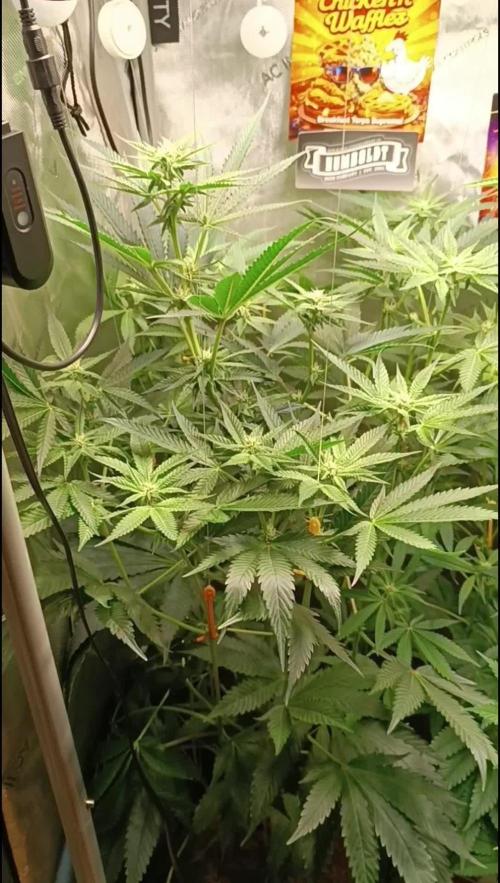
🌸 Blütetag 22 | Tag 66 gesamt 🌸
Gestern wurde ordentlich gelollipopt – und da kam schon einiges runter. Der Stretch trudelt jetzt langsam aus… zumindest fühlt es sich endlich so an. 😄
Jetzt dürfen die Damen langsam anfangen, richtig Gewicht und Masse aufzubauen.
Und besonders die letzten 7–10 Tage waren komplett verrückt.
Vor allem die Fruit Bomb Punch hat nochmal völlig den Turbo gezündet. Ehrlich gesagt habe ich selten erlebt, dass eine Pflanze innerhalb so kurzer Zeit nochmal so eskaliert. Die war am Anfang nach heißem Soil, Spruzit-Stress und dem Topping sogar die empfindlichste Kandidatin im Feld – und inzwischen thront sie mitten über allem. Komplett wild. 🚀
Die Chicken & Waffles und die Fruit Bomb Punch liegen jetzt beide ungefähr bei 1,10–1,12 m, wobei die Fruit Bomb mittlerweile leicht die Führung übernommen hat und mitten im Zelt über allem steht. Und das auch nur, weil sie inzwischen schon drei Clips bekommen hat, um sie seitlich runterzuziehen – quasi Supercropping ohne richtiges Supercroppen. Ohne diese Clips wäre sie wahrscheinlich inzwischen irgendwo bei 1,25 m, 1,30 m oder vielleicht noch höher angekommen. Absolut wahnsinnig, wie die abgegangen ist.
Man merkt einfach, dass sie trotz Topping am Ende komplett Richtung Triebmonster tendiert. Einer der beiden Haupttriebe hat sich deutlich dominanter entwickelt als der andere und zieht jetzt brutal nach oben.
Dazu kommt dieser Geruch… die Fruit Bomb Punch heißt wirklich nicht ohne Grund so. 🍓💥
Das ist inzwischen eine legitime Fruchtbombe. Extrem laut, extrem intensiv und komplett raumfüllend. Wahrscheinlich das stärkste und aggressivste Terpenprofil im ganzen Run bisher.
Die Strawberry AK bleibt dagegen weiterhin die absolute Bilderbuchpflanze im Feld. Kompakt, buschig, brutal gesund und voller Budsites. Von der reinen Höhe hat sie gegen die beiden Monster zwar keine Chance, aber genau das macht sie spannend: Sie hat unglaublich viele kräftige Seitentriebe und Budsites aufgebaut – ehrlich gesagt deutlich mehr als die Fruit Bomb Punch. Deshalb könnte sie am Ende sogar heimlich das eigentliche Ertragsmonster werden. Nicht über Höhe, sondern über pure Masse und Struktur. 😄
Nach dem Lollipoppen habe ich sie deshalb auch etwas auf einen Topf hochgebockt, damit sie besser mit ins Canopy kommt und die vielen Tops ordentlich Licht bekommen. Ihre Struktur ist einfach wahnsinnig sauber. Eigentlich musste man an der Pflanze bisher kaum etwas machen.
Auch die Chicken & Waffles entwickelt sich inzwischen zum absoluten Monster. Trotz untoppter Struktur hat sie extrem viele schöne Seitentriebe hochgezogen und steht überraschend eben im Canopy. Dafür, dass sie nie getoppt wurde, ist das schon ziemlich beeindruckend. Diese riesigen Internodienabstände, die anfangs fast schon zu wild wirkten, sorgen jetzt dafür, dass überall Licht tief in die Pflanze fällt und die Seitentriebe brutal mitziehen.
Terpentechnisch entwickeln sich die drei Damen mittlerweile ebenfalls komplett unterschiedlich:
Die Fruit Bomb Punch ist einfach pure Frucht und komplett laut.
Die Strawberry AK geht eher in eine cremigere, weichere Candy-Fruchtrichtung.
Und die Chicken & Waffles bleibt bisher eher würzig unterwegs.
Auch technisch läuft der Run aktuell erstaunlich entspannt. Die Dripper laufen konstant morgens, mittags und abends – besser geht’s eigentlich kaum. Die Pflanzen wirken super stabil versorgt und gerade in dieser explosiven Phase scheint ihnen das richtig gutzutun. Temperaturtechnisch ist ebenfalls noch alles im Rahmen, auch wenn die Luftfeuchtigkeit inzwischen langsam etwas anzieht. Aber bei der Blattmasse und dem Wachstum wundert das mittlerweile auch nicht mehr. 😄
Gesundheitlich sieht der Run aktuell wirklich top aus. Eigentlich gibt es nichts Auffälliges außer der ganz normalen Aufhellung im Verlauf der Blüte. Keine echten Probleme, keine größeren Mängel – genau so darf’s weitergehen. 🙏
Jetzt heißt es: Budstacking, Gewicht und hoffentlich nicht komplett ans Zeltdach wachsen. 😅
Am Ende entscheidet das Glas. 🍯
Grow on 🌱
Flower Day 22 | Day 66 overall 🌸
Yesterday was lollipopping day — and quite a lot came off. The stretch finally seems to be slowing down now… at least it feels like it. 😄
From here on, the ladies can hopefully start focusing more on proper bud stacking, weight and mass.
And honestly, the last 7–10 days have been completely insane.
Especially the Fruit Bomb Punch absolutely hit the turbo again. I rarely see a plant explode that hard within such a short time. Early on she was actually the most sensitive plant in the tent after the hot soil mix, the Spruzit stress and the topping — and now she completely dominates the middle of the canopy. Absolute madness. 🚀
The Chicken & Waffles and the Fruit Bomb Punch are now both sitting around 1.10–1.12 m tall, although the Fruit Bomb has slightly taken the lead and now towers above everything else in the center of the tent. And that’s only because she already got three clips to pull her sideways — basically supercropping without actually supercropping. Without those clips she would probably be somewhere around 1.25 m, 1.30 m or maybe even higher by now. Just crazy how hard she stretched.
You can really tell that despite the topping she still wants to become one giant dominant shoot monster. One of the two main tops clearly became much stronger than the other and is now absolutely blasting upwards.
And then there’s the smell… the Fruit Bomb Punch truly deserves her name. 🍓💥
This thing is a legitimate fruit bomb. Extremely loud, extremely intense and completely fills the room. Probably the strongest and most aggressive terp profile in the entire run so far.
The Strawberry AK, on the other hand, remains the absolute textbook plant of the run. Compact, bushy, incredibly healthy and completely packed with budsites. Height-wise she can’t compete with the two monsters, but that’s exactly what makes her so interesting: she built an insane amount of strong side branches and budsites — honestly way more than the Fruit Bomb Punch. So she might secretly become the true yield monster in the end. Not through height, but through pure mass and structure. 😄
After lollipopping I even raised her slightly on top of a pot so she can stay better within the canopy and get more light to all those tops. Her structure is just ridiculously clean. Honestly, she barely needed any work during the whole grow.
The Chicken & Waffles is also turning into a complete monster by now. Despite being completely untopped she developed tons of beautiful side branches and created a surprisingly even canopy. For an untopped plant, that’s seriously impressive. Those huge internodal gaps that initially looked almost too wild are now allowing light to penetrate deep into the plant and all the side branches are exploding as well.
Terp-wise the three ladies are also separating more and more now:
The Fruit Bomb Punch is just pure loud fruit.
The Strawberry AK leans into a creamier, softer candy-fruit direction.
And the Chicken & Waffles currently stays more on the spicy side.
Technically the run is also going surprisingly smooth right now. The drippers are running consistently morning, noon and evening — honestly couldn’t ask for much better. The plants seem extremely stable and happy with it, especially during this explosive phase of growth. Temperature-wise things are still under control too, although humidity is slowly starting to creep up. But with this amount of leaf mass and growth, that’s hardly surprising anymore. 😄
Health-wise the run currently looks really great overall. Basically nothing concerning besides the normal lightening during flower progression. No real deficiencies, no major problems — exactly how you want things to go. 🙏
Now it’s time for bud stacking, weight gain and hopefully not completely growing into the tent roof. 😅
In the end, the jar decides. 🍯
Grow on 🌱



Likes
2
Share


@Autower
Follow
Week 10 not long now these smell amazing like sweet blueberry and there's definitely something I've had before when I've bought some personal but can't quite get my head round the smell. started introducing overdrive now as they start to finish fattening and ripening up can definitely see swelling going on over the last 3 days thanks for viewing and happy
Likes
49
Share


@LockDownGrow
Follow
Coming along nicely now apart from alittle cock up yesterday where I accidentally topped her while trying too lst but I have managed too tape the stem in place so I am hoping my little cock up will force the lower branches too shoot upwards while the broken stem heals ,
This week I had too change my lighting too 600 true watts of kingbo dual optical LED range due too the temps getting closer too 30c than I would like , and by doing so I have now got a constant temp of 27c lights on and 18c lights out,
Update on day 4 or week 3 ,
My little cock up snapping the main stem while trying to lst the tape seems too have really don't the trick , and although snapping the main stem is not ideal lol ,
It seems I've managed too top this plant and still get too keep the top , the leaves all look fresh and healthy and feed so I will leave the tape on there for two weeks and then try and remove it as all I had too hand was selotape lol
The breakage really do not seemed too affect the top 2 nodes at all apart from trigger the lower plant too stretch out , as this break was bad , like hanging on by a thread bad , so really shocked it took too the repair so easily , and as always I had just been leaching the soil with a single feed that lasts them 7 days , my set up is completely automated and I only go too the grow space once a week but I have a WiFi cam inside the grow space so I can check the temps and how dry the pots are just incase I need too increase the feeding , but too be fair these autos seem too have a mad feed at week 7 and 8 and then drink one feed per week , keeping it simple has helped I think as the plants seem too love it , and I don't need too do anything apart from check the camera ,
And that's just the way I like it , I pay special attention too the temps in my grow space and a calculator in hand for the nutrients ,
Other than that I leave them alone too do what they do ,
I will take some end of week 3 pics over the weekend at some point it's abit of a drive so once a week suits me down too the ground , :)
Update on day 5 of week 3 well as you can see from the photos this week has had a huge raise in production , the breakage I did too the main stem has completely healed it's self and the plant has bushed right out at the bottom and top of the plant where it broke ,
So all in all my little cock up has actually helped the plant grow larger ,
I today gave them a smaller defoliation basically anything covering a branch that could not be tucked under it I removed ,
This is too get as much light too these spots as possible too get them too develop before flowering starts ,
But so far so good , temps are good and no nutrient burns on any of the plants ,
and the results from day one / first feed on green buzz nutrients too this photo today day 5 is dramatic , the photo of all four was before defoliation , but the defoliation has just shown how busy they have this week and the bud sites on this things already is crazy , my next plan this week is too put the net in there and space out all of the branches too give the best spacing between the breaches
Likes
26
Share

@HinduGod
Follow
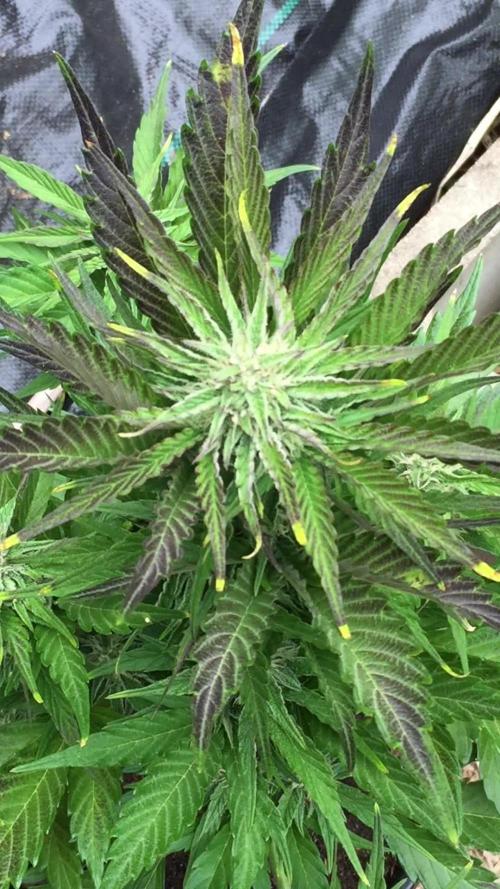
WOW LOOK AT DAT!!! DIS PLANT HAS HAD IT ALL!!! YOU CAN SEE DA FROSTBITE DAMAGE!!! DER IS NOTHING WRONG WIT DAT!!! DIS IS A LATE WINTER EARLY SPRING GROW!!!! IT PROVES DAT YOU CAN GROW AN AUTOFLOWER IN SUBOPTIMAL CONDITIONS OUTDOORS!!!! DIS IS NOT ABOUT YIELD IT IS ABOUT GETTING SOME GOOD SMOKE IN DA WINTER SEASON OUTDOORS DIS IS VERY VERY GOOD!!!!
PLEASE COME AGAIN!!!!
Processing
Likes
15
Share


@MG2009
Follow
08/26/2020
2nd week of flowering and temps are down in soil to 68° going to be 56 tonight. Put a video of her sister plant.
These girls should go another 8-9weeks but our first frost date is around the 10th of October hope for a warm and dry fall.
08/29/2020
got her tied down, snapped the center branch so I tied her stem upright. Gonna give her one last dose of blood meal (12-0-0)before week 3 starts that should be good for the next 4weeks, and 2 tbls of (4-9-3) so my last feeding will be (16-9-3) for the stretching fingers are crossed🙏
Likes
25
Share


@AsNoriu
Follow
Thats it, last fan leaves are yellow and those girls are ready, they still pack up, loads of new pistils visible, despite all going brown from low temps during greenhouse period. I start to see ambers a lot, they are not so leafy and i lost 2 main colas to bud rot, better safe than sorrow !!!
Theirs calyxes are well matured all stems browny pinky, they made a journey in full in my eyes and as always i still hate yellow leaves, don't want to slaughter bud while trimming.
Think two more days, then 48 hours of darkness and late sunday eve - they are chopped and wet trimmed.
Thursday. Added couple closeups, but they are far better then in photos, bulking up each day, packing trichs like crazy.
This time buds don't look so lanky, from airy leafy crap, they become solid nugs...
Its my third different grow of this strain. First 4 plants and Biggest clone looked really similar, this ones - more Real GG4 structure, love it !!!
All got lite pinky , violet colours . All have fruity smell, just not last ones ;)) they are wild strawberries + . Amazing flavour of early buds tells me final harvest will be fire !!!
Have stupid feeling, taking them down too early, but my yellow leaves OCD whispers me " Cut, cut, cut ..." ;)))
Chop Chop Day. Wet trim chosen, they are sparkling !!! Fat, but still leafy ...
Found 3 budrot spots, two would eat big colas, but low humidity forced those leaves just die off without infecting others, so it was perfect timing.
Happy Growing !


Likes
20
Share


@Ieiogrow94
Follow
Eccoci qui...
Scusate il ritardo nella pubblicazione ma sono statoo super impegnato, ora finalmente rimetto in sesto le settimane con questa pubblicazione, MANCA DAVVERO MOLTO MOLTO POCO!!
Sono ormai interdetto da STRAIN 1 è davvero WOW non ci sono altre parole!!!
Grazie a @KhalifaGenetics e @xpertnutrients per la collab e a tutti per il supporto🔥🌲❤️

Likes
40
Share


@MadeInGermany
Follow
Info:
Unfortunately, I had to find out that my account is used for fake pages in social media.
I am only active here on growdiaries.
I am not on facebook instagram twitter etc All accounts except this one are fake.
Flowering day 29
since time change
to 12/12 h.
Hey guys :-)
Once again a nice week has passed in which the lady has developed super :-).
The buds start to grow and are now getting more pk.
This week it was poured 3 times with 1.2 l each (nutrients see table above).
Fresh osmosis water was filled in canisters for the next 2 weeks.
Everything was cleaned and the plant was checked for health :-).
I wish you a lot of fun with the update and stay healthy 👍
You can buy this Nutrients at :
https://greenbuzzliquids.com/en/shop/
With the discount code: Made_in_Germany you get a discount of 15% on all products from an order value of 100 euros.
You can buy this Strain at :
www.Zamnesia.com
Type:
Runtz
☝️🏼
Genetics:
Zkittlez x Gelato
👍
Vega lamp: 2 x Todogrow Led
Quantum Board 100 W
💡
Bloom Lamp : 2 x Todogrow Led
Cxb 3590 COB 3500 K 205 W
Soil :
Canna Coco Professional +
☝️🏼
Nutrients :
Green Buzz Liquids :
Organic Grow Liquid
Organic Bloom Liquid
Organic more PK
More Roots
Fast Buds
Humic Acid Plus
Growzyme Big Fruits
Clean Fruits
Cal / Mag
Organic Ph - Pulver
☝️🏼🌱
Water: Osmosis water mixed with normal water (24 hours stale that the chlorine evaporates) to 0.2 EC. Add Cal / Mag to 0.4 Ec Ph with Organic Ph - to 5.8

Likes
22
Share


@valiotoro
Follow
Hello everyone 😎
Week 6 of flower for the Strawberry🍓
Time to Flush💦
In love with the colors
Photos are coming for the 420 Xmas contest🎄
The smell is divine super fruity 🤤
She’s under the Mars Hydro FCE-6500+adlite for the last Pusshhh
Likes
3
Share


@Mismatas
Follow
APROXIMADAMENTE CUARTA SEMANA EMPEZAMOS POR PRIMERA VEZ NUESTRO LST Y UNA LIGERA PODA DE BAJOS.
SEGUIMOS CON EL CABLE DE CALOR PUESTO Y TAMBIÉN AÑADIMOS UN CALEFACTOR PARA MINIMIZAR LAS BAJAS TEMPERATURAS

Likes
77
Share


@KingSalomonsWeed
Follow
22.12.Day 85 Blüte 44 von 63-70.
Hallo Leute.
🤗 Eine bisher sehr zufriedenstellende Sorte .
Resistent, sieht gut aus, Duftet so süß! Aber nicht nur . Wie im Bonbonladen.
Viele Nuancen drin. Auch natürlich dieser Weed Geruch, den wir alle mögen.
Definitiv hat sie ein paar burn Zeichen. Leicht, aber fast überall. Dafür sind die Knospen ziemlich hart, kleben und werden dicker. PLAGRON hat hier ein Wort mitzureden.
Ich könnte ja weniger geben, aber nö.
Power Buds Contest heißt es. Nicht grüne Blätter Contest. ( Aber Mal ehrlich, Herbstfarben sind schon schön )
Noch mindestens 19 days in denen die Candy Rain Knospen mästen können.
Danke Leute fürs Lesen, liken Kommentieren.
25.12. 9 Tage Dünger, dann 7 Tage Wasser, und schon ist Ernte.
26.12. oh Mann , wenn nicht 63 -70 Tage dranständ, dann würde heute ein Teil gehen....
Aber, der Züchter weiß es am besten.
Vertraut denen ruhig. Die kennen sich bestens aus.
Tja die Knospen:
Reich bedeckt mit Trichomen
Kaum, bis keine Viecher.
Fest wie ein Tennisball,die oberen + canope. Die unteren mangels Licht natürlich nicht.
Das gibt eine Stufen Ernte.
Meine Nase wird vom Geruch reich beschenkt. Olala ( ⬅️ Ein Ausruf der Begeisterung )
👍
Later
Oh, die Knospen werden so schwer, das einige untere Arme umkippen.
Muhaha geil...
28.12. Blüte day 50. Es gibt nochmal Dünger. Sie wird dann Blüte day 67 geerntet. Der Größte Teil wenigstens.
Noch ist sie durstig.