


Likes
Comments
Share

@RBG
Follow
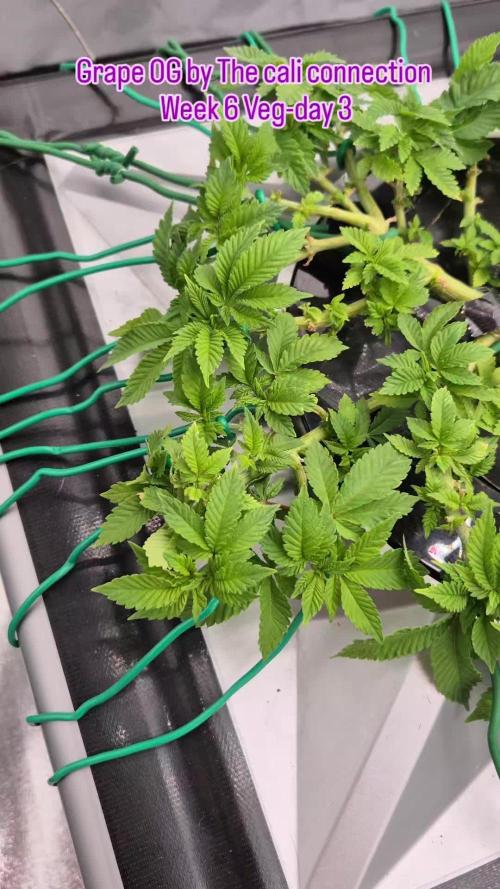
Week 6, here we are.... finally after 6 months of repeated losses and lessons, we've finally made it! Secret ingredient that no one told me. Uv sterilizer and pythoff
Overall I think Grape og is doing well. Notice that in early veg she handles stress, topping and lst nicely but further down in veg she had more temperament, showed more nute burn, slow growth from defoil and topping but bounces back rather quickly even after a complete cut down to her bareback of stems.
Light went from 60% to 90% over Week 5 to Week 6, next 2 days she'll be at 100% ready for flowering.
2 set AC infinity bar lights will go in over this week as well as my scrogg net.
Nutrients this round
Floramax veg1
Floramax organabud
Floramax flowering enhancer ( 1/4 ) dose
Flairforms roots
Sleepz with the fishes ( pythoff )
Cyco platinum series silica
Floramax Calmag
E.c 2.2
Ph 5.9-6
Will continue to keep doing lst and defoilation. I like to keep my lst on for my whole grow due to the way I LST, this will be the first time using a scrogg net to help with spread management, if I feel confident and comfortable ill remove lst in later flower if scrogg net will hold in place other the lady will curl in on herself

Likes
3
Share


@MicroHidroGrow
Follow
Día 19.
Las Tropicana han reaccionado muy bien. Aproveché para hacerle LST a una y HST a la otra. Las Polaris estaban revegetando, así que esos las demoró. Pero ya empezaron a estirar. Además a una le tuve que cortar la rama principal y dejar 2 laterales, dado que estaba muy maltrecha.
Mantuve la solución nutritiva de la semana pasada y la voy a cambiar hoy o mañana seguramente. Voy a tener que esperar para pasarlas a floración, ya que tengo una mudanza en unas semanas. Así que la floración va a ser post mudanza.
Likes
17
Share


@Red_i_jedi
Follow
26/02/19
It's now been a week since my 3 plants sprouted into this life, the seedlings are going very well apart from 2 seedlings toppling, hopefully I've saved them from digging them in deeper. One seems to have stunted though.
Have fed them their first grow feed which was 0.5ml of Kalong Grow and 0.1ml of Rootbastic mixed into 1l of leached tapwater then divided into 3 parts each per pot.
I'll do a mid-week update, nothing like the long read I wrote for the 1st week.
Awesome shit, loving each day!
*******
03/03/19
Did a feed today as the top soil was looking a little dry, it's been 5 days since their last feed with nutrients
0.5ml Guanokalong Grow
0.1ml Rootbastic

Likes
12
Share


@la_piper
Follow
ола
washing machine пересажены в горшки на пмж и включены в систему.
ppm 590.
ph 5.9.
полив: через час после включения света(7.00) помпа включается на 30минут и через 12часов ещё на 30минут

Likes
27
Share


@w33dhawk
Follow
Moin moin aus dem hohen Norden Deutschlands........
Den Ladys geht es ganz gut denke ich bin auf jeden Fall zufriedener als bei Meinen anderen grows.
Am Montag den 23. 01.23 habe ich die ersten 3 Ladys aus ihren 1Liter Töpfen befreit und sie in ihr endgültiges Zuhause umgetopft (15L Stoff Töpfe) die Erde (Bio bizz) wurde mit 75 gramm startrex gut vermengt und ein pflanz Loch mit 5 gramm mycotrex vorbereitet, pflanze aus dem alten Topf raus in neues Zuhause rein und das ganze dann mit einer Lösung aus 1g/L bactrex und 5m/L orgatrex angegossen (jede Lady bekam 500ml).
Am Mittwoch den 25.01.23 habe ich das ganze auch mit der 7 Tage jüngeren Pflanze gemacht damit ich mit den Tabletten von Bio tabs relativ gleich auf bin was den Verbrauch betrifft da ich jetzt 4 Wochen warte und Dann umstelle auf 12/12.
Plan von mir ist in der nächsten Woche das erste topping zu vollziehen Dann 14 Tage Erholung noch mal toppen dadurch Hat sie ca 1 1/2 wochen Zeit sich zu erholen und dann geht es in die blüte. bis dahin (also die nächsten 4 Wochen) gibt es jetzt erstmal nur Wasser.....
Dann wieder mal eine Lösung aus 5ml/L orgatrex und 1g/L bactrex und ab der 4. Blüte Woche fängt erst das wirkliche Arbeiten an mit dem Dünger (Tee brauen) boha freue ich mich darauf 😁👍 das war es auch für diese Woche......
Edit: die oben gezeigten Angaben zu den Dünger Mitteln
Mycotrex= gramm angabe
Bactrex= gramm angabe
Startrex= gramm angabe
Bio tabs = Stückzahl pro topf
Orgatrrex= ml/L


Likes
15
Share


@julian100614
Follow
La 8° semana nos fué de maravilla 😃
Esta preciosa genética esta sacando todo su potencial 💪
Los cogollos tienen un olor potente y bastante pegajosos 😋
Está resistiendo bastante bien ante los inconvenientes que hemos tenido 🔥
Mantenemos la EC 1 para subir a 1,1 la semana que viene. Un pH continúo de 6 y con una temperatura de 30°C.
Condiciones del armario:
•Temperatura día: 28°C
•Temperatura noche: 25°C
•HR: 50%
Likes
26
Share


@420DeepGrow
Follow
Gracias al equipo de Seedsman y XpertNutrients sin ellos esto no sería posible.
💐🍁 Bubba Cheescake:
Bubba Cheesecake es un cruce de Bubba Kush anterior al 98 con Cheese Cake (Wedding Cake x Exodus Cheese). Se trata de un híbrido 70% índica con muy buenos rendimientos, alto en THC y bajo en CBD. Bubba Cheesecake prospera en interiores y exteriores. En interior se aconseja un corto periodo de crecimiento vegetativo debido a la cantidad de estiramiento que presentan las plantas. Las plantas pueden crecer hasta una altura de 250 a 350 cm. cuando se deja crecer naturalmente al aire libre. En interior, la floración dura entre 60 y 65 días, con rendimientos entre buenos y altos, de 400 a 550 gr/m2. Las plantas de exterior son capaces de producir entre 700 - 800 gr. peso seco. En las latitudes norteñas, en exterior, los productores pueden esperar cosechar a principios de octubre. Los cogollos son grandes y duros como piedras. Las plantas maduras muestran atractivos colores púrpuras y azules y brillan con una resina pegajosa que cubrirá las manos del cultivador si no tiene cuidado. El componente Wedding Cake agrega dulzura al sabor del regaliz y el aroma es terroso y musgoso. La producción de THC es muy alta con un nivel bajo de CBD. El efecto es intensamente narcótico, fuerte y duradero.
🌻🚀 Consigue aqui tus semillas:
🍣🍦🌴 Xpert Nutrients es una empresa especializada en la producción y comercialización de fertilizantes líquidos y tierras, que garantizan excelentes cosechas y un crecimiento activo para sus plantas durante todas las fases de cultivo.
Consigue aqui tus Nutrientes:
https://xpertnutrients.com/es/shop/
📆 Semana 7:
Ha sido una semana algo complicada, tormentas, frio y lluvia han ralentizado el crecimiento, espero que pronto lleguen dias soleados, continuo con 1/3 nutrientes recomendados en cada riego.

Likes
44
Share


@Jays_Not_Here_Man
Follow
Girls are stacking nicely ❤️ The one is a bit more finicky than the rest, she is showing signs of nutrient lockout/ ph , but should be easily corrected if I’ve diagnosed it properly. I ended up calibrating by ph pen and I was off by .15 on the scale, might not seem like a lot, but in flower it can be! Shouldn’t set us back too much 🇨🇦👊❤️

Likes
2
Share


@Elguacho420
Follow
Buenas a tod@s!!! Curta semana de floración de la famosa critical, la verdad que la variedad va creciendo bien, la veo fuerte más allá alguna caga...da que habré hecho x eso lagunas hojas amarillas y algunos errores más de novato, es mi primer indoor así q pegas, muchas, como x ej el "exceso" de nutrientes q marcan las hojas, como tanbm la "falta de nutrientes" q marcan las hojas( no todas las hojas ni todas las variedades), esty un poco confuso con ese tema, no me excedo en los ml del producto, hay riegos de agua de x medio tanbm 🤷🏻♂️ es obvió que esto me pasaría, pero siempre con la buena onda y con la positiva... 🙌🏻👍🏻 Se las ve fuerte y en nada veremos qué tal sale todo... Buen finde para tod@s y buenos humos a seguir aprendiendo... 💨💨🇦🇷🤝🏻🇪🇦🏻♂️


Likes
469
Share


@love_2_grow
Follow
D72 - This week's diary starts late since I was gone on a short trip. The girls didn't miss me though as they are simply doing their thing, and with the automatic drip system, I don't even have to worry about watering. The girls look amazing! The colas are huge with plenty of frost. I'm very chuffed with how this grow is turning out :)
D73 - Gave each girl 1.25-liters of water @ pH 6.6, with 25ml EM-1. I'm fighting against temps and humidity since we have a heatwave with thunderstorms and plenty of rain. The average temp in the tent the last 24 hours was 31 degrees C (88F) and RH 63.5%, which is way high this late in flower.
D74 - Yes! Our bad weather has moved on, and the humidity in the tent has dropped significantly to the mid-low 50s. Much better. Have to avoid that budrot!
There isn't much to do in the tent now when everything is automated, so I spend more time observing and scouting the girls.
I figured out that using my hyper-bright flashlight below the canopy is an excellent way to spot leaves that are yellowing from lack of light. I never thought of that before, but damn, it worked great and will now be a new tool in my arsenal. I removed the yellowing leaves and a couple of other fan leaves blocking bud sites. The rest of the leaves I tucked.
Speaking of fan leaves, the stalks on the first girl are purple while they are green on the second. Another difference is that the first look frostier than the second girl. Not sure if that means that the second girl will take longer.
One fan leaf on the first girl has a strange discoloration in the middle of a fan leaf, but I'm not overly concerned, considering it is only one leaf, and we're towards the end of the grow.
Finally, and then I'll stop harping about fan leaves; one leaf tip on the second girl is turning purple.
D76 - I had a first look at the trichomes. Clear/milky on both girls, with a random amber here and there on the second girl. Based on this, I guess chop day is at least a couple of weeks away.
D77 - We have reached the end of the sixth week of flower, and everything is trucking along. It's mainly a waiting game at this point, waiting for the buds to fatten up and for the trichomes to mature.
I ordered nematodes a few weeks ago and forgot to use them. I don't have a fungus gnat infestation, so it was only a preventative measure anyway.
The nematodes were a couple of weeks past their use before date, so no idea if they are still viable, but I figured it is better to use them than throw them. I gave each girl 1.25-liters of nematode water @ pH 6.6, adding 25 ml of EM-1.
Likes
57
Share


@TheBudWhisperer
Follow
Week 7 of flower in the books and we’ve had to adjust to the height issues in an attempt to salvage what we can of the largest mains on the cheese. Really should’ve done this 2 weeks ago and while it’d be preferable not to supercrop this late in flower - there really wasn’t a choice. It was done early in the week and the plant is none the worse for wear. On the whole, the nute burn issue has been rectified and while the damage isn’t massive, it’s still really obvious. For all the above reasons, We’re really not going to get that late flower look with this plant. Kinda sad there. Otherwise, the plants have begun to colour up and were quickly coming in to the harvest window. At this rate it looks like the gorilla cookies and cherry Bomb will go off first, with the cheese to follow and the lemon haze last. The GC is absolutely covered in trichs. We expect a great finish for this one. She’s unlike any pheno I’ve seen on here - ducksfooted with a pineapple shape to her heads but again, got it where it counts. The cherry Bomb is similar but also true to her description - huge cherry diesel scent coming off this plant. She’s chunky and sticky too so very pleased she’s made something of herself. The lemon haze is developing And rounding out slower. Trich production is moderate and I suspect she’s got a week longer than the rest. We’re getting there - maybe a week to 10 days. Almost time for jazz hands👍😎.
Background/Repetitive Nonsense
The strain line up on this grow is look’n quite saucy 😈. We’ve got 2 FB strains this time around - Gorilla Cookies (seems we always have some GSC cross in the works). Mainly because the colours look stellar and remind me of a sugar breathe we did last year that was 🔥. The other FB is their original Cheese strain... because we already smoked all our cheese... and we really like our cheese...😉. Emerald triangle was kind enough to include a freebie of Lemon Haze. Wasn’t really big on the list but we haven’t done a haze strain to write home about yet so worth a go👍. The last is a Cherry auto from Bomb seeds that we’ve been trying to get to for months. Let’s just hope that she’s not a dud like the last bean.
The new digs for this run are courtesy MarsHydro👊. Their 2x4 single grow tent, paired with a shiny new 240w QB courtesy ViparSpectra.
These folks were kind enough to discuss a collaboration and as a result, here we are to test out the gear with an inaugural run of autos. Each week, we’ll try to expand on some of the benefits of each, as well as any limiting factors or considerations that need attention when pondering purchase.
Already I can say that both are high quality products in terms of overall craftsmanship.
MarsHydro 2x4 Grow Tent:
Excellent construction in terms of durability. Reinforced stitching on the zippers and corners ensures zero tearing. Conveniently placed screen vents and intake/exhaust ports. The ceiling exhaust port only exists on the right side. Perfect for me but not great if you’re running exhaust from the top on the left side (left side wall port makes up for this however). The aluminum frame is rigid enough to support the weight of the lights and accessories. Once you have some weight in the tent, she’s go’n nowhere and you can assemble and break it down in record time if moving or stashing the grow op.
Only limiting factors I’ve noticed is that temp. Control will be an issue for a tent. It just doesn’t have the same insulating ability as a wood cabinet or other permanent enclosed space. No worries, this is offset by a small desktop heater and keeps the environment exactly where desired. The other issue was a production problem - the ceiling vent was accidentally stitched into the corner seams on the assembly line. Again, no real issue - just pulled it out with no damage or fraying to the tent or port👍.
Website link here:
https://www.mars-hydro.com/grow-tent/buy-mars-hydro-grow-tent-24x48x70-2-x-4-cabinet-closet-grow-box-upgraded-diamond-1680d-mylar-for-sale
ViparSpectra 240w Quantum Board:
This thing is sleek and slick in terms of design. Closest comparable to it that I’ve seen would be spiderfarmers line of qbs. They feature the same top-o-the-line components and roughly similar spectrums. Where VS takes the advantage is in the convenience of the dimmer nob which is easily accessible and works great at 50% with no strobing👍. The heat sink is also larger which contributes to lower temps. That’s not a good thing in my case but beneficial for most folks.
I can already say that this will be a great fixture through all stages of growth. Where I know this light will excel will be in the veg. Stage for sure. Dimming function gives seedlings a much better chance of success with the ability to use lower lighting levels early on and the coverage area on a 240w is great. The average grower will find this panel suitable and fitting to their needs in a 2x4 grow space although I’d suggest 2 units if going any larger than that. The total output in this space equates to about 30w/sq.ft. Which is a decent amount of coverage based on power vs. Growprint. Ideal for veg. Certainly but, in flower - I tend to run closer to 50-60w/sq.ft to achieve higher yields. Again, similar fixtures have performed admirably in the past and while this wouldn’t be considered an “entry-level” fixture, I’d recommend that any grower new to the game not skimp on lighting and start with one of these. The price points are a great value for quality LED tech. These days, so there’s little reason to even consider a lesser fixture👍.
I have no detail on limiting factors for this light as yet but have heard that stock branded fixtures don’t necessarily incorporate enough red diodes. I’ve seen no issue myself but confess - I’m no lighting guru.
Website link:
https://www.viparspectra.com/collections/xs-series/products/xs-series-xs2000
***8% discount when using code: “ItBudWhisper”***
Happy to have you along for the ride if you made it this far through my opening rant!!😎🤟😎🤟😎


Likes
9
Share

@TangerineDre4m
Follow
Day 106
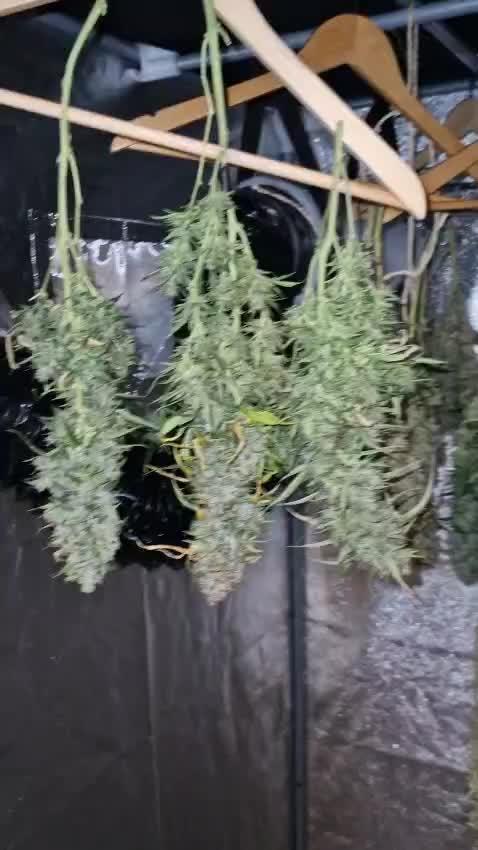
Plant 2 has been dried and jarred. She ended up bigger than I expected at 148g dry. Super sticky and relatively dense buds. It was about 120g of top shelf and the rest was smaller bud. I ended up smoking around 25g before taking these pics already.
Plant 3 probably has about 2 weeks left. She is starting her final bulk and is looking nice and frosty.
Stunty was harvested on 25-12-2025 and ended up weighing around 750g wet after trimming fan leaves.


Likes
12
Share


@sanibelisl
Follow
Major changes here at Night Owl summer camp. Have had a rodent problem! Something has figured out a way to get into the dormitory (greenhouse)and had a feast on my plants. Five branches off the Harvey Wallbanger, and two each off the Vanilla Fizz and the 91Grapes. Oh my gosh! I needed to do something else. My wife gave me a spare bedroom for a grow nursery! What a girl I have! So spent the day yesterday moving tents and hanging lights and got the girls all situated in the new dormitory away from some vampire in the night.
Will give an individual plant update shortly.
***ok, back. Let’s start with the Harvey Wallbanger. Miss Harvey was on her way to becoming my most interesting grow to date before she was devoured by some creature of the night. She’s a cross of Orange Diesel and Cookie Smasher and even at this early stage of flowering she’s producing a nice glossy sheen and sweet aroma to match. She is a towering 48 inches making her the tallest autoflower that I have ever grown. She is slender and resembles the structure of a clone but I believe her flowers themselves will be massive in size and trichomes production. To date she has yet to make a single leaf with more than five points on it. She is truly interesting.
Next let’s explore the Vanilla Fizz. Ms. Fizz didn’t get it as bad as Miss Harvey but suffered significant injuries as well. Loosing two full branches and enough bottom bud sites that the bottom 30 percent is now already cleaned up. She is the bushiest of the three with plenty of growing bud sites. Standing a proud forty three inches tall she comes in last in height but may be stacked up the nicest.
Last but certainly not least comes the 91Grapes. Since she received the least amount damage from nightly feastings we are going to feature her until harvest. Only loosing two branches and not much else she was spared from destruction. She is massive!!! Not a massive amount of vegetation just in size over all. She’s 44 inches tall and big enough around for a bear hug. She takes up the entire 40 inch by 40 inch tent all by herself. She was probably spared damage due to her size. Pom poms are everywhere as is evidence of cheerleading practices and she is captain of the squad. Going to have to get a little more creative with the way watering will be conducted in the future. The formula 707 soil is for retaining moisture in outdoor conditions so I am afraid that it will retain moisture indoors and be a pest problem.


Likes
4
Share


@Nutrient_gro
Follow
Day 86, she’s been in the Corner vegging. Cut off all the fan leafs so everything lower are branches.
Likes
1
Share


@Trinidad
Follow
19.06.25. Day 29
LST. Used plant training clips to push back branches. Also took out some vegetation from bottom of her.
20.06 25. Day 30
She recovered without any signs of stress and is now looking beautiful. I can't wait to see how she turns out.
Likes
11
Share


@TheNug
Follow
too keen for this strain she looks like a strong seedling coming into veg hard , no space between nodes which might be me and too much light, but damn i know they love it
