


Likes
Comments
Share

@Stonerandgrower
Follow
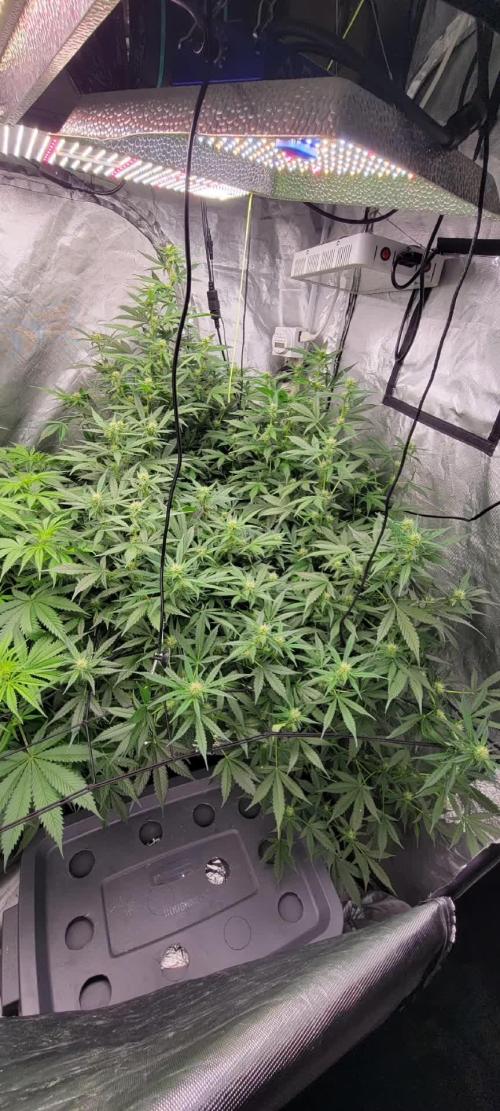
It grew 14 weeks since sprout and it budding for 8 weeks and there's 7 pounds wet and it's some of the prettiest I've ever grown
Edit: there was 25 ounces dry

Likes
22
Share


@EelGrows
Follow
Week 6 Summary: First off, Happy New Year! May the new year filled with peace, love, joy and dank buds! 😄😉
Day 36-39: Despite my heavy defoliation they seem to bounce back quite quickly every time, but this is my first grow so I could be completely wrong and slowly murdering my plants... 😅 WC1 starting to frost up, the two double buds are starting to split themselves up while stretching: WIN! WC2 and WC3 really starting to show their size compared to just a week or 2 ago, really spread out now, and starting to stretch.
Day 40-42: WC2 and WC3 really stretching now. WC2 almost catching up to WC1's height, and has probably spread out the most out of all plants when you compare it to a few weeks ago. Maybe defoliating is a good thing for Autos after all? I'm stoked about these. Although WC2 and WC3 are a few days behind of frost production it's definately starting to show itself by the end of week 6. Stoked for these!!
These are stinking aswell, but for now the 4AM in the tent is sweetening it up!
On to week7!!!

Likes
3
Share

@Aeromatics
Follow
Clementine Slush #3: She is looking strong, benefiting well from a bit of defoliation as well as some major LST heading out of week 5 and well into week 6. As I have said, I am looking for a week 8 flip to flower, so I have a bit more time to get them trained and settled before the bit flip and stretch.
Outside of that, she is happy and looking strong. I can't wait to see how they pop when I activate the autopots!
Tent-Wide Updates: With the big transplant past us, week 6 was focused on LST across the tent and preparing for turning the Autopot system on by getting the root zones prepared and mass growing as much as possible.
My strategy for training is going to be getting individual ScrOGs going within each pot's "Zone" within the tent, using gardening wire first, but eventually using tall bamboo sticks and more wire to train each plant within a certain zone while also keeping the plant mobile.
While I am not quite there yet, I have focused on widening out each plant's canopy as they being to take to their new home, and over the nex week, I will test each plant by adding a bit of water to each autopot base to see if they have their lower roots ready to absorb some solution. If so, we will turn on the autopots and bear witness to the famed boom!
On day 40, I did 1 liter of water in each pot with the following solution recipe:
1 Gallon RO Water
.5 ml Ventana Plant Science Structure
2 ml Ventana Plant Science Grow
7 ml Ventana Plant Science Support
ec 1.0 ph 5.7
They took to the water well!
Additionally, I turned on our Airdomes across the tent. I started low for about 3 hours each day just to avoid too much stress, and I increased them 1 hour each day until I upped it to mostly on the entire time of daylight.
They definitely enjoyed the extra oxygen!
Heading into week 7, I will activate the autopots and Veg into week 8. I expect a week 9 flip to flower and hopefully a x 4 boom in growth!

Likes
5
Share


@Deli_Weed
Follow
Esta fue su última semana con nutrientes, no engordo mucho, creo que mi error fue excederme con los nutrientes a lo largo de su ciclo, yo aproximo que me dará unos 50 gramos masomenos, no es mucho pero es trabajo honesto jaja 😆 la próxima semana será de puro flush ya para darle corte

Likes
8
Share


@Mr_nugs_lover_David
Follow
Very good journey to me, she has responded very well to the lst training, providing me beautiful colas, enough for me to have nice clean organic nuggets to smoke. I would definitely would run this Ak420 by seedstockers again, the sweetest phenotype was the number #2 which you can take a look at here in my page!

Likes
5
Share


@RastaRick
Follow
Keeping natural form. Blackberry gum is huge as I heard from others. Did some heavy defoliation.. first time ever so it's an experiment. Flooded my tent with no tray... Needed to redo connections on the tubing... Then flooded with a new tray, needed to secure the AQUAVALVES on one autopot base.... Looking good. Still running 24 hrs... Rock and roll 🤘
Likes
28
Share


@Foggedaboudit
Follow
We are nearing the end with these! What a stunning display of trichomes! Some of the stickiest genetics I have ever grown for sure! Phenos are all over the place but I am excited about most of them!

Likes
Comments
Share


@Ninjabuds
Follow
I wish they didn't make me do this to get a smileI wish they didn't make me do this to get a smileI wish they didn't make me do this to get a smileI wish they didn't make me do this to get a smileI wish they didn't make me do this to get a smileI wish they didn't make me do this to get a smileI wish they didn't make me do this to get a smileI wish they didn't make me do this to get a smileI wish they didn't make me do this to get a smileI wish they didn't make me do this to get a smileI wish they didn't make me do this to get a smileI wish they didn't make me do this to get a smile

Likes
5
Share


@Stretch448
Follow
Had a few hiccups. Plants ended up developing a nitrogen toxicity from too much worm casting. I simply did a flush on them with water PH’d to 6.3 and allowed the soil to dry out


Likes
13
Share


@OlgaLatepu
Follow
First time growing in a long while. I set up a custom grow tent with some wood and mylar sheets. I'm using an old Rodeadro lamp for now but expecting the new Mars Hydro sometimes soon.
Really doing this for the experience with no great expectations and hopeful for a fair amount of weed in the end.
Likes
10
Share

@NaturalBornHustla
Follow
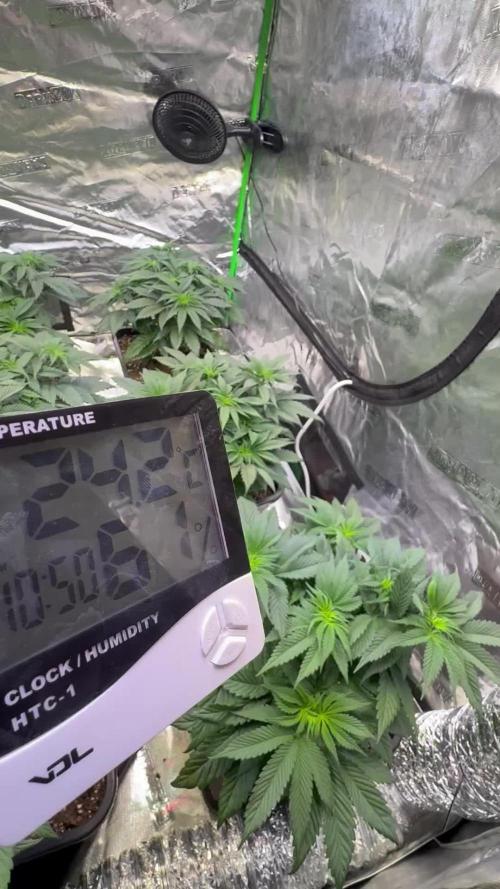
Lfg growing so healthy and looks strong,I made them a good defoliation and opened them as you can see in video,(3left will be done tomorrow).
SANLight Working at 100% intensity.

Likes
55
Share


@Coopmc
Follow
Chelated ready for week 9 cut diet should be amazing!!
Look like might go week 9-1/2 or 10 to
Finish flower
Pulled her at the end of week 9 all pistols were red and all glands had white center and a few the clear part around the Whit was discoloring and I like my Sativas a bit clear headed will have harvest report in a week when dry she been washed and hung to dry
Likes
Comments
Share


@UrbanBoer
Follow
I would be lying if I knew how far her flower phase come, this couple weeks been absence only gave me results, and left me with a catalogue nightmare, but thank goodness my previous posts are dated, so it gives a rough idea, but genes differ within strains, some strain grow vigorously at certain stages, and I think this baby hit her phase. She will be my best tree when it comes bud quantity, when it comes to potency, I will have settle with what I encounter and except the outcome.
Likes
8
Share


@Marijuanaut
Follow
They´re bouncing back from the suspected overfeed after a recently flush 😊
Aptus is no joke... be gentle with this stuff! 😬
The training continues with the removal of the bending clips and introduction of the ScrOG net and some needed light defoliation! 😎
They are ready to FLOW! 😍
Likes
42
Share


@Ukfarmer420
Follow
So this week i will be repotting the ladys in 5gal fabric pots with clay pebbles and a mix of biobizz light mix soil and all mix soil. I will be starting to use 4ml/1l of water of biobizz roots.
I'm thinking of doing a 6 week veg on these ladys as I will be doing a 9 plant auto run in the 4x4.
Happy growing guys.


Likes
9
Share

@Thedibber
Follow
01/09/25 - Watered 3L Ph 6.0 and removed some dying leaves from the lower canopy
02/09/25 - Watered 3L Ph 5.85
03/09/25 - Watered 3L Ph 5.85
04/09/25 - Watered 2L with no nutrition will start feed again tomorrow 👌
Likes
229
Share


@Crashoverite
Follow
Hi everyone 😁
I would like to thank you all fellow growers and breeders for such a great support on this journey. Thank you Grow Diaries and Green House Seeds. Without you all this wouldn't be possible. Love you all
First ever recorded diary so don't know where to even start 😅
I am returning to growing after many many years of break. This is my first ever experience with autoflowers, scrog, lst, led and such tiny grow space.
Choice of strain - Big Bang Auto from Green House Seeds. I have run so many strains from this seed bank in the past and I was always happy with the final outcome. Was looking for indica dominant strain, fast flowering cycle and very important heavy yields on small spaces. Again thank you GHSC in very happy of choosing this strain.
Little bit about my cabinet.
External dimensions:
64 x 50 x 114 cm (W x D x H)
Growing area:
55 x 47 cm cm (0.26 m2)
Panel based on SAMSUNG LM301B diodes
Spectrum:
Samsung LM301B – 5000 x72
Samsung LM301B – 3000k x136
Samsung LM301B – 660nm x9
Samsung LM301B – IR 760nm x1
Regulation in the range of 20W - 110W - Meanwell XLG 100-H-AB
PPF 300 umol/s
PPFD 890 mol/m2/s @30c
Total of 6 adjustable fans, 4 exhaust fans 4 modes - silent/drying, vegetation, flowering, full power
Active carbon mass in the filter 2kg
Absolutely love my grow cabinet. Thinking of next build already.
My grow
3 beautiful ladies - Nuna, Luna and Sweet Mary Jane.
This was a pleasure experience growing autos for the first time. All 3 ladies on the end developed perfectly.
Nuna, left corner lady- tall and beautiful. She had some problems to switch to flowering and was even considering removing her but very happy that I was patient enough and turned great.
Luna, right corner lady - have to say she is the queen. She has the most heavy buds from all, the most. colorful. Her wet weight was 420g, can't say how much of dry but guessing approx. 100g
Sweet Mary Jane, front seat lady. I think she was the most pleasant to grow of her location but due to no other spare space for drying I belive that I have harvested her at least a week to early. If keep longer I belive she could be the most yielder from all 3.
Thank you all for all the support, help, comments, likes, messeges.
Love you all 💚💚💚
Will update this diary in some time and when puff perfectly cured 😎
Peace and love ✌️💚


Likes
11
Share


@PanGrower
Follow
The leaves continue to turn yellow from the bottom.
It seems that I started fertilizing too quickly and the tips of the leaves burned a little
Likes
12
Share
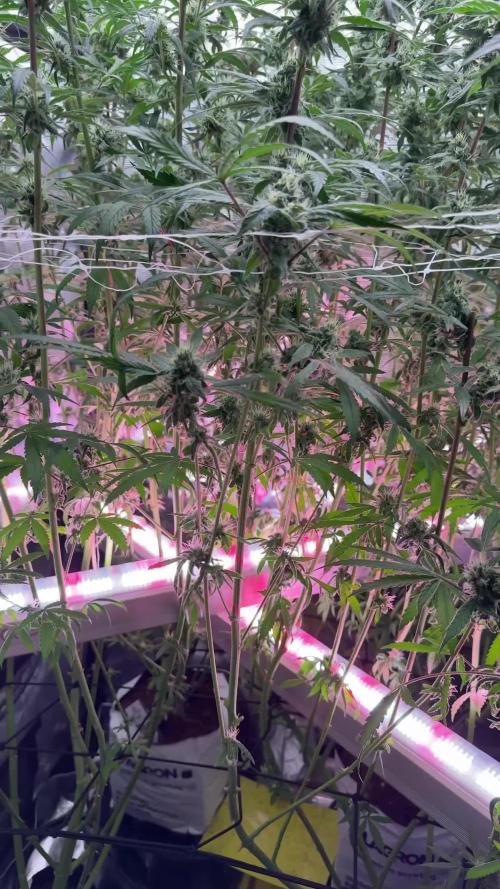

@DogDoctorOfficial
Follow
# 💙 Project Blue Tent – Week 12
## ? Blue Waffle F1 – Pheno A
### 🌸 More Photons, More Flowers, and a Beautifully Balanced Ecosystem
Hello everyone, and welcome back to another chapter of Project Blue Tent! 💙🌱
And honestly, my friends...
LOOK AT HER! 😂🌸
We're now moving further into flowering, and I'm genuinely happy with what I'm seeing inside this little ecosystem.
Four plants. Two different cultivars. One tent. One shared environment.
Our beloved Blue Waffle F1 girls are sharing the space with their Pickle Lemon Haze F1 sisters, and every plant is giving us something interesting to observe.
But today, we're putting the spotlight on Blue Waffle F1 – Pheno A.
Because even though she's sharing the same tent, the same reservoir, and the same environmental conditions as the other girls, she deserves her own report and her own moment to shine.
And this week, we made a couple of small but meaningful adjustments.
We lowered the temperatures and humidity slightly, increased the power of our overhead LEDs, and kept the entire nutrition recipe exactly where it was.
No unnecessary changes. No complicated interventions.
Just a little refinement of the environment and a lot of appreciation for what these beautiful cultivars are showing us.
Let's get into it! 💙🌿
### 🌸 WEEK 12 – A SMALL CHANGE THAT MAKES THIS WEEK INTERESTING
Not every week needs to bring a major transformation.
Sometimes, the most interesting updates are the ones where we make a few adjustments and observe how the plants respond.
That's exactly where we are now.
The major structural work has already been completed. The canopy has been organized, the second SCROG is in place, and the under-canopy lighting experiment is underway.
Now we're concentrating on maintaining a comfortable environment while the flowers continue developing.
This week, we made two principal adjustments:
- We reduced the temperature and relative humidity slightly.
- We increased the power of the overhead LEDs to the highest level we intend to use in this 1 × 1 metre tent.
We're not running everything at 100%, and we're not necessarily trying to squeeze every possible watt out of the equipment.
Instead, we're giving the girls a little more light than before while keeping an eye on how the whole ecosystem responds.
And so far?
They're looking beautiful! 😂💙
### 💡 MORE PHOTONS – BUT WE'RE KEEPING OUR HEADS COOL
Let's talk about the lighting, because this is one of the most interesting changes this week.
We've increased the LED power to the maximum level we currently intend to use in this particular tent.
Not necessarily the maximum the equipment can deliver, but the maximum we've decided to use for this setup.
There's a difference!
I honestly don't think we need to push the lights harder just for the sake of doing it. The tent is relatively compact, and we already have a beautiful, productive-looking canopy.
But we also know that light is one of the important factors influencing plant development and flower production.
So we're giving the girls a little more photon availability and observing how they respond.
The goal isn't simply to turn up the lights and hope for the best.
It's to find a sensible balance between light intensity, temperature, humidity, and the plants' overall condition.
More light can be beneficial when the plants can use it effectively, but more isn't automatically better. The response depends on the intensity reaching the canopy, the environment, and how comfortably the plants are handling the conditions.
That's why we're not jumping straight to 100%.
We're increasing the available light while keeping the ecosystem balanced.
And now we watch.
Because the plants always get the final word. 🌿💡
### 🌸 THE WHITE PISTILS ARE CHANGING, AND THE FLOWERS ARE FORMING
This is where things are becoming particularly beautiful.
The white pistils are developing and changing as the flowers continue to form.
The flowering sites are becoming more defined, and the overall structure is starting to show us more clearly where this plant is heading.
When I look at Blue Waffle F1 Pheno A, I see a plant that's moving through another stage of her flowering journey.
We're no longer looking only at the framework we created during vegetation.
We're watching the flowers develop within that framework.
The branches, the canopy organization, the training, and the support system are all part of the picture, but the flowers are increasingly taking centre stage.
And the close-up photographs make it even more enjoyable to follow.
Every week gives us another opportunity to compare what we're seeing now with what we saw before.
The pistils. The flower structure. The developing resin. The way the plant is progressing.
It's a beautiful process to document.
And she's giving us plenty of reasons to keep the camera ready! 📸💙
### ❄️ THE FROST IS STILL ONE OF MY FAVOURITE THINGS TO OBSERVE
I have to mention the frost again, because you know me...
😂❄️
I love getting close to the flowers and seeing all those little details that are easy to miss when you're simply looking at the whole plant.
The developing flowers and sugar leaves give us so much to appreciate through the camera.
And that's one of the things I love about keeping a detailed diary.
You can see the plant from a distance and appreciate the structure.
Then you get closer, take a photograph, and discover an entirely different level of detail.
We're documenting the plant as she develops, not just taking pretty pictures.
Although, let's be honest...
the pretty pictures certainly help! 😂💙
### 🌡️ A LITTLE LESS HEAT AND HUMIDITY
Alongside the increase in LED power, we've also reduced the temperature and relative humidity slightly.
These adjustments go together as part of the overall environmental management.
When we change the lighting, we're also paying attention to the conditions around the canopy. More light can mean a different thermal load, so we want to make sure the room continues operating comfortably.
We're not changing every setting at once or rebuilding the entire environment.
We're refining the conditions while keeping the rest of the setup consistent.
And that's an important distinction.
We already have a system that we're happy with. We don't need to reinvent it every week.
We simply need to keep observing, make sensible adjustments when appropriate, and avoid changing things without a reason.
The ecosystem is working beautifully, and the goal is to keep it that way. 🌿💙
### 🌱 SAME NUTRITION, SAME RESERVOIR, SAME PHILOSOPHY
Now, here's something that hasn't changed this week.
The nutrition.
We're keeping the same recipe in the reservoir because everything is progressing well, and there's no reason to introduce unnecessary changes just because we've adjusted the lighting and environmental conditions.
Our current recipe remains:
- PLAGRON Hydro A — 2.2 ml/L
- PLAGRON Hydro B — 2.2 ml/L
- PLAGRON Power Buds — 1 ml/L
- PLAGRON pH Plus — 0.03 ml/L
- PLAGRON pH Minus — 0.03 ml/L
The pH Plus and pH Minus quantities are the recorded recipe values; the actual amount required for adjustment can vary with the source water and the solution.
We're not changing the nutrient recipe this week.
The plants are developing, the irrigation system is working beautifully, and we're happy with the overall progress.
Keeping the nutrition consistent also means we're not introducing another variable while observing the effect of the lighting and environmental adjustments.
That's part of what makes this project interesting.
We make a change where we believe it makes sense, maintain the other elements, and watch what happens.
Simple, consistent, and documented. 💙
### 💧 IRRIGATION AND DRAINAGE – THE QUIET HEROES
One of the best things about this ecosystem is that the irrigation and drainage systems are doing their jobs without demanding constant attention.
The girls are sharing the same reservoir, and the automatic irrigation system continues supporting the plants throughout the day.
When these systems are working properly, it's easy to forget how important they are.
But consistency matters.
We want a setup that supports the plants while allowing us to concentrate on observing their development.
And that's exactly what we're aiming for here.
The equipment doesn't need to be the star of every update.
Sometimes, the best compliment you can give a system is that everything is running as expected.
No unnecessary drama.
Just another part of the ecosystem working together. 💧🌿
### 🕸️ THE STRUCTURE IS ESTABLISHED – NOW WE WATCH
Remember how much work went into getting these girls to this point?
The training.
The topping.
The SCROG.
The defoliation.
The management of the stretch.
The adjustments to the available space.
The additional support.
The airflow improvements.
There was a time when the main question was how we were going to manage the canopy.
Now, the structure is established, and we're watching the plants develop within it.
The second SCROG remains an important part of that support system, while the canopy organization helps us observe the flowering sites more clearly.
We're not looking to make unnecessary structural changes this week.
The plant has a framework, the support is in place, and the focus is on monitoring her progress.
Sometimes, the best way to appreciate the work we've done is to stop interfering with it and see what the plant does next.
And that's precisely what we're doing with Blue Waffle F1 Pheno A.
### 💡 TWO LUMIFLORA FIXTURES – LIGHT FROM BELOW
Our under-canopy lighting experiment also remains part of the bigger picture.
We're using two LumiFlora 150W full-spectrum fixtures underneath the canopy, arranged in an X-cross configuration.
The main LEDs provide the primary overhead lighting, while the LumiFlora fixtures give us another way to explore supplemental lighting in the lower portions of the plants.
It's an interesting addition to this setup, particularly because the plants have developed substantial vertical structure.
But, as always, we're approaching this as an experiment.
We aren't assuming that adding lights underneath will automatically produce a particular result.
We're interested in observing how the lower flowering sites develop and how the complete lighting arrangement performs as the plants progress.
The overhead power adjustment and the under-canopy lighting are both parts of the lighting environment, but they serve different roles.
Now we continue monitoring the plants and documenting what we see.
That's what this project is about: experimenting, observing, and learning as we go. 💡🌸
### FOUR PLANTS, TWO CULTIVARS, ONE BEAUTIFUL ECOSYSTEM
This is one of the things that makes Project Blue Tent so enjoyable for me.
We have four plants sharing one tent, representing two different cultivars: Blue Waffle F1 and Pickle Lemon Haze F1.
They're growing in the same room, sharing the reservoir, and experiencing the same general environmental conditions.
And yet every plant deserves to be documented individually.
I know I've mentioned how uniform these plants can look, but I still find it fascinating.
Sometimes, looking across the canopy, the plants appear remarkably similar in their overall development.
At the same time, we need to leave room for individual differences to show themselves as flowering progresses.
That's why I'm keeping separate phenotype reports.
A shared environment gives us a useful basis for comparison, but it doesn't mean every plant will necessarily respond identically.
Each one has its own development to document.
And today, that's Blue Waffle F1 Pheno A's moment.
She's looking fantastic, and I'm genuinely happy with the way this ecosystem is progressing.
### 🌿 WHY THIS WEEK MATTERS – AND WHY IT DOESN'T NEED TO BE DRAMATIC
I think this is an important point to make.
This week matters because we've adjusted two environmental variables: temperature and relative humidity. We've also increased the overhead LED power to the highest level planned for this tent.
Those are meaningful changes to observe.
But this doesn't mean we need to make the week sound more dramatic than it is.
We haven't changed the nutrition.
We haven't introduced a completely new training technique.
We haven't rebuilt the room.
We're refining an already established setup.
And sometimes, that's exactly what a good grow update should document.
Not every week needs a breakthrough.
Not every adjustment needs to produce an immediate, obvious difference.
Some changes need time before we can properly evaluate them.
So we're recording what we've changed, appreciating what we're seeing, and giving the plants time to respond.
That's how we learn.
And that's why I enjoy documenting the entire journey rather than only showing the big moments.
The quiet weeks matter too. 💙
### 🌸 CURRENT GROW CONDITIONS
- Cultivar: Blue Waffle F1
- Phenotype: Pheno A
- Flowering: Week 12
- Height:Approximately 145 cm
- Light schedule: 12/12
- Day temperature: Reduced slightly; current value to be confirmed
- Night temperature:Reduced slightly; current value to be confirmed
- Relative humidity: Reduced slightly; current value to be confirmed
- pH: 6.01
- EC: 2.24 mS/cm, last recorded value
- Solution temperature: 25°C, last recorded value
- Substrate temperature: 24°C, last recorded value
- CO₂: Approximately 666 ppm, last recorded value
- Pot size: 8 L
- Watering volume: Approximately 1.6 L per plant per 24 hours
- Main lighting: LED power increased to the maximum planned level for this tent
- Under-canopy lighting: 2 × LumiFlora 150W full-spectrum fixtures
- Nutrient program: PLAGRON Hydro
- Nutrient recipe: Unchanged this week
Note: The previous recorded readings are retained where no new measurement was provided. They should not be interpreted as newly measured values for this week.*
### 🔭 WHAT I'M WATCHING NEXT
Now I'm particularly interested in seeing how the girls respond to the updated environment.
How will Blue Waffle F1 Pheno A progress with the increased overhead light intensity?
How will the slightly reduced temperature and humidity affect the overall balance of the room?
How will the flowers continue developing?
How will the lower flowering sites progress under the supplemental LumiFlora lighting?
And will the similarities between our Blue Waffle F1 and Pickle Lemon Haze F1 plants continue as they move further through flowering?
We don't need to answer all those questions today.
We need to keep the environment consistent, observe the plants, and record what happens.
That's the beauty of a project like this.
We're not simply trying to reach the finish line.
We're learning along the way.
### 💙 FINAL THOUGHTS – KEEP EVERYTHING SHINING
Blue Waffle F1 Pheno A is looking beautiful, and I'm genuinely happy with the direction this ecosystem is taking.
The flowers are forming.
The white pistils are developing and changing.
The structure is established.
The nutrition remains consistent.
The irrigation and drainage are working beautifully.
We've slightly reduced the temperature and humidity, increased the overhead LED power, and kept the rest of the system stable.
And that's the story of this week.
A few deliberate adjustments.
No unnecessary changes.
And a beautiful plant continuing her flowering journey.
I don't believe we need to push every setting to its absolute maximum to prove that we're doing something.
We need to find a balance that makes sense for the space, the lighting, and the plants themselves.
That's why we're not running the LEDs at 100%.
We're giving the girls more light while keeping the whole environment in mind.
And now we let the plants show us how they respond.
I'm really, really happy with this room.
Four plants. Two cultivars. One ecosystem.
And so much still to discover.
Blue Waffle F1 Pheno A deserves her own spotlight, and this week she's getting exactly that.
Keep the environment balanced.
Keep observing.
Keep learning.
And remember that sometimes the best decision is the one that allows you to appreciate what you've already built.
💙🌸🌿
### 🙏 A HUGE THANK YOU
A huge thank you to Zamnesia for making Project Blue Tent possible and giving us the opportunity to explore these beautiful Blue Waffle F1 and Pickle Lemon Haze F1 cultivars.
Thank you to PLAGRON for the Hydro nutrient line supporting the girls throughout this journey.
A massive thank you to Zamnesia for the Phytonaut LED lighting, curved scissors, and clip fans that have become important parts of this ecosystem.
Thank you to Mars Hydro for the automatic irrigation and drainage system that continues helping us maintain consistency throughout the tent.
And a special thank you to LumiFlora for the 150W full-spectrum under-canopy fixtures that we're using to explore supplemental lighting beneath the canopy.
And of course, thank you to GrowDiaries for giving us the platform to document the journey, the experiments, the lessons, and the beautiful moments along the way.
Most importantly, thank you to everyone following Project Blue Tent! 💙
We're continuing to learn, observe, and enjoy the process, one week at a time.
Until next week...
More flowers.
More observations.
More learning.
And hopefully, even more reasons to stand in front of the tent, look at these beautiful girls, and smile.
😂💙🌸
Growers Love, happy growing, and take care everyone!🌱💙
