Likes
Comments
Share


@CanadianFillmore
Follow
Week 9 - flushing begins. Week 8 went well, the buds packed on weight and density, as the branches are sagging and twisting from the weight of the buds. This girl is incredibly sticky and very sweet and earthy smelling.

Likes
2
Share


@EyeMKing
Follow
As week 2 comes to an end 4 of the 5 have shown great growth 1 is behind (#5) but it also has a mutation and has a few 4 leafers on it. #3 is shorter and has wider leaves.


Likes
19
Share


@pifflestikkz
Follow
Day 17
17/07/24 Wednesday
De-chlorinated tap water pH 6 with calmag 5ml -5L.
Very humid week, noticed a green turning colour on top of soils where the humidity has been far to high.
I have installed door netting and recently left open all day and night now so they can condition over night in colder temps.
Growth wise, explosive little seed 👌💚
Day 19
19/07/24 Friday
Lite Feed today, 250ml each pot small run off.
Seeing excellent start to these babies. Let's get it 👌💚
Day 21
21/07/24 Sunday
De-chlorinated tap water pH 6 with calmag 5ml to 5L.
Watering in 1L each day from now.
Updated video

Likes
7
Share

@CorinnaFarm
Follow
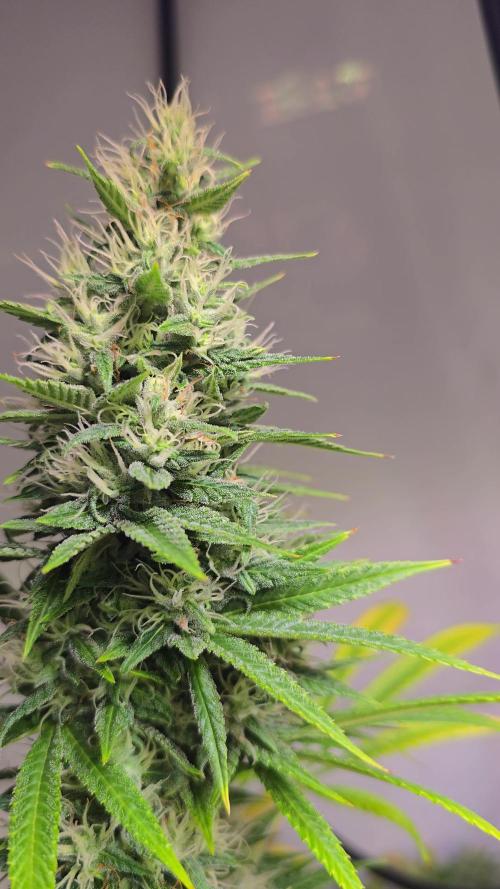
Im Vergleich zur letzten Woche ist eine klare Entwicklung zu erkennen. Die Pflanzen stehen insgesamt vitaler da, mit deutlich stärker ausgeprägten Blütenständen. Viele Budsites haben sichtbar an Volumen zugelegt, die Kelche wirken dichter und die Harzbildung hat spürbar zugenommen. Besonders bei einigen Exemplaren stechen jetzt kompaktere Colas heraus, während andere weiterhin etwas luftiger wachsen – ein typischer Unterschied zwischen den verschiedenen Genetiken.
Die Farbpalette hat sich erweitert: Neben sattem Grün zeigen mehrere Pflanzen inzwischen ausgeprägte violette und rötliche Töne, vor allem an den oberen Blättern und rund um die Blüten. Bei einzelnen Pflanzen setzt zudem die natürliche Herbstfärbung ein, was sich durch gelbliche Blattpartien an älteren Blättern bemerkbar macht. Das wirkt insgesamt harmonisch und passt gut zum fortgeschrittenen Blütestadium.
In der Struktur ist ebenfalls Fortschritt zu sehen. Die Blüten haben sich weiter gestapelt, Internodien erscheinen „gefüllter“ und die Pflanzen wirken insgesamt reifer. Die Höhenunterschiede zwischen den Strains sind klarer geworden: Einige wachsen weiter in die Höhe, andere konzentrieren ihre Energie nun fast vollständig auf die Verdickung der Buds.
Zusammengefasst zeigt diese Woche eine deutliche Reifephase. Mehr Masse, mehr Harz, stärkere Farben und klar erkennbare Unterschiede zwischen den Strains – ein solider Schritt nach vorne im Gesamtbild.
Fortsetzung folgt...💚✌️☺️

Likes
2
Share


@Edibleplant
Follow
5 X Caramelo EV in 40 gallon fabric pot
3 X Sugar Black Rose EV in 50 gallon fabric pot
2 X Eleven Roses EV in 100 gallon fabric pot

Likes
20
Share


@Turtleinweed
Follow
🌿 Power Flower: She’s developing a lovely menthol-pine aroma that I’m really enjoying. The color is looking great, and there are just two weeks to go until harvest!
🍇 Fruit Spirit: For weeks, she carried an intense scent—almost like a stink bug! 😆 But now, the berry notes are finally coming through. I’m curious to see how she’ll taste after curing.
🍋 Rainbow Belts: Absolutely incredible! The only way to describe her is that nostalgic Freeway Lime Lemonade scent—exactly like that! If anyone knows the taste, that’s precisely how she smells. Truly amazing.
💧 A little more nutrients and water for now. I'll give her another compost tea in week 8, and after that, let her finish strong.


Likes
20
Share


@GR0WER
Follow
New week starts!
🌞05.12.2022
This day began with smell rising. I think flowering starts. There's a few pestels in every knot (but not on a top).
Watered my girls with nutrients without 'Roots' stimulator. I should stop to give it a long time ago, I hope it gave no harm.
Soon when the odour will become too intensive I'll turn my filters on. It will be very noizy, that's why I want to do this as late as possible.
🌞06.12.2022
'SeaWeed' spraying today.
I changed distance to lamps. Now it's 40sm. Temperature didn't rise, so it's OK.
Upd: I made some LST on evening. It's a last training for them, I guess.
🌞07.12.2022
Pre-flowering stage started!
I turned on third 100W lamp. Now it's 300W total. Fed my girls with GHE pre-flowering nutrients complect. Sprayed with 'SeaWeed', as usual.
🌞08.12.2022
Today I came home from my job to see both girls increased in their high dramatically, +5cm in 24hrs. Maybe it's because of feeding, maybe lights, maybe auto flowers act like this, I don't know. But I saw larger distance between knots there. I was forced to do one more LST procedure (result is on photo).
Also, I sprayed my 'BPPa's' with 'SeaWeed' (as usual) and moved pots closer to each other to place them in a gaps between three lamps of mine.
I'll feed them tomorrow.
🌞09.12.2022
Today I noticed brown tips on the my babies leaves. #1 has alot of it and #2 kinda few. I considered to water them with 'GHE Clean' solution one time, next time I'll give them half of a nutrients dose.
Smell gets stronger. Tomorrow I'll turn my main ventilator with two carbon filters I have from the previous grow.
🌞10.12.2022
Yesterday I flushed my plants with 'GHE Cleen' solution 2ml/l. Today I do nothing. Tomorrow I'll give them 75% from previous feed formula.
🌞11.12.2022
I putted small amount of sulfur in an upper layer of substrate, ~10g/m².
Watered my plants with 75% from 'pre flowering' GHE recommendation. Sprayed leaves with 'SeaWeed'.
Week ends.

Likes
4
Share


@Ibgrowing
Follow
I have watered her twice this week, once with 3l of rain water and once with 3,5l of rain water. I will probably up the volume a bit more next week. There are still some burned tips but the rest of the plant is OK.
I will not be home for the next 2 weeks so I will rely on other people to take care of my girls, hopefully it al goes well🙏.
Likes
2
Share


@Terpslurpgoat
Follow
A breez to grow 450 grams off 5 plants first ever grow red buds throughout the whole grow
Likes
21
Share


@buddhi_coop
Follow
This week I sprayed my plants with tweetmint. I watered them 3 times since they’ve been in the pot. They’re growing , not that fast but they’re growing.
Likes
8
Share

Likes
Comments
Share


@Witch_in_the_Garden
Follow
Jan 23: soaking the autoflowering seeds
1 Thin Mint (TM)
1 Northern light (NL)
Jan 24: paper towel
Jan 26
NL sprouted
EDIT : None of the Thin Mints seeds made it
I had a lot of problem with the paper towel going dry since it's so dry here now in the middle of winter.

Likes
27
Share


@Coopmc
Follow
A bit slow but healthy and cons
The Vally Fruit is 3 days younger than the Cherry Dream and this are the best of each grouo
Disclaimer I don’t blame the seeds at all they were all nice and good split I just had a bad roll of the dice I do think I’ll have one for a fair sample of the cross


Likes
9
Share


@BLAZED
Follow
Week 11 (26-8 to 1-9)
26-8
Temps: 20.5 to 26.1 degrees
Humidity: 50% to 56%
27-8
Temps: 20.7 to 27.3 degrees
Humidity: 50% to 56%
Watering: Both 1500 ml. (Only Calcium) EC: 0.4 PH: 5.6
Defoliated both plants
Dry Weight: Both 2.6 kg.
28-8
Temps: 21.5 to 28 degrees
Humidity: 51% to 56%
29-8
Temps: 23.3 to 27.4 degrees
Humidity: 55% to 62%
30-8
Temps: 19.9 to 27.7 degrees
Humidity: 50% to 60%
31-8
Temps: 20.2 to 26.6 degrees
Humidity: 50% to 55%
1-9
Temps: 21.1 to 29.1 degrees
Humidity: 49% to 55%
Watering: Both 1000 ml. EC: 1.4 PH: 5.6
Dry Weight #1: 2.5 kg. #2: 2.3 kg.
Recalibrated my PH pen and it was only 0.1 off, so i dont think the leaf problems are PH related.

Likes
12
Share


@EmeraldLakeCannabis
Follow
Good week in the tent, finally now seeing the flowers kicking in. Only took about 3 weeks under 12/12, lol. They've stretched quite a bit since the flip, and by the looks of things should yield more than I initially thought.
-10/6- Gave the girls a drink and a defo today, in the interest of airflow mainly. Don't want a repeat of last time. No matter how miniscule the amount of mold, any is a serious issue by my (and anyone resonable's) standards.
Likes
13
Share


@Alpha_Green
Follow
Some of you may have wondered:
Why do I use CO2 at average 950 ppfd μmol/m2/s (moral flow)?
The answer is quite simple. Because of lack of space in some regions of my cultivation area, I simply cannot keep the ideal distance to my Sanlight high-performance lamp, due to some height growth of various strains. And so some of the main colas have ppfd values of 1250 μmol/m2/s and even more...
So this is how I manage to achieve and compensate for such high radiation levels even with a CO 2 balance. And I have to say, my strategy to avoid various light stress symptoms works just fabulously. In combination with CO 2 implementation, my babies are simply unbeatably insensitive to light. Thats it!
Beginning of 3rd week flowering:
Again feeding my babies by 36 hours fermented potions of Bio Tabs Kompost Tea PK-Booster (15 g pro Liter) and added:
5ml Orgatrex/Liter
1 Spoon of Bactrex
1 Spoon of Mycotrex
1 Spoon of Mycco-Vital
1 Spoon of Dynomyco
A little tip for those who are interested in small modifications that have a big difference or influence - on the result - effect - beauty - health - taste! Before adding microorganisms or beneficial bacteria or Mycorrizae and Trichodermas, please use oxygen-saturated water. On the one hand, unwanted chlorine gases evaporate and the small world of the microbiome becomes even faster and more rewarding in compost tea to sprout.
Last but not least for this week, I would like to introduce my reasons, why I prefer growing biologically and sustainably.
First of all, it’s something which suits very well in these times/days we are living now. Sustainability is a big need and task for our planet. 🌎 Nature means life. Our home, the air we breathe and everything that surrounds us. Not just today. Hopefully tomorrow as well.
Maybe I'm starting to protect our environment on a small scale, but maybe I can also make a big difference at all.
If you change the way you look at things, the things you look at change...
I thought about what’s the difference, between Mineral Feeding and Super Soil Feeding.
It’s very easy. Biologically Growing is a similar process than the natural soil activities out there in the lap of nature’s. So plants has to work and interact with the microorganisms and microbiomic communities in the soil. So the plants will never get lazy like the lazy ones of mineral feeding growers.
If you grow biologically, you will feed the soil first and the microorganisms will support every parameter next to your plant conditions. And that will generate an unbelievable spectrum of Terpenes and Trichomes you will never forget.
It’s the same comparison, when you daily visit McDonalds and you eat only fast food. How does your body and mind react on this shit for money?!?!
May I invite you to think about it…
See you next week dear Growmies! Have a nice Weekend and take care…
Peace out!
Addendum for Day 53:
At the moment we unfortunately have another winter onset here in Germany. This means that I am forced to take additional heating measures due to structural facts in order to be able to keep the temperatures constant. After all, just tonight the thermometer climbs again to -1 degree Celsius.
In addition, my exhaust air system runs out of my bedroom terrace and I therefore grow winter and summer with the patio door open. Well, sometimes I experience real weather-related challenges. But all in all, no problem...
"Where there's a will, there's a way."
Addendum to pouring out the fermented PK tea: I always administer half a liter of lukewarm aerated water with 3.5 ml of cannazyme per liter to each plant. This means that the "root machine" is not supplied with supplies unprepared and the nutrient solution can thus also be better distributed in the soil. Since I also work with cloth shoes, I spray them evenly moistened everywhere with water that is also warm before pouring them out from the outside. This has the advantage that the moisture stays where it should: in the pot!
... I did the math today ;-) We are still in week 7 until this Friday. And week 8 starts on Friday! OMG... still so much time yeahh!
Today my Fast Buds Sour Jealousy and Sweet Seeds Big Devil and Dark Devil Automatics arrived. I'm looking forward to it.
This time Fast Buds next Time Sweet Seeds. Love them too. Very beautiful genetics.
Today a review video of the beginning of week 3.
At the time of the pictures, I had minor signs of nitrogen excess. (Light peaks first at the crown of the roof and then slightly continuing to the middle section.) I then painstakingly racked my brains as to why this could be. I found that very slight dry spots had formed and therefore the root found small accumulations of nitrogen that caused its problems. But then, when I carefully homogeneously checked the moisture content in the substrate, the problem evaporated again. However, they had not shown any loss of growth rate during this time. Nevertheless, they developed as expected.
They Strawnanas had no problem with that.
In the end, I always have a hard time killing them. But I guess that's the way things go.
We live and die.
We come and go.
But it's not there yet. ;-)
Tomorrow is day 56.
Tomorrow’s updating day!
Can't wait to see their progress.
Have a good time and see you tomorrow… 🏽🕊️
🏽 ☮️🕊️
Likes
16
Share


@mojo1985
Follow
viel passiert nimmer im wuchs... noch ausreifen lassen...trichomen produktion merklich erhöht... denke in 2 wochen sind sie fertig 😛