


Likes
Comments
Share

@smoking_hills9
Follow
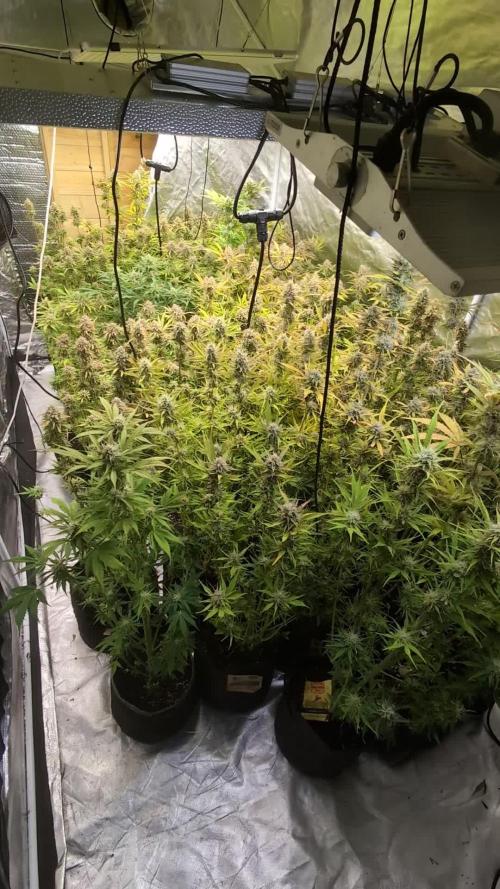
These cali genetics are blowing my mind 🤯 super sticky, very frosty rock dence buds with extra strong smells. All 3 strains are 10 out of 10, very impressed. Done last defoliation few days ago, preparing for the harvest so it's much easier. Stalks are super fat, same as buds.
Got big surprise from Atami, plant food, and many extras. Crazy. Thanks a lot guys. 💚 Start adding you Bloombastic food already. They love it. Smell is mad. I think most of plants ready in week or so.

Likes
3
Share


@Unculti_responsable
Follow
Esta semana hicimos la última poda de bajos y alicales , es una de las últimas podas q hacemos! Después de esto la vamos a pasas a 10 litros y ya la mandamos a florecer creo q esta más q lista para arrancar el proceso de floración

Likes
40
Share


@GYOweed
Follow
Not bad for 2 weeks from seedling stage first time all organic coco my babies were looking pale and yellow edges last week thought oh they were right....nope went to basics...
Foliar clone strength GH synthetic on them to make them happy and found the issue with meat thermometer...
Coco is very aerated....temp was 65f!
Placed heat mat and all goody now!
Coco+wet+dry organic = win.
No raised pots. No runoff. Same with my other bigger tent....ull see...still good idea to gentle runoff flush once every stage.
I hit these with my diy bud factor$ which is way better than that ripoff stuff.
Today i hit them with very light mist yucca, brass, bap, fulvic, 2 organic acids, vitamin c Calcium, tria, and ton of GA3 (🤭😈).
I hit the top left hindsight to drip to see what it does to it vs its sister which looks very uniform.
Guess which one will be the most stretchy and less bushy?


Likes
Comments
Share


@Sn3ak92
Follow
Beginning of the week, Jan20 D29
Continued LST, made an very light defoliation.
Last week I've added 1tbsp of soil adifier per plants (sulfur) my PH should reduce enough to be between 6 and 6.8
Jan21 D30: re raised the light @175w, plants are happy
Jan24 D33: plants are booming rapidly, topped the 2 C&C on all the main branches
Jan27 D37: starting to see a little deficiency. Maybe a lockout of calcium or potassium. Tested soil ph and its around 7. Work to do.
Did a slight defoliation, add 1tsbp of mineral mix 0-1-5 per plant (calmag) 1/4 cup of mykes, 1tbsp of Batguano 0-12-8 and 1tbsp of soil acidifier. Top dressed all 3 with that and watered 2L at ph 5.5... Hope I did not do too much.
Will wait nx weekend to put into flower.


Likes
Comments
Share

@Jardin33ro
Follow
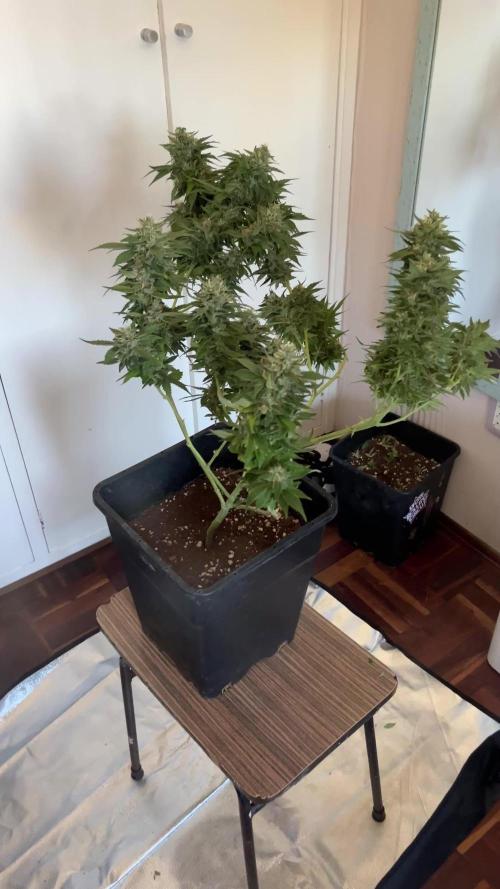
Podriamos haber tenido un punto de corte mas optimo, pero la verdad que un primer cultivo exitoso. Muy rico en aromas y en sabores. El olor a mandarina muy marcado y al final un toque de pimienta que hace que no sea tan impalagoso el citrico tangie. 250 g en seco, nada mal.
Processing
Likes
3
Share


@Nvchods3
Follow
buen engorde se aprecia en la variedad, riego con abono cada riego y medio.

Likes
50
Share


@AsNoriu
Follow
Day 36. One girl is shooting the sky other still have that unhealthy look, made my mind - its genetics and i can't do anything.
Girls got second feed, looks happy and hopefully will bring some nice flowers.
Took some leaves down, spread a bit, but most of work will be done next week, if i will dare ;)))
Last time used Root Juice, added Acti-Vera, increased Bloom and Heaven.
Day 40. After last feed, girls got small rusty spots on 4-5 leaves total, cut out cal mag for couple weeks.
Heavy training, its always tricky to decide what to do with Autos and i have almost no knowledge, but i have SPA Queen and Midget aka Margaret ;))) both different, but bushy, had to clear Midget really heavily and still loads future airbuds left, but maybe ... ;)))
Girls drink 3 liters every day, highest rate ever, but i relate it to most powerfull exhaust ever.
Some leaves on both plants got strange mutation, like leaf tries to branch out ... Never seen anything like this. But by height i presume it happend on first feed, late Root Juice aftermath ?
Happy Growing !

Likes
2
Share


@CanarianGrow92
Follow
The last week for this fatty girls 😁 soon its harvest date, nice strain to grow, really easy, typical old school vigorous and stable! Nice kush smell, since the end of last week we only gave water

Likes
14
Share


@CampaCavallo
Follow
8ª Settimana di Fioritura 💐💐💐💐💐💐💐💐
La RUNTZ 💓 di ZAMNESIA 🗿💙, in collaborazione con GREEN SENSATION ✅ di PLAGRON 💜, sta tirando fuori tutto il meglio di se!
Bud belli gonfi e ricchi di resina brillante 🤩 sono quasi giunti a piena maturazione!
BUON 420 A TUTTI I GROWERS DI GROWDIARIES.COM 💚😘😍🔝🚜💐🏔️

Likes
10
Share


@Naujas
Follow
There are no photos for a few days, I was away on a short vacation :) when I returned, I immediately started working with her, I cut off the single leaves, and used a little LST, Overall, the girl looks really beautiful;) strong, thick branches, I think she will give really tasty buds :) It is an autoflower, but it is not blooming yet, I think it will start soon, all my auto strains that I have grown before, started really earlier, but it is not a problem for me, and maybe even + she will be bigger with bigger flowers :) good luck to everyone :).

Likes
15
Share


@medicalcannabelfast
Follow
This week has flew in , can’t believe I’m on week 5 already :) .
The girls are growing well , allow they are 2 totally different looking plants the smell the same and seem to be maturing at the same rate :)
I can’t wait to see all the little bud sites start to fatten and fill out over the last few weeks
Likes
220
Share


@CRiSPrGrow
Follow
These had a pretty good life. I actually only fed NPK the one time . Germinated them in a Zambeza propagator, i really recommend getting one of those propagators, they're reusable and really take the heat off those first days when you're sweating. Pooped them into their plugs they sprouted out strong, germinated 5 kept 3. transplanted them no problem. Veged these for 4 weeks, then they shot up. during veg they stretched out a bit early on i should have been giving some specialised micro i had on had but for some reason on the other i didnt. They needed extra support for their first three weeks, so i decided to LST them around week 2. Two camping hooks one anchor for the main stem and one to keep the plant down. Once i dialed in my lamp to plant distance they benefitted by slowing down on the stretch a bit. they all took to LST extremely well, bushing out and creating an nice even canopy. They pushedout these thick indica leaves, one of my plants was a lighter colored leaf pheno, the vertafort one. The Six Shooter genetic really stretches, if just off the top of my head it seems that the plants quadrupled in size over an 8 week period, completely eclipsing their neighbours and creating a thick dense canopy throwing shade down below. Each turned into a bush with three or more mains sticking out the top by week 6. IThe results start to look real pro around week 8. Before that though I hadn't been defoliating. This and simple lack of light means that I had loads of undevellopped colas. If I'm honest I should have tried to harvest in stages but by colas. Anyway these kind of grew like a gorilla glue but with much different and much better flower structure. The plants started pushing out flowers and pistils and preflowers etc early, but then took a while to gear up towards towards getting fat. The flower branch out in a spiral pattern up and down the main and secondary colas evenly, creating this misssile shaped colas, but they branch out once sometimes twice, which means less branch to nug ratio than a gorrilla glue by a full multiple. They started smelling like lemons around the time they were fattening up. Then they started getting buff, really little by little, what did rippen rippened evenly. Some colas was basically waste especially the colas stuck on the sides of the tent and some of the colas where for some reason or another there was no light there due to the dense canopy. Truly a BEAST OF A PLANT, HIGH POTENTIAL, great BRANCHING, if you look carefully each plant has more than a dozen colas,
Timed it so the harvest was on a day the plants were chock full for plain water after ten day's worth of additive aided flushing. hung to dry slowly in the tent, got it around 55RH inside the buds over 12 days then trimmed and jarred in miron glass with boveda 62. The trim was a great experience, took a while but not that long because the flowers were so nice in the way they are. you do have to trim every sugar leaf one by one though if you're doing it by hand, broke these sizzors that @Mrs_Larimar sent me because of the resin lol. so I pull these plants out my tent and I just kinda look at them and they're basically dark green because of all the sugar leafs, i'm thinking to myself "shit i messed up this isnt even that frosty". well, what i found out is every time i clipped one of those trademark long sugar leafs off it revealed absolutely resious white frost. That's what can keep someone motivated. ! Once jared, if there's boveda in your jar, you dont really need to burp it daily, or even weekly i just let it sit there, obviously i've been smoking it and following the cure, let me tell you this one needs longer to cure than you're used to maybe, at least two more weeks of cure after a slow dry. Four weeks after the chop , it's a strong weed !
Didn't smell all that loud, but I have a 1300M3/H exhaust so... i'm not surprised. I will say though that my neihbour said she could smell weed even when I wasnt home and she could smell weed in the corridor, from the times I was trimming and basically every time I open my jar. Gonna need a new carbon filter for the next grow. I retired my lightbulb too. Hard to put my finger on the taste because the smoke is so smooth, and when i saw GD had a tag for Woody, i knew right away this was that taste i felt. I will say this though, cure this correctly, dont rush, dry it real slow, then cure it, citrussy tastes, usually those will evaporate, leaving this distinguished terpene heavy hitter much better tasting. So what can i tell you, this weed is white weed, so frosty. Bag appeal is great too, this strain pushes out pistills like no other, maybe even more than the gorilla glue. that means this is a chill weed right? One of the phenos I grew had more pistils than the other two. Mr. B's did, but i dont know if you can really tell from the close ups, i'll try to put some more pictures up. I got two maybe three phenotypes in terms of taste. Mr. B’s is much pine-ier than the others, and when the joint goes out and you light it again, it’s even more piney … I’m actually really happy about that reminds me of white rhino from the east coast back in the day but way piney-ier than that even. When you smoke the other phenos the smell is incense and the taste is really really smooth & woody. Sometimes I find different after tastes on the exhale like coffee, pepper, and maybe sweet/fruity sometimes too depends on the pheno I'm toking on. It is LOUD THOUGH, always have a spare filter on hand IT’S NOT WORTH IT get it !
Well at the end of my first grow, i'd like to quickly review all of Bulbi's own :
Bulbi"s Own Early VegMicro: Fine green powder with calcium and all the rare metals in it. I didnt use it ! Damn, next time I'll amend my soil with it like i did this time on the FBT1
Bulbi's Own Cal Mag : Organic fine white powder with calcium and magnesium, i used it in the feed and sometimes as a spray. I didnt know how much to put in because these things dont come with instructions so i ended up putting 1/4 doses most of time. The correct amount should have been 2.5G/L.
Bulbi's Own Flower Micro : Organic fine beige powder that I used mixed in with the sulfur. I think this one's a keeper, really helped my plants make it through the stress of bottom feeding and all that heat.
Bulbi's Own Mag Sulfur : Organic fine red powder that I used mixed in with the Flower Micro I used this one in my spray too , to great effect, in my opinion
Bulbi's Own Beneficials Trio : This was the base beneficials mix I had, you need to put 7.5 to 15g/l , watch out for clumps, use at the night fall, or when still dark.
Bulbi's Own Anti Afid : I threw it in there i think just in time to protect my plants when I intentionally overwatered when I went on my trip. There were some white flies that emerged, because... well that's what they do isnt it. but there were just a few of them and they ended up flying around wierdly, and within four days, no more white flies, didnt even use yellow sticky tape ! You mix this one with the trio for even more effect. I used these in a spray I think , also.
Bulbi's own Anti-Worm : This one is more directed against larvae, and can be combined with the base trio. I was weary of using it, but I'm glad i did to give my soil matrix that full spectrum of biological protection.
Bulbi's own Humic Acid : This one i loved, looking back I'm regretful not having used it more. the dry humic acid is a great experience, the quality of it was impressive, clumps would seperated into more clumps ad infitum the feed slowly turning completely ink black. definituely using this once a week from now on
Bulbi's own Amino Acids : this one is just amino acids, maybe next time I'll use it at the same time as the humic acid, but I'm not 100% on that. What i did do was spray the top layer of the soil with amino acids when I accidently ran into some issues from spraying kelp all over the place. So in that sense it's an absolute life saver and a must to have on hand.
Bulbi's Own Kelp Extract Concentrate. Loved this one too haha, so thick, and green, check out the video of when i pour it lol. Worked great, raises the pH some so be careful, i used this one as a sprat aswell to get those plant growth hormones pumping during the seeding and veg stage.
Bulbi's Own CO2 : well part of what I set out to do was to test the CO2 theory. Like roots do absorb CO2 but at a lower efficiency than leaves say 15% vs. 85% the theory being enriching your water or feed with CO2 would ultimately benefit the plant. So i enriched water with these ceramic based co2 tablets, because CO2 is a soluble gas, it stays in water. Then i fed the plants in this manner in the feed and also as a spray. The idea behind that was that co2 enriched water would come in direct contact with the plant allowing for absorption of some quantity of CO2 through the leafs. Someone explained to me that these are actually old school techniques. Well I know i started late and didnt follow a regular schedule like i wished for but the plants didn t die, or show any immediate negative upon innoculation, so what can I say? I'm doing this again, perhaps. Only problem is that these things are really a pain to pH correctly
General Hydroponics Dry pH Down : GREAT PRODUCT, hard to find but amazing – not registed on GD for some reason
I still have to make my bubble hash so any advice welcome ! 🚀


Processing
Likes
13
Share


@GangbudsGenesgdl
Follow
21/12/20
inicio de semna riegos solo con agua, esta pequeña se estiro mucho buscando la luz
igual por que parte del dia estan bajo el invernadero con luz natural
23/12/20 68 cm de altura
27/12/20 cieree de semana esta pequeña se esta estirando muy rapido estoy pensando pasarla a flora

Processing
Likes
16
Share


@Andres
Follow
they are growing normal ... one of them regularizing the lack of nutrients with biobizz ... and their flowers growing normal.

Likes
52
Share


@DogDoctorOfficial
Follow
Let's realign our cosmic compass and embark on a harvest report for our magnificent Cosmos F1, a pure CBD strain that has taken us on an extraordinary journey. Brace yourself for cosmic revelations and interstellar delights!
After an impressive 11 weeks from seed and 7 weeks of flowering, the time has come to witness the cosmic culmination of our efforts. I carefully hung the entire Cosmos F1 plant to dry, allowing the cosmic energy to infuse every inch of this botanical marvel. It's a sight to behold, with majestic branches reaching for the cosmos, reminiscent of a cosmic dancer frozen in time.
As our cosmic queen gracefully dries, her vibrant hues continue to amaze. The shades of green, intertwined with delicate hints of purple and gold, are a testament to her genetic splendor. It's as if she has absorbed the cosmic essence of the universe, transforming it into a visually stunning spectacle.
Now, let's talk about the cosmic power of CBD. Our pure CBD strain holds the key to a transformative experience. With minimal psychoactive effects, this cosmic treasure offers a realm of therapeutic benefits. It's like a cosmic massage for the mind and body, soothing and relaxing, allowing us to explore the depths of cosmic tranquility.
The decision to hang the entire plant for drying is a testament to our dedication to preserving the cosmic integrity of our harvest. By allowing the branches to hang freely, we encourage a slow and controlled drying process, ensuring that the cosmic essence remains intact. It's a ritual that honors the plant's journey, preserving its cosmic magic for us to enjoy.
As we eagerly await the cosmic transformation, let us express our gratitude to the celestial forces that have guided us on this cosmic odyssey. The cosmos has aligned to bring us the extraordinary Cosmos F1, a gift from the cosmic garden gods themselves. We extend our heartfelt appreciation to the cosmic harmony orchestrated by @James and Royal Queen Seeds.
In the coming days, our dried cosmic buds will be ready for the next stage of our journey. From cosmic concoctions to cosmic culinary delights, the possibilities are infinite. Imagine infusing the cosmic power of CBD into soothing teas, cosmic creams, or cosmic confections. The universe is our canvas, and with our cosmic harvest, we can create cosmic masterpieces.
As we bid farewell to our Cosmos F1, let us cherish the cosmic memories we've shared. The vibrant colors, the pure CBD power, and the cosmic connection we've established with the universe. May our future endeavors be as cosmic and awe-inspiring as this one.
Until we meet again, my cosmic friends, lets keep exploring the cosmic wonders, nurturing our cosmic gardens, and let the cosmic energy guide our cosmic creations. May our harvest be abundant, our cosmic experiences be enlightening, and our cosmic journey be filled with celestial blessings.
As always thank you all for stopping by and for supporting me on this journey, i am super passion about growing and fell blessed to have you all with me on
Likes
18
Share


@Bluntblazer66
Follow
Mar 10th
Week 13
All is well, plants are filling out nicely
Mar 13th
Fresh nutrients today
Mar 15th
Defoliation day hopefully this is the last time. Just taking off the major fan leaves


Likes
20
Share


@VnknowN
Follow
The baked in Paris Is really Building up, i keep u updated.
But the tropic ozz…. Absolutely lightstressed. I decided to cut her when the baked in Paris Is ready and i think i want to use the whole plant for alcohol extraktion.


Likes
12
Share


@Marihumama
Follow
The weather is shit 😵
She,still looking awesome😛 smelling lovely &Sweet 😍
Don't need to water her now, just shake the rain off every now &than ☺️
I love it when a plant comes together! 😎
