


Likes
Comments
Share

@Day_1
Follow
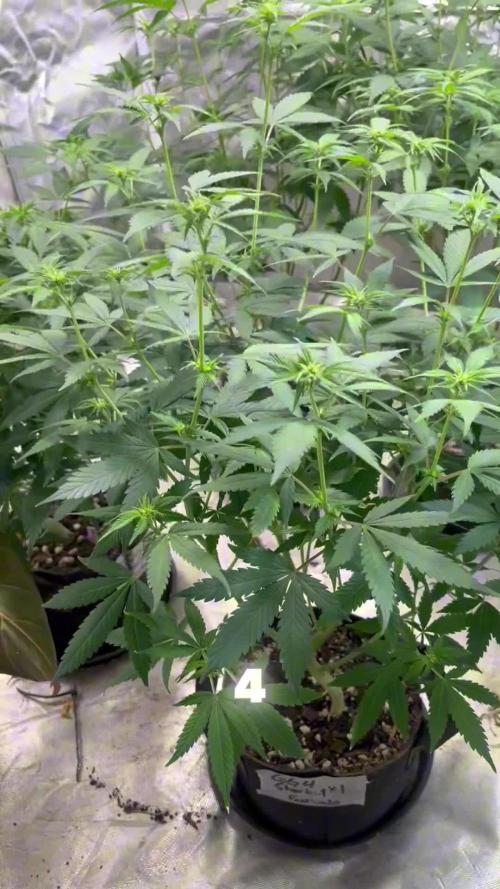
Ladies are doing amazing. First week of flower. I’ve went ahead and topped dressed with worm castings Gaia green 444 and 284 and Bone meal also water them with stash blend.

Likes
4
Share


@CannaIGrow
Follow
This plant was the first of the 4 to come up, it also basically exploded out of the shell in the germination process. While she was still in water I could already see green leaves lol. She’s really plugging along. This is a cross made by a friend of mine and is the first time it’s being grown.
Likes
24
Share


@Frank_cultiva
Follow
Mismos riegos que la semana anterior de acuerdo a la tabla de advanced nutrients.
Las 4 nenas que están en floración(maceteros de 11lt) beben mucha agua, 8lt cada dos días y reciben un riego a la semana con nutrientes, el resto de riegos sólo con agua.
Mientras que las otras 2 que siguen en vegetación (maceteros de 30lt) están bebiendo 9lt cada tres días, también con sólo un riego con nutrientes por semana.
Saludos! Muy buenos humos a toda la gente que le da vida y vibra positiva a este mundo 💚🍀🤓

Likes
10
Share


@Big0zGrower420
Follow
Hello everyone,
I had an outdoor grow that just got ruined by some deer who decided to eat my plants. The wife is letting me grow on the patio thankfully, better than nothing. I am currently germinating one seed and will be growing in soil using distilled water/rain water. I plan to plant the seeds on the 24th
Have a great week.
Update: Seed popped tap root in under 24 hours, I planted the seed and have the humidifier on. Then I will move outside once established.


Likes
19
Share


@Ganjagrandaddy
Follow
Welcome to my Fast Buds sponsored shootout and living organic soil v coco side by side. I also plan to use this grow to my full advantage regarding a few age old nagging questions about methods.
I have had a keen interest in L.O.S ( supersoil) since reading a few threads a while back on how amazing and productive it can be. After too much research and procrastinating I had to give it a go. I have been a decades coco/nft grower and recently threw my hat in the rdwc ring too. I have avoided soil due to the overwatering worry ( heavy handed chimp brain !) and the best potting soil/feeds. Catching up on the advances in indoor soil gardening and organics led me too subcools supersoil recipes to name a few but being a town dweller with farms everywhere around me still drew blanks on a lot of the ingredients needed and where the hell I could even begin to get them from. Thankfully , commercial savvy has now made buying it in ready to use and with a full range of beneficial bacteria ect available in amendments from a grow shop here in the uk. ecothrive have realised the potential for us to dive into this medium with all the mixing , measuring and resourcing. I bit the bullet and £150 later I now have 4 x37Litre pots that will be used for as long as I want to feed the soil for without EVER needing nutrients again potentially. The coco has also had charge mixed in to encourage the bennies to colonize there too. I will be using the shogun nutes that I know do the business with coco to compare with for yield , growth and taste.
I have 3 seeds each of 4 Fast Buds Strains to use as a control for the grow and am journaling each strain in their own diaries. This statement will be used to start each one as the information is identical at this point but following this I will do them individually.
I am now starting their second week since opening the seed packets , straight into soaked and shook root riot cubes and into the heated propagator. They had all showed their heads by end of day 3 and a couple needed helmet surgery to open up without being hindered . I have has them in the prop for a few days but they needed to get settled as they were popping roots out all over the cubes. They have now been in their final pots for 2 days complete and starting their 3rd today at day 8 since planting in cubes. I am impressed with the speed and success of these girls already (12 of 13 germinated) . Well done fast buds.
So here we go folks , any comments , ideas ,questions , advice are always welcome and I hope we can have some fun experimenting with defol v non defol , topping v fimming v bending and any other curiosities along the way. I plan on using a quadline for them all to keep a control for the comparisons too.
Be green folks
Welcome aboard and a huge thank you to Fast Buds for the opportunity to try autos.
Likes
45
Share


@Ultraviolet
Follow
My homework.
Rubisco regeneration is intrinsically linked to nitrogen supply because Rubisco is a major sink for nitrogen in plants, typically accounting for 15% to over 25% of total leaf nitrogen. The regeneration phase itself consumes nitrogen through the synthesis of the Rubisco enzyme and associated proteins (like Rubisco activase), and overall nitrogen status heavily influences the efficiency of RuBP regeneration.Structural Component: Nitrogen is an essential building block for all proteins, and the sheer abundance of the Rubisco protein makes it the single largest storage of nitrogen in the leaf.
Synthesis and Activity: Adequate nitrogen supply is crucial for the synthesis and maintenance of sufficient Rubisco enzyme and Rubisco activase (Rca), the regulatory protein responsible for maintaining Rubisco's active state. Nitrogen deficiency leads to a decrease in the content and activity of both Rubisco and Rca, which in turn limits the maximum carboxylation rate, Vmax, and the rate of RuBP regeneration Jmax, thus reducing overall photosynthetic capacity.
Nitrogen Storage and Remobilization: Rubisco can act as a temporary nitrogen storage protein, which is degraded to remobilize nitrogen to other growing parts of the plant, especially under conditions of nitrogen deficiency or senescence.
Nitrogen Use Efficiency (NUE): The allocation of nitrogen to Rubisco is a key determinant of a plant's photosynthetic nitrogen use efficiency (PNUE). In high-nitrogen conditions, plants may accumulate a surplus of Rubisco, which may not be fully activated, leading to a lower PNUE. Optimizing the amount and activity of Rubisco relative to nitrogen availability is a target for improving crop NUE.
Photorespiration and Nitrogen Metabolism: Nitrogen metabolism is also linked to the photorespiration pathway (which competes with carboxylation at the Rubisco active site), particularly in the reassimilation of ammonia released during the process.
To increase RuBisCO regeneration, which refers to the process of forming the CO2 acceptor molecule Ribulose-1,5-bisphosphate (RuBP) during photosynthesis, the primary methods involve optimizing the levels and activity of Rubisco activase (Rca) and enhancing the performance of other Calvin-Benson-Bassham (CBB) cycle enzymes.
Biochemical and Environmental Approaches:
Optimize Rubisco Activase (Rca) activity: Rca is a crucial chaperone protein that removes inhibitory sugar phosphates, such as CA1P (2-carboxy-D-arabinitol 1-phosphate), from the Rubisco active site, thus maintaining its catalytic competence.
•Ensure optimal light conditions: Rca is light-activated via the chloroplast's redox status. Adequate light intensity ensures Rca can effectively maintain Rubisco in its active, carbamylated state.
•Maintain optimal temperature: Rca is highly temperature-sensitive and can become unstable at moderately high temperatures (e.g., above 35°C/95F° in many C3 plants), which decreases its ability to activate Rubisco. Maintaining temperatures within the optimal range for a specific plant species is important.
•Optimize Mg2+ concentration: Mg2+ is a key cofactor for both Rubisco carbamylation and Rca activity. In the light, Mg2+ concentration in the chloroplast stroma increases, promoting activation.
•Manage ATP/ADP ratio: Rca activity depends on ATP hydrolysis and is inhibited by ADP. Conditions that maintain a high ATP/ADP ratio in the chloroplast stroma favor Rca activity.
Enhance Calvin-Benson-Bassham (CBB) cycle enzyme activity: The overall rate of RuBP regeneration can be limited by other enzymes in the cycle.
•Increase SBPase activity: Sedoheptulose-1,7-bisphosphatase (SBPase) is a key regulatory enzyme in the regeneration pathway, and increasing its activity can enhance RuBP regeneration and overall photosynthesis.
•Optimize other enzymes: Overexpression of other CBB cycle enzymes such as fructose-1,6-bisphosphate aldolase (FBA) and triose phosphate isomerase (TPI) can also help to balance the metabolic flux and improve RuBP regeneration capacity.
Magnesium ions, Mg2+, are specifically required for Rubisco activation because the cation plays a critical structural and chemical role in forming the active site: A specific lysine residue in the active site must be carbamylated by a CO2 molecule to activate the enzyme. The resulting negatively charged carbamyl group then facilitates the binding of the positively charged Mg2+ion. While other divalent metal ions like Mn2+ can bind to Rubisco, they alter the enzyme's substrate specificity and lead to dramatically lower activity or a higher rate of the non-productive oxygenation reaction compared to Mg2+, making them biologically unfavorable in the context of efficient carbon fixation. The concentration of Mg2+ in the chloroplast stroma naturally increases in the light due to ion potential balancing during ATP synthesis, providing a physiological mechanism to ensure the enzyme is activated when photosynthesis is possible. At the center of the porphyrin ring, nestled within its nitrogen atoms, is a Magnesium ion (Mg2+). This magnesium ion is crucial for the function of chlorophyll, and without it, the pigment cannot effectively capture and transfer light energy.
Mg acts as a cofactor: Mg2+ binds to Rubisco after an activator CO2 molecule, forming a catalytically competent complex (Enzyme-CO2-Mg2+). High light + CO2) increases demand: Under high light (60 DLI is a very high intensity, potentially saturating) and high CO2, the plant's capacity for photosynthesis is high, and thus the demand for activated Rubisco and the necessary Mg2+ cofactor increases. Mg deficiency becomes limiting: If Mg2+ is deficient under these conditions, the higher levels of Rubisco and Rubisco activase produced cannot be fully activated, leading to lower photosynthetic rates and potential photo-oxidative damage.
Optimal range: Studies show that adequate Mg2+ application can enhance Rubisco activation and stabilize net photosynthetic rates under stress conditions, but the required concentration is specific to the experimental setup.
Monitoring is key: The most effective approach in a controlled environment is to monitor the plant's physiological responses e.g., leaf Mg2+ concentration, photosynthetic rate, Rubisco activation state, and adjust the nutrient solution/fertilizer to maintain adequate levels, rather than supplementing a fixed "extra" amount.
In practice, this means ensuring that Mg2+ is not a limiting factor in the plant's standard nutrient solution when pushing the limits with high light and CO2.
Applying Mg2+ through foliar spray is beneficial to Rubisco regeneration, particularly in alleviating the negative effects of magnesium (Mg) deficiency and high-temperature stress (HTS). While Mg can be leached from soil, within the plant it is considered a mobile nutrient, particularly in the phloem. Foliar-applied Mg is quickly absorbed by the leaves and can be translocate to other plant parts, including new growth and sink organs.
Foliar application of: NATURES VERY OWN MgSO4 @ 15.0g L-1 in a spray bottle.
Foliar sprays are often recommended as a rapid rescue measure for existing deficiencies or as a supplement during critical growth stages, when demand for Mg is high. Application in the early morning or late evening can improve absorption and prevent leaf burn.
The starting point [of creativity] is curiosity: pondering why the default exists in the first place. We’re driven to question defaults when we experience vuja de, the opposite of déjà vu. Déjà vu occurs when we encounter something new, but it feels as if we’ve seen it before. Vuja de is the reverse—we face something familiar, but we see it with a fresh perspective that enables us to gain new insights into old problems.


Likes
Comments
Share


Likes
4
Share


@badirama
Follow
So i went for quick vacation/holidays to Georgia (love it!) and asked a friend of mine that lives nearby to take care of me babies 😊 so he watered the girls every 3,5 days on average (4 times during 14 days) with just as little as 100 ml per plant. Now I come back yesterday and I’m very happy with my girls - they look super thriving and eager to grow! I’m surprised as so very different they look from my previous grow in same setup except hydroponics - this time in soil in same day of vegetation they look much more dense and just thriving! Wow soil makes huge difference indoors.
I saw 2 top leaves (on pictures & on video) with light nutrients burn (no idea why - I just added root juice). Also I know for sure that my light timer has broken - there were days when light was 24h on...I don’t know what might that cause... but now is all good - light timer fixed. I think that I will just keep feeding them water. What do you think guys? Would love some advice!
Oh and pictures and videos are from yesterday. Before topping and after topping. On 2 girls I have used new topping technique.
Thanks!

Likes
46
Share


@pifflestikkz
Follow
This plant was an absolute dream to. Grow, no issues at all with health of plant, just struggled to tame her as she was a a thick strong climber 💪💪.
I'm so impressed with how this turned out, I could have flushed for another 3 days to make it 12days but I needed the space.
After The 2 days of dark I was recommended I can definitely say it has vastly boosted her trichomes and the smell when I opened the tent blew my head away 😍😋
Aiming for a 10-14 day hang dry,
The 10-12 weeks curing in jars with humidity packs.
I will update with a dry bud weight and smoke test 👌
Bud wet weight is just 500g+
Final bud dry weight is 298g.
Of juicy resinous purple and orange buds 😍 smells like sherbert and hang dry smoke test revealed a candy sherbert, no banana yet but hoping like the grow it matures with cure process now.
Hits eyes straight away, sandy bottom kids, giggles, munchies, fun time with Mrs, bed. Full cycle with this one very happy over here 😉😁💚
FAT BANANA AUTO FROM ROYAL QUEEN SEEDS, big thank you to the team, and the breaders. What a pheno I received. I appreciate you all


Likes
2
Share


@Mr_nugs_lover_David
Follow
Her 2nd week was pretty good,she could be a little bigger with a few hours more of sun that's why I moved my plants almost everyday.she looks very healthy let's see how she performs

Likes
18
Share


@Smokiebear_og
Follow
I'm happy with the harvest but I'll do better next time. This has been a great experience and I can't wait for my next run. 191 grams and I turned most of it into bubble hash. The positive out of it all is I don't have to spend on meds for a little bit.
For all my fellow growers that followed thank you for the positive energy and help. The community here is awesome and I'll be back in no time to give it another go.
Peace and Happy Growing ✌️

Likes
11
Share


@WoodsonCult
Follow
Lower leaves are losing color and browning, flushed out water and added fresh nutes in 4 days ago. Roots have a brown slug on them from left over nutes, probably going to rinse roots off in the next couple days.

Likes
16
Share


@Hydrostyle
Follow
Heiiii boys and girls
This baby gorila she beacome a litlle purple shes very nice😎😎😎😎😎
Likes
31
Share


@DudeGrowsWeed
Follow
RQS Diesel Automatic is growing along pretty strong, pushing out some nodes. Leaves still showing that mosaic look, but all the comments from the GD community have been to not worry about it, so I'm not worrying. But curious to see what happens as she flowers. Gave her some Recharge this week.
Likes
10
Share


@Boomdrawfyah
Follow
Empezamos con Terranabis nos ha facilitado una tabla de cultivo donde mete a sus nuevos productos de este 2021 daran mucho que hablar !! Estar muy agradecido a Terranabis y Paradisw Seeds!

Likes
11
Share


@Kali420Autoflower
Follow
Fruit Automatic - Dinafem
Segunda semana de cultivo.
Tengo muchas expectativas con esta variedad de Dinafem. He visto cultivos de compañeros realmente buenos y espero llegar!!!
A mediados de la segunda semana se la implementado los nutrientes que aparecen reflejados. Además, aportando quelato de hierro para estimular la clorofila de la planta y tierra de diatomeas para prevenir futuras plagas terrestres.
Al igual que sus dos compañeras de viaje, crece por día y sana.

Likes
27
Share


@RDWCGrowing
Follow
I had a lot of fun with this strain and it was grown against 400 growers so let me say PHENO hunting is a true thing. Overall the Bud was a nice dense structure and the smoke on it was smooth and the high nice and even.

Likes
Comments
Share


@curious_jules
Follow
She's very green and healthy, considering the relatively weak lamp and early problems with algae.
Buds are modest in size, but sticky as all hell. She's probably only 1-2 weeks from harvesting now.
