






Likes
2
Share


@KannaGrowing
Follow
Comenzamos con la fertilización de nuestras plantas, correspondiendo con la semana 2 de la tabla.
Recordad que la semana de germinación no cuenta como vegetativo.
Mezclamos 4ml x litro de Grow-Soldier by JUJU Royal BioBizz y 1ml x litro de Green-Mystic by JUJU Royal BioBizz.
Total 10 litros, 5 de agua osmotizada y 5 de agua del grifo, mezclados con los 40ml y 10ml, de los fertilizantes.
Ajustamos el PH con reguladores BIO, en el caso que sea necesario y regamos todas las macetas.
De esta forma aportaremos los nutrientes necesarios para que nuestras plantas puedan comer en el sustrato de de coco.

Likes
5
Share

@Hardy_
Follow
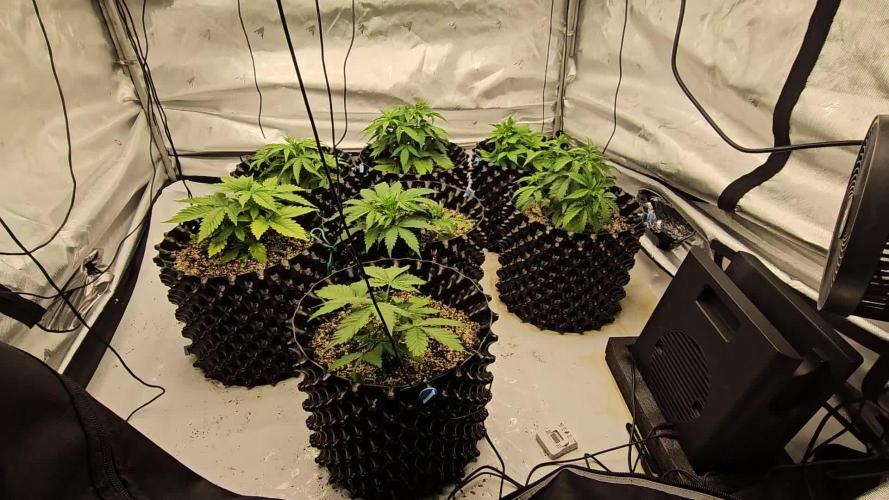
Day 29, please give feedback, thought i stunted them, not sure, have nothing to compare against! Thanks folks

Likes
23
Share


@lemonairlines
Follow
---B62---
Silver has 7-10 days, I could fill the entire area with one plant 😁 Thats really good genetic i love her . All Branches tie up,down,near :)) and there are so confused but its okey last days..
Buds are so fat and heavy and looks fine , i take intense precautions against mold. My cabin is little cold for that. 20-24 degrees
---B69---
She still drinks too much fertilizer, I can't lower the EC value it still 2.2

Likes
15
Share


@leitogrowARG
Follow
1 DE AGOSTO - DIA 8 ✅💨
- Hoy puse en funcionamiento el ventilador para remover el calor concentrado de la lámpara por sobre las plantas y distribuir aire fresco en todo el indoor. Beneficiando también a el tronco y las ramas, generando una resistencia al viento. El crecimiento se ve uniforme en todas las plantas.
2 DE AGOSTO - DIA 9 🌱💪🏼
- Hoy es un gran día!!
Apliqué la técnica de LST a todas mis nenas. Mi deseo es obtener buenos resultados al final de la cosecha, pero ya me siento muy feliz porque al final del cultivo lograré ganar experiencia!!
3 DE AGOSTO - DIA 10 💦👨🌾🏻
- Hoy es día de riego.
1 litro de agua para cada una de las niñas (600 cc desclorada y 400 cc destilada)
- PH 5.9 📊
- LSD-25 #2 y SIX SHOOTER #1 parecen ser las más vigorosas del cultivo.
- Relleno las macetas con tierra debido al crecimiento del tallo de las plantas. Todo marcha muy bien!!!
- LSD-25 #3 aparentemente esta pasando por un leve estrés, ha dejado de crecer a la par de las demás. ¿Que puedo hacer al respecto? ¿Perjudicará el ciclo de vida de la planta?
4 DE AGOSTO - DIA 11 💡📏
- Subo la lámpara a 40 cm de distancia.
- Por lo visto las niñas respondieron bien a la técnica de LST.
5 DE AGOSTO - DIA 12
- Reviso la humedad del sustrato y aparentemente se encuentra en buenas condiciones, por lo tanto mañana voy regar las niñas.
- Como todos los días controlo los ganchos y la soga colocadas, parece que las plantas se adaptaron al entrenamiento sin ningun problema.
LSD-25 #2 y SIX SHOOTER #1 tienen un crecimiento mas rápido por sobre las demás.
- LSD-25 #3 que habia pasado por leve estrés (dentro de mi punto de vista) parece comenzar a desarrollarse de manera normal.
6 DE AGOSTO - DIA 13 💦👨🌾🏻
- Hoy es día de riego.
LSD-25 #2 y SIX SHOOTER #1.
En primera instancia regaré solo a ellas dos, ya que el sustrato se encuentra bastante seco.
1 litro de agua a cada una (500 cc destilada y 500 cc desclorada) con una dosis de 2 ml VOODO JUICE 💀 y 2 ml PIRANAHA 🐟
- PH 5.9 📊
- Antes de finalizar el día repetí el riego con todas las demás nenas (LSD-25 #1, #2, SIX SHOOTER #2 y GORILLA GLUE)
7 DE AGOSTO - DIA 14 🌱💪🏼
- Hoy cumplen dos semanas en tierra. Estoy muy contento por que se nota el progreso de todas!!
Cargue las fotos del día para culminar esta semana, se puede observar como el tallo y las ramas se van adaptando a los alambres que les fui colocando. Una BELLEZA 😍


Likes
2
Share


@nenenedudu
Follow
lowered the ionbeam lights and adjusted all lighting to get even 20k lux everywhere.
Likes
109
Share


@MadeInGermany
Follow
Welcome to the Green House Seeds Company Cup 🏆
Day 20 since the time change to 12/12 h.
Hi everyone 🤗.
Every day she continues to develop her beautiful flowers 😀.
It does not grow any further, but focuses entirely on the full flower production 😍.
About 1 - 1.5 l is poured every 2 days.
The bottom shoots have also been removed so that they don't waste the power in popcorn buds 😊.
The buds are starting to smell better 👍.
I wish you a lot of fun with the diary, stay healthy 🙏🏻 and let it grow 🌱
You can buy this Strain at :
https://greenhouseseeds.nl/
☝️🏼☝️🏼☝️🏼☝️🏼☝️🏼☝️🏼☝️🏼☝️🏼☝️🏼☝️🏼☝️🏼☝️🏼
Green House Seeds Company Cup 🏆
Type:
Wonder Pie
☝️🏼
Genetics:
Wedding Cake x OG Kush
👍😍
Vega lamp: 2 x Todogrow Led
Quantum Board 100 W
💡
Flower Lamp : 2 x Todogrow Led
Cxb 3590 COB 3500 K 205 W
💡💡☝️🏼
Earth: Canna Bio
☝️🏼
Fertilizer: Bio Grow Feeding ( GHSC ) , Enhancer ( GHSC ) , Bio Bloom ( GHSC)
☝️🏼🌱
Water: Osmosis water mixed with normal water (24 hours stale that the chlorine evaporates) to 0.2 EC. Add Cal / Mag to 0.4 Ec Ph with Organic Ph - to 6.0
Likes
27
Share


@ohserp
Follow
Everything is looking good so far, gonna do start some LST this week and continue feeding 1 time per week at .5 tsp to a gallon. Gonna take pictures when I can but will be doing weekly for sure.

Likes
75
Share


@deFharo
Follow
Bienvenidos cultivadores de marihuana clandestinos y también a los que tienen la fortuna de no serlo!🖐️👨🌾
Se ha completado la octava semana desde el paso a floración, veo a la planta una vez al día, pues permanece todo el tiempo en la carpa de cultivo, ya que los días están siendo muy nublados, poco trabajo sobre el cultivo, apenas me preocupo, sólo regar en el momento justo, para esto, peso todas las macetas una vez al día y llevo el control de consumo de agua y riegos en una hoja de excell.
La planta ayuda mucho, fagocitando, poco a poco, las hojas más viejas, capturando los últimos minerales que estas hojas generosamente dejan, y además, dejando más espacio libre para que la luz entre hasta el centro de la planta. He seguido cortando ramas bajas que no prometían nada.
Sigo nutriendo a la planta con cada riego, creo que es adecuado para engordar al máximo las colas, controlando la concentración de mis preparados solubles no corro el riesgo de sobre fertilización, de todos modos, en estas últimas semanas baso mis mezclas de riegos en el aporte de fósforo y potasio, ácidos húmicos y Microorganismos de Montaña Activados (MMA).
El productor habla de una etapa de floración entre 8-9 semanas, la planta va a cumplir, tal vez llegue a las 10 semanas, ya que el paso a floración fue más lento de lo normal, pues me empeñé en un horario de 14/10h y retrasó la pre flora, al menos, semana y media.
• DATOS:
👨⚖️🤷♀️ Cultivo clandestino de marihuana en el norte de España
🌲 Cepa: https://es.seedfinder.eu/strain-info/Double_Strawberry_Diesel_Jones/Connoisseur_Genetics/
🌼 Maceta textil de 15l
🌍 Sustrato personalizado con 14 minerales y etc... Ver la mezcla: https://growdiaries.com/diaries/127088-grow-journal-by-defharo
💡 Luces del dosel: Mars TS 1000 al 100%, Vipar P1000 al 100%.
💡 Luz lateral:
- Panel LED 30x30cm (36w) 3000K + 660nm, proporción 3/1.
- Panel LED 20x20cm Samsung LM301B (50w) 2700K + 660nm. proporción 12/1.
- Tled SJ Blooming (23w) 3000K, 2100K, IR, proporción 1/1/1.
- Led COB (50w) a 2800K con lente de 90°.
🌞💡 Horario: 12 en interior.
🏠 Carpa de cultivo compartida con 3 plantas y otras 4 plántulas: 60x120x178cm.
🥗 Nutrición soluble 3M, hecha en casa con Materia orgánica, Minerales y Microbiología.
Hasta pronto...
SALUDOS CULTIVADORES!!🖐️👨🌾💧💦🌞💡
=================================


Likes
24
Share


@Alpha_Green
Follow
Everything’s wonderful.
But a lot of work to do @ the moment..
Today I had to realize once again how different a run can be. One Dark Devil has given up. So I had to harvest her. About 2 weeks early. This specimen had already resented the topping, I think. She didn't show much effort to become more branched and was already pre-flowering in week 2.
I am looking forward to a few suggestions or opinions from you, dear garden friends.
I'll put photos in a moment...
Normally, I wouldn't top an automatic of the Red Family from Sweet Seeds from experience. Somehow they had problems more often, when I did. When they were fully grown, they were usually very productive and healthy.
She simply had too weak nerves. But that's ok. My nerves are also pretty down. Due to the loss of my beloved Quimaria - I miss my sweet cat girl insanely.
That's why I didn't want to interrupt this passage with the good old Secret Jardin to set up the Homebox. Too many beautiful memories stick to this tent, because my ladybug always sat at the edge of the bed, when I did my gardening.
For me, this also means a kind of farewell.
This plant also began to bloom after a very short time. But I'm happy about more space, because all the other comrades-in-arms like it very much and everything is progressing properly.
She behaved as if she was already slightly over time. Little perspiration. And no changes were noticeable. Leaves with an autumnal touch. But a wonderful berry-like scent.
Now I have hung up their flowers to dry.

Likes
29
Share


@Reaper
Follow
Day 22 - december 26
The hydro goes really fast now we can see the difference in growth vs the soil
ppm 500 Ph 6.1
day 23
water change - 730ppm
day 25
i cut off the 2 top fanleaves of the hydro and soil plant wich are blocking light on the stems underneath, now both plants have 6 main stems so both plants will have the same structure. nothing needs to be cut from here its just veg a bit longer and wait for flowers.
also did LST on all 6 branches each has a string on them with a pencil attached to them to bend the young stems gently as you can see in the final video of this week.
day 28:
the hydro plant recovered from the too light nute mix new growth is healthy again theres just brown spots on the oldest water leaves. temps are also a bit low when lights turn of (15ceclius) in the res. i put the timer of the light now at 20/24 to keep it 2h warmer.


Processing
Likes
5
Share


@CRIPPYGROWS
Follow
she's grown so nice ...topped her at the third node...spilled a little bit of nutes on one of the leaves any suggestions on what to do? cut it off leave alone? fan leaves are really nice and big..i also have a container with eggshells and banana peels fermenting in water that i mix in with her nutes..
Likes
6
Share


@DogDoctorOfficial
Follow
# 💙 Project Blue Tent – Week 12 💙
## Blue Waffle F1 – Pheno B
### 🌸 466 Photos. 600 Photos. One Ridiculously Frosty Girl! ❄️😂
Hello everyone, and welcome back to another chapter inside Project Blue Tent! 💙🌱
And my friends...
I REALLY DON'T KNOW WHAT TO SAY ANYMORE! 😂❄️
Well, actually, I do. I have plenty to say, because this beautiful girl deserves her own report!
Last week, we talked about the incredible uniformity we're seeing throughout this tent. Four plants, two different cultivars, the same environment, the same irrigation system, and the same nutritional program.
And this week?
Her sister is looking ridiculously beautiful too!
But today, we're giving the spotlight to Blue Waffle F1 – Pheno B, because even when plants share the same room and the same conditions, each one deserves to have her own story documented.
And honestly, what a story she's giving us.
The flowers are stacking. The buds are developing. The frost is becoming increasingly impressive, and the whole plant is showing us why I love documenting every stage of a grow.
We've made a few small adjustments to the environment, increased the power of the overhead LEDs, and left the nutrient recipe unchanged.
No unnecessary interventions.
Just a beautiful ecosystem, some seriously frosty flowers, and a grower who's spending far too much time staring at them.
😂💙🌸
Let's get into it!
## 🌿 PHENO B – SAME ROOM, SAME ENVIRONMENT, SAME BEAUTIFUL STORY
If you've been following Project Blue Tent, you'll already know how much work went into getting these girls to this point.
The long vegetative period gave us the structure. The topping and training helped organize the growth. The SCROG supported the canopy, and the second layer of support helped us manage the flowering structure after the stretch.
We also improved the available space inside the tent by moving the extraction equipment outside and raising the main lights.
All those decisions helped us establish the environment we're working with today.
And now?
We're watching the flowers develop within that structure.
Blue Waffle F1 Pheno B is approximately 145 cm tall, and the overall framework is already established. We're not looking to reshape the plant every week or make changes just to have something to report.
At this stage, I'm much more interested in observing the flowers, following their development, and seeing how the plant responds to the environment.
And she's giving us plenty to look at!
## 🌸 THE FLOWERS ARE STACKING BEAUTIFULLY
One of the things that really catches my attention this week is the flower development.
Look at those close-ups!
The flowering sites are becoming increasingly defined, the buds are developing along the branches, and the amount of visible resin in the photographs is absolutely beautiful.
The white pistils are still prominent, and the flowers are continuing to develop.
This is such an interesting stage because the plant is gradually shifting our attention away from the structure and toward the flowers themselves.
Earlier in the project, we were talking about stretch, canopy management, training, defoliation, and support.
All of that work established the framework.
Now we're looking at what that framework is carrying.
And Pheno B is certainly giving us a reason to keep the camera ready.
She's stacking. She's budding. She's developing.
And she's looking ridiculously frosty!
😂❄️💙
## ❄️ THE FROST IS REAL, MY FRIENDS!
I know I keep saying it.
And I know I'm probably going to keep saying it next week too.
But LOOK AT HER!
😂😂😂
The close-up photographs show an incredible amount of detail across the developing flowers and surrounding sugar leaves.
And that's precisely why I enjoy taking the time to photograph these plants properly.
From a distance, you can appreciate the overall structure and the way the flowering sites are distributed.
Get closer, though, and there's an entirely different world waiting to be discovered.
The trichomes. The pistils. The tiny details across the flowers.
It's beautiful to see, and it's even more satisfying when we can document those details and compare them with the previous weeks.
And the best part?
Her sisters are looking just as impressive.
This isn't a story about one plant doing all the work while the others watch.
The entire tent is giving us something to appreciate.
But today, Pheno B gets the spotlight.
And she's absolutely shining! 💙🌸❄️
## 📸 PHOTO STACKING – 466 PHOTOS AND 600 PHOTOS COMBINED!
Now, let's talk about something a little different in this week's report.
The photography!
For this girl, we managed to create two separate photo stacks.
One combines 466 photographs, while the other combines 600 photographs.
And yes, my friends, that's a lot of photographs!
😂📸
We weren't able to take this plant out of the tent and move her into the studio setup, so we had to work with the conditions available to us inside the grow room.
It's not the same as stacking photographs in the studio, where we have much more control over the environment and the shooting conditions.
But we made it work!
And honestly, I'm happy with the results.
The two stacks give us a closer look at the flowers and allow us to appreciate details that can be difficult to capture in a single photograph.
More importantly, they give everyone following this diary a better view of what's happening throughout the flowering structure, including the lower portions of the buds.
Because the top of the plant isn't the whole story.
There's plenty happening further down, too, and I want to document as much of that development as possible.
These photographs are another way of bringing the community closer to the plants.
We can't all stand inside the tent together, so let's bring the tent to the community!
😂💙
And if you're interested in photography, this is also a nice opportunity to see what can be achieved through stacking hundreds of images, even when we're not working in a dedicated studio.
Are the results identical to studio stacking? No.
Am I happy with what we managed to achieve under the circumstances?
Absolutely!
Two stacks. Hundreds of photographs. One very frosty Pheno B.
I'll take that!
📸❄️🌸
## 🔬 WHY PHOTOGRAPH THE LOWER FLOWERS?
This is something I particularly wanted to highlight this week.
When we photograph a flowering plant, it's very easy to concentrate on the most accessible tops.
They're usually easier to reach, easier to frame, and often the first places our eyes are drawn to.
But the plant is a three-dimensional structure.
There are flowers at different heights, branches extending in different directions, and flowering sites that don't all sit in the same position relative to the main lights.
That's why I wanted to make these stacks available.
They help us look more closely at the flowers beyond the most obvious parts of the canopy.
And that matters for documentation.
We're trying to record the plant as a whole, not simply collect a few attractive photographs of the uppermost flowers.
The more detail we can preserve, the better we can appreciate the development we're documenting.
The stacks aren't a substitute for observing the whole plant, of course, but they're a fantastic addition to the diary.
And personally, I love having the opportunity to show everyone a little more of what's happening inside this beautiful ecosystem.
## 💡 MORE LIGHT FROM ABOVE – A SMALL BUT INTERESTING CHANGE
This week, we increased the power of the overhead LEDs.
We're now running the main lighting at the highest level we've decided to use in this 1 × 1 metre tent.
Notice the wording!
We're not necessarily running the equipment at its absolute maximum output. We're using the maximum level we've currently planned for this particular setup.
I honestly don't think we need to push everything to 100% just because we can.
The goal is to give the plants an appropriate amount of light while maintaining a balanced environment.
Light intensity is an important factor in plant development and flower production, but more light doesn't automatically mean more weight.
The response depends on how much light actually reaches the canopy, how the plants tolerate it, and whether the surrounding conditions remain suitable.
So we're increasing the available light without treating maximum output as the objective in itself.
And now we observe.
How will the flowers continue developing?
How will the plant respond to the additional light?
How will the environmental adjustments work alongside the lighting?
Those are the questions we're interested in answering as the project progresses.
We're not making promises about the outcome.
We're documenting the experiment.
And that's what makes this interesting!
💡🌿
## 🌡️ SLIGHTLY LOWER TEMPERATURES AND HUMIDITY
Alongside the lighting adjustment, we've also reduced the temperature by approximately one degree and lowered the relative humidity slightly.
We're making small adjustments rather than changing the entire environment.
The structure is established, the equipment is working, and we're happy with the overall direction of the grow.
So there is no reason to introduce unnecessary changes everywhere at once.
We want to maintain a comfortable environment while observing the plants as flowering progresses.
The increase in lighting power makes it particularly important to keep paying attention to the relationship between light intensity, temperature, humidity, and the plants' overall condition.
It's all connected.
And this is where I think a well-organized ecosystem really makes a difference.
You can adjust one part of the system while keeping the rest as consistent as possible.
That gives you a much clearer picture of what you're observing.
The temperature has come down a little. The humidity has come down a little. The lights have gone up a little.
And the nutrition?
Exactly where it was.
No need to change everything just because we've adjusted a few settings.
## 🌱 NUTRITION – KEEPING THE RECIPE CONSISTENT
The nutrient recipe remains unchanged this week.
We're continuing with the PLAGRON Hydro line, and we're keeping the same mixture in the reservoir.
Our current recorded recipe is:
- PLAGRON Hydro A — 2.2 ml/L
- PLAGRON Hydro B — 2.2 ml/L
- PLAGRON Power Buds — 1 ml/L
- PLAGRON pH Plus — 0.03 ml/L, recorded quantity
- PLAGRON pH Minus — 0.03 ml/L, recorded quantity
Hydro Roots is not part of the current recipe.
We're keeping the nutrition consistent while making the environmental adjustments, which means we're not introducing another variable into the picture.
The current recorded pH is 6.01, and the last recorded EC is 2.24 mS/cm.
Those readings give us a reference point, but we shouldn't automatically assume they're unchanged without taking fresh measurements.
For now, the important point is that the recipe itself remains the same.
We're observing the plants, maintaining the system, and recording what happens.
Consistency is part of the experiment too!
## 💧 IRRIGATION AND DRAINAGE – STILL PART OF THE BIG PICTURE
The automatic irrigation and drainage system continues to play an important role in this setup.
All four plants share the same reservoir, and the system allows us to maintain a consistent approach across the tent.
That's particularly useful for this project because we're documenting the individual plants while keeping the shared inputs as consistent as possible.
The irrigation system doesn't need to be the star of every report.
When everything is working as expected, that's already a positive result.
Our job is to keep an eye on the system, monitor the plants, and make adjustments when there's a reason to do so.
And that's the philosophy we're following this week.
Keep things running smoothly, avoid unnecessary changes, and let the plants continue developing.
💧🌿
## 🕸️ THE STRUCTURE IS READY – NOW THE FLOWERS TAKE CENTRE STAGE
Remember how much work went into creating this structure?
The topping and training.
The original SCROG.
The management of the flowering stretch.
The defoliation.
The second SCROG for additional support.
The changes to the extraction system and the available vertical space.
All those steps helped us reach the stage we're at now.
The plant has an established framework, and the support system remains in place.
We're not trying to redesign her this week.
Instead, we're observing how the flowers develop throughout the existing structure.
And this is one of the most satisfying parts of a long grow.
You make decisions weeks earlier, sometimes without knowing exactly how everything will look when the plant reaches flowering.
Then time passes.
The plant develops.
And eventually, you can stand back and appreciate the result of all that work.
That's what I'm enjoying right now.
The structure has done its job.
Now the flowers are telling their story.
## 💡 TWO LUMIFLORA FIXTURES – THE LOWER CANOPY MATTERS TOO
Our two LumiFlora 150W full-spectrum under-canopy fixtures remain part of the setup.
The main LEDs provide the primary lighting from above, while the LumiFlora fixtures supplement the lower portions of the canopy.
This is an interesting experiment because the plants have substantial vertical structure, and the light reaching different parts of the plant naturally varies with position.
We're interested in observing how the lower flowering sites develop as the plants progress through flowering.
We're not assuming that supplemental lighting will automatically produce a particular result.
We're watching, documenting, and learning.
And this week's photo stacks complement that experiment beautifully.
They allow us to inspect the flowers more closely and give the community a better view of the details we're observing.
The lights are one part of the experiment.
The photographs are another part of the documentation.
Together, they help us tell a more complete story of what's happening inside Project Blue Tent.
## F1 UNIFORMITY – THESE SISTERS ARE INCREDIBLE
And now we come back to something that continues to amaze me.
The similarity between these plants!
We have four individual plants sharing the same tent, with two different cultivars represented.
Blue Waffle F1 and Pickle Lemon Haze F1.
They're sharing the environment, irrigation, reservoir, and general cultivation approach.
And when I look across the room, the similarities in their development are genuinely impressive.
Similar overall structure.
Similar flowering progression.
And now, increasingly impressive flowers across the tent.
Of course, we're still keeping individual diaries because each plant deserves to be documented separately.
Even when two plants look remarkably similar, we shouldn't assume they'll remain identical throughout the entire flowering cycle.
The subtle differences are part of what makes these comparisons interesting.
But right now?
I'm extremely happy with what we're seeing.
And I have to say, Blue Waffle F1 Pheno B is absolutely holding her own.
Her sister looks incredible too, and so do the other girls.
Four plants. Two cultivars. One beautiful ecosystem.
What a pleasure it is to document this!
💙🌸
## 🌿 SOMETIMES THE BEST DECISION IS TO LEAVE THINGS ALONE
One of the biggest lessons from this stage of the project is that not every week requires a major intervention.
There was a time when we were constantly managing the structure, training branches, opening the canopy, and making room for the stretch.
Now, the main structure is established.
The support is in place.
The irrigation is running.
The nutrition remains consistent.
And the flowers are developing.
So we're making a few deliberate adjustments to the environment, but otherwise, we're allowing the plant to do what she needs to do.
There's always a temptation to change something simply because another week has passed.
But that isn't a good reason by itself.
If the system is working, sometimes consistency is the most valuable thing we can provide.
We observe.
We record.
We learn.
And we intervene when there's a genuine reason.
That's how I want to approach the rest of this journey.
## 🌸 CURRENT GROW CONDITIONS
- Cultivar: Blue Waffle F1
- Phenotype: Pheno B
- Flowering: Week 12
- Height: Approximately 145 cm
- Light schedule: 12/12
- Day temperature: 27°C, last recorded
- Night temperature: 27°C, last recorded
- Relative humidity: 59%, last recorded
- pH: 6.01, last recorded
- EC: 2.24 mS/cm, last recorded
- Solution temperature: 25°C, last recorded
- Substrate temperature: 24°C, last recorded
- CO₂: Approximately 666 ppm, last recorded
- Pot size: 8 L
- Watering volume: Approximately 1.6 L per plant per 24 hours, recorded value
- Main lighting: Increased this week to the maximum planned level for this tent
- Under-canopy lighting: 2 × LumiFlora 150W full-spectrum fixtures
- Nutrient program: PLAGRON Hydro
- Nutrient recipe: Unchanged this week
The environmental readings above are the last recorded values shown in the diary. This week's temperature and humidity were reduced slightly, but the new readings have not yet been provided.
## 🔭 WHAT I'M WATCHING NEXT
At this stage, my attention is on the details.
I'm watching the flowers continue developing.
I'm watching the pistils and the way the buds are forming.
I'm watching the overall appearance of the plant and the visible resin across the flowers and sugar leaves.
I'm interested in how the plants respond to the increased overhead light intensity and the slightly cooler, less humid environment.
And I'm particularly interested in continuing to document the lower flowering sites.
The two photo stacks have already given us a fantastic opportunity to look more closely at Pheno B.
I want to keep building that photographic record as the plant progresses.
Because every week adds another piece to the story.
And we're not finished yet!
## 💙 FINAL THOUGHTS – SHE'S FROSTY, AND HER SISTERS ARE TOO!
My friends, if I had to describe this week in a few words, I'd say:
Same room. Same environment. Same beautiful cultivar sisters. And a whole lot of frost!
😂💙❄️
Blue Waffle F1 Pheno B is looking fantastic.
The flowers are stacking.
The buds are developing.
The frost is beautiful.
The structure is established.
The nutrient recipe remains unchanged.
We've slightly reduced the temperature and humidity, increased the overhead LED power, and continued observing the plants without making unnecessary changes.
And we also managed to create two photo stacks, combining 466 and 600 photographs, giving us a closer look at the flowers and the lower parts of the buds.
I'm genuinely happy with the results.
It's not the same as taking the plant into the studio, but it gives us another way to appreciate and document the incredible details we're seeing.
And honestly, I think that's what matters.
We're working with the conditions available to us, finding ways to improve our documentation, and sharing the results with everyone following the project.
I also have to say how much I'm enjoying this entire ecosystem.
Four plants. Two cultivars. Shared conditions. Individual diaries.
The similarities between these girls are fascinating, and the flowers are becoming more impressive every week.
But today, Pheno B gets her moment.
And she deserves it.
We've done the structural work.
We've established the system.
We've made a few small environmental adjustments.
Now we're watching these beautiful flowers develop.
Let's see what the next week brings!
More flowers. More photographs. More observations. And hopefully, even more reasons to stand in front of the tent and say...
"MAN, SHE'S FROSTY!"
😂💙🌸❄️
## 🙏 A HUGE THANK YOU
A huge thank you to Zamnesia for making Project Blue Tent possible and giving us the opportunity to document these beautiful Blue Waffle F1 and Pickle Lemon Haze F1 plants individually.
Thank you to PLAGRON for the Hydro nutrient line supporting this project.
A massive thank you to Mars Hydro for the irrigation and drainage system helping us maintain consistency throughout the tent.
Thank you to Zamnesia for the Phytonaut LED lighting, curved scissors, and clip fans that have become important parts of this ecosystem.
And a special thank you to LumiFlora for the 150W full-spectrum under-canopy fixtures that we're using to explore supplemental lighting beneath the canopy.
Thank you to GrowDiaries for providing the platform where we can document the entire journey, including the experiments, the photographs, the unexpected moments, and the lessons we learn along the way.
And, of course, thank you to everyone following Project Blue Tent!
Your support makes sharing these individual diaries even more enjoyable.
We're continuing to learn, observe, photograph, and appreciate every stage of the journey.
Four plants. Two cultivars. One beautiful ecosystem.
And four girls giving us plenty of reasons to smile.
Growers Love, happy growing, and take care everyone! 🌱💙🌸

Likes
11
Share


@GorillaZativus
Follow
👑Actualización Jardin 21-22 días . Llenamos pan de raíz en 7 días.
⌛️Videos :
🎥pretransplante 21 días , con preventivo diatomeas espolvoreo.
🎥6 transplantes con su pan de raíz , great white premium@y granular , orca , mycochum , tierra de algas , phoskaya, kodama .
8 Litros : mycochum 3,5 ml , orca 1,5 para activar los microorganismos y riego post transplante en 2 litros .
🎥 22 días despertándose post aplicación de knactive + proactive.
🌱Solución foleo 2 litros :
knactive + proactive (4,0 ml ) y ( 0,8 de proactive ( melazas , quitina , etc ) Y sumamos foleo, antes que se de despertaran .
Ec : 0,5
Ph: 6,2
🌱metimos más amarres al y full lst .

Processing
Likes
10
Share


@Kush_T_Big_Nugz
Follow
All looking good, was looking like there was gonna be a few mutants but they seem to have sorted themselves out. Topped most of them now at day 22, will start spreading them out a bit this week and start training them up
