


Likes
Comments
Share

@kdifiori_
Follow
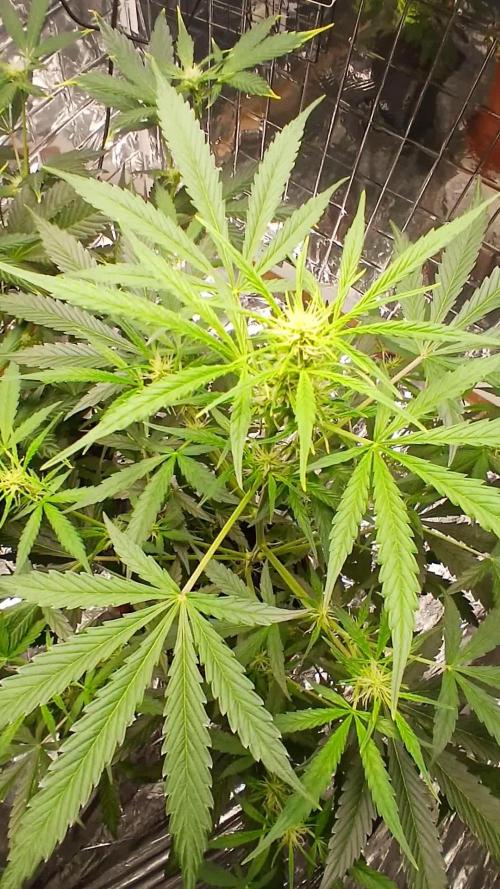
The sixth week is over! This girl is taking it easy, while becoming more and more beautiful. Pistils, pistils everywhere, as Buzz would say. The prospects are really excellent. This week she grew to 83 cm and drank a total of 3.5 L, 2.5 with nutrients and 1 L of water only. The lamp is now fixed at 30 cm at 100%. Week seven is coming! Show us some calyxes, girl!

Likes
12
Share


@Xpie77
Follow
✂️ Oogst & Droging
Aantal planten: 5
Verwachte opbrengst: ±30g per plant
Totaal verwacht: ±150g droog gewicht
Status: Hangend te drogen in een donkere ruimte, 18–19°C bij 55% RV
Verwachte droogtijd: 7–10 dagen, daarna start de curingfase
De geur is tijdens het drogen al zeer intens: een combinatie van zoete bessen, kush en gas. Toppen zijn compact en rijk aan trichomen.
---
🔜 Wat volgt
Zodra de toppen voldoende gedroogd zijn (stelen breken met een ‘snap’), start het curingproces in glazen potten. Dit zal het terpenenprofiel nog verder verdiepen.
---
Eerste conclusie:
Zeer sterke run met Blue Zushi. Alles wijst op een premium eindproduct, met een goede balans tussen geur, smaak en potentie. Eindbeoordeling volgt na curing & testsmoke!

Likes
92
Share


@Regenwurm
Follow
Die Ladies sind wunderbar in der Blüte.
Diese Woche ein leichtes entlauben!
Es sind ausreichend Nährstoffe enthalten (Blattfarbe) , daher nur 2 mal gedüngt sonst nur Wasser!
Außerhalb vom Zelt habe ich einen großen Entfeuchter auf rd 50 % regulieren müssen um im Zelt optimale Bedingungen von rd 55% zu erreichen.
Tage der Keimung = 4 Tage.
Tage in Wachstum = 28 Tage
Tage Blüte=42
Wachstum h = 0 cm
2 mal in dieser Woche mit Purolyt Mischung 1:25 besprüht
Lichtstärke: 95 %
PPFD: ca. 850 umol
Lichtabstand: 40 cm
Std Tag/Nacht: 12/12
Temperatur Tag: ca. 25 Grad
RLF Tag: 55-60%
Temperatur Nacht: 22 Grad
RLF Nacht: ca. 55 %
VPD Wert: ca. 1,00-1,10
PH Wert Wasser/Düngelösung: 6,4
EC Wert: nicht gemessen
Ventilator Oszillation: Stufe 2
Befeuchter: aus
Entfeuchter: Außerhalb Entfeuchter an
Zusätzlicher Entfeuchter: 1 Stk. außerhalb vom Zelt im Raum
Bewässerung: 2* bewässert mit Dünger mit den o.g. Mengen, 3 mal pures Wasser
Purolyt Besprühung: 2 mal
Besprühung Fast Plants Spray: 0 mal
Controlling: Grow Control
Dünger: Greenbuzz Nutrients
Licht: Pro Emit Vollspektrum
Abluft: EC Carbon Active 750 m3
Danke an Greenbuzz
https://greenbuzznutrients.com/de/
Ihr bekommt 25 % Rabatt bei der Nutzung des Codes auf der GB Homepage
https://greenbuzzliquids.com/de/shop/
Code: GD42025
(Mindestbestellwert 75€)

Likes
64
Share


@MadeInGermany
Follow
Hi everyone 🤗.
On 07/16/20 she was placed in the flower tent.
She gets a good growth spurt :-).
From the next watering there will be Canna Flores instead of Canna Vega.
I am very excited that this bush will develop in bloom Blüte.
In the next 3-7 days everything will be taken down that would later end up as popcorn buds 😅.
I hope you enjoy the update, stay healthy 🙏🏻 and let it grow 🌱😃
You can buy this Strain at :
https://www.barneysfarm.com
Strain :
Blue gelato 41 clone from mother (Barney's Farm)
☝️
Genetics:
Blueberry x Thin Mint Girl Scout Cookies x Sunset Sherbert
👍
Vega lamp:
2 x
Todogrow LED HLG Quantum Board 100 W ( 200 W )
💡
Flower lamp:
2x Todogrow LED CXB3590 205 W = ( 410 W )
💡 ☝️
Soil : Canna Terra Professional +
☝️
Fertilizer:
Canna Terra Vega , Canna Terra Flores , Rizotonic, Cannazym, CANNA Boost, Pk 13/14, Canna Cal / Mag, Canna Ph - Grow, Canna Ph-Bloom
☝️🌱
Water:
Osmosis water mixed with normal water (24 hours stale that the chlorine evaporates) to 0.2 EG. Add Cal / Mag to 0.4 Ec Ph with Ph - to 6.0 - 6.3
💦 💧


Likes
11
Share


@Yellabeard
Follow
Here we are start of week 6 and the girls have burst into flower .
No problems yet everything seems to be as I would expect .
The #AutoPots make my growing experience so much easier and the plants seem to thrive in this system .
Likes
27
Share


@Theia
Follow
Great progress with not much to report. All my plants this grow I trained to be tall instead of my normal method where I like to spread a plant to the width of my space. About 80cm across.. I thought this time if I trained them tall and thin I could fit 2 side by side. But as I am chicken I decided to do the kush as I normally would so she is a lot wider and not as tall. She is beautiful and I love this strain so far. Fat leaves early in veg to power her stretch and then a more slim leaf like a sativa in flower. This works great as it's letting loads of light through to her lowers
Feeds are going in at 1.8 to 1.9ec she's loving it and I think could take a bit more.. but as I said earlier I'm a chicken and she is doing so well...😜
Sorry about the poor video I have 4 plants that are over a meter tall all squashed behind me so I could barley move..😔
Thanks for looking.
Grow well 🌿💚🌿🙏🏼


Processing
Likes
9
Share


@Goldenboy2020
Follow
5th week of flower everything still looking good. Nugs getting bigger.
9/8 Middle of week 5 some of the buds are starting to flower and just thc everywhere. Will have plenty of trimmings for concentrates. Still wondering about the yield??? But see a little burn on edges of leaves. Probably go water only anyway cause still have organic toil soils working. Smells so good!!
Last day of week 5 looks amazing so much THC everywhere. Looking forward to them fattening up in next week or two.


Likes
4
Share


@Nachtjasmin
Follow
Einige Blätter, die ich nicht aus dem Weg bekommen habe und welche die künftigen Buds beschatten, habe ich abgenommen. Ebenso abgestorbenes Blattmaterial.
22.11. Die ersten Trichome sind sichtbar und darunter scheint es ziemlich violett zu sein *freu*
Likes
42
Share


@Prototype0181
Follow
Day 21,
These 3 are a pain in the 🍑 i know why they look like they do🤦♂️🏻 (K) but i just don't get it. I'm already pushing these 3 to EC 1.8 but they just keep hungry🤷 I'm gonna switch to Greenhouse powderfeeding for a little while to get them a higher dose of K. Hope this solves the issue.
Rock on Growmies 🌱

Likes
7
Share


@Naujas
Follow
To be honest, I was very surprised by this girl :) I didn't expect her to grow so much, so far everything looks good :) to be honest, I don't even know how she grows so much, where there is minimal sun :).

Likes
12
Share


Likes
60
Share

@GrowerBaal
Follow
Day 92
Had no time.
Day 93
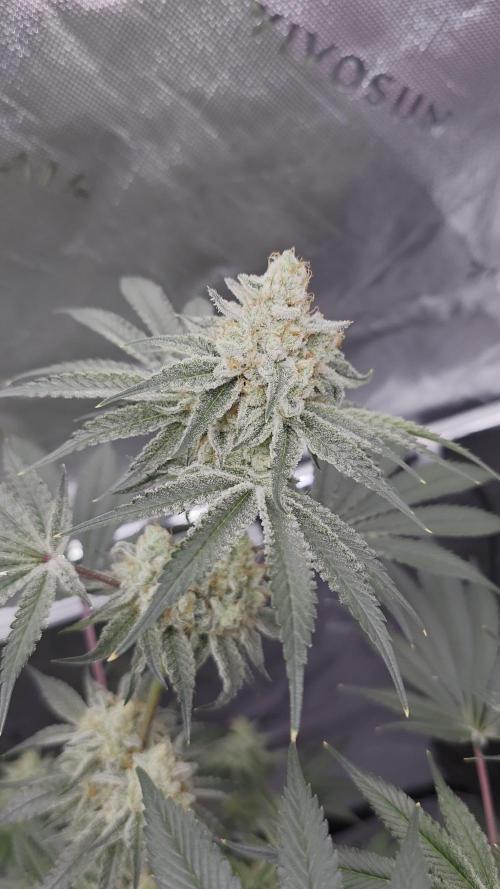
Her eighth full week of flowering started yesterday and today is the 55th day on 12/12. HSC wrote she needs 50 to 55 days to mature, so i will check her this weekend. Her buds became already very frosty . As the heat wave had ended the humidity inside also decreased.
Day 94
Decided to chop her after i checked the trichomes. There are already amber ones at the buds on the middle of the height. She smelled intensively like sour oranges.

Likes
21
Share


@PrairieFrostGrow
Follow
*******This week will be used for 4 cuts that were taken of the seeds......Gorilla Girl from Sweet Seeds SWS74......There were three of the green pheno and the last of the purple pheno***********
********Week of June 1 to 7, 2019.
First full week of 12/12 light schedule and she is setting in her flowers.
Second SCROG put in to help with those future heavy buds😀👍
More detail coming :)

Likes
15
Share


@Nvchods3
Follow
Se da fin a este cultivo de 2 variedad en carpa de 80x80 por 240w.
La primera variedad ya en proceso de curado es la Green crack punch (5plantas)
tuvieron buen crecimiento, pasaron por 2 transplantes ( 3lt a 7lt)
muy rico sabor se llega a sentir los terpenos de cada cogollo.
No es todo, en este mismo espacio nos quedan aun las 4 powerFlower, las cuales estos dias se iran de corte para preparar el secado y posterior curado.
5 Green crak punch

Likes
43
Share


@The_Northern_Skunk
Follow
Well most of the autos have came into flower a couple are still slacking behind and the others are a week younger so i expect them to come into flower in the next week or so..
Likes
90
Share


@MrCOCO
Follow
Hi ... It's been a crazy week and it switched to 12/12 on the 40th day of vegetation.🍃🍃🍃 They are ready for sure there is no more to wait ... 🍃🍃🍃Good luck girls during the flowering stage🍃🍃🍃
Likes
24
Share


@Dingle
Follow
No feed this week just continuing to flush.
Seeing more and more amber trichomes starting to appear now so it’s lights out from tomorrow for 48 hours before harvesting to dry.
The buds have bulked up nicely over the week and are smelling really tasty!
All going well the next update will be the final harvest. 🙌
🍪🍧🍪
Likes
32
Share

@MadeInGermany
Follow
Unfortunately, I had to find out that my account is used for fake pages in social media.
I am only active here on growdiaries.
I am not on facebook instagram twitter etc All accounts except this one are fake.
Flowering day 35
since time change
to 12/12 h.
Hi everyone :-) .
We got lost in the middle of bloom.
The buds are developing really well 😁.
The scent gets stronger every day when you open the tent .
I watered it twice this week with 1.2 l each time (see table for nutrients).
Almost every leaf was examined for animals and diseases.
Everything looks great 👍.
I'm really looking forward to the coming weeks and I wish you all a lot of fun until the next update.
Stay healthy 🙏🏻
You can buy this Strain at :
www.Zamnesia.com
Type:
Runtz
☝️🏼
Genetics:
Zkittlez x Gelato
👍
Vega lamp: 2 x Todogrow Led
Quantum Board 100 W
💡
Bloom Lamp : 2 x Todogrow Led
Cxb 3590 COB 3500 K 205 W
💡💡☝️🏼
Soil : Bio Bizz Coco
☝️🏼
Nutrients : Green House Seeds Company Powder Feeding Bio
☝️🏼🌱
Water: Osmosis water mixed with normal water (24 hours stale that the chlorine evaporates) to 0.2 EC. Add Cal / Mag to 0.4 Ec Ph with Organic Ph - to 5.8