Likes
Comments
Share
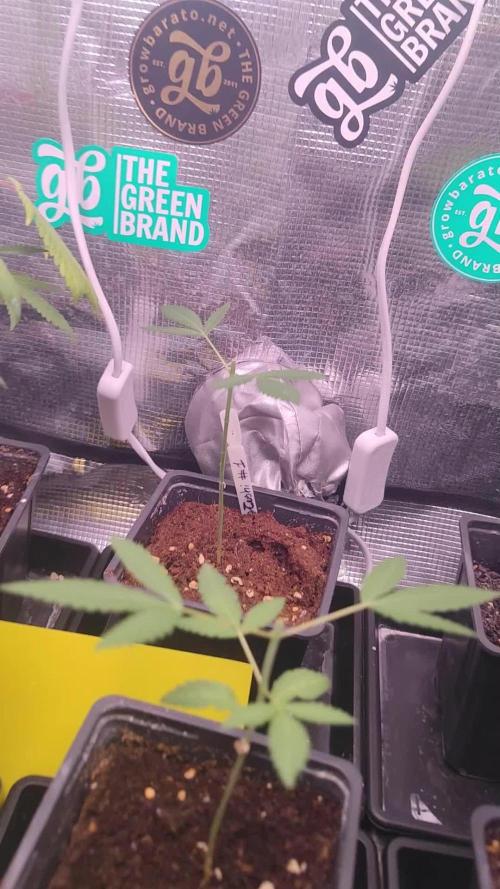
The first 2 one companion planting a f1photoperiod(documented on another diary) and in a 2L pot are both lemon cherry cookies auto and the last one in a 1L pot is frozen face auto there are 2 sets of 2 side branches streaching on each autoflowers and handeling first set of defoliation and LST extremely well hopefully should see signs of more streaching as coming up to pre flower due to autos genetic makeup
Processing
Likes
24
Share
**Encontrarás la traducción a español al final de la descripción** From/Desde: 07/10/19 || To/Hasta: 13/10/19 From day/Desde día: 77 || To day/Hasta día: 83 If you like this week, please hit a like, it costs you nothing! 👊. Thanks in advance 😉! -----WEEK SUMMARY----- The colas have already begun to be well defined this week, as it can be seen. It does not seem that the buds are going to cover from the bottom to the top because there is much space between the middle nodes. I really don't know what this may be due to, probably because of lack of light or by using nutrients in the wrong way. The same happened to me with the Gorillas and Money Makers in my last diary and in that case I attributed it to the failed defoliation I made. This week I begin to detect a deficiency of magnesium in one of the large leaves (or so I think), even so within 2 weeks I do not take precautions because until then it was not obvious to me (serious error). On the other hand this week I started to go hard with the E.C. in the irrigations, I trusted that I was not feeling so bad E.C. sings on Alice and the problems came all at once within 2 weeks. -----WATERING CALENDAR----- 08/10/19 DAY 78 - 3 l with BudCandy, BigBud, Bloom Nutrition & Stimulator, RhinoSkin, B52, Nirvana, Sensyzim & PKBooster @ (2.3 EC | PH 6.4 | 24.8ºc) 11/10/19 DAY 81 - 4 l with Megabud (1 g/l), SilicaPower, Budcandy, BudFactorX, BloomStimulator & (BigBud & BloomNutrition) half dosed @ (2.1 EC | PH 6.3 | 24.5ºc) *****ESPAÑOL***** Por favor, si te gusta esta semana dale un like, no te cuesta nada 👊. ¡Gracias por adelantado 😉! -----SUMARIO SEMANAL----- Esta semana ya se han empezado a definir bien las colas, como se puede observar no parece que los cogollos vayan a cubrir de la parte inferior a la superior pues hay bastante espacio entre los nodos medios. Realmente no se a que puede ser debido esto, probablemente por falta de luz o por estar usando los nutrientes de forma equivocada. Esto mismo me ocurrió con las Gorilas y Money Makers de mi último diario y en ese caso to lo achaqué a la fallida defoliación que realicé. Esta semana empiezo a detectar una deficiencia de magnesio en una de las hojas grandes (o eso creo), aún así hasta dentro de 2 semanas no tomo precauciones pues hasta entonces no se hizo obvio para mí (grave error). Por otro lado esta semana se me empezó a ir la mano con la E.C. en los riegos, me confié en que no la estaba sentando mal tanta E.C. y los problemas vinieron todos de golpe dentro de 2 semanas. -----CALENDARIO DE RIEGO----- 08/10/19 DÍA 78 - 3 l with BudCandy, BigBud, Bloom Nutrition & Stimulator, RhinoSkin, B52, Nirvana, Sensyzim & PKBooster @ (2,3 EC | PH 6,4 | 24,8ºc) 11/10/19 DÍA 81 - 4 l with Megabud (1 g/l), SilicaPower, Budcandy, BudFactorX, BloomStimulator & (BigBud & BloomNutrition) half dosed @ (2,1 EC | PH 6,3 | 24,5ºc)
Likes
13
Share
@4F1M6
Follow
Such a beautiful canopy! These ladies are all flowers now. Working on fattening up their rows of colas. And I mean ROWS! Healthy and strong and looking sexy. Definitely attributes that keep me happy. So easy going.... I can't wait to find out how generous they will be. They got treated with Dr zhymes as a preventative. That will basically wrap up their treatments ...possibly once more with lost coast. Upped the pk intake as they are blooming strong now. Gotta keep those engines well fuelled. Response was stellar. Happy happy happy ladies. Until next update. Happy growing and stay lit fam.
Likes
9
Share
The Bruce Banner girls went wild this week! 💪 At the start of the week, all three were sitting on IFCO crates to even out the canopy, but #2 stretched so much that she had to be moved down to the floor. She’s officially the tallest now and really taking off.🚀 #1 started stretching more as well and keeps growing strong, while #3 is still a bit smaller but catching up nicely.🌿 All three look healthy and vibrant — deep green color, no signs of stress or deficiencies.💚 They got a light defoliation this week, just removing a few big fan leaves that were shading lower budsites.🍃 A proper defoliation will come once the stretch phase is over. Environment: Temp: 25–26 °C RH: 55–60 % PPFD: around 900–1000 µmol/m²/s under the Spider Farmer SE5000 Controlled by the AC Infinity AI system 🌡️ They’re drinking a lot #1 still the thirstiest one, taking about 4 L every 2 days, while #2 and #3 get the same amount roughly every 3 days.💧 Overall, they’re stretching beautifully, stacking up nicely, and looking more impressive each day. Can’t wait to see them finish the stretch and start focusing on those buds.✨🔥
Likes
2
Share
@lleuquino
Follow
Probablemente en un par de días empiece con el lavado de raíces y aumente progresivamente la defoliación.
Likes
2
Share
@Rustynugz
Follow
This week I decided to introduce nutrition. I am new to this so i went for organic (from what I've read) bio bizz and is also readily available at my local grow shop thankfully haha my first run so I halved the recommended amounts more or less as I didn't was to burn the plants as they are still young.
Likes
Comments
Share
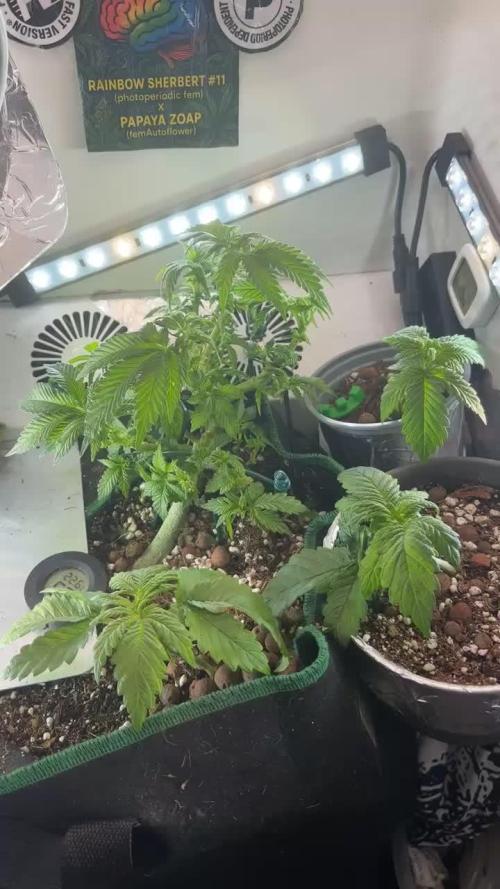
Having cal mag issues going to hit the grow store tomorrow am and see can I get some organic cal mag and see if that helps other than that no real issues 2/24 I’m going sit my dumb ass down and chill I did a defoliation and man I over did it I think it’s pretty aggressive and i don’t know what I was thinking I was just clipping away 🤦🏾‍♂️…… anyway got some calmag for the color issues only going 1/2 tsp see how that goes hopefully when the new growth and more stretch happens it’ll look a lot better I’m also bottom feeding the calmag hope that works too
Processing
Likes
3
Share
Very happy with the size and shape, exactly what I was hoping for. Almost cured the copper defiency then the rain started and I haven't been able to feed the problem plant. Should have it sorted by next update!! 🙏🙏 They have all had strength training but seem to straighten themselves out on the same day and continue growing!
Likes
13
Share
Recette du tco pour 20 litres. (Grammes : gr) 50gr biochar 250gr zéolite 3gr granulé Micro-Organisme IT45 10gr pollen d’abeilles 10gr levure de bière 3gr endomychorize 10gr consoude 20gr vers de farine 10gr cendre coque de ricin 12gr ortie microniser 15gr Kelp 10gr spiruline 10gr de cbd living soil 20ml de miel liquide 30ml de mélasse 20ml d’acide humiques et fluvic Mettre tous les ingrédients (sauf la mélasse ,l’acide h/f et le miel) dans un filtre 400micron, le placer dans un seau avec de l’eau (10litres). Rajoutez le miel et 10ml de mélasse Y mettre un micro bulleur alimenter sur une pompe à air et faire oxygéné le mélange pendant 24h. Rajout de 10ml de mélasse après 12h le début de la mise en route de la pompe. A la fin des 24h rajoutez le restant de mélasse et d’acide h/f, mettez y en plus 10litres d’eau au mélange. Reste plus qu’à arroser! j’y ai incorporé 7litre de mélange La veille j’ai préparé le pot à l’arrosage avec 500ml d’eau et 2gr de Bacillus IT35 Amyloliquefaciens X5 Bacillus Amyloliquefaciens : rhyzosphère, probiotiques. Aspersion et arrosage. Utilisable pour toutes cultures. La bactérie Bacillus Amyloliquefaciens se fixe dans la rhizosphère en se nourrissant des exsudats racinaires. En contrepartie, elle stimule la croissance racinaire en sécrétant des métabolites de croissance et solubilise le phosphore en sécrétant des phytases (enzymes). Effet probiotique consistant en l’utilisation de micro-organismes bénéfiques pour la nutrition et la santé des plantes. La spiruline, le plus riche et le plus complet des amendements organiques La Spiruline est une algue aquatique connue comme complément alimentaire, la Spiruline est aussi un amendement organique et écologique très complet. D'une grande qualité nutritive, elle apporte à vos plantes une quantité de nutriments, dont l'azote, phosphore, potassium, minéraux, acides aminés, vitamines, chlorophylle et protéine. Le charbon végétal actif est capable d’absorber jusqu’à cinq fois son poids propre en eau ainsi que les éléments nutritifs qui s’y trouvent. Il joue ainsi le rôle de catalyseur et d'amplificateur pour les fertilisants traditionnels, qu'ils soient d'origine organique ou minérale. Ce pourquoi il est idéal pour activer un sol et pour les thés de compost oxygénés. Le charbon végétal améliore la diffusion et la disponibilité des éléments nutritifs dans le sol et offre des conditions propices au développement des micro-organismes. Le Biochar peut être introduit dans une grande variété de sols. Il est particulièrement efficace dans les sols pauvres, difficiles et acides. Pour faire agir rapidement et efficacement sa capacité d’amendement, le charbon végétal est enrichi et biologiquement activé avec des micro-organismes. Le Biochar se comporte ainsi comme un structurateur et un activateur dans le but de valoriser les sols. Composition : • Charbon végétal actif 31%
• Matière organique 33%
• Matière sèche 75%
• C/N : 17
• PH : 7,2
• Azote (N) : 2,1 % dont 1,2 % azote organique
• Phosphore (P205) : 0,74%
• Potassium (K20) : 1,18%
• Calcium (Ca) : 6,8%
• Magnésium (MgO) : 0,65% Le pollen est l'ingrédient de base de la fabrication du miel par les abeilles. Riche en vitamines et minéraux, il est qualifié « d'aliment parfait », y compris pour les plantes ! Les zéolithes sont des roches cristallines, présentant des capacités d'adsorption particulièrement importantes vis à vis des polluants que l'on rencontre dans l'eau et dans certains liquides, ainsi que dans l'air et les gaz. Elles sont extrêmement poreuses comme les charbons activés et elles peuvent être chargées électriquement pour opérer comme des échangeurs d'ions. La zéolithe est un produit naturel qui respecte notre environnement. Utilisé dans le milieu industriel depuis de longues années déjà, ce minerai aux propriétés filtrantes particulières commence à se vulgariser dans le domaine de la piscine privée, de l'aquariophilie, des bassins d'agrément, de la récupération des eaux de pluie, ou encore de la culture des bonsaïs et autres plantations diverses par exemple... 4 points techniques majeurs : - Grâce à leur propriété hydrophile, les zéolithes peuvent adsorber l'eau jusqu'à 30% de leur poids total et sans aucune variation de volume : pas de gonflement en présence d'eau ni de craquement en cas de déshydratation comme certaines argiles. Les zéolithes sont d'ailleurs de puissants agents anti-mottant (anti-agglomérant). Cette propriété est très appréciée dans le cas des terrains de golf et autres aires de jeux. - Les zéolithes ne captent pas l'eau de façon irréversible, elles se comportent comme une réserve au voisinage des racines. Celles-ci peuvent capter l'eau en fonction de leur besoin. Les zéolithes permettent ainsi de réduire les besoins d'arrosage jusqu'à 35 %. - Une zéolithe se comporte comme une "Zone de Stockage" qui retient l'azote et les éléments minéraux nutritifs au voisinage des racines et les relâche lentement en fonction des besoins de la plante. Cela se traduit par une croissance harmonieuse mais rapide du végétal. - La capacité d'adsorption et l'énorme rapport surface/volume des zéolithes, vont permettre à la fois la rétention de la solution du sol et une bonne oxygénation au voisinage du système racinaire. Les zéolithes favorisent donc l'organisation biologique des sols en contribuant au développement de la micropopulation. L'apport en nutriments (N, P, K) est réduit de 20 à 25 %. Ces derniers, adsorbés par la zéolithe, sont beaucoup moins sensibles au lessivage et à l'évaporation. Composition minéralogique : * Chabasite 70 % * Phillipsite 2 % * Feldspath 5 % * Augite 3 % * Illite - Mica 2% Analyse atomique: * Sio2 52 % * AL2o3 17 % * CaO 5,7 % * K2O 6,1 % * MgO 2 %, * Na2O 0,6 % * Fe2O3 3,6 % Amendement calcaire, dolomie et gypse avec préparation microbienne à base de Bacillus Amyloliquefaciens IT45 et Saccharomyces cerevisiae LYCC6420 Formulation : micro granulés (1 – 1,6 mm) à base de rhizobactéries favorisant la croissance des plantes qui se multiplient et colonisent rapidement la zone des racines, et de levures Saccharomyces cerevisiae souche LYCC ayant un effet probiotique. Les PGPR produisent des enzymes qui solubilisent le phosphore à partir de complexes inorganiques et organiques dans le sol et stimulent la croissance des racines efficaces augmentant ainsi la zone d'interception des éléments nutritifs. Les levures LYCC permettent une occupation de la rhizosphère par une flore bénéfique. Composition :
• Matière sèche : 96,8%
• Matière organique : 91,5%
• N total : 6,6% dont N soluble dans l'eau 0,17%
• P total : 2%
• K total : 1,7% Micro-granulés : 
• Oxyde de calcium (CaO) total : 30%
• Oxyde de magnesium (MgO) total : 7%
• Anhydride sulfurique (SO3) : 13% La levure de bière est une matière vivante qui permet un meilleur fermentation pour les thés de compost oxygénés notamment conseillé pour accompagner les croissances ou apporter un gros coup de pousse pendant la floraisons. La levure stimule la vie des sols également à l'arrosage direct en apportant tout aussi bien que dans le TCO sa population l'espèce micro-bactérienne positive pour votre sols ainsi que des oligo-éléments et diverse vitamines. Composition : • 2,8% (N) total dont 1% (Norg), • 2,3% (P205) • 1,6% (K20) • 35% de MO • C/N : 8. PH : 8,4. Sous forme de poudre mouillable. Il contient des spores du champignon mycorhizien Rhizophagus Irregularis MUCL57891 avec des levures inactivées spécifiques. 2000 spores/gramme d’endomycorhize Rhizophagus Irregularis MUCL57891 et Saccharomyces Cerevisiae LYC6420 inactivée. Se connecte efficacement au système racinaire et forme un vaste réseau souterrain de filaments, qui agissent comme des extensions pour atteindre les nutriments et l’eau au-delà de la rhizosphère Composition : • Poudre contenant 2000 spores/g. d’endomycorhizes Rhizophagus irregularis La Consoude (Symphytum Officinale) est une plante présentant de nombreuses propriétés. Particulièrement riche en Potassium (K) organique, la consoude est une alliée idéale pour les périodes de floraison. La consoude a tout pour plaire : riche en vitamine B12, elle agira également comme stimulateur racinaire, mais aussi comme biostimulant cellulaire, grâce aux alcaloïdes, aux allantoïnes et jusqu'à 30% de protéine ! 100% déjection de vers de ténébrions.
Très riche en microorganismes, le guano de vers de farine est une matière directement composté par les vers. En effet, c'est bien la digestion de matières végétales par des larves, insectes ou autres arthropodes qui valident le processus de compostage, que ce soit en zone de production de cultures d'insectes, pour le compost maison ou la dégradation de litière forestière. Les bactéries et autres champignons obtenus grâce au système digestif de nos vers, permettent la dégradation accélérée des éléments nutritifs dans vos supersoils, et les symbioses permettant l'assimilation des éléments nutritifs. Cette bio-activation intense mettra dans vos sols, à la disposition de vos plantes, un panel tellement varié de nutriments frais qu'il nous est aujourd'hui technologiquement impossible de pouvoir tous les nommer et de les compter. Le guano de vers de farine fournit une grande polyvalence. Très équilibré, il s'utilise en entretien ou en apport ciblé seul ou en complément de d'autres amendements ou fertilisants organiques. Il agit comme un puissant activateur de sol et/ou de substrat. Cendre coque de ricin NPK 0,1-18,6-16,5. 0,1% (N-Azote), 18,6% (P205-Phosphore), 16,5% (K2O-Potasse), 11,7%(Ca0), 9,1 (Mg0) - Origine : Inde ACTION SOL • rend rapidement accessible au sol Phosphore, Potasse, Magnésium et Calcium. ACTION PLANTE • Apport aux stades agronomiques propices. • Produit riche en éléments fertilisants : combinaison NPK 35%. • Régularité de l’apport, milieu et fin de floraison. . Favorise la sénescence. Analyse chimique : • NPK 0,1-18,6-16,5 • N-Azote 0.1% • P205-Phosphore 18,6% • K2O-Potasse 16,5% • CaO-Calcium 11,7% • MgO-Magnésium 9,1% Ortie bio micronisée Stimule la vie du sol et la végétation. Composition : • 2,8% (N) total dont 1% (Norg), • 2,3% (P205) • 1,6% (K20) • 35% de MO • C/N : 8. PH : 8,4 KELP poudre
ascophyllum nodosum
- amendement sol Croissance et floraison - Meilleure germination - Meilleur développement racinaire Meilleure assimilation - Résistance aux stress osmotiques - Augmente la production de chlorophylle = plantes plus vertes = lumière mieux captée - Lutte contre le stress osmotique - Développement des Micro-Organismes dans le sol – Riche en vitamines, fer, iode, oligo-éléments, hormones de croissance auxines et cytokinines - Idéal en épandage et pour les thés de compost oxygénés. Important : notre Kelp est un goémon noir mais il n'est pas le varech bien moins fertile de la même famille qui est l'algue qui pullule et pollue la Bretagne, notre algue pousse uniquement à plus de 50 mètres de fond dans les grands courants froids au large de la Norvège.
Likes
6
Share
Plant is responding really well to the change in conditions! I've noticed a rapid turn around in her vigor and overall growth day by day. Really glad I decided to ride this out. Next update should be a great one! Happy growing!
Likes
11
Share
@B4niTa
Follow
On day 32 big runoff On day 34, a little defoliation
Likes
24
Share
Flowering day 15 since time change to 12 / 12 h Hey guys :-) This week the ladies developed beautifully 👍. The stretch has started very strongly :-) . Watering was done twice this week with 1.2 l (see table above for nutrients). The heating mat does exactly what it is supposed to do, you can see that the ladies are doing perfectly again 😃. Fresh osmosis water was mixed with tap water in a 100 liter tank so that I would have enough stale water for the coming week 👍. Otherwise everything was cleaned and checked. During the check, I noticed that after spraying neem oil 3 times, there were still a few damn trips to see. I have ordered nematodes for leaf and substrate against tripse. Then they should finally be gone again 🙏🏻 have fun and stay healthy 💚 👇🏼👇🏼👇🏼👇🏼👇🏼👇🏼👇🏼👇🏼👇🏼👇🏼👇🏼👇🏼 You can buy this Nutrients at : https://greenbuzzliquids.com/en/shop/ With the discount code: Made_in_Germany you get a discount of 15% on all products from an order value of 100 euros. 👇🏼👇🏼👇🏼👇🏼👇🏼👇🏼👇🏼👇🏼👇🏼👇🏼👇🏼👇🏼 You can buy this strain at : Clearwater Seeds Water 💧 💧💧 Osmosis water mixed with normal water (24 hours stale that the chlorine evaporates) to 0.2 EC. Add Cal / Mag to 0.4 Ec Ph with Organic Ph - to 5.8 - 6.5 MadeInGermany
Likes
8
Share
@Oldwied
Follow
Day 58 The colours of autum are so beautiful. 1 week left to haverst.
Likes
25
Share
She stretched a good bit this week will be much better for airflow. The plant structure if one expected from its lineage, stocky and hardy. No smells of pinene just yet but I would expect at some point. Thanks again Beans! Stay safe, 🍻
Processing
Likes
4
Share
Added some CO2 to help with photosynthesis while at higher temps. These ladies really blew up at the end of last week and this week! The smell has really starting to be noticeable and pistols / flowers are finally showing! Side note I finally got more seeds to replace the one I lost early on. These ladies are really starting to become a treasure. Ended my LST this week.
Likes
15
Share
Chugging along and looking good. Nothing major to report. Keeping feeds pretty consistent. Things are going smooth. Hate to mess that up right now. 🌱 👊🏻
Likes
6
Share
@Rinna
Follow
This was a wild ride. Gave way to many nutrients and I realised this way too late, when lock-ups already started to happen. The buds still look very potent, I just think they had way more in em size/potency wise if the nutrients would've been on point. Not growing auto flowers indoor anymore, but I'll deffo be growing this one outdoors this year! The smell is out of this world, #1 smells like tropical fruit juice, #2 more of a candy-sweetness but definitely tropical. Can't wait for ya'll to grow this one!
Likes
Comments
Share

@A-C-H
Follow
Ich habe Kompost hinzugefügt. Der Beginn der Blüte ist explosiv.
Likes
165
Share
She start a little bit weak but then she is a big champion plant. Really nice colors. I recommend give all cares possible the firsts weeks and she will do the rest later. When I read that she is very good to extractions I never imagined how good she is for that. I get 159 g of trim from 3 plants. I honestly recommend this strain. I will upload better photos and more info about flavor, dry weigh and all the rest
Processing
Likes
29
Share
================================================================================= CRIB NOTES - I'M USING A LIGHT CYCLE OF 6 ON 2 OFF THIS SHOULD KEEP THE LADIES FROM STRETCHING AND GROW VERY COMPACT. Many growers advocate the use of an 18/6 light schedule (18 hours on, 6 hours off) while plants are in Veg. However, this may not be the most beneficial light schedule. Switching to a series of 6/2 (6 hours on, 2 hours off) light patterns may increase plant growth while also potentially creating a more stable controlled environment. While this new schedule may sound risky, it actually comes with a number of benefits. Cannabis is a “short-day plant,” meaning that it will only flower when exposed to long periods of darkness and short periods of light. For cannabis to flower, there must be at least 12 hours of continuous darkness. This allows for the use of a series of shorter light schedules while the plant is in Veg – as long as the plant receives less than 12 hours of continuous darkness, it will stay in Veg. BENEFITS OF A 6/2 LIGHT SCHEDULE There is a lot of research that suggests that cannabis plants can only process a certain amount of light per day. After that level has been reached, the plant can no longer absorb more light, and any additional light is essentially wasted. By breaking the light cycle into multiple 6 hour periods, the plant is able to rest and process the light it has received. When the lights come back on 2 hours later, the plant will be ready to process additional light, allowing you to get the most plant growth out of every minute your lights are on. At a biological level, cannabis’s inability to grow more once it has received a certain amount of light can be attributed to the way the plant processes carbon dioxide (CO2). A majority of the mass accumulated in cannabis is associated with the amount of CO2 found inside plant cells. While under light, cannabis tries to prevent CO2 from leaving its cells by cutting off transpiration. However, this prevents new CO2 from entering into the cell, blocking new growth. When the lights are turned off, and no photosynthesis is occurring, the plant is able to absorb new CO2 into its cells. Additionally, when plants are exposed to 18 straight hours of intense light, they become stressed. Signs of stress – droopy or curled leaves – will usually appear towards the end of the light cycle. While some stress can be beneficial to plant growth, too much stress can cause harm to your plants and prevent them from reaching maximum growth potential. Giving plants 6 hours of intense light at a time not only puts less stress on the plants, it also spread out the load on your cooling system over a longer period of time. The cooling system works the hardest when lights are on. By turning off the lights for 2 hours at a time throughout the day, your cooling system will get a break between light cycles, allowing the room to be cooled to desired temperatures before the lights come back on. With a properly sized cooling system, this benefit will be minimized as the system will be designed to handle the heat load throughout the entire light cycle. While there are many approaches to Veg light cycles for cannabis, a 6/2 schedule allows for maximum plant growth. A 6/2 schedule allows plants to process more intense light, prevents plants from becoming stressed and puts less stress on your cooling system. It’s a win all around. Give your plants a break every 2 hours and you’ll be amazed at the results. ================================================================================= Day 1 October 1st - 2018 - The 3 Seeds are in germination at the present. The seeds were soaked in reverse osmosis water for 16 Hr. then transferred to a paper towel. DAY 2 October 2nd - 2018 - 2 out of the 3 seeds have germinated. the first 2 will be put into hydrofarm soilless seed starters using Revers Osmosis water and placed under 3 grolux flor 45 watt. Day 2 October 2nd - 2018 1:00 Pm. All 3 seeds planted into hydrofarm soilless seed starters using Revers Osmosis water and placed under 3 grolux flor 45 watt Day 3 October 3rd - 2018 - 9:00 Am. 2 ladies have popped out there little heads. Day 4 October 4th - 2018- 9:30 Am Seedlings are doing fine. All 3 seeds have germinated. Day 5 October 5th - 2018 ROW being installed. 2:30 Pm ROW installed. Day 5 October 5th - 2018 Seedlings are getting first set of single serrated leaves. Day 5 October 5th - 2018 The tent is setup and running R.O.W. Day 5 October 5th - 2018 Washed all Hydroton Clay Pellets in ROW. NO DETERGENTS. Rinse and Rinse again. Using R.O.W. so the medium has a practically no Ph. Day 6 October 6th - 2018 - Transferred the best 2 seedlings to tent under Veg. 1000 Watt L.E.D. Each bucket contains 19 liters of R.O.W. no nutrients added. This will continue for the next 2-3 weeks depending on growth. Day 6 October 6th - 2018 Seedlings put under Light Cycle of 6 On 2 Off Ect. Day 7 October 7th - 2018 - Seedlings looking good. Seems everything is fine on 6 on 2 off light cycle. Day 7 October 7th - 2018 - The 3rd seed germinated is looking very healthy. Transplanted it from the hydro seed starter to a 1 gallon planter with soil. Placed this in between the 2 main plants in the D.W.C. & used R.O.W.
Likes
5
Share
@pareto
Follow
She looked so great but just didnt bulk up. -------------------------------------------------------------------------------------------------------------------------------------------------------------------------------- Set up cost (fixed costs) -Lamp: 40€ -Timer: 3,5€ -Pot: 4€ -Total fixed costs: 47,5€ Given 5 years (or 15 grows) usage time translates to around 3,17€ per grow in materials. Variable costs: -Seeds: 3,17€ -Soil: 6€ -Fertilizer: 3,50€ -Power (100 days 18h/day): ~25,92€ (exact figure after harvest) -Total variable costs: ~38,59€ -Total costs per grow: ~41,76€