


Likes
Comments
Share


@GreenAutoConsumo
Follow
Muy buenas amigoooos!! Aquí dejo una nueva publicación de otro par de las matas de mi amigo que como podéis ver para colmo después de todos los problemas que an pasado.. Para colmo cogieron araña algunas de ellas, como podéis ver la Royal Domina a sido la más afectada pero hemos podido sobrellevar el cultivo y finalizarlo a pesar de esta plaga tan temida, la hemos combatido con aplicaciones foliar es de agua muy fría y mucho aire para que no se reproducieran más y las que estuvieran se fuesen y la verdad que a resultado bueno a podido cosechar algunas ya. Solo le quedan tres ejemplares en vida que lo iremos viendo estos días, lo dicho.. Espero que os guste!!
Buen día y buena semana!






Likes
4
Share


@Altitonans_Fulmen
Follow
The thoughts shared in this journal are my own—a snapshot of personal understanding at the exact moment of writing. It is not intended as a reference of absolute fact, but rather as an exercise in ἐπίνοια (epinoia): an exploration of thought, intuition, and creative insight.
Epinoia(ἐπίνοια) is a Greek term meaning thought, intention, purpose, or conception, stemming from "mind" (nous) and "upon" (epi), representing the mind's reflective or creative process, used in philosophy (Aristotle, Gnosticism) and theology to discuss understanding and divine names, appearing once in the New Testament for the "intent of your heart" (Acts 8:22). It signifies the mind's operation to form ideas or designs, contrasting with raw data or innate perception, and in Gnosticism, it's an emanation of divine wisdom (Sophia).
"Φsis" is a stylized spelling of the Ancient Greek word φύσις (physis), which translates directly to "nature" or the intrinsic essence of a living thing.
Exploring the deep intersection of science, intuition, and creative insight often leads to breakthroughs that challenge our understanding of what is possible. When we approach high-performance cultivation not just as a hobby, but as an exercise in pushing a biological system to its absolute genetic ceiling, the results can transform from simple data points into profound proof of concept. Achieving a highly optimized environment requires a shift in mindset away from empty promises and directly toward verifiable proof, building true confidence through a detailed archive of past lessons and strategic adjustments.
This philosophy turns a standard space into a precise mass and energy balance equation, where every variable is managed to eliminate biological bottlenecks entirely. In a recent project four individual plants produced 344 grams, 280 grams, 445 grams, and 255 grams respectively, resulting in a total harvest of 1,324 grams, or 47.2 ounces, of dry product. Operating with a 600-watt light source inside a four-by-four footprint, this brings the final efficiency to an exceptional 2.21 grams per watt.
To put this in perspective, the standard traditional indoor benchmark has long been established at 1.0 grams per watt, while expert commercial operations target 1.5 grams per watt, and elite commercial systems push the envelope between 1.8 and 2.0 grams per watt. Reaching 2.21 grams per watt places the outcome squarely within the top 0.1 percent of global benchmarks, acting as a true statistical outlier that demonstrates what happens when flawless environmental parameters meet a cultivar pushed to its maximum potential. Reaching this level of mastery demands that we move past the common trap of the mirror fallacy, where the ego mistakes its own limited perspective for universal truth and views different ideas as personal threats. True progress requires curiosity and dismantling the illusion that our immediate viewpoint is the objective standard, shifting the focus instead toward how a system actually operates under the absolute laws of physics. In a high-performance setup, maximizing output is never about adding random additives or forcing growth, but rather about systematically removing the limitations that hold the organism back. By maintaining a perfect vapor pressure deficit, ideal root-zone oxygenation, and precise structural canopy training every single minute of the cycle, the plant is freed to express 100 percent of its DNA potential without any lingering genetic latency.
Managing a dense canopy inside a tight footprint presents the ultimate challenge of mitigating stagnant air and preventing moisture issues. Overcoming this bottleneck relies on a sophisticated synganic approach, which seamlessly marries the precise control of synthetic mineral inputs with the natural resilience of active organic living soil. This method transforms the room into a closed-loop system where the internal microclimate is entirely isolated from external weather fluctuations and pests. Rather than openly exhausting the atmosphere, the air is continuously recirculated, enriched, and scrubbed using 264-nanometer ultraviolet light.
The foundation of this thriving ecosystem is a comprehensive substrate composition designed to provide perfect aeration, structural integrity, and biological buffering. The primary media base integrates expanded clay aggregates, coir chunks, premium coco coir, sphagnum peat moss, horticultural perlite, vermiculite, pumice, and volcanic basalt rock. To continuously condition the soil and fine-tune mineral availability, the mixture is amended with agricultural gypsum, wollastonite, dolomitic limestone, basalt rock dust, micronutrient-rich volcanic ash, greensand, crushed seashells, biochar, and shungite. This mineral architecture creates an incredibly stable environment where active soil biology naturally prevents salt toxicity and ensures steady, reliable nutrition throughout the entire life cycle.
Living organisms within the substrate play a vital role in maintaining this delicate biological balance and breaking down organic material. Red wigglers continuously process organic matter into easily accessible plant nutrients while aerating the media; specialized predatory mites offer excellent biological control against common soil pests, and pillbugs excel at breaking down tough, woody elements. These biological components are further supported by a rich layer of organic amendments including high-phosphorus steamed bone meal, high-nitrogen dehydrated blood meal, fish bone meal, cold-processed kelp meal, dehydrated moringa powder, spirulina powder, and marine crustacean biomass rich in chitin. Combined with biological inoculants like mycorrhizal fungi, premium worm castings, and concentrated humic and fulvic acids, the entire system operates as a flawless biological transducer of light and energy.
Ultimately, shifting our perspective to view a grow space as a complete mass and energy balance equation changes the entire nature of agriculture. Success ceases to be a matter of luck or anecdotal habits and instead becomes the predictable result of meticulous design, patience, and the strategic elimination of failure. When science, biology, and engineering converge so harmoniously, we gain a deeper appreciation for the intricate natural systems that sustain life and growth. By sharing these detailed insights and refining our techniques, we can continue to unlock the absolute maximum potential hidden within the living world around us.
Comprehensive Substrate Composition:
1. Substrate Base & Aeration Media
Expanded Clay Aggregates (Hydroton Pebbles)
Coir Chunks & Horticultural Coco Coir
Sphagnum Peat Moss
Horticultural Perlite
Horticultural Vermiculite
Horticultural Pumice
Volcanic Basalt Rock
2. Mineral Amendments & Soil Conditioners
Agricultural Gypsum (Calcium Sulfate)
Wollastonite (Calcium Silicate)
Dolomitic Limestone (Calcium Magnesium Carbonate)
Basalt Rock Dust (Trace Mineralizer)
Azomite (Micronutrient-Rich Volcanic Ash)
Glauconite (Greensand)
Crushed Seashells (Calcium Carbonate Source)
Pyrolyzed Carbon Feedstocks (Biochar & Horticultural Charcoal)
Shungite (Carbonaceous Mineraloid)
3. Organic Nutrient Amendments
Steamed Bone Meal (High Phosphorus)
Dehydrated Blood Meal (High Nitrogen)
Fish Bone Meal (Phosphorus & Trace Calcium)
Cold-Processed Kelp Meal (Ascophyllum nodosum)
Dehydrated Moringa Oleifera Powder (Botanical Nutrient)
Spirulina Powder (Arthrospira platensis / Cyanobacteria Nutrient)
Marine Crustacean Biomass (Shrimp & Crab Chitin)
4. Biological Inoculants & Organic Acids
Mycorrhizal Fungi Inoculant (Endomycorrhizae / Ectomycorrhizae)
Vermicompost (Premium Worm Castings)
Humic & Fulvic Acids (Concentrated Humates)
Human Body
65% Oxygen (in all liquids and tissues, bones, and proteins)
18% Carbon (everywhere)
10% Hydrogen (in all liquids and tissues, bones, proteins
3% Nitrogen (in all liquids and tissues, proteins
1,5% Calcium (lungs, kidney, liver, thyroid, brain, muscles, heart, bones)
1% Phosphorus (urine, bones, DNA)
0,35% Potassium (enzymes)
0,25% Sulphur (proteins)
0,15% Sodium (in all liquids and tissues) (in terms of salt)
0,05% Magnesium (lungs, kidney, liver, thyroid, brain, muscles, heart)
Plant
Mother-nutrients: Carbon 47%, Oxygen 43%, Hydrogen 4%.
Macro-nutrients: Nitrogen 3%, Phosphorus1%, Potassium1%, Calcium1%, Magnesium0.5%, Sulfur0.5%.
Micro-nutrients: All the rest combined 1%
More energy, more blueprint.
Although CO2 is a naturally occurring gas that both humans and plants use, it is invisible and odorless and can be fatal at high-levels. If you’re supplementing carbon dioxide in your grow room, ensure there are no leaks in any CO2 devices and always use a CO2 monitor and alarm.
0.02% Life unsustainable
0.03% Life OK
0.04% Current ambient atmospheric co2
0.04%-0.1% =400-1000ppm standard indoor co2.
0.1%-0.2% = 1000- 2000 ppm (prolonged exposure: drowsiness).
0.2%-0.4% = 2000-4000ppm (Headaches, fatigue, stagnation, stuffiness, poor concentration, loss of focus, increased heart rate, nausea).
1% is toxic
5% is quick death.
"Dabo vobis quod oculus non vidit, nec auris audivit, nec manus tetigit, quod in cor hominis non ascendit."
Likes
17
Share


@OrganicChronic
Follow
GMO (Garlic mushroom onion) was slow to flower but came on strong weeks 8 and 9 to produce some dense heavy sticky buds. The dry weight of the plant material is unsure, but I’ll report the weight of various bubble microns when dry. Pictures of the dry bubble and maybe a melt shot impending! To dry, I decided to microplane into pizza boxes lined with parchment. It’s been fun growing along with everyone on grow diaries. Awesome


Likes
27
Share


@Smokepurple137
Follow
All have taken well to nutrients, will probably keep at same ratio throughout flowering. Will also be using 1ml/l of b52 from flower week 3 and then ripen before flush. A few seem to be fattening up before the others but all are doing OK. Will update every 1-2days.

Likes
9
Share


@Garamantes
Follow
After 4 days of heavy rain, the first mold appeared...
So I spent about 18 hours searching for plants and picking out mold with tweezers
After last year's experience with another seed bank, I expected the plants to be very affected by mold, but I have to say that Fast Buds genetics coped very well! Mold appear mainly on blisters to which the stem of the leaf leads water, which then collects between the stem and the blister
I trimmed the plants more so that the air flows better and that water does not stick to them
The plants look healthy and the flowers are gaining strength
Especially the dark purple phenotypes look very dense and hard. it also looks very resistant to mold
Very pleasant sweet fruity scent
I haven't seen my children for 3 days, it's raining extremely ... the last time I was chased out by swarms of ants in the early evening, I've never experienced this before, there were maybe a million of them and they sat on me and on the plants
I'm finally going to visit them tomorrow, I expect I'll have a lot of work to do with mold and I hope the swarms of ants haven't harmed them in any way
Likes
8
Share


@CanabisLoverHobbyGrower
Follow
Well crisis averted she reacted really well to what turned out to be just a very early top,.. she reacted so well I've topped the other one today,.. both look good and healthy, roll on next week 👌
Likes
4
Share


@Blesax_haze
Follow
Bajé la dosis de agua de llave a purificada en 1/3 del total. Dejé de utilizar top roots y están prontas a floración. Las ultimas tres fotos corresponden a una defoliación.
Likes
102
Share


@Roberts
Follow
I am harvesting Ztrawberriez autoflower. She grew in a 1 gallon perlite Ice cream bucket. She did excellent under the Spider Farmer SE3000. The worst issues I had was keeping her moist. She did really well. I am eager to try her out. Thank you Spider Farmer, and Fast Buds. 🤜🏻🤛🏻🌱❄️🌱
Thank you grow diaries community for the 👇likes👇, follows, comments, and subscriptions on my YouTube channel👇. ❄️🌱🍻
Happy Growing 🌱🌱🌱
https://youtube.com/channel/UCAhN7yRzWLpcaRHhMIQ7X4g
If anyone needs to purchase fastbuds here is a link for my affiliate program
https://myfastbuds.com/?a_aid=60910eaff2419


Likes
42
Share

@Miketama
Follow
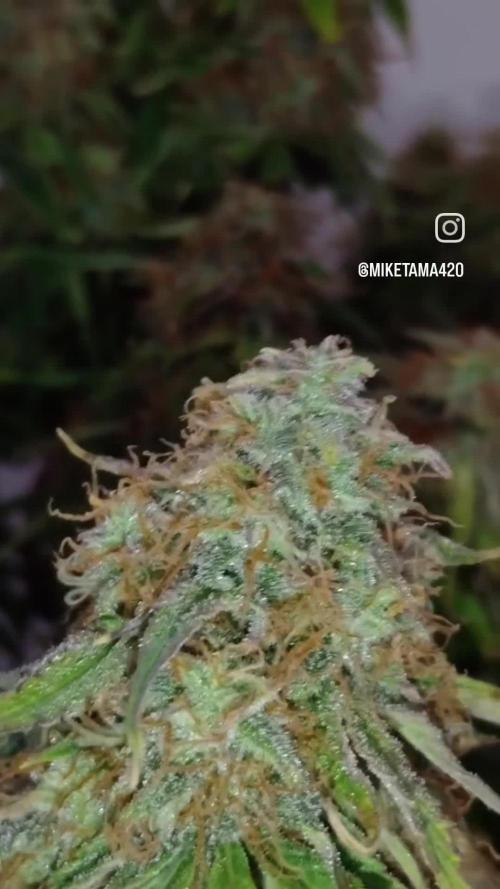
Harvest week for the Milky Way F1 growmies 🙌 Pretty happy with how she handled this cycle, recycled soil first time ever, dead of winter, undersized light for a 100x100 tent… she just kept going 💪
In previous runs I did scaled harvests, and every time I noticed a visible resin boost and even some anthocyanin production on some phenos, confirmed that a sudden light intensity increase late in flower does something interesting.
This time I went a different route: last 6-7 days I stripped most of the non-resinous fan leaves and redirected a lateral bar onto the mid/lower zone to get the same effect. Curious if mechanical stress from defoliation plays a role here too, anyone know anything about jasmonic acid? 🤔
Late flower I pushed the setup to ~200w adding 660nm red bars at 40-50cm, which clearly tightened up the buds compared to previous runs 👀
Pulled the CO2 bottles in flower, without a way to measure it I’d rather focus on VPD and fresh air circulation 🤷 Kept them in veg where humidity tolerance is higher anyway.
Now she’s drying and I can’t wait to see how the wet/dry ratio lands 🌿


Likes
30
Share


@Ts1Ko
Follow
Look at her flowers 🤩 they are so attractive 😋🤤 can't wait for her to finish 😬 Other than that everything looks nice. No signs of any kind of dis balance ✌️
Likes
7
Share


@Cultivatorcarlos
Follow
december 20th gave her half a gallon of dechlorinated tap water phd to 6.6 with 1/2 tsp of bloom nutes to each 3 gallons of water. runoff tested at 6.3 ph. she was showing a few deficiencies

Likes
12
Share


@Vegetoo420
Follow
Hey hey ! Trying to limit the stretch and it’s good !
Flowers started to show them faces !
Likes
16
Share


@GRow_M8s
Follow
Fast drying method with dehumidifier at 21C° for 3 days and dry trimming, even the sugar leaves are smokable and full with amber crystals, no harshness at all.
District odours.

Likes
5
Share


@beer420
Follow
Were getting there!
Plants looking beautiful and swelling up.
Two questions below!
Thanks for reading and happy growing.
Likes
37
Share


@Dapper_Buds
Follow
Going into week 9. Train wreck is turning out amazing buds are still stacking new growth. The smell is just amazing. Soil ph tested at 6.3. The tds reading 2150. Lights at full 100%. So very happy how this grow has turned out. Exited to see it when the buds start to fatten up.
Leave a like an comment below.
Thank you for viewing. Happy growing.


Likes
3
Share


@Dgessy
Follow
Fin de la 1er semaine, tout se passe bien 😁 Arrosages à l'eau déminéralisée au PH ajusté à 6.8.
