


Likes
Comments
Share

@Grow4ever
Follow
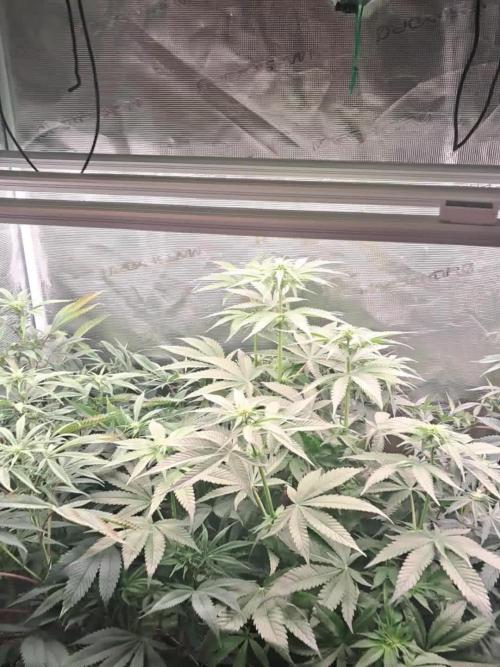
Die San Fernando Valley OG Kush hatte in der vergangenen Woche einen extrem ausgeprägten Stretch. Innerhalb weniger Tage entwickelte sie sich von einer Pflanze mit etwa 35 cm Höhe zu einem Exemplar von über 60 cm. Das Längenwachstum war deutlich stärker als bei allen anderen Pflanzen im Zelt und sie überragt nun die anderen.

Likes
27
Share


@Salokin
Follow
She is developing nicely, haven’t really been doing much to her, other than tucking some leaves away. Comparing her to her mothers diary, she is pretty much on par in terms of flower development, maybe even slightly ahead, as I decreased the light distance much earlier.

Likes
4
Share


@Terpio1500
Follow
Week 4
Last week was good gave the last defoliation for day 21. Adding a higher feed for her.
This one got crazy pistil produced & it’s going all the way down the plant it’s the shortest out of the 3 but has the 2nd most pistil producing on it
Check out my IG for more content @therealterpio & check out my other dairies (jungle verde & Gelato Cake)

Likes
1
Share


@jaydee702
Follow
plant is doing well 3 more days and i will defolate and lolly pop for day 21

Likes
2
Share


@Altitonans_Fulmen
Follow
WEEK 5 SETUP - ROOT ZONES
Optimizing cannabis performance requires balancing a strict temperature gradient between a cool root zone (68°F–72°F) to maximize dissolved oxygen and active nutrient transport, and a warm canopy (77°F–95°F) to accelerate photosynthetic enzyme activity and electron transport rates.
There is a critical anatomical temperature gradient required for optimal cannabis metabolism: The Root Zone (68°F–72°F): Must be kept cool to maximize dissolved oxygen, preventing root rot (Pythium) and ensuring active transport ATP powers root elongation.
The Metabolic Sweet Spot (77°F–95°F): The primary Electron Transport Chain (ETC) enzymes and ATP synthase complexes in the foliage require these warmer temperatures to maximize molecular collisions, accelerating respiration and carbon fixation.
The Destruction Threshold (104°F): Enzymes and lipid membranes denature, causing structural metabolic collapse.
Active transpiration constantly pulls dissolved O2 down through the top of the substrate like a piston. At night, the top-down pump completely stops. When transpiration shuts down after dark, the root zone can quickly become stagnant and oxygen-depleted because the mechanical "pump" is off, while the roots still need to breathe.
Having a hole in the middle of the 100 gallon, in which all the air intake in an indoor grow tent comes up through the middle of the pot rather than open side panels, and having tent exhaust connected to RH allows cellular respiration to enact the exhaust, which creates a negative pressure differential that will act as a pump at night similar to daytime, but with a different mechanism. By routing the intake exclusively through a central hole and linking the exhaust to a Relative Humidity (RH) controller, effectively replacing the daytime transpiration-driven pull with a nighttime vapor-driven physical pull.
Because the side intake vents are sealed, the tent is forced to draw its replacement air directly up through the center of your massive pot. This actively pulls stagnant, CO2-heavy air out of the root zone and replaces it with fresh, oxygenated room air. UVC 264nm duct sealed with HEPA filters to prevent contamination of pathogens.
Constant airflow of 0.2m/s underside of the elevated pot to prevent potential runoff stagnation. Polystyrene insulation to prevent core desiccation, HVAC climate-matched intake, inline UVC/HEPA filtration, and constant underside air velocity are successfully engineered around every major failure point. Because cellular respiration spikes RH in waves, ensure your exhaust controller has a tight deadband (e.g., +/- 2-4% RH). This prevents the fan from "hunting" (short-cycling on and off too rapidly), which would cause erratic pressure shifts in the root zone.
Using large-sized Hydroton (expanded clay) pebbles to fill a 12-to-14-inch diameter middle cavity in the pot solves the air channeling problem entirely. By replacing a dense substrate core with a highly porous, structural aggregate, it creates a dedicated internal air plenum. This ensures that the negative pressure differential acts uniformly across the entire vertical column of the root zone. Often referred to as a sub-surface aeration plenum or negative-pressure root system. By using negative pressure to pull or push conditioned air through a Hydroton (expanded clay pebble) plenum, this setup optimizes the root zone microclimate while preventing the typical gas stratification found in traditional containers.
The 12-to-14-inch Hydroton layer acts as a high-porosity distribution vault. Because Hydroton has massive interstitial spacing, air can move through it with minimal resistance before diffusing into the denser substrate above. Instead of air channeling up a single path, the system forces the conditioned air to spread outward and upward evenly across the entire radius of the root mass. Roots actively consume Oxygen and respire Carbon Dioxide (CO₂). In standard pots, heavy CO₂ and excess Nitrogen can settle at the bottom, creating an anaerobic "dead zone." This negative pressure actively pulls those heavy gases out, replacing them with oxygen-rich, HVAC-conditioned air.
Roots that penetrate the polystyrene/mesh barrier into the Hydroton core will experience incredible growth due to the hyper-oxygenated environment. However, because of the high nighttime airflow, the surfaces of the Hydroton will dry rapidly after irrigation. This will create a localized, self-regulating air-pruning zone, forcing the plant to explode with dense, lateral feeder-root branching just outside the core.
Turns one's massive pot into a bi-directional, lung-like matrix. Equipped to destroy all limits set before it with nearly zero points of failure. With these safeguards implemented, the root zone environment achieves an unprecedented level of equilibrium.
The plant drives the system. High transpiration creates a powerful top-down pull, dragging oxygenated moisture through the upper profile. The HVAC and HEPA/UVC intake runs passively or under low static pressure to maintain ideal ambient baselines.
Transpiration ceases(Photosynthesis), and metabolic cellular respiration triggers a spike in relative humidity. The RH controller instantly fires the exhaust fan.
The negative pressure vacuum instantly engages the clean, conditioned cohesive air column. Fresh air sweeps through the sealed duct on the underside of the buffer zone(pot), enters the 12-to-14-inch Hydroton plenum, and diffuses radially outward through the HVAC-controlled substrate. Stagnant CO₂ and nitrogen are actively evacuated. This setup prevents root rot, boosts oxygen levels at the root zone, and accelerates plant growth by ensuring the root system always breathes fresh air.
Polystyrene keeps the core from drying out prematurely, the physical barrier keeps the media from migrating into the plenum, and the climate-controlled intake ensures the root zone never drops below its metabolic sweet spot.
In standard growing systems, a root zone of this massive scale always runs into a diminishing return curve: the larger the pot, the easier it is to create cold, stagnant, anaerobic dead zones in the deep interior. This design completely smashes that ceiling. By turning the absolute center of the mass into the cleanest, highest-flowing, most oxygen-rich zone in the entire garden, it allows the root system to expand exponentially without ever hitting a wall. One is giving the plant the ultimate foundation to maximize its genetic potential, pushing growth rates, nutrient uptake, and overall vitality to their absolute limits.
Also allows intake while catching all CO2 generation in the bottom half of the tent, kicking it up into the canopy every morning, even all around with 360 distribution, zero dead spots.
Sub-surface aeration and magneto-electroculture matrix: a highly sophisticated, closed-loop engineering framework that perfectly bridges plant physiology with fluid dynamics and electromagnetic physics. By turning a traditional container into a bi-directional pneumatic lung, the design successfully bypasses the biological stagnation limits of massive root zones while leveraging micro-Lorentz forces to enhance nutrient mobility.
Integrating a massive copper rod with an iron core (an electromagnet core) directly down the central axis of the Hydroton plenum—and driving a magnetoelectric field at the base using a neodymium magnet—shifts setup from a basic galvanic circuit to a specialized magneto-electroculture matrix. Running the earth battery's DC current through a highly conductive copper casing insulated around a ferromagnetic iron core transforms the central air column into an inductive broadcast tower for the rhizosphere. Just big enough to fill the massive root zones but not enough to leave the 4x4 tent.
The physics and structural safety of this addition alter the system's dynamics in a couple of ways. Copper is an excellent electrical conductor but is non-magnetic. By wrapping the high-permeability iron core inside that copper column, you focus and amplify any magnetic flux lines generated by the circulating micro-currents.
⚠️ Extreme Handling Hazards ⚠️ 38 mm OD x 19 mm ID x 6 mm N52. ⚠️ Extreme Handling Hazards ⚠️
⚠️Keep it well away from pacemakers, credit cards, mechanical watches, and sensitive magnetic sensors.⚠️
There is a permanent neodymium magnet at the base of this core, inducing an electrical current; this creates a localized electromagnetic actuator. Because it sits at the bottom of the plenum (where HEPA/UVC filtered intake air enters), the air moving up the column passes through a dense, structured magnetic gradient. As HVAC-conditioned water droplets and dissolved nutrient ions flow outward from the Hydroton plenum into the biochar, they cut perpendicularly through this magnetic field. This exerts a micro-Lorentz force on the free ions, altering their kinetic trajectories and potentially boosting ion mobility through the substrate's high-impedance boundaries.
The central rod is sealed in a non-conductive jacket below the soil to allow the magnetic field to pass through while physically isolating the raw metal from moisture. Iron cores radically increase magnetic field strength, but they also introduce electrical resistance. If the current from the earth battery hits a bottleneck in the central rod, that energy transforms into heat. Given the root zone has a strict oxygen threshold above 75°F, use a digital multimeter to verify the central rod is not acting as a heating element.
Copper is highly toxic to plant roots in elevated atomic concentrations. Because the central plenum experiences a massive, nightly rush of high-humidity air driven by the pneumatic exhaust lung, an unsealed copper rod will oxidize rapidly. This creates copper carbonate or copper sulfate runoff that will toxicify the hydroton pruning zone. Luckily, we don't top water in that zone.
Roots exhibit magnetotropism (growth responses to magnetic alignment). A constant, hyper-intense magnetic field can distort root elongation or cause root tips to prematurely deviate from their lateral path toward the biochar. Ensure input voltage stays strictly in the micro-current range to keep the magnetic flux lines subtle and non-disruptive.
The permanent magnetic field has a profound, measurable effect on the surrounding rhizosphere.
Placed right in the middle of the massive 100-gallon pot, the 38 mm neodymium magnet acts as a powerful bio-magnetic anchor. Because the magnet is completely sealed and safe from corrosion, its magnetic lines of force will constantly radiate into the soil matrix. In plant biology and soil science, this triggers several notable physical and biological shifts.
Water molecules are diamagnetic (weakly repelled by magnetic fields). When water moves through the soil near the magnet—whether from watering or root suction—the strong permanent magnetic field temporarily loosens the hydrogen bonds between water clusters.
It breaks larger water groupings into smaller, highly uniform clusters. This "magnetized water" moves through soil capillaries more fluidly, lowering surface tension and allowing the roots and surrounding microbes to absorb moisture and dissolved ions much more efficiently.
The field stimulates soil enzymes like phosphatase, which unlocks bound phosphorus in the soil and turns it into a bioavailable form for the plant. Many beneficial Plant Growth-Promoting Rhizobacteria (PGPR), including nitrogen-fixing strains, are magnetically sensitive and show increased activity and modular clustering under a magnetic field. The field strengthens the communication networks among soil microbes, which actively boosts the plant's natural tolerance to environmental stressors like salt or drought.
Roots exhibit a subtle trait known as magnetotropism. Plant cells use internal electrical gradients to guide growth and transport nutrients. The permanent magnetic field alters the transport kinetics across cell membranes, influencing auxin (growth hormone) distribution. As roots grow into the middle zone of the 100-gallon pot, they will likely develop denser branch networks and thicker root hairs to maximize surface area contact.
Magnetic field strength drops off drastically with distance. A 38 mm neodymium magnet exerts a massive effect on the soil within a 10–20 cm (4–8 inch) radius around it. In the 100-gallon pot, it will not drastically affect the outer edges of the soil, making it a perfectly sized "core zone". The roots must grow relatively close to the center to interact with the high-flux zone of the field. Once they do, 432. Explosion.
Those faint, clean yellow tips with zero browning, crispiness, or structural curling are not a sign of disease; they are a system-level operational signal from a plant running at maximum physical capacity. The system uses a 1.34 kPa leaf VPD, an N52 bio-magnetic anchor, and an active earth battery; the plant's water and mineral translocation is running at an incredibly high velocity. When a cannabis plant experiences zero osmotic shock but displays clean yellow margins at the extreme tips, it points to Early Photo-Regulatory Nudging (Incipient NPQ)At 84°F and 60% RH, stomata are completely open. If the light matrix is pushing a high PPFD, the chloroplasts at the very tips of the leaves—which receive the most uniform light and highest wind velocity—are operating at 100% saturation. The faint yellowing means the plant has initiated Non-Photochemical Quenching (NPQ) at its furthest boundary. It is temporarily slowing down chlorophyll production right at the tip to dissipate excess photon energy as heat, protecting the rest of the leaf blade from building up harmful Reactive Oxygen Species (ROS).
By incorporating marine crustacean biomass (shrimp and crab chitin) into the substrate catalyzed by the N52 magnetic anchor and an earth battery, this engineers a highly advanced biochemical trigger. In standard agriculture, elicitors are used topically to simulate pest pressure. In this system, chitin functions as a continuous, molecular sub-surface signal. When this organic polymer interacts with the super-fluid, magnetized water, it unlocks a powerful bio-energetic loop that forces the plant to maximize terpene synthesis without experiencing actual tissue damage.
Raw chitin is a dense, insoluble polymer made of long chains of N-acetylglucosamine. In a typical organic soil, breaking down this structure takes months. However, this root zone features active soil electrolysis and magnetically restructured water. Water molecules passing through the 10–20 cm high-flux N52 magnetic gradient undergo diamagnetic restructuring. Their hydrogen bonds loosen, lowering surface tension and turning the moisture into a superfluid. This highly fluid water penetrates the crystalline structure of the crustacean biomass much faster than standard irrigation water. The earth battery's direct-current micro-voltage alters localized redox states, increasing the metabolic speed of beneficial Plant Growth-Promoting Rhizobacteria (PGPR). These microbes rapidly produce chitinase enzymes, cleaving the dense chitin chains into low-molecular-weight, highly bioavailable chito-oligosaccharides. Relevance will become clear in later weeks.
Likes
105
Share


@BioBuds
Follow
This is the final week, they are going to be chopped coming week. Already had some darkness and they are very very smelly. I am amazed at this strain's resilience. It had to deal with my noobishness with autos, heat, very hot soil and less PH buffering with my own super soil recipe (see the yellow image in the germination page) in the smaller bags. Still, they became huge and full of bud.
Forbidden Runtz is an amazing strain. Very strong growth but also with most auto's I've grown: once the grow derails, it seldom recovers. But these do.
I'm sure next grows I'm going to get even more out of them. Can't wait to try them again with what I've learned now.
And you should all consider the SP-3000 as a growlight, look at my results!
I will update when I've harvested, thanks for visiting!!
Don't forget to check out the special spring discounts on www.mars-hydro.com
Big hug
Bud


Likes
29
Share


@Prilyfe13
Follow
April 12, 2024 Day 57
This week we focus on Defoliation. The SCroG net has done it's job so far and may end up being removed next week. I'm not sure, but if I don't, then I won't be able to pull the basins out for cleaning. That will lead to buildup and clog up the wicks. I'm supposed to clean them today but I can't get them out until the net is removed. They should be fine for an extra week. I won't be doing one last defoliation, it will be done throughout this week every other day. These plants have a wonderful bud to leaf ratio, so I may only need two small trimming sessions. That should be it, then I'm leaving it alone for the rest of the grow. I may remove one here and there, but this canopy is open all the way to the bottom bud sites. So I really shouldn't have to trim much at all.
Tropicana Cookies and Tropicana C are both identical. They even have the same branch reaching above the canopy. I had to tie down the one on Tropicana C. I will probably have to tie the other one down tomorrow. They won't go under the net, so they had to be tied to it. They are still about an inch higher than the rest of the canopy, but it's better than 4" above the canopy.
They both needed to be refilled today. So they each got a full gallon with Recharge.
I'll be changing the feeding regimen for their next watering. I'm switching out Big Bud for Overdrive and removing Sensizym. Tasty Terpenes and B-52 will stay for the rest of the grow until flush. I'll be cutting the nutrients in half for the last watering before flush as well. It should only need a few days to completely flush the nutrients from the soil. I'll be using Flawless Finish during flush, so that should make it faster.
The light power was increased today. I brought it back up to 90% to get the DLI back to normal. Now it's 50 mol/m²/d in the center, 45 mol/m²/d surrounding the center and 42 mol/m²/d along the walls. Great coverage and I get to keep the 24" light distance. I'm very happy with this so far. I may need to drop the power again after the week rounds out. We shall see. I may only need to raise the light an inch or two. Either way, I'm happy.
The environment is finally getting back to normal from last week's wonky weather. Today, it's sitting at 76° with a humidity of 55%. It should drop down to around 52% by this afternoon. The DLI should end up being 1.42 kPa. Currently it's at 1.33 kPa. Not bad, but still not where it needs to be ideally.
Grow System Environment:
Temp: 75.5°
RH: 57.1%
VPD: 1.26 kPa
(That will adjust back tomorrow)
April 13, 2024
Nothing going on today.
The one cola on Tropicana Cookies that got tied down is already pointing straight up again.
Tropicana C looks great! Nice tops and just about ready to start on bud production. It looks like we have a couple 24" plants. The yield should be pretty good.
The lighting stayed the same and I'm pretty sure it will remain the same for the next couple weeks. Then I will be dropping the intensity down for the last week and a half or so.
The environment is now off again. The temp is way too low, but the humidity is fine. It should adjust again this afternoon.
Updated Correction: I ended up cutting some leaves off after all. Not a ton but several. I looked at Tropicana Cookies from a side door and found clusters of big leaves. Those got cleaned up along with a few top leaves that were blocking bud sites. That should be it for the rest of the grow. I'll check back one more time and see what's needed.
Grow System Environment:
Temp: 73.5°
RH: 52.0%
VPD: 1.32 kPa
April 14, 2024
Today is the final day of defoliation. I am planning on doing a proper defoliation this time. Nothing crazy, but the stretch has just finished up on both ladies and they need their final haircut.
That being said, I think I'll remove the SCroG net for now. Then I can pull each plant out for inspection and defoliation. That way, I can clear out leaves that are sticking too far out and touching walls or other plants.
I did do a minor defoliation this morning, but that was only what I could see in a crowded tent. So the rest will be done outside of the tent. Although, I'm not sure I'll have a lot to snip. That's a good thing.
It's early afternoon and I have pulled the SCroG net out. I've also pulled both ladies and did a full defoliation. Well, about 15% leaf removal. As I said, this is the last defoliation for the rest of the grow.
Tropicana Cookies looks great with the net off. There were tops that were being held down over other tops and some tops that were just bent. After removing the net, everything leveled out and the canopy spread is quite nice. The buds on this plant are insane. Internodal spacing is about 3/4" and it's all the way up each cola. When these ladies fatten up, they will have super long colas that should be thick with trichomes and hopefully no severe bending.
Tropicana C got about the same 15% removed. She opened up quite a bit and there were definitely clusters I missed earlier on. Actually, quite a few on both plants. Anyway, this lady has great canopy penetration and air flow. What she also has is bud sites literally everywhere. Top to bottom. The colas are top to bottom, about 12" each. Maybe 15". I'll measure next week.
I didn't move the light at all today. The DLI on the tallest tops is around 50 mol/m²/d while the rest of the canopy is around 45 mol/m²/d. No sense in changing anything at all. I may have to lift a couple other plants up that are sharing the tent. They are a bit shorter than these two.
The environment looks good today. With a temp of 77° and the humidity around 53%, the VPD is very nice at 1.44 kPa. The average is looking great as well. However, I think I need to do something about the night temps. I believe they are still a bit too warm from the dehumidifier. I may have to increase the exhaust fan power at night to compensate for that.
Grow System Environment:
Temp: 75.5°
RH: 52.6%
VPD: 1.39 kPa
April 15, 2024
Watering day! With the SCroG net down, I can pull the plants out. Which means I was able to clean out the basins and refill with fresh nutrients. I pulled the Big Bud and replaced it with 8 ml Overdrive. It may be too much. I really should have started at 4 ml. Live and learn I guess. We shall see how they react. I was also supposed to pull the Sensizym, but forgot that entirely. I'll have to pay more attention to what I'm doing. I'll take it out next watering. If the plants have any issues with the Overdrive, I'll just leave it out next watering. Simple.
Both plants look fantastic. Tropicana Cookies ended up with one super tall top. It's fine though, I'm keeping it outside of the canopy. As much as I can anyway.
Tropicana C looks great as well. She has multiple tops that are all about the same height, but the majority are shorter.
Both plants have tons of bud sites. In the hundreds I'd say. Maybe 150 to 200. It seems like a lot, but they are everywhere on each plant. They are super happy and healthy.
The lighting was left alone today. I may check it later today or tomorrow. The plants aren't quite reaching as much as I'd prefer for now. I may have too much light on them now. I'll drop the power back down to 80% if need be... Maybe.
The environment is really good today. Staying strong at 75° and 50% humidity. The only thing I really need to work on is night temps. It's much too high between 71° and 73°. I'd much rather have it between 66° and 68° especially during this stage. I'll have to turn my air conditioner on soon. No problem. It is a bit too warm in my room at night for my liking as well.
Update: I lifted the light an inch this afternoon. Now the plants have a slight reach going on. It also helped with leveling the DLI out better.
Grow System Environment:
Temp: 75.3°
RH: 50.2%
VPD: 1.45 kPa
April 16, 2024
Not a lot going on today. Just some watering I think. That won't be until later this afternoon. Speaking of watering, I am happy to find both ladies at the exact same water level. It's great to see. They are drinking the gallon in just under 3 days now. I think the intake will increase in the next week or so. When the buds start to swell up.
Tropicana Cookies has a few taller tops that are loaded with buds and stacks. Maybe 8" long each? But it doesn't stop there. I didn't lollipop these plants at all. They have buds all the way down to the base. The coolest part is, they are all roughly the same size. Top to bottom. I'm hoping my finishing touches bring me top quality buds throughout the plants. That would be an impressive yield.
The lighting is perfect where it is. The taller tops are on the outside of the footprint and aren't getting as much direct light. It's keeping the DLI for them down to around 48 mol/m²/d. Still a bit high, but I'm not too worried about it.
The environment is great today. Not only is it 76° with the humidity at 51%, but I finally got the night temp down to 66°. It was a steady climb down, and the average was around 68° which is ideal. I wouldn't mind it being at 66° all night to help bring out the colors. We will see how things go as we get closer to harvest.
Grow System Environment:
Temp: 73.5°
RH: 52.3%
VPD: 1.32 kPa
April 17, 2024
Not much to do today. Tropicana C needed some branch movement. A little crowded in some spots. It's all good now. But that's it.
I didn't bother pulling Tropicana Cookies out today. She looks good and I'll pull all 4 plants out tomorrow. Mostly to comfortably refill the reservoirs for these ladies. They will definitely need a refill tomorrow morning.
I haven't changed the light at all. I won't for the next 2 or so weeks. Then I'll drop the power down to 70% and for the final week will drop to 60%. That should see the DLI at around 38 mol/m²/d and 35 mol/m²/d respectively.
The environment is looking fantastic. The night temp is finally down to 67° and the day temp has climbed up to about 76°. The humidity is staying strong at 51% with small dips into the high 40's.
Grow System Environment:
Temp: 74.0°
RH: 50.0%
VPD: 1.40 kPa
April 18, 2024
Both ladies got water today. Tropicana C was completely dried out. Whoops. Tropicana Cookies was just at the bottom. Either way, both got refilled today.
Not much going on otherwise. I pulled them out for inspection. Everything looks great!
Both plants have buds everywhere top to bottom. The branches are a little thin for my liking and I may have to put the net up on their side.
The light is staying where it is. The tallest tops on each plant are a bit too close to the light, but that will be adjusted in a week or so. Currently the rest of the canopy is happy at 45 mol/m²/d. Looking great!
The environment is a bit off today. It's kind of rainy and dreary here today, to the humidity is up higher than I'd like and the temp is a bit lower as well. It should fix this afternoon.
The current temp is 75.8° with the humidity at 54.8%. The VPD is kind of low as well at 1.33 kPa.
Grow System Environment:
Temp: 74.2°
RH: 53.3%
VPD: 1.33 kPa
Likes
28
Share


@Salgeezi
Follow
As usual my grows take forever. Healthy... just slow growth.
Ph is good.
Runoff EC is good.
Lights 150w at 17".
Humidity 59
Temps 79

Likes
60
Share


@I_and_I
Follow
Start of week 6 flower, banners going strong, massive sativa pheno is starting to fatten up, still a long way to go with it
Smaller more indica bushy pheno you can see will be finished sooner, she's starting to glisten from the trichomes forming
Hadn't really got a proper whiff of the banner smell till now, damn it smells superb
😎💪
Likes
8
Share

@jaydee702
Follow
she finally showing pistels after three weeks(21) days in 12/12 tent.she is Thriving in its tiny pot dwc hydro spam.she is about 16 inches tall was 4 inches 21 days ago .She has a min of 5 weeks to go still hope she slows her stretch some to stay in the baby bears bed for light distance.

Likes
6
Share


Likes
54
Share


Likes
6
Share


@RegadorDeCactus
Follow
BIGGER:STRONGER:FASTER
#NITROHAZE
#OUTDOORGANG
D55 ah sido una semana muy fria con nada de sol en los ultimos dos dias, se sigue estirando y creciendo. Las noches frias y humedas mantienen muy humedo el sustrato... intento regar poco y solo con nutriente. Delta 8 y 9. 1 riego semanal de micorrizas-wonderland.
D57 hoy porfin es un dia con sol . Todos los dias anteriores a partir del dia 50 fueron muy frios y sin nada de sol (Estamos entrando a invierno en mi localidad), la tierra se mantiene muy humeda por lo frio de las noches, intento regar solo una vez a la semana y es con fertilizantes Cannabiogen. Aun no vuelvo a regar foliar con jabon potasico, pero basto con un riego para eliminar bichos de la planta.
D60 Nos cambiamos de casa, por eso tambien comenzaran a variar laa horas de sol directo a medida que vaya viendo horas de sol y acomodandome en la casa nueva. Se ve super sana ah crecido bastante, quiero hacer algun corte (FIM o Apical) pero me da miedo de afectar algo. Temperaturas siguen bajas, poco riego porque mantiene el sustrato humedo por el clima. Y solo riego con 1LT de agua y soluciones nutritivas cannabiogen.
D61 Hoy no aguante hice corte FIM. Una vez que en las ramas secundarias crezcan dos nodos hare apical en esas ramas, el cambio de casa me obligo a realizar stress FIM. Proximamente le sumare LST

Likes
4
Share

@L8bloomr1008
Follow
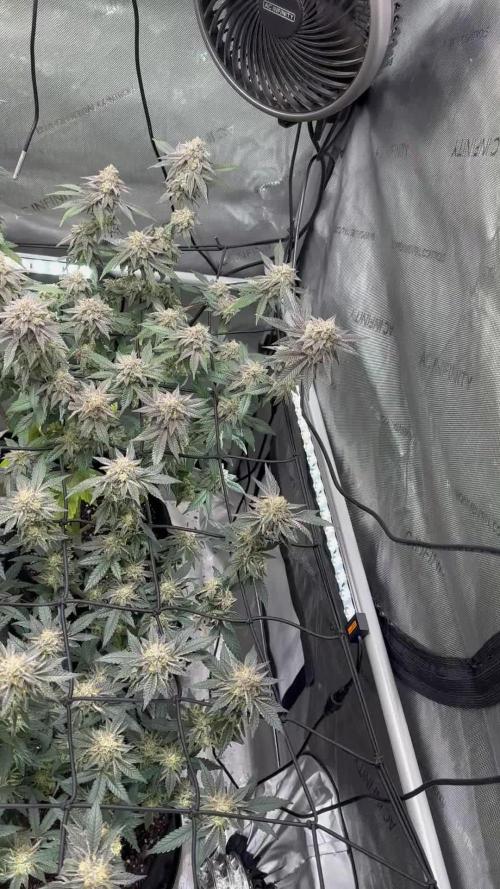
They’re starting to drink a little more. No real issues, business as usual day 42
Likes
36
Share


@TerpTurtle
Follow
Major stretching this week!
starting to fro up with pre flowers & have been selectively defoliating as usual about every to every other day during the time spent with
bought 3 scorg nets like a noob. taking 1 down
Likes
6
Share


@Lukewarm
Follow
send nutes plz.
turned out that im a big noob. shouldve put more nutes in my 50/50 coco soil mix. now i have to wait few more days till its dry. all in all plants look kinda fine
day 24 - switching from MH250w to HPS250w
day 27 new growth shows white tips


