The Grow Awards 2026 🏆
Likes
Comments
Share

@yan420
Follow
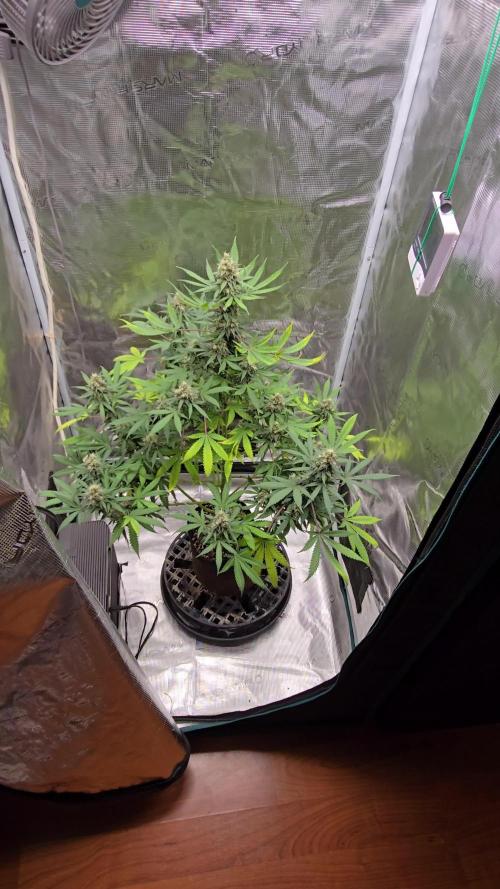
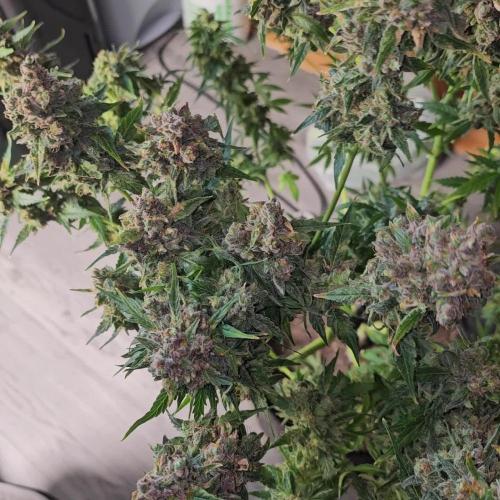
🌸🍏✨🍭🌸🍏✨🍭🌸🍏✨🍭🌸 Harvest – Apple Fritter (Kannabia) 🌸🍏✨🍭🌸🍏✨🍭🌸🍏✨🍭🌸 Chopped on 05.09.25 (FW9) after a clean 9-week flower. Didn’t weigh every single gram, but what I trimmed wet came out to 939 g+, and there’s still some left unweighed. Dry yield will land somewhere in that ~quarter-kilo zone once everything’s cured. She finished with 14–16 solid mains, stacked up dense and resinous. Scissors got glued quick, buds are heavy, sticky, and already giving off that sweet fruity/pastry smell Kannabia promised. Had a couple bumps (bit of bleaching during stretch, thrips halfway through), but she bounced back fine. Easy to train, forgiving when stressed, and filled the tent nicely. Super happy with this one — pressing part into rosin and slow-curing the rest for the jars. 🍏🍪🔥 Ps rest of grow info in week 20

Likes
16
Share
Potted up yesterday and a little lst, this will probably be the last time I run the strawberry lemonade cuttings and hoping to find a decent pheno from the orange punch to keep for at least another run or two.
Likes
15
Share
Welcome to my CBDV diary. Has been blast.. there's so much more to growing a CBD plant, my point is I'm far from where I want to be with the Quality of the end product as far as density goes. (I got the quality part down) she's 1 stinky sticky ass bitch. Wk 9 Day 58-63 Plant was kept on feed till the bitter end. She was confided to the 70cm2 for her last few weeks of life but I've no doubt, if I had of kept her going under the FC 3000 she would of reached deeper down and gave me denser buds on top. There is so much airy ripe bud below I'd say it'll make up for 1/3 of the overall harvest. Which will be quite a lot. Id say in the 80-100g no doubt. She has some major big buds that are stacked with swollen calyexs that are glistening and very sticky. I can she's had enough. I didn't have the light to finish the end that the FC 3000 created on a lot of my autos. On most I clipped it away after I had to confine my plants to their own tents for good. But, she kept eating. Wk10 63-67 I stopped everything nutrient wise. And let her finish the ride out on water until day 67 and she gladly ate what was in her pot and showed no signs of wanting more, so I hard flushed her 1x pot value (11L) and got a ppm of 900ish, so 2x (22ish) more the pot value until it came down to 210. And for 3 more days I left them girls drink what they could from the pot and left them under my 100w where they've lived the past 3-4 weeks and I'm gonna pull them this week, they are resting 30hrs already and then I'll pull them, and harvest them whole, roots and all will be pult and I'll shake the clay off, bag the roots and hang dry upside down, (so no dirt falls on the buds while drying from the roots) and will dry at 55-60 rh with a temperature of 17-19c. I'll try keep the RH around 59 but I'm not gonna worry too much if it differs from that range. I already cut a wee bud off her the today, just a small 1 to try her for taste. And I'll rate it on harvest. As she's low on CBD, I'll rate her on taste. But, she'll be a nice addition to my full THC smoke no doubt. Never really removed any substantial growth from her to even call it a defoliation, there really was no need. I done a decent job at LST and my plants got rotated every day and I pult nodes/leafs this way and that. So, I'm happy with the results. She has a lot of girt and not too much lollipoped with a good amount of CBDV bud in 70 days. Very nice indeed.. Thanks so much for looking at my diary guys. I hope to do better the next time. But, as I am using dry additive powders I'm sure I'll be able to dial in that key nutrient ratio for my CBDS. She's been my biggest auto of this grow. At 71cm tall, and a big ass cola I am very happy. She has a lot of girt and stinks fruits, mainly passion, I'm guessing. As I've learnt, you don't know the true smell of your weed until you get at least a 2 month cure on it. Harvest Day.. Day 70 was done on day 65 then I left as I like my weed little on the harsher side. She very punchy. Has like a deep wood smell but very citruses with hints of tropical fruits. I've harvested 6 autos today. And, its hard to pick up the smell. Very sweet smelling and citrus fruits. (Ill give a more independent smell profile upon the trim and hopefully she'll come into her true smell upon a 2 month cure. As all my bud is given) To my sponsors from kannabia thanks so much for allowing me to try this plant. I've loved growing it. Hopefully I'll do it more justice on my next round of growing it. And, to my sponsor from marshydro, she's a rock star. Thanks very much for all your help. COUPON FOR MARSHYDRO Use code "ggs" at any official marshydro site for a discount. FC 3000 & MARSHYDRO LIGHTS The FC 3000 300w it has a high ppfd 1525 umol/s, 2.85 efficacy and has the new UV addition which brings it closer to the (RA) spectrum, that's the Sun spectrum. The FC-FC-E has this, Also it has a much even PPFD making for a more evenly grown canopy and has a deep penetrative light as it allows you to move the light closer to your canopy with a reduced risk of light stress. The TS versions are a great light to. These are different though. As they have a much higher ppfd in the middle, so I suggest you rotate them plants and move em about to get the best out of the high PPFD And to the community. Much respect for anyone that can grow their own bit of chronic. Fair play to you. Enjoy your harvests and thanks for tuning in. Be sure to drop a like or comment so I can visit your diaries. Either way, thanks for dropping by.
Likes
1
Share
This week was an absolute nightmare. For five days straight, our residual-current circuit breaker (RCD) kept tripping multiple times a day until I finally discovered—regretfully—that the dehumidifier was the cause. As a result, the ladies will now have to go without a dehumidifier for an indefinite period, which is leading to very high humidity levels in the basement. Besides that the Merengon looks awesome and healthy! Light hits with around 600 PPFD
Likes
28
Share
My pictures seem to have re organized themselves, just give me a few here and I'll get the full rundown . So this week ( day 21-23) was MAJOR defoliating. What my first step is to start taking the largest fan leaves . My next step is about halfway through the canopy I'll stop and then I'll start working on the very bottom of the plant now at this stage in the game anything that doesn't even have a nice Bud site so a nice white hair sticking bud at the very bottom like shoots I'll just cut them right off. This is the first steps of a main line but I don't complete the actual full main line I probably will try it sometime soon just not this time. So you take off anything that is a small shoot coming off the main stems and then your next step is . STOP. It might be a minute it might be 10 minutes, 20 min , it might be an hour or more ( my tip is don't wait a full day I try and do it within the first 12 hours of starting it) but I always stop just to look at what I've done sometimes if you get going too quickly you can end up doing way too much. Stand to talk to canopy and look what sites are getting hit by light what places are these families beneficial to use for photosynthesis. Anything that is not doing as much good will be taken off and at that point I'll probably do another you know 5-10 minutes of defoliation maybe take one or two more shoots at the bottom to ensure what's left there is a huge fat cola that's going to give you those huge buds . After this you're going to want to do your best to support those stems that are going to hold a lot more weight as if the plant would have been with all the shoots so you're going to want to just make sure that you have staking in place or some sort of support system to keep them from flopping over a breaking them in the future because that's one thing yeah it's great but then it'll get to a point where oh no stuff falling over and then it's just more hassle than it is helpful. I got alot more pictures to follow this week so stay tuned !!!
Likes
4
Share
Likes
12
Share
@Bluemels
Follow
Tag 116: Ab heute beginnt die Spülzeit, nur noch ungedüngtes Wasser. Und in 2 Wochen ist dann schon ernte, bin schon sehr gespannt auf das Endergebnis. Sie riecht auf jedenfall schon ganz hervorragend 😍
Likes
13
Share
@GrowGuy97
Follow
Day 21 - RH 58% Temp 78F . I couldn’t be happier with how this lady is growing so far, she hasn’t gave me any issues & is starting to show pistols😍 Thank you following & make sure to check back for daily updates! Happy growing friends!✌️🏼🌱 Day 22 - RH 57% Temp 79F . I think we should be in flower by next week Day 23 - RH 58% Temp 81F . Starting to get little buds👍🏼✌️🏼🌱 Day 24 - RH 55% Temp 78F . Stock is getting nice & thick can’t wait to see what this lady puts out! I’ll be installing a dehumidifier in this tent today just to get the RH a little lower Day 25 - Lady is growing strong💪🏻 Day 26 - RH down to 51% & Temp 78F . Everything is looking good so far✌️🏼✌️🏼 Day 27 - RH 53% & Temp is 81F. Got watered again today with PH at 6.4 Day 28 - RH 52% & Temp is 80F . Bottom leaves are looking a little yellow for some reason other than that lady is still doing great!✌️🏼🙏🏼
Likes
45
Share
2nd net is up. Early bud formations are promising. holding up to the extremes pretty well, some leaves taking minor damage, but overall, she is holding up, gave her 1 night at 50F see how she would react, stressful. Not advised as it messes with her metabolism, but I want to see if it triggers any anthocyanin response. Love to see her purp up but no signs yet. Remember, For every molecule of glucose produced during photosynthesis, a plant needs to split six molecules of water. This process provides the hydrogen needed for synthesizing glucose and other organic compounds, while oxygen is released as a byproduct. Homework. If Rubisco activity is impaired and it cannot properly function or regenerate its substrate, the plant's leaves are likely to turn a pale green or lime green, a condition known as chlorosis. Essentially, Rubisco activity is highly regulated and susceptible to various environmental and metabolic factors that can cause it to become inhibited, leading to an apparent failure in RuBP regeneration due to a lack of consumption. Rubisco regeneration is intrinsically linked to nitrogen supply because Rubisco is a major sink for nitrogen in plants, typically accounting for 15% to over 25% of total leaf nitrogen. The regeneration phase itself consumes nitrogen through the synthesis of the Rubisco enzyme and associated proteins (like Rubisco activase), and overall nitrogen status heavily influences the efficiency of RuBP regeneration. RuBisCO is a very large enzyme that constitutes a significant proportion (up to 50%) of leaf soluble protein and requires large investments in nitrogen. Insufficient nitrogen supply limits the plant's ability to produce adequate amounts of RuBisCO, thereby limiting the overall capacity for photosynthesis and carbon fixation. Maintaining the optimal, slightly alkaline pH is crucial for the proper function and regeneration of Rubisco. Deviations in either direction (too high or too low) disrupt the enzyme's structure, activation state, and interaction with its substrates, leading to decreased activity and impaired RuBP regeneration. (Lime/yellowing) Structural Component: Nitrogen is an essential building block for all proteins, and the sheer abundance of the Rubisco protein makes it the single largest storage of nitrogen in the leaf. Synthesis and Activity: Adequate nitrogen supply is crucial for the synthesis and maintenance of sufficient Rubisco enzyme and Rubisco activase (Rca), the regulatory protein responsible for maintaining Rubisco's active state. Nitrogen deficiency leads to a decrease in the content and activity of both Rubisco and Rca, which in turn limits the maximum carboxylation rate, Vmax, and the rate of RuBP regeneration Jmax, thus reducing overall photosynthetic capacity. Nitrogen Storage and Remobilization: Rubisco can act as a temporary nitrogen storage protein, which is degraded to remobilize nitrogen to other growing parts of the plant, especially under conditions of nitrogen deficiency or senescence. Nitrogen Use Efficiency (NUE): The allocation of nitrogen to Rubisco is a key determinant of a plant's photosynthetic nitrogen use efficiency (PNUE). In high-nitrogen conditions, plants may accumulate a surplus of Rubisco, which may not be fully activated, leading to a lower PNUE. Optimizing the amount and activity of Rubisco relative to nitrogen availability is a target for improving crop NUE. Photorespiration and Nitrogen Metabolism: Nitrogen metabolism is also linked to the photorespiration pathway (which competes with carboxylation at the Rubisco active site), particularly in the reassimilation of ammonia released during the process. To increase RuBisCO regeneration, which refers to the process of forming the CO2 acceptor molecule Ribulose-1,5-bisphosphate (RuBP) during photosynthesis, the primary methods involve optimizing the levels and activity of Rubisco activase (Rca) and enhancing the performance of other Calvin-Benson-Bassham (CBB) cycle enzymes. Biochemical and Environmental Approaches: Optimize Rubisco Activase (Rca) activity: Rca is a crucial chaperone protein that removes inhibitory sugar phosphates, such as CA1P (2-carboxy-D-arabinitol 1-phosphate), from the Rubisco active site, thus maintaining its catalytic competence. •Ensure optimal light conditions: Rca is light-activated via the chloroplast's redox status. Adequate light intensity ensures Rca can effectively maintain Rubisco in its active, carbamylated state. •Maintain optimal temperature: Rca is highly temperature-sensitive and can become unstable at moderately high temperatures (e.g., above 35°C/95F° in many C3 plants), which decreases its ability to activate Rubisco. Maintaining temperatures within the optimal range for a specific plant species is important. •Optimize Mg2+ concentration: Mg2+ is a key cofactor for both Rubisco carbamylation and Rca activity. In the light, Mg2+ concentration in the chloroplast stroma increases, promoting activation. •Manage ATP/ADP ratio: Rca activity depends on ATP hydrolysis and is inhibited by ADP. Conditions that maintain a high ATP/ADP ratio in the chloroplast stroma favor Rca activity. Enhance Calvin-Benson-Bassham (CBB) cycle enzyme activity: The overall rate of RuBP regeneration can be limited by other enzymes in the cycle. •Increase SBPase activity: Sedoheptulose-1,7-bisphosphatase (SBPase) is a key regulatory enzyme in the regeneration pathway, and increasing its activity can enhance RuBP regeneration and overall photosynthesis. •Optimize other enzymes: Overexpression of other CBB cycle enzymes such as fructose-1,6-bisphosphate aldolase (FBA) and triose phosphate isomerase (TPI) can also help to balance the metabolic flux and improve RuBP regeneration capacity. Magnesium ions, Mg2+, are specifically required for Rubisco activation because the cation plays a critical structural and chemical role in forming the active site: A specific lysine residue in the active site must be carbamylated by a CO2 molecule to activate the enzyme. The resulting negatively charged carbamyl group then facilitates the binding of the positively charged Mg2+ion. While other divalent metal ions like Mn2+ can bind to Rubisco, they alter the enzyme's substrate specificity and lead to dramatically lower activity or a higher rate of the non-productive oxygenation reaction compared to Mg2+, making them biologically unfavorable in the context of efficient carbon fixation. The concentration of Mg2+ in the chloroplast stroma naturally increases in the light due to ion potential balancing during ATP synthesis, providing a physiological mechanism to ensure the enzyme is activated when photosynthesis is possible. At the center of the porphyrin ring, nestled within its nitrogen atoms, is a Magnesium ion (Mg2+). This magnesium ion is crucial for the function of chlorophyll, and without it, the pigment cannot effectively capture and transfer light energy. Mg acts as a cofactor: Mg2+ binds to Rubisco after an activator CO2 molecule, forming a catalytically competent complex (Enzyme-CO2-Mg2+). High light + CO2) increases demand: Under high light (60 DLI is a very high intensity, potentially saturating) and high CO2, the plant's capacity for photosynthesis is high, and thus the demand for activated Rubisco and the necessary Mg2+ cofactor increases. Mg deficiency becomes limiting: If Mg2+ is deficient under these conditions, the higher levels of Rubisco and Rubisco activase produced cannot be fully activated, leading to lower photosynthetic rates and potential photo-oxidative damage. Optimal range: Studies show that adequate Mg2+ application can enhance Rubisco activation and stabilize net photosynthetic rates under stress conditions, but the required concentration is specific to the experimental setup. Monitoring is key: The most effective approach in a controlled environment is to monitor the plant's physiological responses e.g., leaf Mg2+ concentration, photosynthetic rate, Rubisco activation state, and adjust the nutrient solution/fertilizer to maintain adequate levels, rather than supplementing a fixed "extra" amount. In practice, this means ensuring that Mg2+ is not a limiting factor in the plant's standard nutrient solution when pushing the limits with high light and CO2. Applying Mg2+ through foliar spray is beneficial to Rubisco regeneration, particularly in alleviating the negative effects of magnesium (Mg) deficiency and high-temperature stress (HTS). While Mg can be leached from soil, within the plant it is considered a mobile nutrient, particularly in the phloem. Foliar-applied Mg is quickly absorbed by the leaves and can be translocate to other plant parts, including new growth and sink organs. Foliar application of: NATURES VERY OWN MgSO4 @ 15.0g L-1 in a spray bottle. For those high-intensity workouts when 1 meal a day is just not enough! Foliar sprays are often recommended as a rapid rescue measure for existing deficiencies or as a supplement during critical growth stages, when demand for Mg is high. Application in the early morning or late evening can improve absorption and prevent leaf burn. The plant was getting a little limey yellow in the centre. Shortly thereafter, she was back in business, green mostly regenerated. The starting point [of creativity] is curiosity: pondering why the default exists in the first place. We’re driven to question defaults when we experience vuja de, the opposite of déjà vu. Déjà vu occurs when we encounter something new, but it feels as if we’ve seen it before. Vuja de is the reverse—we face something familiar, but we see it with a fresh perspective that enables us to gain new insights into old problems. Confidence is evidence... nothing more. You are confident because you have driven 10,000 times, you are confident because you have spoken 10,000 times. People think confidence is a feeling, but it's not. If you want more confidence, then you need to create evidence, take more shots, collect more data, build more experiences, take more risks; fail, confidence doesn't come first; it is the reward you get for doing the work. no one else wants to do.
Likes
5
Share
Her aroma is suuper citric and strong, beautiful strain to grow and very strong purple color, she's not gonna produce too much but like every girl in my garden she's gonna give top quality purple buds,the flowers are very sticky and frosty, can't wait to try her, she's got the exact same aroma as her sisters. So will see how she ends up performing on this diary peace 🌱💚✌️
Likes
12
Share
Day 8 - First official day of veg and both ladies are looking good and on schedule for a couple of changes. Nutrients: 10ml of Hydro A & Hydro B were added to both buckets (10L of water in each bucket) PH: the Milwaukee PH controller was set to work - starting at a PH of around 7.6 - 7.8, it slowly worked down to a perfect 6.0 over about 50minutes. Lights: The lights were readjusted to be 60cm from the seedlings who are all between 8-10cm tall and the intensity of the lights were increased to about 70% brightness. Day 9 - Both plants are taking nicely to the adjustments and I am happy with the progress. Temp and humidity are stable and PH is controlled. Day 11 - The second nodes are clearly visible today for both Chong and Max which would hopefully put them at 3 nodes by the end of the week - right on schedule! Day 13 - The ladies seem to be showing some signs of heat stress, so thinking about adjusting the lights after their period of dark today because they are due to be adjusted tomorrow anyway for the new week of veg
Processing
Likes
12
Share
1/14: This morning, I did a foliar application of big bloom and fulvic acid, then about 5 hours later I watered them with about a half-gallon of rainwater each and added armor si, humic acid, endoboost myco/tricho, liquid molasses, and a bunch of cal-mag. Today, I also I wired up and mounted my new samsung sun board strips (660nm/730nm) and my Solacure FlowerPower UVB fixture. I'm running the deep red/far red bud boosters a few hours per day right now, but will run them for the entire photoperiod once I start flowering them. I'll run the UVB for 4 * 15-minute sessions a day for the full flowering cycle, and if they don't protest too much I'll increase each session by 5 minutes and evaluate again. Some strains are more forgiving than others and I've got 5 different strains in this space...so really not sure much time I'll get away with exposing them to the deadly rays without damaging them too much...😈 1/15: I received one of the rapid led/growmau far red initiator pucks today. With the placement of my UVB light, I'm realizing I'll need another far red puck to have even and intense far red coverage, so I'm ordering another with Prime delivery and waiting to start flowering until I receive it. I sprayed them down really well with ph adjusted rainwater tonight to rinse off nutrient build-up from foliar applications. 1/16: I'm really excited to try flowering under 14/10. I grew photos indoors on an off for 15 years before I semi-retired. If I added up all the additional flowering time I could have done through the years if LED technology existed, I'd have had an extra truckload of bud to smoke. I did another application of Axiom Harpin a|b Proteins this evening, right before dark. I'm expecting a big growth burst this week, leading up to the flower stretch. I really need them to trigger under 14/10 within 4 or 5 days🙏 ...if not, I'll switch to 13/11 and wait a few more days🙏😟..if still no pistils are poppin, I'll go to 12/12 and chalk it up as bad luck or varietal indifference to Pr and Pfr manipulation. 1/17: I fed each of them about 3/4 gallon of full strength veg nutes. This will be the last. I'll go with half-strength veg and half-strength bloom for a week, then go with full strength bloom nutrients until I start flushing them in 6-8 weeks. 1/18: I installed the second far-red flowering initiator today and got all my timers configured for flowering: ========================================= timer#1 - power strip with qb's and red boosters 10:00am -12:00am timer#2 - (dual/independent setting) sideA- 3-way cube with uva bars 10am - 3pm 7pm - 11pm sideB- flowerpower uvb 1pm - 1:15pm 4pm - 4:15pm 7pm - 7:15pm 11pm - 11:15pm timer#3 - far red pucks 11:00pm - 12:15am timer#4 - sub-canopy tube 10am - 1pm 3pm - 6pm 8pm - 11pm ======================================== I also did some testing on the timers and sealed myself into the closet to check for any light leaks. All good.👌 1/19: Tonight is their first long night. It's ON!👍 1/20: I watered them today with about a half gallon each. I'm seeing calcium and magnesium deficiences here and there, so added some boomerang and heavy cal-mag-Fe along with liquid molasses, humic acid, and endoboost myco. I also foliar fed with big bloom and fulvic acid. That's it for week 4-
Likes
5
Share
We wanted to try to experience the effects of global warming. We are from a Mediterranean area that has made it possible to grow the oudoor up to the winter, they are not as big as the summer ones but very very frozen and of a purplish color that they take with the evening swings that you cannot get in the summer. It looks like a Smoothie but it's a gorilla glue.
Likes
11
Share
unprecedented how fast they grow they grow on average off 10 cm per day which I have never experienced on soil but had many problems to keep the pH under control I do notice that less is more on rdwc now that I have reduced the nutrition, the pH remains a lot more stable 4 days ago they transferred to 12 12 now comes the fun part I also ordered a co2 set so from next week we will add co2 to the space
Likes
10
Share
Harvest day 66 since time switch to 12 / 12 h Hey guys :-) Finally it's time 💚 The lady is done the large leaves have been removed and hung upside down to dry in the dark drying room. You can now stay there for 13-15 days at a temperature of 18-20 degrees and 55-62% humidity. After 13-15 days it is neatly trimmed by hand and placed in jars with boveda packs 62. After 4 weeks Boveda 58% come in and are ready for testing ;-). After everything has been cut cleanly, the last update comes with the smoke report and the finished pictures. Let's get to the plant 💚. Unfortunately, the rating system at Growdiaries is a bit strange because I have to give the stars before the Smoke Report and in the end it might have led to more stars in terms of taste. . The smell is great I'm curious about the taste 💚 Have fun and stay healthy 💚🙏🏻 👇🏼👇🏼👇🏼👇🏼👇🏼👇🏼👇🏼👇🏼👇🏼👇🏼👇🏼👇🏼 ‘Powered by GreenHouse Feeding’ Copy the link for 10% off all Nutrients 👇🏼 http://shop.greenhousefeeding.com/ affiliate/madelngermany_passiongrower/ 👇🏼👇🏼👇🏼👇🏼👇🏼👇🏼👇🏼👇🏼👇🏼👇🏼👇🏼👇🏼 Water 💧 💧💧 Osmosis water mixed with Cal/Mag (24 hours stale that the chlorine evaporates) to 290 ppm and Ph with Ph- to 5.8 - 6.4 MadeInGermany
Likes
7
Share
@hooolian
Follow
23/01/22: Plants are really tall and flowering well with lots of bud sites - pistils are long and prominent - the beginnings of the trichomes are starting to spread onto the leaves to make them sugar leaves. all looknig very healthy - the ventilation system in this tent is great with an intake fan and two circulation fans. ideal temperatures - looking very well. average around 36 inches in height the largest one is around 47 inches.
Likes
7
Share
On this week I noticed how crazy she got so I decided to throw some netting on top to further decide where I’d like my tops at and to flatten my canopy better
Processing
Likes
57
Share
this lady from the off set was the fastest growing and largest plant from the off set growing bushy with lots of leaves needing the biggest defoliation's too get that important light down too the many branches below, she is drinking about 8 pints of feed a week and loving life , and her bud production is also coming along nicely too , i cant wait too try this one ,