Likes
Comments
Share
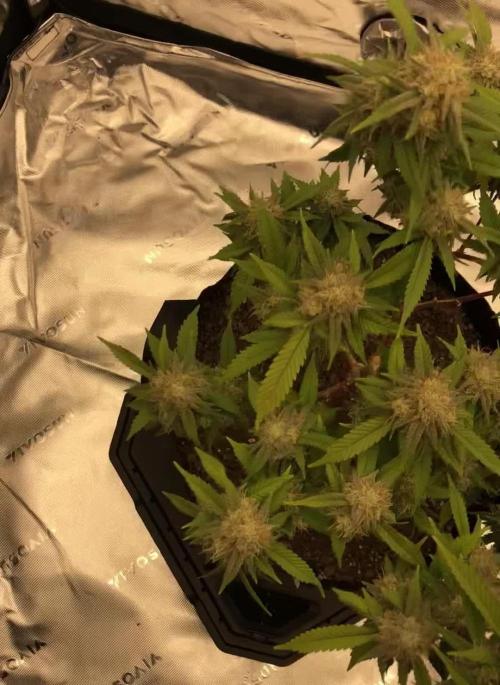
Mid-Week 6. O Christmas Tree 🎵 Merry Christmas to all!
Processing
Likes
5
Share
@ladyjane
Follow
8/19 - Start of week two and so far everything is going smoothly. Just watering each day w/ RO water and organic black strap molasses. 8/21 - I think I may have two phenotypes going here. It seems I have two of the faster growing/taller pheno and one of the shorter, slower growing pheno. 8/24 - Doing a 24 hour brew of some compost tea for all my plants. I think these new seedlings will love it. 8/25 - Watered all with compost tea. They seem to be coming along nicely. No issues so far!
Likes
9
Share
-5/7/23 Start of Week --Week 7/Flower 1 -5/9/23 (Day 52/Flower 3) --Observations: large quaintly of three-point leaves, some nutrient burn --Changes: stopped giving Miracle-Gro nutrients, stared spraying with filtered water --Comments: the LST being use may be more stressful that originally thought, evident in the formation of several three-point shade leaves. some nutrient burn has started killing the tips of some shade leaves, stopped giving nutrients and stared spraying with filtered water. lemon balm is still small and not growing very fast, lemon basil is getting burst of growth and has a light lemon sent. -5/13/23 (Day 56/Flower 7) --Observations: starting to get clustered with leaves again, still not much stigma growth --Comments: can only see a few spots that were damaged by the nutrient burn now because of how clustered the shade leaves are getting. stigma have started forming but are not in abundance, also it is still hard to see the ones that did form. expecting growth of branches and stigma to boost within the next two weeks, still not going to remove anything until the end of week three flower. will start giving low doses of Build-a-Soil's Build-a-Bloom as a foliar spray sometime next week, may also give some in watering as well. -5/13/23 End of Week -Post Note: noticed that the amount of nutrients being given was not accurate, thought it was in tbs and not in tsb. amount of nutrient per gallon has been updated for this week and prior weeks and will be added correctly in future weeks.
Likes
39
Share
@G4NJAG4NG
Follow
Day 28 - well it's the beginning of week 5 and I have now got the nutes finally tuned for my girls, all of them are looking gorgeous, nice green and healthy ✊ showing some great growth this week and the new growth just keeps on coming, I think another 2-3 weeks vegging and then its time to make the switch and see the stretch 😎 laughing buddhas are doing so well, considering a few were running slow at the start but they always catch up! Zkittlez OG auto at the top right is coming along nicely, currently week 4 of vegging for that girl, cookies kush at the top left is also doing well, showed some yellow leafing but managed to recover nicely. Also the HPS coverage is perfect for this tent, was using LED before which yes if far cheaper to run but I can already picture great results for these 😍 fingers crossed! Day 31 - I'm going with a sea of green and scrog method but without topping, I want these girls to grow out naturally but I can now organise the bud sites thanks to the scrog net, I will be putting the net in in week 7 if all goes well. Changed water amount to 1.25 litres, saw some nute burn so going a little easier on the nutes, will feed just Ph'd water in next feed in 2 days time. Thanks for tuning in! 😎 Day 32 - lower d the HP's light to about 60cm above to help with growth, lowered scrog net as well. Bud sites are starting to show, will organise them when ready. Switching to 12/12 on week 8. Found silver tails in Coco, must be watering too often, will let Coco dry out - not showing any damage to the plants as of yet. Hopefully drying out Coco will get rid of them.
Likes
6
Share
@Muybien
Follow
Dont know why one of them is 1.75 m. In the description they say BB Kush will only grow up to 0.70 m or 1.00 m max.
Likes
2
Share
@Trinidad
Follow
15.06.25. Day 30. Plants are looking healthy. Lots of growth in past week. She is showing preflower so I switched to flowering nutrients. First reservoir change out since I placed them into buckets. One plant topped herself because of rapid growth, I did not pull back training wire on main node and so the branch snapped where it was tied down. She is entering stretch now so I took of training wire on all plants. 18.06.25. Day 33! Defoliation, lilipop.
Likes
2
Share
@ShinWeed
Follow
. 🌱 Tag 28 - Eine Woche, die sich endlich wie Routine anfühlt Seit dem letzten Update ist eine Woche vergangen und trotz kleiner Unruhe in den letzten Durchgängen hat sich das Setup diesmal deutlich stabilisiert. Kein pH-Chaos, keine Mischfehler im Tank, einfach konstante Versorgung und gleichmäßiges Wachstum. Wir merken deutlich, dass sich unser Wachstum gerade verändert. Es geht nicht mehr nur darum, größer zu werden, sondern darum, Struktur aufzubauen. Die ersten Anzeichen der Blütephase sind da und der ganze Rhythmus verschiebt sich langsam in diese Richtung. Noch ist es kein kompletter Wechsel, eher ein Übergangszustand. Aber wir arbeiten sichtbar anders weiter als noch vor einer Woche. Wir wachsen weiterhin gleichmäßig und ohne Stresssignale. Die Blätter werden dichter, die Struktur klarer und intern passiert deutlich mehr, als man von außen direkt sieht. Diese Phase fühlt sich ein bisschen so an, als würden wir uns neu sortieren, bevor es richtig losgeht. Das Wasser und die Nährlösung passen aktuell gut zu uns. Der pH wird konsequent auf 5,7 eingestellt und driftet über ein bis zwei Tage auf etwa 6,3, wo er sich dann stabilisiert. EC liegt konstant im Bereich 1,6–1,8. Bisher kommen wir damit sehr gut klar und zeigen keine negativen Reaktionen. 👨‍🌾 Gärtner: Diese Woche war unangenehm unspektakulär. Ich hab mittlerweile den Dreh mit dem Wasser wirklich raus. pH-Management läuft inzwischen bewusst und reproduzierbar, nicht mehr nach Gefühl und Hoffnung. Die anfänglichen Probleme durch Hydrogencarbonate im Leitungswasser sind jetzt eingeplant statt überraschend. Wichtigste Erkenntnis der letzten Tage: Wenn man den pH sauber auf 5,7 einstellt und die EC-Spanne 1,6–1,8 hält, ist das System deutlich weniger anfällig. Der leichte pH-Anstieg über 1–2 Tage auf ~6,3 ist inzwischen kein Problem mehr, sondern einfach ein bekanntes Verhalten des Systems. Nichts, was Panik auslöst. Eher so ein: „Ja gut, du bist halt so“-Moment gegenüber dem Wasser. Und das eigentlich Beste: Die Pflanzen reagieren darauf bisher stabil und ohne Beschwerden.
Likes
9
Share
@Bncgrower
Follow
Another week is over. I've been a bit short on time and this week has been really busy, but here we go... it seems to be fine, except for some of the leaves looking a bit burnt and yellow, probably due to the increased nutrient load in the last few weeks. They've been eating a lot and the smell is really delicious. Happy growing! 🌱🌱🌿
Likes
5
Share
@BombBuds
Follow
Jetzt geht’s rund! Bin mal gespannt wie die jetzt abliefern. Hab ne kleine Defoliation gemacht. Gelollipoppt wurde diesmal nichts, weil ich n canopy diameter von 30-40cm hab und das alles im Bereich ist wo das Licht stark genug hinkommt. Sie sehen jetzt auch wieder top top gesund aus und beten zum Licht. Die trichomen Produktion gefällt mir bis jetzt auch gut, da ziehen sie ordentlich an! Ende der Woche nehme ich falls nötig nochmal das ein oder andere überflüssige Blatt ab und dann lass ich sie in Ruhe.
Likes
37
Share
@MrJones
Follow
MrJones Pink Sugar Breath F2 by VMAN - ViparSpectra XS2000 240W Infrared Full Spectrum LED Grow Light ´🌿⊱╮🌿╰⊰🌿 WEEKLY GOALS 🌿╰⊰´🌿╰⊰´🌿 🏡Indoor - 3"x4"x8" Custom Built Grow Closet 🌞Environment - 80F and 65% Humidity - using Humidfyer as needed. 🌾This strain likes to stretch during flower, so a heavy training regiment will be needed. 🗓️Vegging ⚱️1-Gallon 📊6.4 / 6.8 PH 💧 Feeding / Dry Amendments using Dr. Erth Live all Purpose and Using Up my Mr. B's Green Trees ORGANIC BLOOM 2-8-6 🌞ViparSpectra XS2000 240W x2 Infrared Full Spectrum LED Grow Light 🕷️ IPM - We will be using Green Cleaner" 1 OZ per Gallon, and CannControl from Mammoth alternating between products each month for Integrated Pest Management. 🌿╰⊰´🌿╰⊰´🌿 PLANT UPDATES 🌿╰⊰´🌿╰⊰´🌿 📝 Notes - A good friend of mine gave me some of his crosses, please read below for his amazing details, I am very excited to see what I can accomplish with these genetics and my cannabis gardening approach. ╰⊰´🌿 ╰⊰´🌿 ╰⊰´🌿 ╰⊰´🌿 ╰⊰´🌿 ╰⊰´🌿 ╰⊰´🌿 🗓️Sunday 09/05/22 - A week in their new pots and this strain is doing very well, they are stacking very tightly. odd because they have a strong Sativa trait, so I am still trying to figure out my training process, I started a compost rea yesterday and will be ready tomorrow, and hope the plants have dried out a bit from my watering on Friday. I have placed a recipe for my Nitrigeon Rich Tea Below, I am hoping it really supports the natural organic soil and activates the microbes to help the plants blow up! The plants are starting to develop a nice sweet smell, very fresh! 🗓️ Wednesday 09/07/22 Fed the Sugarbreath the Compost tea on Monday, they are looking great, decided to do defoliation on Tuesday, and the plants are bouncing back and looking amazing! I am going to give them the remainder of the week and decide if to top or just do some LST, the plants are stacking, the internode spacing is very tight, and would like to see how I can open this up. Stay Tuned! 📝 Saturday - 09/10/22 Thursday I topped dressed with the first-time feeding of Dr. Earth Life, watered in with dechlorinated H20, these ladies are really starting to explode! ╰⊰´🌿 ╰⊰´🌿 ╰⊰´🌿 ╰⊰´🌿 ╰⊰´🌿 ╰⊰´🌿 ╰⊰´🌿 Breeders Notes by VMAN Pink Sugar Breath is a creation of Platinum Kush Breath x Pink Sugar cookies originally Bred by UFO Genetics. Pink Sugar Breath F2 is the second filial Generation that was hunted and creates by Visions. The vigorous cultivar takes 63 to 75 days to flower with various phenotypes. These phenotypes can express terpene profiles ranging from Bakery Dough, Sugar, Og Funk, Fruity, Gas, Dank, Chemical Floor Cleaners, and much more. Expect Purple and Pink Phenotypes to pop up fairly easily. Color starts to show within 7 to 8 days of flower for the purple and pink phenotypes. Green phenotypes have more of an OG Funk/Floor Cleaner presence ╰⊰´🌿 ╰⊰´🌿 ╰⊰´🌿 ╰⊰´🌿 ╰⊰´🌿 ╰⊰´🌿 ╰⊰´🌿 Compost Tea 1 Cups Worm Casting 1 Cups Lobster Compost 1 Cups Home Made Compost 2T Molasses 2 T Alfalfa Meal (DTE) 2 T Kelp Meal (DTE) 1 T Bat Guano (DTE) 1 teaspoon Rootwise Bio Elixir I used a small paint strainer to hold my composts, placing an air stone right in the bag and zip-tie it nice and tight - this allows air bubbles to really agitate the micro matter off of the compost and into your tea I like to mix in the molasses (microbe food) and start my main air stone, the dry amendments and Rootwise can be just measured in the bubbles Keep the temp of the water warm 75F/85F - too cool and the microbes reproduce too slowly and too hot will kill them. I do not delete my teas and let the plant pots dry out slightly before feeding. I try to do this weekly - as we get further into the growth during the flowering stage I will add DTE Seagull Guano increasing the phosphorus. If any questions post up in the comments and will do my best to answer them for you
Likes
24
Share
@Caertner
Follow
Nun geht es los... "Rosi", "Claudia" und die etwas divenhafte "Franziska" konnten sich etwas stabilisieren. Mal sehen, wann der Hydro-Boost anfängt... (*freu*). Claudia hatte Glück mit dem Netztopf und hat bereits anfang der Woche eine Wurzel im Wasser... Tag 18: Rosi hat wohl Ärger mit dem Netztopf... Claudia legt schon los und Franziska will gepflegt werden. Ich denke ich mache aus ihr einen Bonsai ;) Gesamt: Diesmal war das Umtopfen wohl sehr stressig... next time direkt die Keimlinge in den Blähton.
Likes
24
Share
@Wondrej
Follow
🎼 Week 13: The Grand Finale Approaches (Flower Week 8) One love growmies, we still not done yet with this BPP auto 😻🤤 I’m giving them like 2 more weeks maximally. The finish line is in sight, and the symphony is reaching its crescendo! This week has been all about patience and classical vibes. I’m still playing B. Smetana - Vltava every morning, and I swear the trichom production is responding to those majestic crescendos. Some buds are becoming rock-hard and the scent is so heavy it almost has a texture. 📈 Final Weeks Strategy: I’m starting to taper off everything. Just pure, clean water from here on out to let the plant finish its cycle naturally in the living soil. No more top-dressing, just letting the biology do the final touch-up. Girls are almost ready to graduate. It’s been a long journey from that first Scrog tucking to this massive sea of purple and green. Trichoms still not even cloudy so stay tuned, the harvest is just around the corner!
Likes
54
Share
@Mr_Pgrow
Follow
Good week, no issues popping up. Just watered when needed. WCC she is packing on weight, with buds stacked on buds and smells amazing. C4 Very strong girl, nothing has fazed her from the beginning. Beautiful purple plant and the smell is floral. And packing some nice looking buds. Gelato Pretty much the same as C4, very strong, looking amazing and the smell is delicious. Bud sites aplenty. SBP Small bud sites are developing with a few white hairs. More just growing her on as a little experiment really she how she turns out. Not expecting much, but we'll see
Likes
32
Share
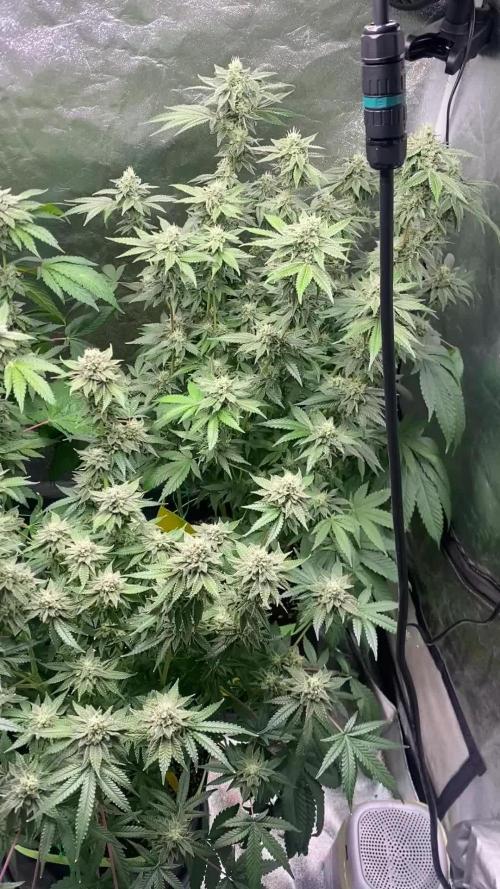
The pistils on all plants are getting more and more brown, its time to check the trichomes now. I check with a handheld microscope and they are getting milky, but not yet amber, which means they are ALMOST READY TO HARVEST, but not yet. The amount of crystals produced under the Q6W-Gen.2 LED-lamps from SANlight is astounding, the plants are coated in trichomes! This week I stopped giving any nutrients in order to FLUSH the plants, this is VERY IMPORTANT in order to get a smooth smoke of the dried end-product. The aroma of the plants is VERY STRONG NOW, they smell mouth-watering. The Shiva Skunk has a sweet, musky smell with a fresh citrus note to it, its a delight to smell those plants. The Serious Kush smells EXTREMELY fuely and gassy, like the OG-Kush, but with an amount of buds like the White Russian, its FLABBERGASTING. I cant wait to try those two strains...😎
Likes
52
Share
Lacewings seemed to have mostly killed themselves by flying into hot light fixtures. I may have left the UV on which was smart of me :) Done very little to combat if anything but make a sea of carcasses, on the bright side its good nutrition for the soil. Made a concoction of ethanol 70%, equal parts water, and cayenne pepper with a couple of squirts of dish soap. Took around an hour of good scrubbing the entire canopy. Worked a lot more effectively and way cheaper. Scorched earth right now, but it seems to have wiped them out almost entirely very pleased. Attempted a "Fudge I Missed" for the topping. So just time to wait and see how it goes. Question? If I attached a plant to two separate pots but it was connected by rootzone, one has a pH of 7.5 ish the other has 4.5. Would the Intelligence of the plant able to dictate each pot separately to uptake the nutrients best suited to pH or would it still try to draw nitrogen from a pot with a pH where nitrogen struggles to uptake? Food for stoner thought experiments! Another was on my mind. What happens when a plant gets too much light? Well, it burns and curls up leaves. That's the heat radiation, let's remove excess heat, now what? I've always read it's just bad, or not good, but when I look for an explanation on a deeper level it's just bad and you shouldn't do it. So I did. How much can a cannabis plant absorb, 40 moles in a day, ok I'll give it 60 moles. 80 nothing bad ever happened. The answer, finally. Oh great........more questions........ Reactive oxygen species (ROS) are molecules capable of independent existence, containing at least one oxygen atom and one or more unpaired electrons. "Sunlight is the essential source of energy for most photosynthetic organisms, yet sunlight in excess of the organism’s photosynthetic capacity can generate reactive oxygen species (ROS) that lead to cellular damage. To avoid damage, plants respond to high light (HL) by activating photophysical pathways that safely convert excess energy to heat, which is known as nonphotochemical quenching (NPQ) (Rochaix, 2014). While NPQ allows for healthy growth, it also limits the overall photosynthetic efficiency under many conditions. If NPQ were optimized for biomass, yields would improve dramatically, potentially by up to 30% (Kromdijk et al., 2016; Zhu et al., 2010). However, critical information to guide optimization is still lacking, including the molecular origin of NPQ and the mechanism of regulation." What I found most interesting was research pointing out that pH is linked to this defense mechanism. The organism can better facilitate "quenching" when oversaturated with light in a low pH. Now I Know during photosynthesis plants naturally produce exudates (chemicals that are secreted through their roots). Do they have the ability to alter pH themselves using these excretions? Or is that done by the beneficial bacteria? If I can prevent reactive oxygen species from causing damage by "too much light". The extra water needed to keep this level of burn cooled though, I must learn to crawl before I can run. Reactive oxygen species (ROS) are key signaling molecules that enable cells to rapidly respond to different stimuli. In plants, ROS plays a crucial role in abiotic and biotic stress sensing, integration of different environmental signals, and activation of stress-response networks, thus contributing to the establishment of defense mechanisms and plant resilience. Recent advances in the study of ROS signaling in plants include the identification of ROS receptors and key regulatory hubs that connect ROS signaling with other important stress-response signal transduction pathways and hormones, as well as new roles for ROS in organelle-to-organelle and cell-to-cell signaling. Our understanding of how ROS are regulated in cells by balancing production, scavenging, and transport has also increased. In this Review, we discuss these promising developments and how they might be used to increase plant resilience to environmental stress. Temperature stress is one of the major abiotic stresses that adversely affect agricultural productivity worldwide. Temperatures beyond a plant's physiological optimum can trigger significant physiological and biochemical perturbations, reducing plant growth and tolerance to stress. Improving a plant's tolerance to these temperature fluctuations requires a deep understanding of its responses to environmental change. To adapt to temperature fluctuations, plants tailor their acclimatory signal transduction events, specifically, cellular redox state, that are governed by plant hormones, reactive oxygen species (ROS) regulatory systems, and other molecular components. The role of ROS in plants as important signaling molecules during stress acclimation has recently been established. Here, hormone-triggered ROS produced by NADPH oxidases, feedback regulation, and integrated signaling events during temperature stress activate stress-response pathways and induce acclimation or defense mechanisms. At the other extreme, excess ROS accumulation, following temperature-induced oxidative stress, can have negative consequences on plant growth and stress acclimation. The excessive ROS is regulated by the ROS scavenging system, which subsequently promotes plant tolerance. All these signaling events, including crosstalk between hormones and ROS, modify the plant's transcriptomic, metabolomic, and biochemical states and promote plant acclimation, tolerance, and survival. Here, we provide a comprehensive review of the ROS, hormones, and their joint role in shaping a plant's responses to high and low temperatures, and we conclude by outlining hormone/ROS-regulated plant-responsive strategies for developing stress-tolerant crops to combat temperature changes. Onward upward for now. Next! Adenosine triphosphate (ATP) is an energy-carrying molecule known as "the energy currency of life" or "the fuel of life," because it's the universal energy source for all living cells.1 Every living organism consists of cells that rely on ATP for their energy needs. ATP is made by converting the food we eat into energy. It's an essential building block for all life forms. Without ATP, cells wouldn't have the fuel or power to perform functions necessary to stay alive, and they would eventually die. All forms of life rely on ATP to do the things they must do to survive.2 ATP is made of a nitrogen base (adenine) and a sugar molecule (ribose), which create adenosine, plus three phosphate molecules. If adenosine only has one phosphate molecule, it’s called adenosine monophosphate (AMP). If it has two phosphates, it’s called adenosine diphosphate (ADP). Although adenosine is a fundamental part of ATP, when it comes to providing energy to a cell and fueling cellular processes, the phosphate molecules are what really matter. The most energy-loaded composition for adenosine is ATP, which has three phosphates.3 ATP was first discovered in the 1920s. In 1929, Karl Lohmann—a German chemist studying muscle contractions—isolated what we now call adenosine triphosphate in a laboratory. At the time, Lohmann called ATP by a different name. It wasn't until a decade later, in 1939, that Nobel Prize–-winner Fritz Lipmann established that ATP is the universal carrier of energy in all living cells and coined the term "energy-rich phosphate bonds."45 Lipmann focused on phosphate bonds as the key to ATP being the universal energy source for all living cells, because adenosine triphosphate releases energy when one of its three phosphate bonds breaks off to form ADP. ATP is a high-energy molecule with three phosphate bonds; ADP is low-energy with only two phosphate bonds. The Twos and Threes of ATP and ADP Adenosine triphosphate (ATP) becomes adenosine diphosphate (ADP) when one of its three phosphate molecules breaks free and releases energy (“tri” means “three,” while “di” means “two”). Conversely, ADP becomes ATP when a phosphate molecule is added. As part of an ongoing energy cycle, ADP is constantly recycled back into ATP.3 Much like a rechargeable battery with a fluctuating state of charge, ATP represents a fully charged battery, and ADP represents a "low-power mode." Every time a fully charged ATP molecule loses a phosphate bond, it becomes ADP; energy is released via the process of ATP becoming ADP. On the flip side, when a phosphate bond is added, ADP becomes ATP. When ADP becomes ATP, what was previously a low-charged energy adenosine molecule (ADP) becomes fully charged ATP. This energy-creation and energy-depletion cycle happens time and time again, much like your smartphone battery can be recharged countless times during its lifespan. The human body uses molecules held in the fats, proteins, and carbohydrates we eat or drink as sources of energy to make ATP. This happens through a process called hydrolysis . After food is digested, it's synthesized into glucose, which is a form of sugar. Glucose is the main source of fuel that our cells' mitochondria use to convert caloric energy from food into ATP, which is an energy form that can be used by cells. ATP is made via a process called cellular respiration that occurs in the mitochondria of a cell. Mitochondria are tiny subunits within a cell that specialize in extracting energy from the foods we eat and converting it into ATP. Mitochondria can convert glucose into ATP via two different types of cellular respiration: Aerobic (with oxygen) Anaerobic (without oxygen) Aerobic cellular respiration transforms glucose into ATP in a three-step process, as follows: Step 1: Glycolysis Step 2: The Krebs cycle (also called the citric acid cycle) Step 3: Electron transport chain During glycolysis, glucose (i.e., sugar) from food sources is broken down into pyruvate molecules. This is followed by the Krebs cycle, which is an aerobic process that uses oxygen to finish breaking down sugar and harnesses energy into electron carriers that fuel the synthesis of ATP. Lastly, the electron transport chain (ETC) pumps positively charged protons that drive ATP production throughout the mitochondria’s inner membrane.2 ATP can also be produced without oxygen (i.e., anaerobic), which is something plants, algae, and some bacteria do by converting the energy held in sunlight into energy that can be used by a cell via photosynthesis. Anaerobic exercise means that your body is working out "without oxygen." Anaerobic glycolysis occurs in human cells when there isn't enough oxygen available during an anaerobic workout. If no oxygen is present during cellular respiration, pyruvate can't enter the Krebs cycle and is oxidized into lactic acid. In the absence of oxygen, lactic acid fermentation makes ATP anaerobically. The burning sensation you feel in your muscles when you're huffing and puffing during anaerobic high-intensity interval training (HIIT) that maxes out your aerobic capacity or during a strenuous weight-lifting workout is lactic acid, which is used to make ATP via anaerobic glycolysis. During aerobic exercise, mitochondria have enough oxygen to make ATP aerobically. However, when you're out of breath and your cells don’t have enough oxygen to perform cellular respiration aerobically, the process can still happen anaerobically, but it creates a temporary burning sensation in your skeletal muscles. Why ATP Is So Important? ATP is essential for life and makes it possible for us to do the things we do. Without ATP, cells wouldn't be able to use the energy held in food to fuel cellular processes, and an organism couldn't stay alive. As a real-world example, when a car runs out of gas and is parked on the side of the road, the only thing that will make the car drivable again is putting some gasoline back in the tank. For all living cells, ATP is like the gas in a car's fuel tank. Without ATP, cells wouldn't have a source of usable energy, and the organism would die. Eating a well-balanced diet and staying hydrated should give your body all the resources it needs to produce plenty of ATP. Although some athletes may slightly improve their performance by taking supplements or ergonomic aids designed to increase ATP production, it's debatable that oral adenosine triphosphate supplementation actually increases energy. An average cell in the human body uses about 10 million ATP molecules per second and can recycle all of its ATP in less than a minute. Over 24 hours, the human body turns over its weight in ATP. You can last weeks without food. You can last days without water. You can last minutes without oxygen. You can last 16 seconds at most without ATP. Food amounts to one-third of ATP production within the human body.