


Likes
Comments
Share


@Dendegrow
Follow
Good plant had haze mango terps was faster then the other ones i will try it again

Likes
11
Share


@BluetenVomBodensee
Follow
Day 56
Happy 8 weeks, Fiona!
Still the easy going plant everyone wishes for :)
I am pretty sure I can see first signs of flower. So one week after switching to 12-12, we are in (very) early flowering.
Day 58
Well, I am running out of space 😅
My Scrog-Screen is bursting and I am really happy I have been using it because this Green Princess Fiona is BIG in every aspect (I guess this is what a long veg does with them 😍).
From now on, I‘ll only use LST to adjust height differences but no more Scrogging.
I‘ll defoliate her soon (probably towards the end of the week).
Day 61
Decided to make perfect use of home office and defoliated Fiona. Also fed her 2.5l with half the recommended dose of nutes.
Day 62
She looks happy! Doesn‘t seem to care about the leaves she lost yesterday. I‘ll give her another day rest before one final round of LST tomorrow 👑
Likes
7
Share


@4k2ofarmer
Follow
3º SEMANA DE FLORACION
-DE LA 2º SEMANA A LA 3º
-''LA PODA'' DE LOS 21 DIAS
Likes
5
Share


@Cana_Bus92
Follow
This week I tried some gentle LST by just bending the main branch over every day once or twice a day I didn’t use tie downs, I figured for my first grow I’ll keep it as simple as possible and see if I can even get it to harvest. It has definitely grown this week from last, and seems to be liking the 50-50 mix of FFOF and FFHF. I have noticed some yellow on the tips of a few leaves I’m assuming it’s cal mad deficiency comparing with others pictures but it’s minor. I have to say fast buds has a very hearty strain here it withstands well despite not having quite enough light, but I hope that’s something I can change in the future grows. I just worry that when she flips to flower she will struggle more under my lighting configuration and fox tail or larf out. That being said I’m intrigued to see what happens and see what she produces. I see her getting into a stretch getting taller daily and wanting more frequent watering I’m assuming I’ll start to see flower in week 5 or maybe 6. All in all I’m very happy for my first grow and the fast buds northern lights, I agree with others that say this strain is resilient. Happy growing!

Likes
68
Share

@Ultraviolet
Follow
Removed autoflower and put her in her own pot outside the tent.
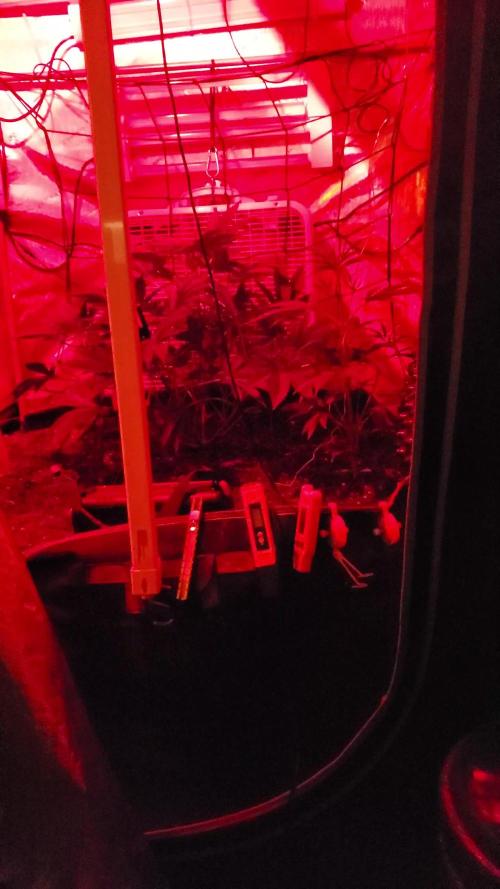
Foliars applied in strong blue 430nm with 4000Hz tone. 20-minute dose prior to application.
In essence, you're seeing a combination of the infrared light reflected by the plant, which the camera perceives as red, and any residual visible blue light the plant reflects, which results in a purple hue.
I was doing more stretching of the stems, adjusting weights, just a little too much, and it snapped almost clean. I got a little lucky in that it was still connected, wrapped her almost instantly while holding her in place with yoyo's. The core framework is now in place.
If your soil has a high pH, it's not ideal; you want a pH of 6.4, 6.5, or 6.6, which is ideal. If you are over a pH of 7, you have no hydrogen on the clay colloid. If you want your pH down, add Carbon. If you keep the pH below 7, you will unlock hydrogen, a whole host of new microbes become active and begin working, the plant will now be able to make more sugar because she has microbes giving off carbon dioxide, and the carbon you added hangs onto water. Everything has electricity in it. When you get the microbes eating carbon, breathing oxygen, giving off CO2, those aerobic soil microbes will carry about 0.5V of electricity that makes up the EC. The microorganisms will take a metal-based mineral and a non-metal-based mineral with about 1000 different combinations, and they will create an organic salt! That doesn't kill them, that the plant loves, that the plant enjoys. This creates an environment that is conducive to growing its own food.
Metal-based: Could include elements like iron, manganese, copper, or zinc, which are essential nutrients for plants but can exist in forms not readily accessible.
Non-metal-based: Examples like calcium carbonate, phosphate, or sulfur are also important for plant growth and potentially serve as building blocks for the organic salt.
Chelation in a plant medium is a chemical process where a chelating agent, a negatively charged organic compound, binds to positively charged metal ions, like iron, zinc, and manganese. This forms a stable, soluble complex that protects the micronutrient from becoming unavailable to the plant in the soil or solution. The chelate complex is then more easily absorbed by the plant's roots, preventing nutrient deficiency, improving nutrient uptake, and enhancing plant growth. Chelation is similar to how microorganisms create organic salts, as both involve using organic molecules to bind with metal ions, but chelation specifically forms ring-like structures, or chelates, while the "organic salts" of microorganisms primarily refer to metal-complexed low molecular weight organic acids like gluconic acid. Microorganisms use this process to solubilize soil phosphates by chelating cations such as iron (Fe) and calcium (Ca), increasing their availability.
Added sugars stimulate soil microbial activity, but directly applying sugar, especially in viscous form, can be tricky to dilute. Adding to the soil is generally not a beneficial practice for the plant itself and is not a substitute for fertilizer. While beneficial microbes can be encouraged by the sugar, harmful ones may also be stimulated, and the added sugar is a poor source of essential plant nutrients. Sugar in soil acts as a food source for microbes, but its effects on plants vary significantly with the sugar's form and concentration: simple sugars like glucose can quickly boost microbial activity and nutrient release. But scavenge A LOT of oxygen in the process, precious oxygen. Overly high concentrations of any sugar can attract pests, cause root rot by disrupting osmotic balance, and lead to detrimental fungal growth. If you are one who likes warm tropical high rh, dead already. Beneficial, absolutely, but only to those who don't run out of oxygen. Blackstrap is mostly glucose, iirc regular molasses is mostly sucrose. Sugars, especially sucrose, act as signaling molecules that interact with plant hormones and regulate gene expression, which are critical for triggering the floral transition. When sucrose is added to the growth medium significantly influences its effect on floral transition.
Probably wouldn't bother with blackstrap given its higher glucose content. Microbes in the soil consume the sugar and, in the process, draw nitrogen from the soil, which is the same nutrient the plant needs. Glucose is not an oxygen scavenger itself, but it acts as a substrate for the glucose oxidase (GOx) enzyme, effectively removing oxygen from a system. Regular molasses (powdered if you can), as soon as she flips to flower or a week before, the wrong form of sugar can delay flower, or worse. Wrong quantity, not great either. The timing of sucrose application is crucial. It was more complicated than I gave it credit for, that's for sure. When a medium's carbon-to-nitrogen (C:N) ratio reaches 24:1, it signifies an optimal balance for soil microbes to thrive, leading to efficient decomposition and nutrient cycling. At this ratio, soil microorganisms have enough nitrogen for their metabolic needs, allowing them to break down organic matter and release vital nutrients like phosphorus and zinc for plants. Exceeding this ratio results in slower decomposition and nitrogen immobilization, while a ratio below 24:1 leads to faster breakdown and excess nitrogen availability.
Carbon and nitrogen are two elements in soils and are required by most biology for energy. Carbon and nitrogen occur in the soil as both organic and inorganic forms. The inorganic carbon in the soil has minimal effect on soil biochemical activity, whereas the organic forms of carbon are essential for biological activity. Inorganic carbon in the soil is primarily present as carbonates, whereas organic carbon is present in many forms, including live and dead plant materials and microorganisms; some are more labile and therefore can be easily decomposed, such as sugars, amino acids, and root exudates, while others are more recalcitrant, such as lignin, humin, and humic acids. Soil nitrogen is mostly present in organic forms (usually more than 95 % of the total soil nitrogen), but also in inorganic forms, such as nitrate and ammonium. Soil biology prefers a certain ratio of carbon to nitrogen (C:N). Amino acids make up proteins and are one of the nitrogen-containing compounds in the soil that are essential for biological energy. The C:N ratio of soil microbes is about 10:1, whereas the preferred C:N ratio of their food is 24:1 (USDA Natural Resource Conservation Service 2011). Soil bacteria (3-10:1 C:N ratio) generally have a lower C:N ratio than soil fungi (4-18:1 C:N ratio) (Hoorman & Islam 2010; Zhang and Elser 2017). It is also important to mention that the ratio of carbon to other nutrients, such as sulfur (S) and phosphorous (P) also are relevant to determine net mineralization/immobilization. For example, plant material with C:S ratio smaller than 200:1 will promote mineralization of sulfate, while C:S ratio higher than 400:1 will promote immobilization (Scherer 2001).
In soil science and microbiology, the C:S ratio helps determine whether sulfur will be released (mineralized) or tied up (immobilized) by microorganisms.
A carbon-to-sulfur (C:S) ratio smaller than 200:1 promotes the mineralization of sulfate, when the C:S ratio is low, it indicates that the organic matter decomposing in the soil is rich in sulfur relative to carbon. Microorganisms require both carbon and sulfur for their metabolic processes. With an excess of sulfur, microbes take what they need and release the surplus sulfur into the soil as plant-available sulfate
A carbon-to-sulfur (C:S) ratio higher than 400:1 will promote the immobilization of sulfur from the soil. This occurs because when high-carbon, low-sulfur materials (like sawdust) are added to soil, microbes consume the carbon and pull sulfur from the soil to meet their nutritional needs, temporarily making it unavailable to plants.
200:1 C:S 400:1: In this range, both mineralization and immobilization can occur simultaneously, making the net availability of sulfur less predictable.
This dynamic is similar to how the carbon-to-nitrogen (C:N) ratio regulates the availability of nitrogen in soil. Just as microbes need a certain amount of nitrogen to process carbon, they also require a balanced amount of sulfur. Both mineralization and immobilization are driven by the metabolic needs of the soil's microbial population.
Sulfur is crucial for protein synthesis. A balanced ratio is particularly important in relation to nitrogen (N), as plants need adequate sulfur to efficiently use nitrogen. A severely imbalanced C:S ratio can hinder the efficient use of nitrogen, as seen in trials where adding nitrogen without balancing sulfur levels actually lowered crop yields.
Maintaining a balanced carbon-to-sulfur (C:S) ratio is highly beneficial for plant growth, but this happens indirectly by regulating soil microbial activity. Unlike the C:N ratio, which is widely discussed for its direct effect on nutrient availability, the C:S ratio determines whether sulfur in the soil's organic matter is released (mineralized) or temporarily locked up (immobilized).
Applied 3-day drought stress.
Glucose will hinder oxygenation more than sucrose in a solution because glucose is consumed faster and has a higher oxygen demand, leading to a more rapid decrease in oxygen levels. When cells respire, they use oxygen to break down glucose, and this process requires more oxygen for glucose than for sucrose because sucrose must first be broken down into glucose and fructose before it can be metabolized.
In a growth medium, glucose is a more immediate and universal signaling molecule for unicellular and multicellular organisms because it is directly used for energy and triggers a rapid gene expression response. In contrast, sucrose primarily acts as a signaling molecule in plants to regulate specific developmental processes by being transported or broken down, which can be a more complex and slower signaling process.
Critical stuff.
During wakefulness (DC electric current) life can not entangle electrons and protons. During the daytime, the light is sensed as multiple color frequencies in sunlight. Coherence requires monochromatic light. Therefore, at night, IR light dominates cell biology. This is another reason why the DC electric current disappears during the night. The coherence of water is maintained by using its density changes imparted by infrared light released from mitochondria in the absence of light. This density change can be examined by NMR analysis, and water is found to be in its icosahedral molecular form. This is the state that water should be in at night. This is when a light frequency is lowest and when the wave part of the photoelectric effect is in maximum use.
3600
Likes
37
Share


@Rob96
Follow
Cut net down this week and had a reshuffle around, dos si dos was a lot taller so move lights up and put other 3 plants on top on boxes to level top as much as i can
Had to do a little late trimming to help airflow down low and just give a little more breathing space as suffered with a little rot on my first grow luckily not too bad though but fingers crossed none at all this time, i managed to avoid it on my secone grow so hopefully will be ok
Plant looks strong and healthy, had no issues so far plenty of tops cant wait to see it fatten up

Likes
62
Share


@Santica_Garden
Follow
So this is how things are looking for the ladies at the end of Week 4 of Flower, not much to update, I have uploaded a video for you guys with all the information you need. Any questions just ask away guys 👍🏾🌱💚

Likes
1
Share


@Randomjcb
Follow
Really started to fill out now most branches are supported with fishing line cant wait to see wat comes off it defo one of my new fav strains
Likes
20
Share


@DeepRootGrows
Follow
Let’s just say for what I got out of this plant, I’m extremely pleased. This plant was put through a lot of stress and never really skipped a beat. I stunted the growth early on in the seedling stage, I then decided mid veg state that I wanted to do coco coir instead of DWC bucket, which then slowed it down a few days, then during my first time doin any training to a plant I snapped the main node off slowing it down again. My cat then one day got into my tent when it was down while I went to use the restroom, and ended up digging out an entire side of the pots and roots. I truly thought this was the end of this plants life, I decided to just let it go and hopefully I could maybe get some small stuff to make some butter with or something. She bounced back from even the cat attack and produced something very great.
All in all this was really fun to grow, she was resilient as hell and would love to try this strain again with no hiccups down the road in the near future.
Lastly, thank you to everyone who has liked or commented on this journal. I hope to see and hear from you on my other diaries. I look forward to the feedback y’all leave me. 🤙🏼

Likes
14
Share


@Mr_Terps
Follow
🔥GrowDiaries Report: Sleepy Joe von Anesia Seeds – Start der Blüte unter 630W LED
Der Grow mit Sleepy Joe von Anesia Seeds ist gestartet, und die Pflanzen zeigen schon jetzt ihr Potenzial. Nach einer stabilen Wachstumsphase geht es jetzt in die Stretch-Phase der Blüte. Das Setup mit 630W LED sorgt für optimale Lichtverhältnisse, und das Zelt ist bereit, die nächsten Wochen Vollgas zu geben.
---
Setup & Start der Blüte
Beleuchtung: 630W CMH – perfekt für dichte Buds und starke Trichomentwicklung
Zelt: 120x120 cm – genug Platz für die Damen, um sich zu strecken
Nährstoffe: Advanced Nutrients (Grow, Micro, Bloom) + CalMag
Lichtzyklus: Umgestellt auf 12/12 für den Start der Blüte
Temperatur: Stabil bei 24-26°C (Licht an), 18-20°C (Licht aus)
Luftfeuchtigkeit: Runter auf ca. 50%, um Schimmel vorzubeugen
---
Pflanzenentwicklung & Stretch-Phase
Direkt nach der Umstellung auf den 12/12 Lichtzyklus zeigt Sleepy Joe ein ordentliches Stretch-Verhalten. Die Internodien-Abstände bleiben dabei schön kompakt, was für eine kräftige Blütenbildung spricht. Der 630W CMH Strahler liefert das perfekte Lichtspektrum für diese Phase, was die Pflanzen dazu anregt, ordentlich in die Höhe zu schießen und gleichzeitig die Basis für dichte Blüten zu legen.
---
Nährstoffstrategie mit Advanced Nutrients & CalMag
In der frühen Blütephase kommt jetzt Advanced Nutrients Bloom ins Spiel, ergänzt durch CalMag, um den erhöhten Bedarf an Calcium und Magnesium durch die starke Lichtintensität abzudecken. Die Pflanzen reagieren gut auf die Nährstoffzufuhr, das Blattgrün bleibt satt und kräftig.
Tipp: In dieser Phase genau auf Anzeichen von Nährstoffmangel achten, besonders Magnesium und Kalium sind jetzt gefragt.
---
Erste Blütenansätze & Ausblick
Nach etwa einer Woche Blütezeit sind die ersten Blütenansätze zu sehen. Die Spitzen der Pflanzen bilden feine, weiße Härchen, die sich in den kommenden Wochen zu den dichten, harzigen Buds entwickeln werden, für die Sleepy Joe bekannt ist.
Mit der 630W CMH-Beleuchtung und der richtigen Nährstoffstrategie sieht es nach einem vielversprechenden Grow aus. Die nächsten Wochen werden zeigen, wie gut Sleepy Joe das Setup annimmt und wie sich die Blüten weiterentwickeln.
---
Wichtige Keywords für Grower:
Growshop Tipps
Anesia Seeds Erfahrungen
630W LED Grow Report
Advanced Nutrients Anwendung
CalMag für Cannabis Pflanzen
Indoor Growing mit Growlight
Beste Nährstoffe für Cannabis
Blütephase starten mit Anesia Seeds
Stretch-Phase optimieren
Grow-Report für Anfänger und Profis
---
Bleibt dran für das nächste Update, wenn die Blüten richtig an Fahrt aufnehmen. Happy Growing! 🌱

Likes
2
Share


@fabialien
Follow
Semana sel 2 de septiembre al 8 de septiembre 8 de septiembre, fotos del dia Jueves 5 de septiembre 2024.
Se regaron con Floralicius plus adicionado con Hidrol-pez + vitaminas.


Likes
2
Share

@eldruida_lamota
Follow
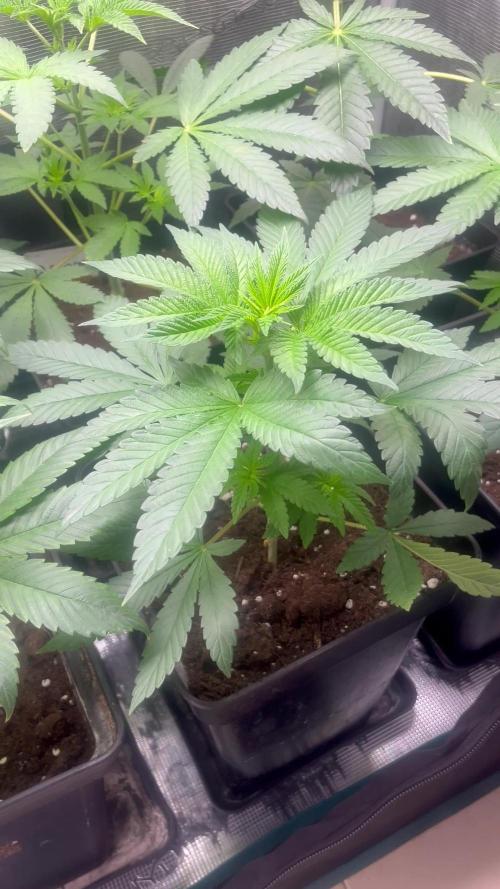
Que pasa familia, vamos con la quinta y última semana de crecimiento de estas Drizl Pickl feminizadas de Seedstockers.
Vamos al lío ,se trasplantaron en macetas de 7 litros definitivamente.
El ph se controla en 6.0 , la temperatura la tenemos entre 24/20 grados y la humedad ronda el 50%.
El ciclo de crecimiento puse 16h de luz, el foco está al 50% de potencia.
De momento van creciendo a buen ritmo y tienen un buen color, aplique de manera foliar el tetra 9 ahora cara a la floración.
Agradecer Agrobeta por el envío del kit gold series para esta temporada, son unos jefes 🙏
- os dejo por aquí un CÓDIGO: Eldruida
Descuento para la tienda de MARS HYDRO.
https://www.mars-hydro.com
Hasta aquí todo, Buenos humos 💨💨💨
Likes
10
Share


@Pechu420
Follow
Her scent is incredible, something sweet. The buds developed quickly, and now appear to be getting fatter. Let's see what these last 4 weeks of flowering will be like. 12/12 from the beginning, left it with an acceptable size, but in the next cultivation I will start LST ties from earlier, to make better use of the light. Let's see the difference.
Processing
Likes
142
Share


@MadeInGermany
Follow
Hey everyone :-).
The last plants were also placed in the bloom chamber kammer.
Everyone has made great progress this week 🙏🏻.
There is not much to say about this week, I think videos and pictures say more like words 🙈😎.
I wish you all a good start into the week :-) Stay healthy and let it grow 🙏🏻👍


Likes
7
Share

@PEAKYPLANTERS
Follow
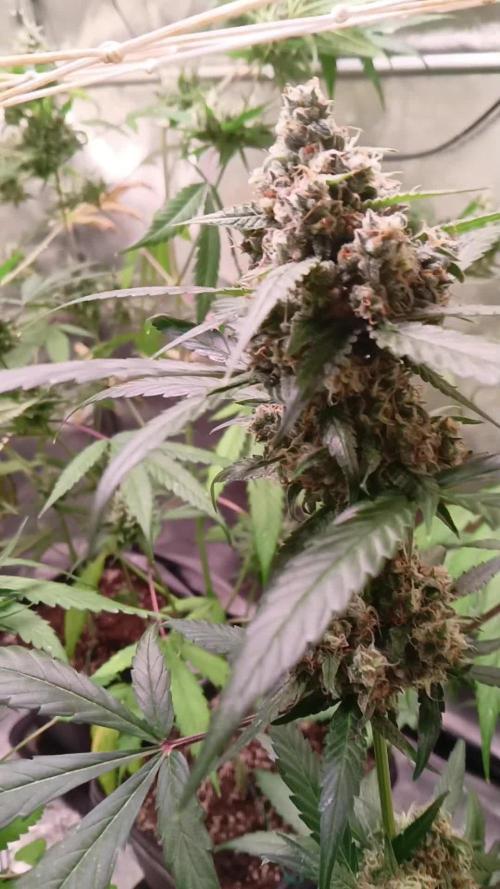
They look like ice cream scoops, nice and compact, it's a shame it wasn't very productive
Likes
15
Share


@Waveform
Follow
Instead of pictures showing a dying lady: A timelapse video of their whole life.
Had lady #2 run under continuous light for the last days. Probably went one day too far, which caused her buds to become somewhat fluffy too, but full of resin as well.

Likes
7
Share


@L8bloomr1008
Follow
Harvest week for atleast the BG’s. The motor breath looks like it could go a couple more weeks but won’t have the time so….. we rollin with it!
Likes
18
Share


@PakkaFarm
Follow
Harvest day 76.
Dry in 50-60% humidity, totally night and ventilation maxed 🔥🍊💨
I'm filled with pain as happy for the end of our adventure together.
Dry Day 1-2: humidity level 55-60
Dry Day 3-4 : 52-58
Dry Day 5-6-7 : 50-55
Manicure day 3 and 6 of dry ✂️
Use Ice-O-Lator to make Orange Sherbet bubble hash
My density note : 8/10
Speed : Really fast, some LST, defoliation, toping. She really looks good ever time!
Likes
6
Share


@3rnest
Follow
Die 6. Woche ist abgeschlossen und die Pflanzen haben sich gut entwickelt. Die Leistung der Lampe wurde im Laufe der Woche schrittweise erhöht. Aufgrund der steigenden Temperaturen im Zelt musste die Leistung jedoch wieder etwas reduziert werden, da die Pflanzen bereits begannen, ihre Blätter hängen zu lassen.
Die drei Pflanzen haben inzwischen eine Höhe von etwa 25–28 cm erreicht.
Ab der kommenden Woche werde ich damit beginnen, die Beleuchtungsdauer schrittweise zu reduzieren.


Processing
Likes
3
Share


@Dico29
Follow
Day 128 it’s good smells sweet and every time I walk into my room it smells like gas
Even though quantity is lower then I expected, the trichomes are crazy


