




@Hempface86
Follow
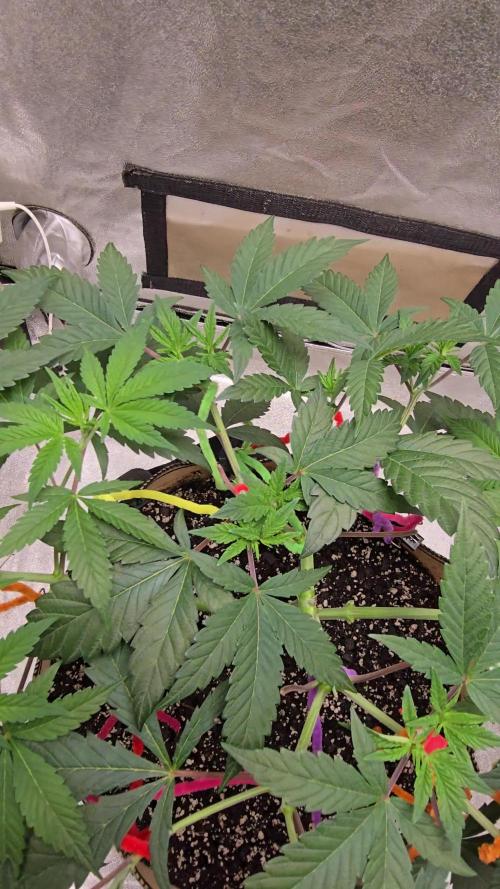
You can see this girl is getting big. I've done a few rounds of topping and she has spread out i'm going to put her in her own tent in a few days when my new fans come in... She's gonna be a big one =) .. Hope all is well.God bless and happy growing 🙏

shorts_status_processing


@CannabisAprendiz
Follow
Hola asi vamos con las niñas en esta semana , muy contento con el resultado visual que se esta viendo en el cultivo , las plantas están muy resinosas con un aroma muy rico de oler. Ya paramos la fertilización para empezar solamente con agua hasta sus días finales , no se ocupara ningún aditivo de limpiador de minerales , esperamos que consumas sus reservas estas semanas y así obtener el amarilleo final 👌
Hello, so we go with the girls this week, very happy with the visual result that is being seen in the crop, the plants are very resinous with a very rich smell of smell. We already stop fertilization to start only with water until its final days, no mineral cleaner additive will be used, we hope you consume your reserves these weeks and thus obtain the final yellowing👌


@Samsemilla
Follow
I cut the plants, remove the remaining fan leafs and hang the plants upside down inside the dark tent for 8 days.
After 8 days I trimmed the buds and put them into glass containers with boveda packs.
I burped the containers everyday for 10 minutes (first two weeks twice) for about 4-6 weeks.




@Hou_Stone
Follow
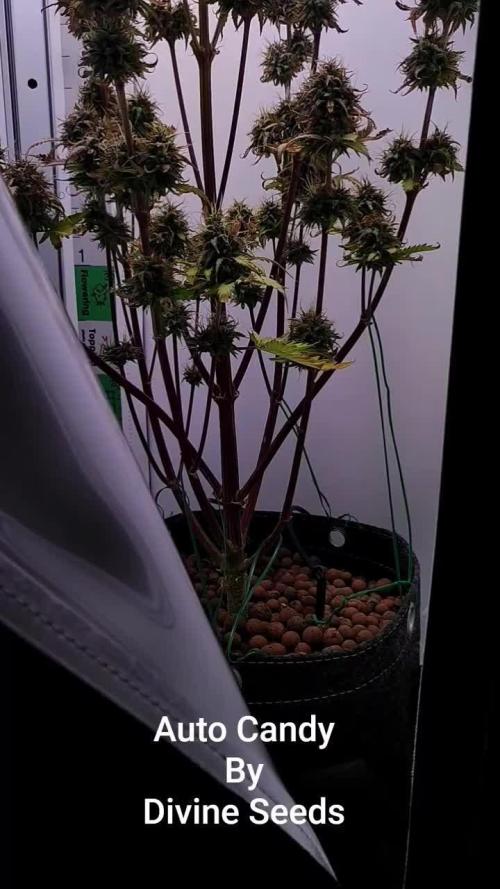
️ Genetics of Tarte Tatin = Caramel Apple Gelato x King’s Tart ️
🌱Here I am with 4 small seedlings of Tarte Tatin 🥧
With her genetics, I have a feeling she's going to be delicious, I can't wait to taste it! 😋
After a short week of growth I place my seedlings in their final 7Liters pot with a mixture that I made. I use unfertilized soil as a base.🌱
And I add organic nutrients from GreenHouseFeeding that I mix at the top of the pot (35Grams BioGrow 14Grams Biobloom).
Then I water each pot with 1L of water.💧
I use tap water. I lower the pH and sometimes add a little BioEnhancer😘
My Instagram 🌱❤️️ :
https://www.instagram.com/hou_stone420/
------------------------------------------
Equipment used :
Light FC3000 Mars hydro. power 25% at 30cm
Extractor 6 inch Mars Hydro. power 1/10. ON 24/24h
No other fan this week
Heating mat Romberg 95x95cm. ON half an hour every hour
☄️🌠🌠🌠🌟
Thanks for your visite mate 💪
🙌Have a nice day !



@SkunkyDog420
Follow
Hallo zusammen 🤙.
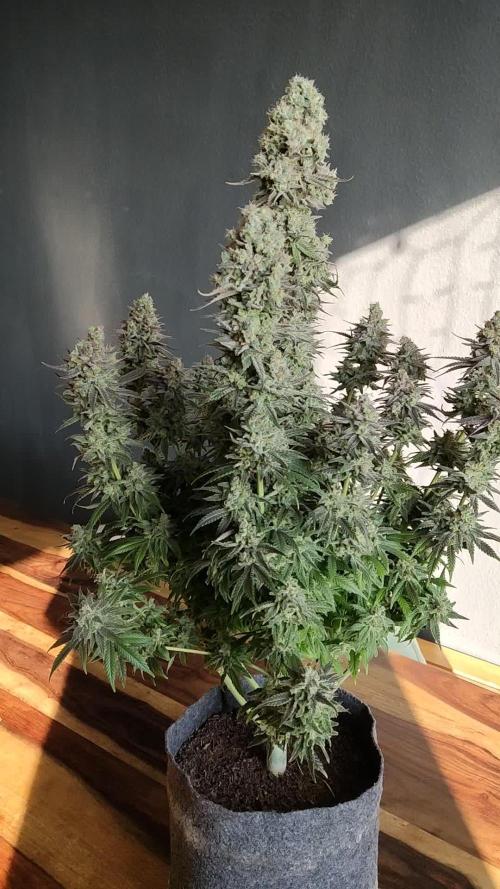
Habe sie heute geerntet. Sie riecht phantastisch 🤤
Wir hören uns in 3 Wochen mit dem Erntebericht




@Grasshopper96
Follow
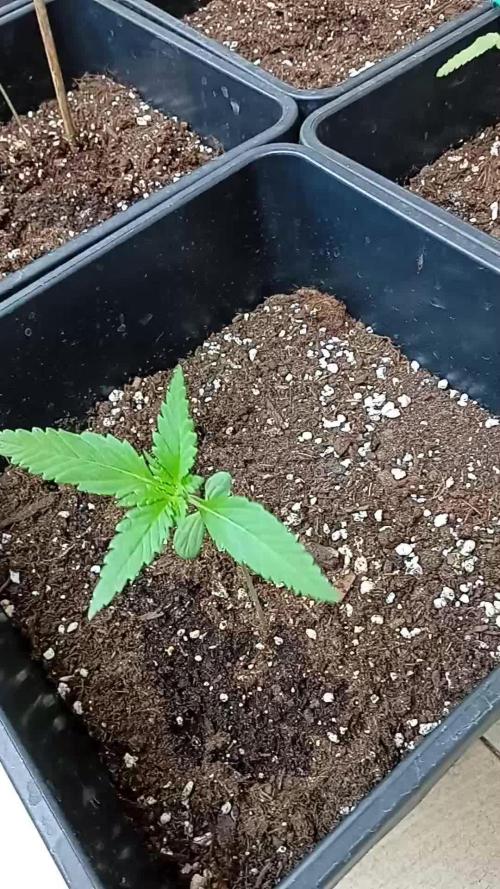
Thiss week start Better , the plant grow and make new couple of leaves, i Hope this plant grow much😁




@Ultraviolet
Follow
What's in the soil? What's not in the soil would be an easier question to answer. 16-18 DLI @ the minute. +++ as she grows.
Probably not recommended, but to get to where it needs to be, I need to start now.
Vegetative @1400ppm 0.8–1.2 kPa 80–86°F (26.7–30°C) 65–75%, LST Day 10, Fim'd Day 11
CEC (Cation Exchange Capacity):
This is a measure of a soil's ability to hold and exchange positively charged nutrients, like calcium, magnesium, and potassium. Soils with high CEC (more clay and organic matter) have more negative charges that attract and hold these essential nutrients, preventing them from leaching away.
Biochar is highly efficient at increasing cation exchange capacity (CEC) compared to many other amendments. Biochar's high CEC potential stems from its negatively charged functional groups, and studies show it can increase CEC by over 90%. Amendments like compost also increase CEC but are often more prone to rapid biodegradation, which can make biochar's effect more long-lasting. biochar acts as a long-lasting Cation Exchange Capacity (CEC) enhancer because its porous, carbon-rich structure provides sites for nutrients to bind to, effectively improving nutrient retention in soil without relying on the short-term benefits of fresh organic matter like compost or manure. Biochar's stability means these benefits last much longer than those from traditional organic amendments, making it a sustainable way to improve soil fertility, water retention, and structure over time. Needs to be charged first, similar to Coco, or it will immobilize cations, but at a much higher ratio.
a high cation exchange capacity (CEC) results in a high buffer protection, meaning the soil can better resist changes in pH and nutrient availability. This is because a high CEC soil has more negatively charged sites to hold onto essential positively charged nutrients, like calcium and magnesium, and to buffer against acid ions, such as hydrogen.
EC (Electrical Conductivity):
This measures the amount of soluble salts in the soil. High EC levels indicate a high concentration of dissolved salts and can be a sign of potential salinity issues that can harm plants.
The stored cations associated with a medium's cation exchange capacity (CEC) do not directly contribute to a real-time electrical conductivity (EC) reading. A real-time EC measurement reflects only the concentration of free, dissolved salt ions in the water solution within the medium.
98% of a plants nutrients comes directly from the water solution.
2% come directly from soil particles.
CEC is a mediums storage capacity for cations. These stored cations do not contribute to a mediums EC directly.
Electrical Conductivity (EC) does not measure salt ions adsorbed (stored) onto a Cation Exchange Capacity (CEC) site, as EC measures the conductivity of ions in solution within a soil or water sample, not those held on soil particles.
A medium releases stored cations to water by ion exchange, where a new, more desirable ion from the water solution temporarily displaces the stored cation from the medium's surface, a process also seen in plants absorbing nutrients via mass flow. For example, in water softeners, sodium ions are released from resin beads to bond with the medium's surface, displacing calcium and magnesium ions which then enter the water. This same principle applies when plants take up nutrients from the soil solution: the cations are released from the soil particles into the water in response to a concentration equilibrium, and then moved to the root surface via mass flow.
An example of ion exchange within the context of Cation Exchange Capacity (CEC) is a soil particle with a negative charge attracting and holding positively charged nutrient ions, like potassium (K+) or calcium (Ca2+), and then exchanging them for other positive ions present in the soil solution. For instance, a negatively charged clay particle in soil can hold a K+ ion and later release it to a plant's roots when a different cation, such as calcium (Ca2+), is abundant and replaces the potassium. This process of holding and swapping positively charged ions is fundamental to soil fertility, as it provides plants with essential nutrients.
Negative charges on soil particles: Soil particles, particularly clay and organic matter, have negatively charged surfaces due to their chemical structure.
Attraction of cations: These negative charges attract and hold positively charged ions, or cations, such as:
Potassium (K+)
Calcium (Ca2+)
Magnesium (Mg2+)
Sodium (Na+)
Ammonium (NH4+)
Plant roots excrete hydrogen ions (H+) through the action of proton pumps embedded in the root cell membranes, which use ATP (energy) to actively transport H+ ions from inside the root cell into the surrounding soil. This process lowers the pH of the soil, which helps to make certain mineral nutrients, such as iron, more available for uptake by the plant.
Mechanism of H+ Excretion
Proton Pumps: Root cells contain specialized proteins called proton pumps (H+-ATPases) in their cell membranes.
Active Transport: These proton pumps use energy from ATP to actively move H+ ions from the cytoplasm of the root cell into the soil, against their concentration gradient.
Role in pH Regulation: This active excretion of H+ is a major way plants regulate their internal cytoplasmic pH.
Nutrient Availability: The resulting decrease in soil pH makes certain essential mineral nutrients, like iron, more soluble and available for the root cells to absorb.
Ion Exchange: The H+ ions also displace positively charged mineral cations from the soil particles, making them available for uptake.
Iron Uptake: In response to iron deficiency stress, plants enhance H+ excretion and reductant release to lower the pH and convert Fe3+ to the more available form Fe2+. The altered pH can influence the activity and composition of beneficial microbes in the soil. The H+ gradient created by the proton pumps can also be used for other vital cell functions, such as ATP synthesis and the transport of other solutes. The hydrogen ions (H+) excreted during photosynthesis come from the splitting of water molecules. This splitting, called photolysis, occurs in Photosystem II to replace the electrons used in the light-dependent reactions. The released hydrogen ions are then pumped into the thylakoid lumen, creating a proton gradient that drives ATP synthesis.
Plants release hydrogen ions (H+) from their roots into the soil, a process that occurs in conjunction with nutrient uptake and photosynthesis. These H+ ions compete with mineral cations for the negatively charged sites on soil particles, a phenomenon known as cation exchange. By displacing beneficial mineral cations, the excreted H+ ions make these nutrients available for the plant to absorb, which can also lower the soil pH and indirectly affect its Cation Exchange Capacity (CEC) by altering the pool of exchangeable cations in the soil solution.
Plants use proton (H+) exudation, driven by the H+-ATPase enzyme, to release H+ ions into the soil, creating a more acidic rhizosphere, which enhances nutrient availability and influences nutrient cycling processes. This acidification mobilizes insoluble nutrients like iron (Fe) by breaking them down, while also facilitating the activity of beneficial microbes involved in the nutrient cycle. Therefore, H+ exudation is a critical plant strategy for nutrient acquisition and management, allowing plants to improve their access to essential elements from the soil.
A lack of water splitting during photosynthesis can affect iron uptake because the resulting energy imbalance disrupts the plant's ability to produce ATP and NADPH, which are crucial for overall photosynthetic energy conversion and can trigger a deficiency in iron homeostasis pathways. While photosynthesis uses hydrogen ions produced from water splitting for the Calvin cycle, not to create a hydrogen gas deficiency, the overall process is sensitive to nutrient availability, and iron is essential for chloroplast function.
In photosynthesis, water is split to provide electrons to replace those lost in Photosystem II, which is triggered by light absorption. These electrons then travel along a transport chain to generate ATP (energy currency) and NADPH (reducing power). Carbon Fixation: The generated ATP and NADPH are then used to convert carbon dioxide into carbohydrates in the Calvin cycle. Impaired water splitting (via water in or out) breaks the chain reaction of photosynthesis. This leads to an imbalance in ATP and NADPH levels, which disrupts the Calvin cycle and overall energy production in the plant. Plants require a sufficient supply of essential mineral elements like iron for photosynthesis. Iron is vital for chlorophyll formation and plays a crucial role in electron transport within the chloroplasts. The complex relationship between nutrient status and photosynthesis is evident when iron deficiency can be reverted by depleting other micronutrients like manganese. This highlights how nutrient homeostasis influences photosynthetic function. A lack of adequate energy and reducing power from photosynthesis, which is directly linked to water splitting, can trigger complex adaptive responses in the plant's iron uptake and distribution systems.
Plants possess receptors called transceptors that can directly detect specific nutrient concentrations in the soil or within the plant's tissues. These receptors trigger signaling pathways, sometimes involving calcium influx or changes in protein complex activity, that then influence nutrient uptake by the roots. Plants use this information to make long-term adjustments, such as Increasing root biomass to explore more soil for nutrients. Modifying metabolic pathways to make better use of available resources. Adjusting the rate of nutrient transport into the roots. That's why I keep a high EC. Abundance resonates Abundance.


@Natrona
Follow
Sponsored grow 👉WeedSeedsExpress👈
Harvest
Love Potion grew in my AC Infinity 4x4 with 4 other plants. I harvested her April 12, 90 days after germination. Love Potion demonstrated strong resistance to mold, bud rot and pests. Based on her appearance of burnt and curled leaves, she did not recover after overfeeding then flushing in mid growth cycle. I trained her hard by topping her twice and tie downs to all limbs. Even though Love Potion is an auto, she seemed to tolerate this stressful training.
Because of the mix of strains growing in the tent, no smell was discernable. Now as it hangs by herself, she smells fruity and sweet. Love Potion remained under 2 feet tall after topping. Even without topping, she would remain short. This would make Love Potion very good strain for small closet grows. Love Potion grew without difficulty or issues. Produced a nice outcome. Wet weight 358g.
Your likes and comments are appreciated. Thanks for stopping by.
Thank you @WeedSeedsExpress for this opportunity to grow your strains.
Growers love 💚🌿
💫Natrona💫




@Ninjabuds
Follow
My OG Kush plant is from Royal Queen Seeds, and I know they sometimes get a bad rap, but I've grown their OG Kush before and it was fantastic. This pheno has some awesome leaves and just a really good structure overall.
It's been a challenging week with the constant rain and ridiculously high humidity. Keeping things dry indoors has been a real struggle. Despite the weather, I managed to flip all my feminized photoperiod plants to flower this week. I'm hoping the switch will go smoothly, but with this humidity, it's going to be tough.


@DeepRootsGrowTrees
Follow
MIMOSA ZKITTLEZ FF /
GANJA FARMER
WEEK #5 OVERALL
WEEK #4 VEG
This lady is a fast grower is how I must stay this week she's a plant that will take the training you provide to her I'm using the budtraining clips to help train her as well I've as topped her. Great genetics with this lady!! Stay Growing!!
Thank you for stopping by and taking a look it's much appreciated!!
Thank you GANJA FARMER!!!
MIMOSA ZKITTLEZ FF GANJA FARMER
.




@Enki_Weed
Follow
Week 6: Veg – Reset & Silicon Boost 🌿
System-Update: Komplette Reinigung der DWC (35L). Umstellung auf Osmosewasser + CalMag (Base EC 0,45).
• pH-Wert: Stabilisiert bei 6.0 (nach anfänglichem Silic-Rock-Jo-Jo).
• EC-Wert: Aktuell 1.24 mS/cm (Leicht steigend, Beobachtung läuft).
• Wassertemp: Perfekte 18,9°C – 20,3°C.
Nutrient Mix (pro 35L):
• Plagron Silic Rock: 35 ml (First in!)
• Hesi Hydro Wuchs: 175 ml
• Hesi Wurzel Complex: 175 ml
• Hesi Power Zyme: 70 ml
Strain-Check:
• AK: Absolut vital, tiefgrün, reagiert sehr gut auf das LST mit den Biege-Clips. Zeigt leichte Adlerkrallen (N-Limit erreicht).
• Tuntz Lake Cake: Wurzeln sind da, aber der "Take-off" verzögert sich im Vergleich zur AK. Sie wirkt etwas nährstoffsensibler.
Maßnahmen: Lichtabstand leicht vergrößert, um Transpirationsstress ("Canoeing") zu mindern. EC wird durch Zugabe von reinem Osmosewasser leicht gesenkt, um der Tuntz Lake Cake den Start zu erleichtern.


@Bubble_Budz
Follow
Week 4
Happy New Year everyone!
Got an explosion of growth between the previous week and now. She must like that top dressing I did last week... closer to 2 weeks ago actually now that I think of it. Any who... she's branching out nicely and I'm just trynna train an even-ish canopy before flipping to flower. She's already showing signs that she's ready. I wanna take a few clones from her in about 2 weeks and let her rock a while longer to recover before we flip the lights so until then, our routine is train, water, and top dress every 2 weeks. Water with recharge every other watering. Watering occurs currently about every 4-5 days.
That's all for this week's report 🙌🏾
As always...
Stay Highly Medicated & Highly Dedicated folks 🔥🎄😎🌬️🤙🏾






@OrganikTek
Follow
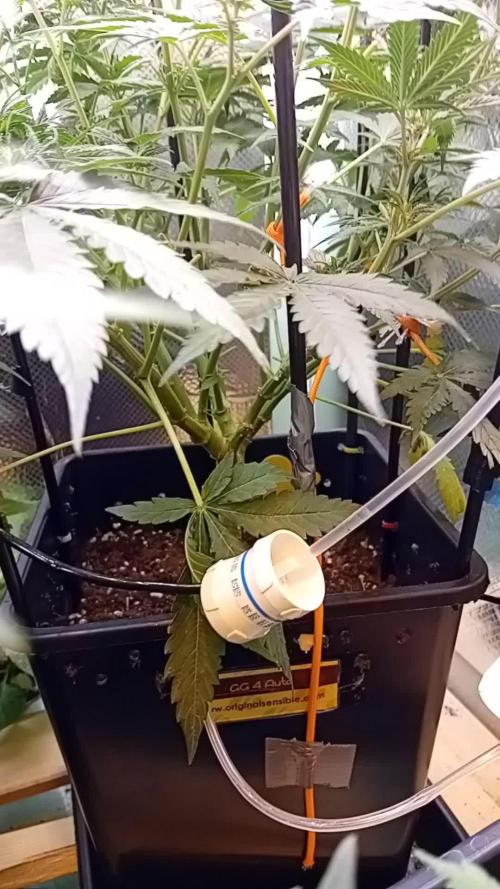
Black Cream Starting To flower. Beautifull plant.. It as came to the first scrog level. Started Training. Dont know if it let her got or make another scrog level. Please share your ideias. Scrog Its new for me but in small budget space i get it. ... this its the way to go.
Bomberry its a slowstarter maybe gave her a little more water in seedling fase. The pots are big and it was dificult to control seedling moist at begening.... Killed 3 seedlings.
Wedding Cake looking good
Purple Couscous Tink its going to be another beast.
Share Idias. Sensores with possibel integration. i will make it work.
Hope You Like This Diferent Aprotche To The Culture




@I_T_C_R_W___GROW
Follow
went from 15 to 14 and
then to 12 h - after second defoil in a few days and a 24 H lightday after that.
250 Watt HDL reactivated. Now giving them 6h 240W LED (1300PPFD) and 6 h 250 W HDL (1400PPFD) with 1h overlapp.
Now using all of the Hesistuff like in the Plan : Root, Enzym, TNT, Phosphor, Bloom, Booster + Vitamins.
Dripper overwatered a bit - back to handfeeding it.
3 fat psydo main-Colas are growing well :)
plants seems happy with the haircut and the new lightsituation.
- the LEDS are not as good as the HDL , they make a bit more PPFD from distance, but in shorter range and with good Fans the HDL is way better for the plant.


@Mr_Prawn
Follow
Creo que hay un problema en las raices, las hojas tienen clorosis y se caen, aplico cannaflush hace 2 días y cuando seque un poco añadiré rootbastic a ver si noto mejoría. Algunas plantas ya casi están a otras les queda un poco



@foxbberg
Follow
Day 22:
Drain EC 3 feet high and risin'😅( average 3.3 to be exact...)
dunno how much whatever-salt is building up in that pots, but it obviuosly doesn't bother the ladies.
Dark green colour, very few 'claws', no signs of tipp-burn, new foliage appears in a juicy green and turns dark in an instant, leafs point upwards.......
looks like they're happy😊.
Planns for this week:
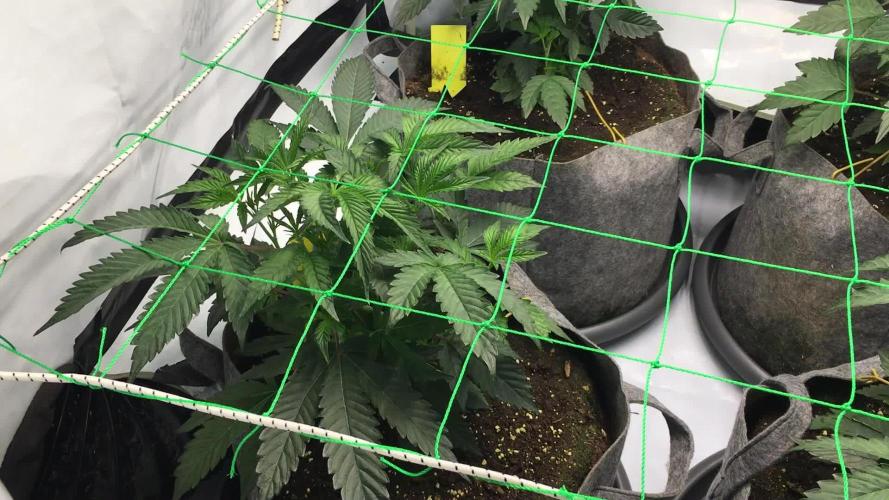
- Install the scrog-net
- Obsereve plants/soil ( when do i have to feed nutrients again?)
otherwise there will be no changes......
Thoughts:
These bushy babies will be kind of a challlenge to create this scrog the way i'm used to (basically bending the 4 main main colas to the corners of the tent, upper branches to the walls and spaces between the pants, lower branches to the very center).
Now these ladies make so many branches, so close togehter and so equal in length, underneath huge fanleafs..... i'd love to have them in a 100 square meter canna-crib....but in a tent...????? I really hate doin' things without having them planned - but in this case i guess i will have to install the net, start weaving and see what's happening😯
Day 23
Let's keep it positive...... indoor-climate of 64% rh is perfect for my health💪😁!!! ......but in my tent it's killing the vpd😖.
at a lousy 24 degrees C, i'm readin' about 60-64 % rh wich results in about 0.7 to 0.8 kPa.*
More figures? Here come the crazyones👻!:
pH 5.5; EC 4.2😨
but thats only drain from plant 3....... average was 6.1/3.6
The girls busy produce roots, shoots and leafs....... still very green, still not unhealthy.......few claws, no tipp-burn.
Basically a comfortable place to be: It's not bad yet - no work but watering - and it can only get better!!!😁
*VPD issue solved:
The sensor hung too close to a fanleaf - didn‘t expect this thing beeing so sensitive 😅.
Day 24
Climbed new hights this morning: Plant 1 had an EC of 3.8 - the others didn't climb any higher than yesterday.
So maybe we've reached the climax..... 😇
Visible growth now - so i installed the scrog-net and will start bending and weaving these days:-)
Thoughts:
Did beeing out of VPD-range for one day harm my plants? How exact can my sensor measure VPD?
after a bit of research i found out: Whatever you buy for less than 200 bucks is far from beeing exact! Even professional sensors have a margin of about +/- 1% in relative humidity. Thermometers at least +/- 0.5 degrees C. This could give some a good guess of the actual VPD BUT: Leaf-temperature-offset is absolute key! Many of our trusted homegrow-equippment isn't even able to measure it (some offer default temp-offset) ....don't wanna go further here - but there's no way to achieve something like a precise VPD-measurement in homegrowing.
So why caring for VPD?
Even with those less accurate instruments, you may be able to keep your plants in something like a comfort-zone. Way better than only guessing 👆!!!
In case i ran a much higher VPD than planned, yesterday (due to a missplaced sensor) , it will not harm or kill my plants. they might have had a bit of stress from dry air - but nothing to worry about!
Day 24:
Decreasing salt-levels in the drain - excepting plant 4, wich had an EC of 4.0 - so i guess i'm slowly draining exess-salts from top to bottom and might have collected some build-up.
The girls seem to be quite okay. Root-growth is vigorous (there are thick, white roots penetrating through the pots, everywhere), the stems are relatively thin.
removed the LST-lines.
the Sc.r.o.g:
only materiels needed, were a climbing-net for gardening (HDPE) cut to 90x90 for my 1x1 tent, 4 cable-ties and 2 meters of strong rubber-cord.
Pre-installed the net with the cable-ties, then weaved the cord around the outter cords of the net, led it aroud the posts and pulled tight.
Then brought the net into it's final position. Not as sturdy as with a wooden frame - but i had less than half the work and a bit of freedom to move things if necessary.
Any shoot will now be put to the next outter square (relative to the center of each plant) as soon as can be held by the net, without harming the top.
Once i moved all of the dominant colas to the next square, i'll have to take 10-15cm steps (vertical growth), to reach the next square.
As soon as i have about 70 of my 81 squares filled, i'm going to flip to 12/12. Since i'm plannin' to have them full of sugar when flippin', i don't expect too much of a stretch. This way i hopefully have the longest and strongest shoots framing the shorter ones in the center - so the canopy shapes like a bowl, in order to achieve the most even light distribution possible.
Day 25:
The main colas visibly reached out for the light - but yet i only moved 1 single shoot to the next square.
Girls look good, EC is dropping slowly, climate fine.
CU tomorrow👋
day 26:
on Track... nothing to worry about......
STAY TUNED 👈!