


Likes
Comments
Share

@Bread_n_Buds
Follow
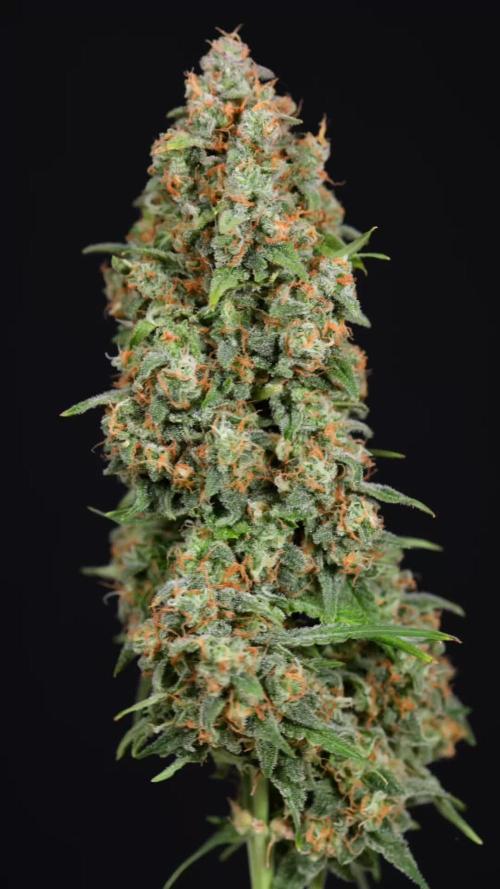
Our Watermelon Candy Automatic #1 from Zamnesia Seeds is ready, and we're excited to show it to you.
This plant has always performed well, a true powerhouse of nature as it grows, especially as it swells with high-quality central and lateral flowers.
Ripeness - The resin content is excellent. The trichomes are mostly white and milky (about 60%), with some clear (20%), and some amber (20%). Some beautiful red-headed trichomes are quite common. The pistils are almost all red (about 80%). Remember, the plant should be harvested according to your taste. Since this is a 50/50 plant, I want to maintain the sativa/day-use characteristics and not turn it into an indica bomb by over-ripening the amber colors. (Amber is a sign of THC oxidation.)
The overall shape of the plant is truly splendid.
Techniques chosen: As mentioned, we only performed pruning, lollipopping, and defoliation here. Basically, we simply cleaned the bottom parts, which, as mentioned, helps us achieve better results at the top.
We're 100% organic and 1000% Plagron, as always.
The soil we chose is the recently launched Plagron Bio LightMix, which will allow us to start with smoother and more reliable watering, without the sudden changes that liquid fertilizers can cause. A week's worth of soil is enough, so don't overdo it.
Choose your preferred style and calculate your results on the website:
www.plagron.com
Visit the new Growshop area on the Zamnesia website:
Z - https://www.zamnesia.io/it/531-growshop
A fantastic strain, not too tall but very bushy! Give it a try!
Z - https://www.zamnesia.io/en/7484-zamnesia-watermelon-candy-automatic-semi-seeds.html
Z - This feminized strain boasts everything you've come to know and love about the original cultivar, but with some welcome improvements. Combining Watermelon x Candy Kush with a pinch of ruderalis genetics results in a strain you won't want to miss, we promise.
Being an autoflowering strain, the growing options are virtually endless. So, whether you choose to grow her indoors or outdoors, one thing is certain: she'll be extremely easy to grow. Otherwise, she'll take care of herself without requiring any special care. With a little general care and pruning, you can control her growth all the way to harvest. She's perfect for beginners growing indoors, as well as more experienced growers looking for easy-to-grow, high-yielding plants.
Although she's not a particularly tall plant, her size can be easily controlled with LST, to which she responds positively. So, if you're interested in experimenting with this technique, don't be afraid to try Watermelon Candy Auto.
In just 9-10 weeks from seed to harvest, this strain grows rapidly and, just like the original, will display a bushy canopy completely covered in large buds. Regardless of your growing environment, you can expect impressive yields. Indoor plants produce 350-400 g/m², while plants left to flower outdoors produce 50-100 g/plant. These are quite substantial yields for an autoflowering strain.
With a THC level of 20%, Watermelon Candy Auto is a 50/50 sativa/indica hybrid, offering users the best of both worlds. After a few tokes, you'll feel more optimistic, and even the most stoic smokers won't be able to suppress a smile. After a few minutes, a deep sense of relaxation will take over, perfect for welcoming you home after a long day.
Overall, Watermelon Candy Auto builds on the qualities that made the original so popular, but it also has other qualities that make it a much simpler and more practical option.
You know it, but I recommend it. You'll find so much beauty here, essentially "the best nature has to offer."
Z - www.zamnesia.com
Music // www.radionula.com
+ Feng Shui Music
+ Frequency 432Hz

Processing
Likes
21
Share


@EasyName
Follow
Welcome to week 13🤠
This week I have been doing a bit of LST every day, so I've been bussy. I have also trimmed her a litlle bit, but not to much
She's comming to a halt in growth, so very soon the buds will start swelling up
They have a very sweet smell, something like vitamin drinks, and the buds are getting sticky
Watered her with ph7.21 water, run-off water was at ph6.39, So I still have to raise the pH
Weather was worm this week and very sunny, but it should cool down again
She's very symnetrical and beautiful, I really like relaxing next to her❤️
I've also got all the material for my drying box, so hopefully I'll make it soon
And I'll be making a small roof so my harvest doesn't get ruined
So I think this is all to be said, I'll edit this week if I forgot to say something or made some mistakes
Otherewise see you soon!🤠🤠

Likes
Comments
Share

@Budhunter
Follow
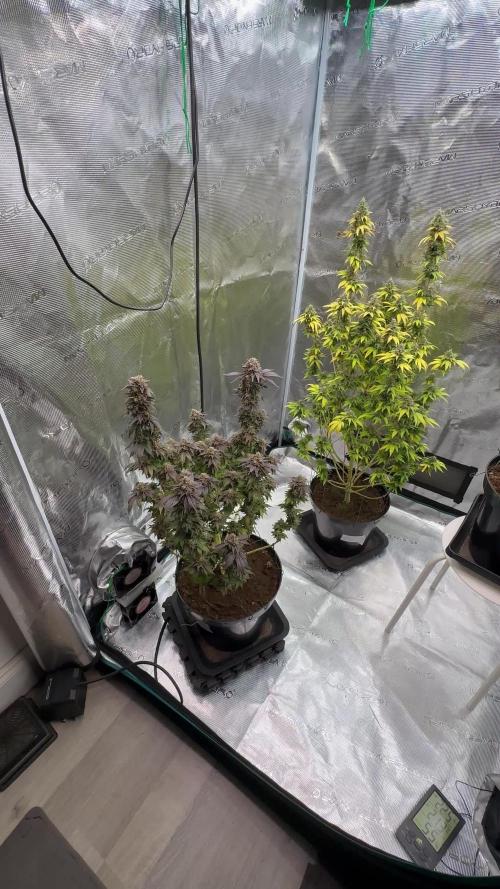
Week 10 day 70 of flowering, day 126 of cycle
Jealousy is a large plant, with nice nugs.. leaves are yellowing as we go to last days.. plant is tasting diesel and kunk, like querosene 🔥🔥🔥
Final week, let’s go

Likes
58
Share


@Gisbert
Follow
Die letzte Wachstumswoche ist für Dame angebrochen und die Sonne ist seit 2 Tagen wieder verschwunden. Nächste Woche Mittwoch kommt Sie für 2 Tage ins dunkle um dann geerntet zu werden. Danach lasse ich Sie für 2 Wochen kopfüber trocknen. Schon jetzt bekommt Sie nur noch Wasser. Ich habe auch noch einmal ein paar der verbliebenen Fächerblätter entfernt. Es ist Tag 80 und die Zeit der Ernte rückt immer näher. Ich habe versucht alle Blätter entfernt die keine Trichome tragen. In dieser Woche gab es nur Wasser.

Likes
43
Share


@Hashy
Follow
********************************************
Week 5 Veg.
********************************************
Light cycle=18/6
Light Power=120w 50%
Extractor controller settings
High temp= Day 25c, Night 20c
Low temp= c
Temp step=0c
High Rh= Day 58%, Night 62%
Low Rh= %
Rh step=0%
Speed max=9
Speed min=2
Smart controller settings (during lights on).
Lights on=4.00am
Top fan on=+23.5c
Top fan off=-23.0c
Dehumidifier on= +60%
Dehumidifier off= -55%
Smart controller settings (during lights off).
Lights off=10.00pm
VPD aim=0.6-1.3
DLI aim=30-40
EC aim=0.2-2.0
PH aim=6.0-6.8
NPK(26-8-17)
💧💧💧💧💧💧💧💧💧💧💧💧💧💧💧💧
Method= Autofeed 6 drippers.
Feed=Veg Nutes.
Neutralise=0.1ml/L
Grow=4.0ml/L
Roots=0.2ml/L
Silicon=1.0ml/L
Calmag=1.0ml/L
Volume=9L
Easy Ph down= 0.125ml/L
Ec=2.0 PH=6.4/6.1
Runs=13
Run times=4min (240ml each)
Gap times=16min
Total runtime=52mins (3.1L each)
Total flowrate= 120ml/min (60ml/min each)
Auto start time=5.00am
Auto stop time=9.04am
💧💧💧💧💧💧💧💧💧💧💧💧💧💧💧💧
********************************************
📅16/6/24 Sunday (day 29)
📋 Still thinking about removing lower nodes.
📅17/6/24 Monday (day 30)
📋 Looks like weather is getting warmer.
📅18/6/24 Tuesday (day 31)
📋 Remove lowest nodes and fan leafs. LST. Looks strong.
📅19/6/24 Wednesday (day 32)
📋 Got feeds out of sync this should have been a watering.
💧💧💧💧💧💧💧💧💧💧💧💧💧💧💧💧
Method= automatic
Feed=Nutes veg
Volume=9L
Ec=2.0PH=6.4/
Volume left=3.5L
Volume used=5.5L (120ml/min)
Volume each=2.75L (60ml/min)
Runoff.
Total runoff=0L
Ec= PH=
💧💧💧💧💧💧💧💧💧💧💧💧💧💧💧💧
📅20/6/24 Thursday (day 33)
📋 Lst
very hot day.
📅21/6/24 Friday (day 34)
📋 Hot again, I'm going to have to start prepping for summer.
📅22/6/24 Saturday (day 35)
📋 H=33cm D=37cm Dli=30.6 Ppfd=472
Got signs of stress on the tips probably overfed from 2 feeds in a row.
💧💧💧💧💧💧💧💧💧💧💧💧💧💧💧💧
Method= automatic (4 extra runs).
Feed=water
Volume=10L
Ec=0.2 PH=6.3/6.5 (PH D=0.012ml/L)
Volume left=1.5L
Volume used=8.5L (120ml/min)
Volume each=4.25L (60ml/min)
Runoff.
Total runoff=0L
Ec= PH=
💧💧💧💧💧💧💧💧💧💧💧💧💧💧💧💧
Then 0.75L manually.
Total 5L water with 100ml runoff.
EC 3.7 PH 5.9
********************************************
Weekly roundup.
📋 She's been trained this week and is looking very strong and ready to be flipped into flower. The only problem so far is the mix up in feed/water which she's showing with her tips, but she should be fine. I'm holding off flipping to flower until the other plant gets a little stronger. The weather shifted this week and temps have started to rise.
Take it easy.
Back soon.
********************************************

Likes
11
Share

@KnightRider
Follow
Hey Cannafam Happy Monday,
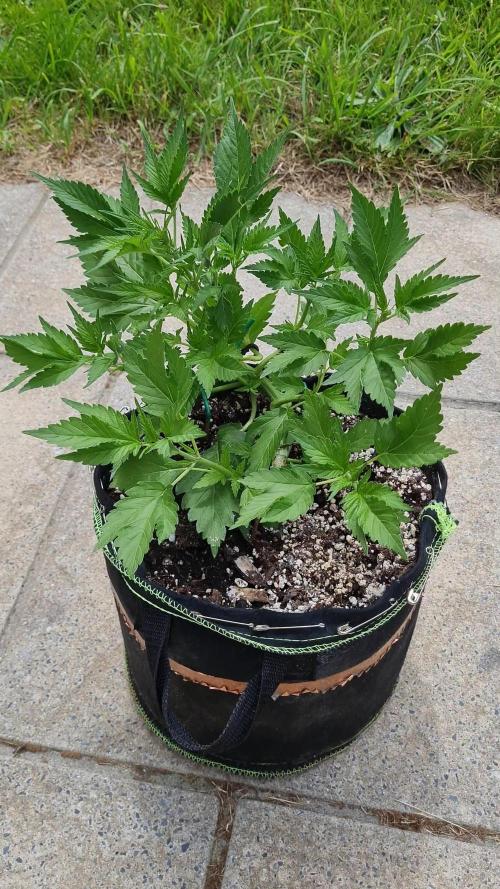
My Apricot gal has had a fairly good week overall, mainly due to a rare bout of very hot weather.
Its been absolutely scorchin, Monday and Tuesday 28c ,Wednesday and Thursday 30c with continuous Sun and average nighttime temps of 24c, Friday through to Sunday thing tapered of a bit down to 23c with Sunshine and clouds.We did also have a thunderstorm Thursday night ,but its been pretty solid on the weather front 😊
Daylight hours are currently at 16 hrs 22 minutes.
We are now in Flower and her first Pistils have appeared! 😊
Training has continued a bit each day and ive been guiding her branches away from the middle and trying to keep them fairly level with some more light defoliation There was one shoot which had grown from the underside of the plant which was struggling for light which has now been exposed.
All shoots have had really good growth this week and ive virtually got her in to the shape i want trying to give spacing for decent airflow in flower, but its a case of constant tweeking.
The leaf miner problem has now ceased but my other friends the slugs appeared after a thunderstorm thurday night and had a go a couple of the fan leaves. This occured after the rain had washed away the diamatous earth from around the pot and the copper tape dididnt work 😑 Ive therefor now decided to roll put some local ale in a beer trap for them to try as id rather they drink than eat, hopefully i can take lock the in beer jail!
Feed wise ive actually managed two feeds this week with the plagron n trace to help power that growth and il be flippin over to flower nutes next week. Although this gal has been attacked a bit shes coming along nicely and doin her Daddy proud 😁
Thats all from me for now, thanks for stopping by ✌️💚
Likes
44
Share


@Saint
Follow
This grow is powered by @SwissKush
Welcome to Week 7
Grow Area is 3feet-3feet same as 1M-1M
Day 43
Refilled with 5 Liters of water with nutrients
Clipped lower stems that were not able to get light, I chose ones to cut by their stem width.
Temperature is very high. 28-30° Celsius. But she is managing.
She is stretching so much, I don't know where to take lights, but I still have about 10-15 cms to lever.
I don't know what kind of monstrosity is this, but I love it ❤️
Day 44
Refilled with 5 liter + nutrients
Defoliated some leaves for better light access.
Buds are forming, can't wait for it to start exploding
Day 45
I changed the light schedule from 20/4 to 18/6 due to high temperatures outside. It gets really hot where the tent is.
Refilled with 5 liters and nutrients. I was right about hot weather, it is the cause of so muh water consumption.
Here are some photos from different angles.
Crystals are visible. I can even see them shining on bigger leaves, but in smaller amounts.
Day 46
Traditionally added 5 liters with nuts, did not add Grow - First part today, I am experimenting checking on PPM, I think she is not eating all the Grow part and goes in to overdose. Saw couple leaves with burnt tops, but all really is fine, it's not even an issue rn.
Added ventilation, made myself from old nonworking portable air heater. Removed coils and everything, and keft onlt Fan inside.
Can't wait to see her explode, I think she is planning to do it quite soon.
I am amazed by how low smell she has right now, even though temperature is high enough, around 28-30 degree celsius.
Day 47
Refilled with 5 Liters
I saw difference between yesterday buds and today buds size. I think she will go turbo in the en of the week or in next week.
I think I got the temperature under control. Possibly, I will remove one or two hours from schedule, but I really don't want to. But if weather continues to push so hot, I think it will be the only option.
Day 48
She is starting to smell sweet 😍
Refilled with 5 liters
She is getting covered in glitter all around
Day 49
Final day of the week
Refilled with 5L. I will need to top up some nutrients.
Special Thanks to @Chadmeister for supplying me and helping me❤️
She is going strong, I already see buds getting thicker,
I can only imagine where it's going 🚀
Noticing more and more sugar all around.
I am amazed by this Genetics of Barney's Farm
And I somehow think this ain't no luck, this is standart for them ❤️🚀
Let's get this Massive baby to the moon 🚀🌕✨🌌
See you in the next week
Thank you for following and observing this diary 🙏🤜🤛
Likes
6
Share


@Aleks555
Follow
Zamnesia - Pineapple Express (F1 Auto) - 76 Days
The time has come—harvest day! It's bittersweet to say goodbye to this incredible journey, but all great things must come to an end. The Pineapple Express (F1 Auto) has been a true wonder, delivering both in strength and flavor, with an aroma that's unforgettable. This strain produced the hardest buds we've ever grown—rock-solid and packed with resin, the likes of which we’ve never seen before.
A massive thank you to Zamnesia for providing these remarkable seeds! And an extra special shoutout to Xpert Nutrients for the outstanding fertilizers. The results speak for themselves—your nutrients truly work miracles, creating those dense, powerful buds that we're so proud of.
Stay tuned for the final photo and video showcase of this incredible harvest. We're thrilled to share it with you all!
Xpert Nutrients – The Key to Powerful Harvests
When it comes to achieving the best results, we trust only proven solutions. And with Xpert Nutrients, our plants are getting nothing but the best! These nutrients are not just a product, they’re a true catalyst for growth and powerful yields. Thanks to a balanced formula, each dose nourishes our plants with essential elements, promoting their health, strength, and abundant harvests.
Every cycle with Xpert Nutrients shows progress. We see incredible results: dense, resinous buds, rich aromas, and, of course, yields we can be proud of. With these nutrients, there are no compromises – only maximum performance!
Thank you, Xpert Nutrients, for your continuous support and for helping us unlock the full potential of our plants. The results speak for themselves!
Likes
13
Share


@Dunk_Junk
Follow
She only grew 1cm this week. She's really charging through flowering. Trichome production has been high this week.
I wish there was a way to view the pictures in hi-res on a desktop pc instead of the small window.
Timelapse this week is almost useless.
No input from me other than watering/nutrients.
Likes
21
Share


@w33dhawk
Follow
Gibt nicht viel zu erzählen die Ladys laufen ganz OK leichte Probleme mit dem Ph Wert (im Abfluss wasser der Töpfe), mal schauen wie ich das etwas runter gedrückt bekomme will die Ladys nicht unbedingt spülen in der Phase. Zum Geruch die lady die vorne links steht riecht nacht Erde, Moos-artig mit einem intensiven typischen Gras Geruch, sie ist aber auch gute 10 cm kürzer als die anderen. Denke mal das sich da mehr indica in der Genetik befindet. Die anderen 3 riechen identisch nach was tropischem, mehr die frucht Note kann es schlecht beschreiben wie ein multi vitamin Saft der mehr Banane und ananas enthält und dadurch so ein cremigen Abgang entwickelt dazu mischt sich der typische gras Geruch und es wird von Tag zu Tag intensiver 🤤🤤🤤🤤 wen das so weiter geht ziehe ich mit Sack und Pack in mein Zelt ein und wohne mit da drinnen😂😂😂 euch noch nen schönes Wochen Ende growmies

Likes
9
Share

@Provokateur
Follow
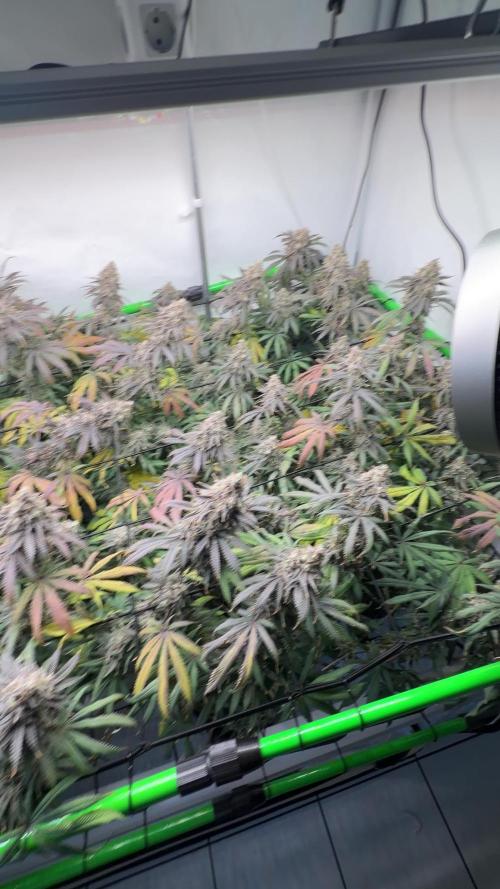
Noch etwa 5 Tage bis zur Ernte, jetzt gibt es noch 3 Tage lang nur Terra aquatica final Part und anschließend 2 Tage nur Terra aquatica Flash clean


Likes
25
Share


@Grower_Of_Persia
Follow
week intel:
we getting close to end of ripening , this week i raised drought , Nitrogen and E.C stress by feeding them 2 times per week and raised e.c to 3 to cause real stress that will help increase terpenes production
stresses :
Nitrogen deficiency Stress by removing the fertilizers that has N in them
Drought stress via removing one meal in week
high E.C stress around 1.7 and the other feeding day 3.0 , 2 times a week
feeding:
no more Nitrogen
i feed them 2 times this week with this order :
day 1 : i feed them high with Bio-Bizz Top-Max + Feeding Booster about 850 ppm - 1.7 e.c to cause a medium e.c stress.
day 3 : no more feeding this day
day 5 : i feed them very high dose of Bio-Bizz Top-Max + Feeding Booster around 1500 ppm - 3 e.c to cause high e.c stress
guide of the week :
be patient in the last weeks, never hurry for harvest because its the time of ripening in last 2 weeks you should let plants to do their work
last weeks of ripening is the time to break the limits we should cause 3 stresses as i said above Nitrogen stress , Drought Stress , E.C Stress
Likes
165
Share


@Tropicannibis_Todd
Follow
💩Holy Crap Growmies We Are Back💩
So what do you say we have some fun 👈 We got some EXOTIC SEEDS 👉 👻👻👻MONSTERMASH👻👻👻 😛
Well my friends we are just at the 63 mark and as you can see shes doing great 👈
👉 So folks , she's been quite the little monster , and she's building some nice buds 👈 Shes the only one that hasn't had any real issues 😎
Lights being readjusted and chart updated .........👍
👉I used NutriNPK for nutrients for my grows and welcome anyone to give them a try .👈
👉 www.nutrinpk.com 👈
NutriNPK Cal MAG 14-0-14
NutriNPK Grow 28-14-14
NutriNPK Bloom 8-20-30
NutriNPK Bloom Booster 0-52-34
I GOT MULTIPLE DIARIES ON THE GO 😱 please check them out 😎
👉THANKS FOR TAKING THE TIME TO GO OVER MY DIARIES 👈

Likes
5
Share


@JolliGrowz27
Follow
Definitely grow again, everyone fell in love with this plant in our small grow tent. The density of the calyxes was insane. The branches could barely hold the flowers up. The flower was purple to the core, didn't start green, it started to flower purple from the start. I didn't mess with the temperature during flower. Hot and dry climate here, 75 to 80 feirenheight average in our tent. 85 to 100 outside. Had 3 strains going, this one Pineapple Runtz Auto from Ethos, Tropicana Cookies Auto from FastBuds, and Rainbow Kush Auto from Blimburn seeds which was the freebie pack from NASC.

Likes
31
Share


@MrJones
Follow
MrJones VIPARSPECTRA XS1000 LED
📜 SUMMARY - I have been given the opportunity to run the next generation of LED lights by VIPERSPECTAR, the XS1000! I set up a Stealth Cabnient and moved 3 Cream Manderain Auto XL.s under these lights, the cabinet set up is automated with WIFI light controllers, and INKBIRD Temperature and Humidity Controllers, I am very excited about this opportunity!
Specs and Discount Codes Listed Below.
🔹🔹🔹🔹🔹🔹WEEKLY GOALS 🔹🔹🔹🔹🔹🔹
🌞Environment - 80F and 55%Humidity - using Humidfyer as needed.
💧 Feeding - Feeding with FOOP Canna Organic Nutrient Line
🍃Training / Super Cropped - and put 2 plants into a training hoop.
🕷️ IPM - Will be using Green Cleaner" 1 OZ per Gallon, and CannControl from Mammoth alternating between product each month for Integrated Pest Management.
💡 Vegetation & Flower (new) Viparspectra XS-1000 Release on March 15th.
🔹🔹🔹🔹🔹🔹🔹🔹🔹🔹🔹🔹🔹🔹🔹
📜 Week 8 and the buds are starting to get larger, thining I may have to clean up a few more fan leaves. great combination of Lights, Nutrients, Environment, and Strain.
🔹🔹🔹🔹🔹🔹🔹🔹🔹🔹🔹🔹🔹🔹🔹
▶️Monday 04.12.21 / Fed about 30 ounces today - looking great!
▶️Tuesday 04.13.21 / Fed about 30 ounces today - looking great!
▶️Wednesday 04.14.21/ laying off the feeding tonight, had to readjust one of the plants this afternoon, added some support to it.
▶️Thursday 04.15.21 / These ladies are doing well, the height is right up to the lights, but still looking pretty good. Drop the feed down to 20 ounces per day.
▶️Friday 04.16.21 / Fed about 20 ounces today - looking great!
▶️Saturday 04.17.21 / Fed about 20 ounces today - looking great!
▶️Sunday 04.18.21 / Fed about 20 ounces today - looking great!
🔹🔹🔹🔹🔹🔹🔹🔹🔹🔹🔹🔹🔹🔹🔹
VIPARSPECTRA XS1000 LED
🔹🔹🔹🔹🔹🔹🔹🔹🔹🔹🔹🔹🔹🔹🔹
Amazon US:
XS1000 10% off: in10MrJones http://yx-8.cn/0y-6
XS1500 5% off: in15MrJones http://yx-8.cn/0yA
XS2000 5% off: in20MrJones http://yx-8.cn/0y2Y
XS4000 5% off: in40MrJones http://yx-8.cn/0y5k
Amazon Canada
XS1000 10% off it10MrJones https://amzn.to/38udUVe
XS1500 5% off: it15MrJones https://amzn.to/3esVUyr
XS2000 5% off: it20MrJones https://amzn.to/3l5zAfg
XS4000 5% off: it40MrJones https://amzn.to/3l7k5Uj

Likes
5
Share


@Lazuli
Follow
She has smaller flowers this time but more dense, purple fade at the end that indicates shes very blueberry


Likes
166
Share


@iMeus
Follow
I payed 55 dollars an eight for the same level of quality, I got 18 eights of top shelf for $10 not including nutrients and supplies, yeah I'm never going back to a dispensary unless I'm traveling. This experience has improved my life in many ways. I got a total of 7.8 ounces from this grow, I'm happy :)

Likes
2
Share


