


Processing
Likes
Comments
Share


@eldruida_lamota
Follow
Buenas noches fumetillas, de nuevo volvemos, y es que estas green ak xL se están poniendo increíbles, son bastante delicadas a los cambios de temperatura y a las variantes en los nutrientes , hay que ser muy estable y cuidar en los cambios climáticos, si se consigue salen unas flores enorme y llenas de tricomas.
Ph controlado, temperatura y humedad dentro de los parámetros correctos, 1 de los 2 ejemplares que quedan recibirá un lavado de raíces pronto, la otra seguiremos abonándola una o 2 semanas más. La próxima semana nos vemos familia.

Processing
Likes
47
Share


@Growdaddy420
Follow
Hey guys, I'm in bud heaven right now. Everything is maturing, lots of dense crystal covered buds forming everywhere. The Cinderella 99 is the slowest to flower and is still stretching.
Do si dos is in full flower. Beautiful tight resin covered nugs. Going to be a nice early finisher, finishing mid-late September.
I am keeping an eye open for mold and mildew. Treating the plants weekly and closely monitoring. The slower flowering plants won't be ready untill mid October.
Happy with the results and mother nature so far. Until next week farmers!

Likes
19
Share


@Jaxx_Teller
Follow
Some good growth early on.
First reservoir change after 2 weeks.
Adjust PH each day back to 5.5 as it creeps up to 6.8 over 24hrs.

Likes
183
Share


@OrganicNature420
Follow
Germination date 🌱 12/07/2021
Day 29 12/08/2021
Strain 🍁 Ethos Genetics Banana Hammock R1
(Mandarin Sunset x Grapegod)
THC% • Unknown
💡 Mars Hydro FC4800
• Power draw 480W + 5%
• Max coverage 5 x 5
• LED 2070pcsSamsungLM30B1&Osram660nm
• Max Yield 2.5g / watt
• Noise level 0 DB
• Removable Driver +2m cable
• Daisy chain (multiple lights)
https://marshydroled.co.uk/products/mars-hydro-fc-4800-led-grow-light-samsunglm301b-commercial-greenhouse-medical-indoor-kit 🇬🇧
https://www.mars-hydro.com/buy-fc-4800-480w-4x4-energy-saving-full-spectrum-commercial-led-grow-light-mars-hydro-for-sale 🇺🇸
PROMO CODE • (ORG420) DISCOUNT 👍🏻 marshydroled.com
⛺ Mars Hydro 120 x 120 x 200cm
📤📥 AC infinity 6inch
💧 10lt dehumidifier
❄️ 3.1kw air con system
💉 Nutrients GreenBuzzLiquids
Organic Grow Liquid • 1-4ml until 2wk flower
Organic Bloom Liquid • 2-4ml flower stage
Organic More PK • 2-4ml +wk3 of flower
Organic Calmag • 1-2ml/lt whole grow
Fast Plants Spray • first 3days at night lights off
More Roots • 2-5ml veg +2wks flower
Fast Buds • 5ml +wk2 of veg until 1wk flower
Humic Acid Plus • 2-5ml whole grow
Growzyme • 2-5ml whole grow
Big Fruits • 2-5ml flower stage
Clean Fruits • 5ml flush 1wk
Ph powder
Root Gel
Living Organics
PROMO CODE • organicnature420 15%off ✌️🏼
https://greenbuzzliquids.com/
🥥 Growing Media • Coco Coir
Notes 📝
So the plan wasn't to top the shit out of it, I had just woken up and thought I'd start LST without taking a bong hit first. I'm never composed without getting high first but I'm actually feeling this as hopefully I should get 4 main heads. Apart from the slight cock up the grows going full speed now and thinking of sticking these on a 8-9 week veg and just pack the tent out. It becomes a ball ache during flower but have way more space with the new tent and the accessible sides. Great idea Mars 👍🏻💡 Plants loving the nutrients and will start to reduce Organic Grow by 30% when leaves get a touch darker. Maybe next week 👍🏻 peace GD
Happy growing fam ❤️🌱🍁👍🏻

Likes
Comments
Share

@420DeepGrow
Follow
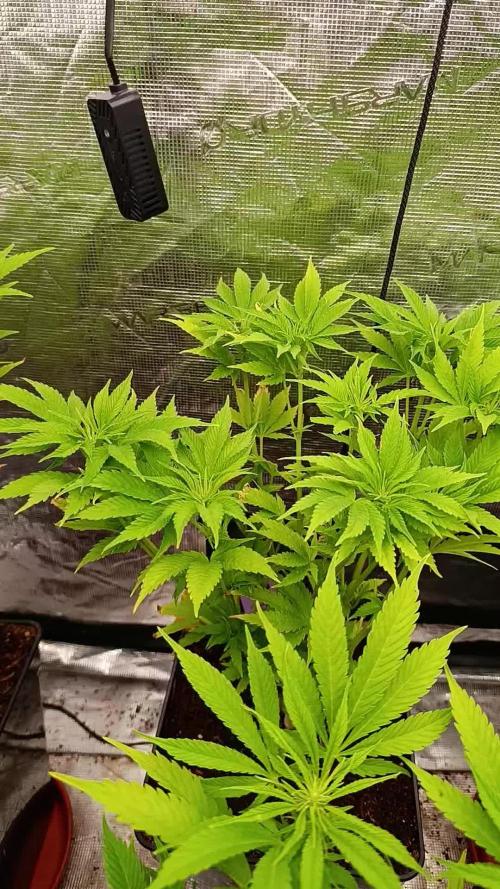
📆 Semana 3
Con el coco ya estabilizado, la EC se mantiene en 1.4–1.5 y el pH se afina hacia 5.9, consolidando una absorción constante y raíces activas. El estiramiento entra en su fase final y las preflores se definen en todas las puntas, con color ya más uniforme y buena turgencia.
Los aromas se intensifican poco a poco, semana de transición.
Seguimos creciendo fuerte 💪

Processing
Likes
Comments
Share


@Mr_nugs_lover_David
Follow
She's looking absolutely gorgeoys very bushy with 12 main colas,wish I could have had more time to grow her in vegetative stage however she's eating very good,no problems at all,she went trough a bad week where she was lacking some nutrient I don't know why because she is in a living soil like her sisters and none of them had any issues however she's starting flower,actually she started force flowering with her sisters on August 3rd

Likes
22
Share


@Rap_a_cap
Follow
106 °F today and still these girls thrive while I got very low blood pressure and remains to me only the strength to water them, peppers and tomatoes.
Cookies Gelato is very happy and in a such way is adapting herself to extreme heat and still maintains a very short internode length with very thick branches.
MALEB is a girl. Borned from regular seed is a cross between a male lebanese "Black Gold" landrace and a female morroccan landrace. Lebanese seeds came from Majdaloun where a great friend of mine has served in a peacekeeping mission. Morroccan's came from Issaguen in the Rif. Both landraces at that latitudes show semi-automatic behaviour where are planted in early april and finish their short cycles in mid-august. My latitude is higher and usually photodependants start to preflower at 14.30 hours of light on July 15. Maleb starts to preflower on June 27 at 15.05 hours of light. A great result more than any "fast version" around. Her savages genetics are very clear, simply she don't care a fuck about heat and critters avoid her.
When temps will go down I'll take some cuttings trying to obtain some feminized seeds from them, under HPS
Cheers Bros

Likes
7
Share


@Daniel_Tri95
Follow
i’d say another two weeks on these girls and they are about done one of the other phenos of this finished up quite quickly and it’s already drying Can’t wait to give you the full results and numbers 🔥 and remember
It’s 420 somewhere

Likes
140
Share


@MrJones
Follow
mrjones - Slurricane #7 S1
🌱Slurricane #7 S1
@inhousegenetics_official
👨🌾🏽GD Grower: MrJones
🔹🔹🔹🔹🔹🔹GOALS🔹🔹🔹🔹🔹🔹
🌞Environment - 75/80℉ and 55% Humidity
💧 Feeding - Advanced Nutrients Organic
⚗️Soil - 50% Ocean Forest / 20% Tupur Royal Gold / 10% Earth Worm castings / 10% lobster Compost / 10% Additional Perlite
🍃Training / HST, Will be topping, Cloning, and creating larger plants, and placing to flower under a trellis
🕷️ IPM - Will be using Green Cleaner" 1 OZ per Gallon, and CannControl from Mammoth alternating between product each month for Integrated Pest Management.
💡Mars Hydro LED / Veg Geeklight Monster Board 480W V4 / Flower 480W FC 4800
🔹🔹🔹🔹🔹🔹🔹🔹🔹🔹🔹🔹🔹🔹🔹
📜 Rambling - Week 9 underway the plants are responding very well to the decreased nutrients - the clones are coming along, but trying to ween them off the biodomes is a bit tricky.
🔹🔹🔹🔹🔹🔹🔹🔹🔹🔹🔹🔹🔹🔹🔹
▶️ Sunday - 04.11.21 / Fed 30 Ounces today
▶️ Monday - 04.12.21 / Fed 30 Ounces today
▶️ Tuesday - 04.13.21 / Fed 30 Ounces today
▶️ Wednesday - 04.14.21 /These Mother plants are on cruise control, Fed 30 Ounces today
▶️ Thursday - 04.15.21 / Fed 30 Ounces today
▶️ Friday - 04.16.21 / Fed 30 Ounces today
▶️ Saturday - 04.17.21 / Fed 30 Ounces today
🔹🔹🔹🔹🔹🔹🔹🔹🔹🔹🔹🔹🔹🔹🔹
📜 Cultivar Information - In House Genetics - Slurricane #7 S1
🔹🔹🔹🔹🔹🔹🔹🔹🔹🔹🔹🔹🔹🔹🔹

Likes
2
Share

@SpaceCadet3000
Follow
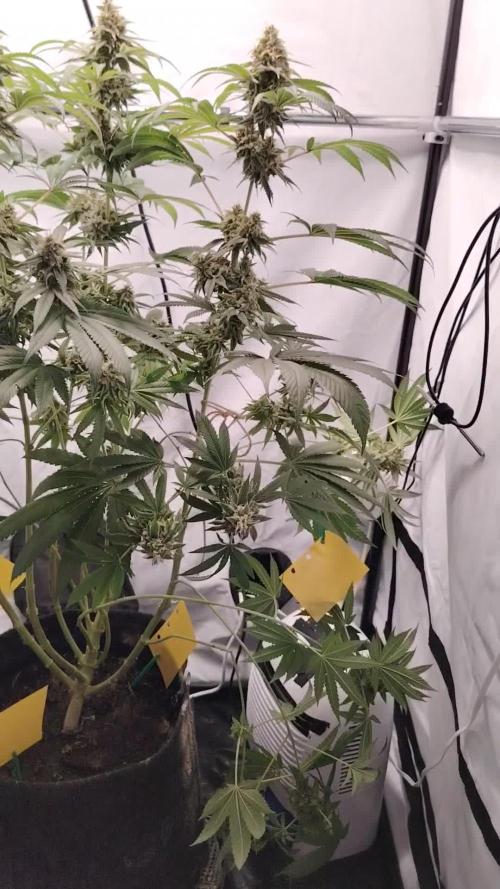
No idea about the weight. I'll have to update when they are dry. I'll buy a hanging scale next cycle so I can measure moisture loss.
The temp is now around 21-23 C, but the RH is holding around 60% so hopefully it'll still be a slow, steady dry.
One smelled of pure grapefruit, one almost like Rhubarb and very gassy, the other was more citrus.. still a bit of grapefruit and gas, but more of a bergamot smell.
At different points I've smelled Rhubarb, pepper, mint and cream/milk coming from these plants. Will be an interesting smoke.
Likes
31
Share


@AsNoriu
Follow
Day 43. All is good, but she is so stretchy that all top buds stay in shade, I still have 20-30 cm of height left, but maybe I'll SuperCrop one more branch here too.
Big feed and after that I'll decide what to do.
Girl is showing colours !!!
Happy Growing !!!
Likes
Comments
Share

@GERGrowDesigns
Follow
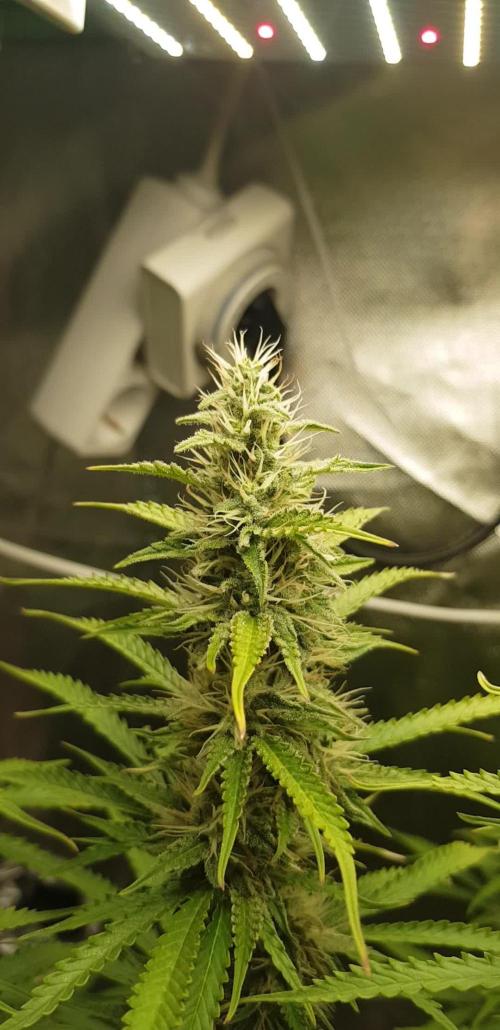
Welcome to Flower Week 7 of Divine Seeds Auto White Widow
I'm excited to share my grow journey with you all as part of the Divine Seeds Autoflowering Competition 2025. It's going to be an incredible ride, full of learning, growing, and connecting with fellow growers from all around the world!
For this competition, I’ve chosen the Feminized Automatic strain: Auto White Widow
Here’s what I’m working with:
• 🌱 Tent: 120x60x80
• 🧑🌾 Breeder Company: Divine Seeds
• 💧 Humidity Range: 50
• ⏳ Flowering Time: 58 Days
• Strain Info: 20%THC
• 🌡️ Temperature: 26
• 🍵 Pot Size: 3
• Nutrient Brand: Narcos
• ⚡ Lights : 200W x 2
A huge thank you to Divine Seeds for allowing me to be a part of this amazing competition and Sponsoring the Strains. Big thanks for supporting the grower community worldwide! Your genetics and passion speak for themselves!
I would truly appreciate every bit of feedback, help, questions, or discussions – and of course, your likes and interactions mean the world to me as I try to stand out in this exciting competition!
Let’s grow together – and don’t forget to stop by again to see the latest updates!
Happy growing!
Stay lifted and stay curious!
Peace & Buds!

Likes
2
Share


@thegreatdeadpoolio
Follow
10/23-10/30 final week.
10/24 - this grow is not as ready as I would like it to be but its needed to be on a set schedule since the get-go as this was the first plant in my perpetual. the next plant will be harvested on trich color not time window. 90% cloudy 10% clear hoping the rest of those clear finish up this final week. I usually prefer at least 10% amber.
10/26 - Starting to get amber triches faster than expected, should hit my 10% threshold by tuesday for harvest!
Processing
Likes
23
Share


@MadeInGermany
Follow
Hey everyone 🤗.
This week it has taken up more and more of its fertilizer and has got a nice color.
It also grows very well 👍.
It was topped again this week.
Otherwise everything will continue as before and will continue to be topped 👍.
I wish you a lot fun with the update, stay healthy and let it grow 👍🙏🏻
You can buy this Strain at
https://thecaliconnection.com/seeds/girls-scout-cookies-34.html
You can buy the fertilizer at
https://www.greenbuzzliquids.com/
Type:
Girls Scout Cookies
☝️🏼
Genetics:
GSC Tint Mint
👍
Vega lamp:
2 x Todogrow Led
Quantum Board 100 W
💡
Bloom Lamp :
2 x Todogrow Led
Cxb 3590 COB 3500 K 205W
💡💡☝️🏼
Soil :
Canna Coco Professional +
☝️🏼
Fertilizer:
Green Buzz Liquids :
Organic Grow Liquid
Organic Bloom Liquid
Organic more PK
More Roots
Fast Buds
Humic Acid Plus
Growzyme Big Fruits
Clean Fruits
Cal / Mag
Organic Ph - Pulver
☝️🏼🌱
Water:
Osmosis water mixed with normal water (24 hours stale that the chlorine evaporates) to 0.2 - 0.4 EC. Add Cal / Mag 2 ml per l water every 2 waterings . Ph with Organic Ph - Pulver to 5.8 .

Likes
10
Share


@Eldorado_ed
Follow
Really hot but looking fine some heat issues but sorted with running lights at 50%

Likes
20
Share


@StickyHands
Follow
Day 7 of Flowering
Seven days ago, the ladies were switched into the flowering phase. To facilitate the transition, a final top-dressing was applied.
Ingredients:
200g Bloomshoot (couple of plants)
150g Remineral (couple of plants)
50g Algae Meal (couple of plants)
50g Volcanic Rock Dust
2L PK Compost Tea
Last time Foliar feeding mg12 and power flour from rootinn
Defoliation was carried out at the end of the first week, focusing primarily on the lower sections of the plants.


Likes
6
Share


@HIAZ_urbanbudfarmer
Follow
Everything going well buds continue to develop & put on size, starting to get frosty with trichomes & buds are sticky to touch & smell a bit aswell


Likes
7
Share


@StickyFingah420
Follow
Semana de cosecha! Al fin el tan esperado momento momento se aproxima y no puede tener una mejor pinta! Realmente he quedado maravillado con la belleza de este fenotipo muy parecido al que promociona el banco en su portal, así que muy satisfecho por eso.
Solo esperar a que se seque bien el sustrato y estaremos cosechando estos bellos frutos 🤩😍
Likes
16
Share


@DrLaggis
Follow
🌱 Start: 17.07. 🌱
Hello everyone! This is my very first grow and I'm thrilled to share every step with you! 🎉 I'd appreciate any tips you might have to help me achieve the best results! 😊
Equipment:
I've geared up with an Indoor Grow Kit from MarsHydro along with some BioBizz supplements to ensure my plants get the best care. 🌿
🌼 Seeds:
I opted for Fast Buds seeds after hearing great things about them. They were delivered super fast—just two days! I’m especially excited to test the C4 strain. 🚀
I've begun soaking the seeds and setting up my space. Eagerly awaiting the transition to the next stage in a day or two! 🌱
📅 Update: 19.07.
All three of my C4 seeds sprouted 1-2 cm within just 1.5 days! 🌱 It’s often recommended that autoflowers be planted directly into their final home, so I'm following that advice.
I'm working on improving the air circulation in my tent to ensure the best environment for growth. 🌬️
I'm currently using 0.2L cups with big holes over the sprouts to maintain higher humidity during their initial two weeks. 💧
🎉 UPDATE 22.07. - THEY ARE ALIVE 🎉
My C4 sprouted on 20.07., and I'm overjoyed to soon share photos and a video of my little green buddy! 📸🎥
PS: My plant enjoys 2 hours of chill jazz music every day! HAHA 🎷🎶
Likes
34
Share


@BOMbolenath
Follow
The plant is developing well despite the high temperature.
During the week the weather got better, the plant is growing well.
