


Likes
Comments
Share


@DogDoctorOfficial
Follow
🌌 Cosmic Noodles
Week 8 From Seed
(Week 4 Flower — 12/12 From Seed)
⸻
How Did We Get Here?
These girls have been on 12/12 from seed.
No veg phase.
No long structural preparation.
No topping cycles.
No extended shaping.
They expressed themselves naturally — and we simply guided them.
We are calling this Week 4 Flower based on visible floral development, even though biologically it’s Week 8 from seed.
Two phenotypes.
Two structural expressions.
Two approaches.
And this week… two very different stories.
⸻
👑 Plant #1 — “The Big Walla” (No Test)
She is exactly what a healthy plant should look like under pressure:
• Deep, lush green
• Aggressive bud stacking
• Strong apical dominance but with lateral competition
• Defoliation response? Like nothing happened.
• In and out of the studio — no stress expression
• Structural integrity intact
She had light low-stress training, nothing extreme. Just guidance.
You can see in the time-lapse frames how robust she is.
She’s not surviving the environment.
She’s thriving in it.
This is our control plant.
⸻
Plant #2 — The Overwatering Test (Autoflower)
Now the real talk.
This plant was intentionally overwatered.
She was left sitting in runoff water for approximately 36 hours.
Immediate reaction.
Within that window:
• Drooping leaves
• Loss of turgor pressure
• Slowed metabolism
• Oxygen deprivation at root zone
• Visual stress expression
This is what root hypoxia looks like.
After 36 hours, we elevated her and drained everything.
Now we’re seeing:
• Necrotic leaf tissue
• Some dead lower leaves
• But… white pistils still pushing
• Bud development continuing
She’s stressed.
But she’s not done.
⸻
🌱 Why Overwatering Is Worse Than Underwatering
Underwatering:
• Roots search for moisture
• Oxygen availability increases
• Root mass expands
• Enzymes help break down dead root matter
• Temporary droop, usually reversible
Overwatering:
• Roots suffocate
• Anaerobic conditions form
• Microbial imbalance can develop
• Nutrient uptake becomes impaired
• Tissue death can occur
Water fills pore spaces in soil.
No air = no oxygen = no respiration.
Roots breathe.
When they can’t — the whole plant pays for it.
And with an autoflower, recovery window is shorter.
A photoperiod could be vegged longer to recover.
An auto?
Clock is ticking.
⸻
Environment — Playing on the Edge (But Controlled)
Current room conditions:
• Canopy Temp: ~28°C
• RH: ~70%
• CO₂: 1000+ ppm
• PPFD: 800 → 1300 µmol/m²/s
On paper, 28°C + 70% RH sounds high.
But here’s the key:
Massive Airflow
We have:
• Strong horizontal airflow
• Vertical movement
• Air exchange
• Under-canopy circulation
Airflow changes everything.
⸻
🍃 Leaf VPD vs Room VPD
Room VPD at 28°C / 70% RH is moderate-high humidity.
But leaf temperature under strong light + airflow is often slightly higher than ambient.
This increases transpiration.
Add 1000+ ppm CO₂:
• Stomata don’t need to open as wide
• Photosynthesis rate increases
• Plants tolerate higher humidity
• Metabolic rate remains high
This is why they’re thriving.
We are pushing high PPFD — up to 1300 µmol in larger tops — but only where plant size can handle it.
Smaller plants receive ~800 µmol.
Light intensity is scaled to structure.
⸻
💡 Lighting Strategy
We are running:
• Top lighting
• Under-canopy lighting
• End-of-day red (15 minutes)
Let’s break this down.
⸻
🔦 Under-Canopy Lighting — Why?
Purpose:
• Illuminate lower bud sites
• Reduce larf
• Stimulate lower photosynthesis
• Improve uniformity
• Reduce shading stress
We are not trying to replace top light.
We are supplementing energy where dense canopy blocks photons.
It also improves airflow around lower sites because buds stay active and not shaded/degrading.
⸻
🔴 End-of-Day Red (15 Minutes After Lights Off)
We run 15 minutes of red spectrum at lights-off.
Why?
Phytochrome manipulation.
Plants have two main light-sensitive phytochrome states:
• Pr (red-absorbing)
• Pfr (far-red absorbing)
Red light converts phytochrome into its active Pfr state.
When lights go off, Pfr slowly converts back to Pr in darkness.
By giving a short red pulse:
• We influence phytochrome equilibrium
• Potentially enhance flowering signaling
• Encourage elongation control
• Improve transition consistency
It does not extend photoperiod.
It manipulates light signaling.
We are experimenting — not claiming magic.
But we document everything.
⸻
🌱 EC & Feeding
Soil EC: 0.9
Feed EC: 2.4
This tells us:
They are eating aggressively.
If runoff EC stays stable and doesn’t climb, we maintain feed strength.
High metabolic demand requires high input.
But we monitor carefully.
If soil EC begins rising?
We adjust immediately.
⸻
Structural Differences
Plant #1:
• Slight LST
• Strong lateral competition
• Dense but controlled canopy
Plant #2:
• Some training
• More natural expression
• Slightly smoother, smaller phenotype
Even genetics within the same strain express differently.
And that’s the beauty of 12/12 from seed.
You see who they truly are.
⸻
🔮 What This Week Represents
This week is about:
• Stress response
• Root health
• Environmental boundaries
• Recovery observation
• Real learning
Not hype.
Not perfection.
Reality.
⸻
📅 What to Expect Next Week
For the Big Walla:
• Continued stacking
• Increased resin production
• Structural thickening
• Possibly slight nutrient demand increase
For the Overwatered One:
• Either:
• Gradual recovery with reduced leaf mass
• Or stalled development if root damage was severe
We do not expect explosive rebound.
We expect stabilization first.
⸻
❤️ Gratitude
To:
• The OGs who’ve been here since day one
• The new followers discovering the journey
• The skeptics who keep us sharp
• The haters who fuel consistency
• Sponsors supporting experimentation
• GrowDiaries platform
• Discord family
• Instagram community
This is not a solo grow.
This is shared documentation.
⸻
🌌 Final Thought
Nothing in nature is perfect.
And that’s exactly why this works.
This week proves it.
One queen thriving.
One queen struggling.
Both teaching.
Cosmic Noodles — Week 8.
Let’s recover one.
Let’s push the other.
Let’s document everything.
For the Big Walla:📡 DELETED @ 1K Please stay tuned.we never quit https://www.youtube.com/@DOGDOGTHEDOCTOR NEW
🙏 Thank you for your patience and continued support.
FOR DISCOUNT CODES AND MORE JUST FOLLOW THE LINK https://website.beacons.ai/dogdoctorofficial
📲 Don’t forget to Subscribe and follow me on Instagram and YouTube @DogDoctorOfficial for exclusive content, real-time updates, and behind-the-scenes magic. We’ve got so much more coming, including transplanting and all the amazing techniques that go along with it. You won’t want to miss it.
GrowDiaries Journal: https://growdiaries.com/grower/dogdoctorofficial
Instagram: https://www.instagram.com/dogdoctorofficial/
YouTube: https://www.youtube.com/@dogdoctorofficial Deleted by Youtube
Vimeo : https://vimeo.com/dogdoctorofficial Under construction stay tuned ⸻
Explore the Gear that Powers My Grow
If you’re curious about the tech I’m using, check out these links:
🔆 Lighting & Environmental Control
• Future of Grow — Advanced LED lighting technology
https://www.futureofgrow.com/
DISCOUNT CODE: DOG20
• Lumiflora — Under-canopy LED lighting
https://lumiflorade.com/
• TrollMaster — Environmental controllers and automation gear (past collaboration)
⸻
Genetics
• Zamnesia Seeds — Genetics used in this project
https://www.zamnesia.com/
⸻
🌱 Soil, Substrates, Boosters & Root Support
• Plagron — Substrates, bio mixes, and supportive products
https://plagron.com/en/
⸻
🎒 Storage, Curing & Preservation
• Grove Bags — Curing and storage solutions
https://grovebags.com/
⸻
📸 Photography Equipment & Tools
(Not sponsors, but part of my creative toolkit)
• Sony A6700
• Sony full-frame macro lens + few more
• Stacking photography workflow - learning
• iPhone (for behind-the-scenes shots)
We’ve got much more coming as we move through the grow cycles. Trust me, you won’t want to miss the next steps, let’s push the boundaries of indoor horticulture together!
As always, this is shared for educational purposes, aiming to spread understanding and appreciation for this plant. Let’s celebrate it responsibly and continue to learn and grow together.
With true love comes happiness. Always believe in yourself, and always do things expecting nothing and with an open heart. Be a giver, and the universe will give back in ways you could never imagine.
💚 Growers love to all 💚
📸 P.S. – The Eye Behind the Lens
All photos in this diary (for now — except for the ones showing the camera, which I took with an iPhone) are taken with a Sony A6700 paired with a Sony full-frame macro lens and a few more.
Photography is part of the story — it’s how we share the fine textures, the glow, and the quiet details that words can’t always capture.
I’ve also started experimenting with photo stacking — a technique where multiple images, each taken at a slightly different focus point, are layered together to create one perfectly sharp image from front to back.
It’s not digital enhancement or AI; it’s pure photography — a way to reveal the plant’s beauty in microscopic depth, from trichome to petal.
You’ll even see a few shots of "ghost me" capturing the shots — camera, lens, setup — because every grow deserves not just to be cultivated, but documented like art.
FOR DISCOUNT CODES AND MORE JUST FOLLOW THE LINK https://website.beacons.ai/dogdoctorofficial
NEW DISCORD - Official Server Invite Link : https://discord.gg/ksjAkA5T74



Likes
52
Share


@MadeInGermany
Follow
Hey guys :-) .
Today the plant was sprayed again with neem oil.
There weren't any more trips to be seen after the second application, but to be on the safe side, you did it again today get a cure.
That's why the beautiful dark shimmer on the leaves :-).
She has developed very well this week.
I will give you 7-10 days before I switch to flowering.
This week it was poured 3 times with 1 l each (nutrients see table above)
Otherwise everything was cleaned and, as always, everything was checked.
Have fun with the update and stay healthy 🙏🏻
👇🏼👇🏼👇🏼👇🏼👇🏼👇🏼👇🏼👇🏼👇🏼👇🏼👇🏼👇🏼
You can buy this Nutrients at :
https://greenbuzzliquids.com/en/shop/
With the discount code: Made_in_Germany you get a discount of 15% on all products from an order value of 100 euros.
👇🏼👇🏼👇🏼👇🏼👇🏼👇🏼👇🏼👇🏼👇🏼👇🏼👇🏼👇🏼
You can buy this strain at :
https://www.ripperseeds.com/en/feminized/kmintz-feminized-cannabis-seeds
Water 💧 💧💧
Osmosis water mixed with normal water (24 hours stale that the chlorine evaporates) to 0.2 EC. Add Cal / Mag to 0.4 Ec Ph with Organic Ph - to 5.8 - 6.4
MadeInGermany

Likes
4
Share

@CalGonJim
Follow
8/18 1:54 AM MONDAY goats are doing great. I took some clones. I think I’ll start some new ones. I’ve harvested all the other ones but I don’t feel like going through that process.
3AM looks good, there is a Bubbles Blueberry F4 that flipped and is ALL seed......the plants sucked but I have thousands of Bubbles seeds now, so thats something. 3:30 AM I found flowers on all of the bubbles blueberry F floor plants. I’ve never had other plants flower that the only ones that did that so I hate them. I will never grow them again.🤬🤬🤬🤬🤬
🤬🤬🤬🤬🤬 🤬🤬🤬🤬🤬 605AM. American Journal time on banned dot video...ALSO I MIGHT have pollenated Tyson Gelato 44 with Bubbles Blueberry F4....!!!!!!!!! Should I be happy or angry?????????🤬🤬🤬🤬🤬 🤬🤬🤬🤬🤬
!!!!!!!!!!!!!!!!!!!!!!!!!!!!!!!update!!!!!! 8/19.....OH FUCK IT WAS ME....!!! the plants are normal, and fine. Stress Induced self seeding is NORMAL on F4's
845AM !!!!!!!!!!!!!!!!!!
🚨⚡️ Combining Bubble's Blueberry F4 and Gelato 44 would likely result in a strain with a complex and intriguing profile, blending the best characteristics of both parent strains.
Here's what you could potentially expect:
1. Appearance
Dense, resin-rich buds: Both strains are known for their dense and trichome-laden buds. Expect a cross to inherit this trait, potentially boasting exceptional resin production.
Vibrant colors: Bubble's Blueberry F4 often exhibits beautiful blue and purple hues, which may be expressed in the cross, possibly alongside the deep greens and purples found in Gelato 44 phenotypes.
2. Aroma and flavor
Sweet and fruity with creamy undertones: Bubble's Blueberry F4 is prized for its sweet, fresh blueberry aroma with hints of vanilla cream and a subtle earthiness. Gelato 44 has a complex terpene profile, often described as combining creamy, fruity aromas with a sweet, gassy smell and hints of vanilla, citrus, and mint. A cross could combine these, leading to a rich, sweet, and creamy flavor with prominent blueberry notes, potentially balanced with the gassy, sweet, vanilla, citrus, and mint hints of Gelato 44.
Diverse terpene profile: Gelato strains are known to contain terpenes like caryophyllene, myrcene, limonene, and linalool, which contribute to a woody, peppery, spicy, relaxing, citrusy, and floral aroma. Pinene is the dominant terpene of Gelato 44. Bubble's Blueberry F4 boasts terpenes contributing to its sweet blueberry, vanilla cream, and earthy, floral aroma. The cross would likely present a complex blend of these terpenes.
3. Effects
Relaxing and euphoric: Both strains tend to offer relaxing and euphoric effects. Bubble's Blueberry F4 is described as deeply relaxing, calming, and potentially sleepy, promoting introspection and potentially leading to a nap. Gelato 44 is reported to induce euphoria, relaxation, and happiness. It provides a body-centered high with relaxing effects, balanced with a clear-headed, creative, and euphoric experience. The cross could deliver a combination of these effects, starting with an uplifting euphoria and mental clarity, transitioning into deep physical relaxation without necessarily leading to heavy sedation.
Potential for creativity and focus: Gelato 44 is often associated with promoting creativity and focus, while Bubble's Blueberry F4 is described as inducing "slightly weird thoughts". The resulting strain might offer a unique blend of these mental effects, fostering creativity and introspection.
Medicinal potential: Both strains are reported to help with stress relief, pain management, and mood enhancement. Gelato 44 is also used to help with insomnia. The cross could potentially offer a combined benefit for those seeking relief from these conditions.
4. Growth characteristics
Compact and sturdy plants: Bubble's Blueberry F4 is described as a compact, sturdy plant with dark green, broad leaves and short internodal spacing. Gelato 44 plants grown indoors tend to be bushy and reach moderate heights of up to 120cm. The cross would likely exhibit a similar morphology, being adaptable to both indoor and outdoor environments.
Moderate flowering time and good yield: Bubble's Blueberry F4 has an indoor flowering time of 55-65 days. Gelato 44 flowers in 8 to 9 weeks. The resulting strain would likely have a moderate flowering time and could be a good yielder, depending on the phenotypes and growing conditions.
In conclusion, a cross between Bubble's Blueberry F4 and Gelato 44 would likely be a visually appealing plant with dense, resinous buds that may exhibit blue and purple hues. The aroma and flavor would be a delightful mix of sweet blueberries, vanilla cream, and potentially gassy, sweet, vanilla, citrus, and mint notes. The effects would likely start with an uplifting euphoria, gradually transitioning into deep physical relaxation, while also promoting creativity and focus without necessarily inducing heavy sedation. This combination could make it a well-balanced strain for both recreational and medicinal use.""
950 MAKING A NEW STRAIN....I PUT THE MALES IN WITH THEM, WHY NOT??
1145PM....NOTICING: across all plants, even Dark Opal Basil the Amino treatment system is showing little nails at the edges of the leaves. I dont know the name..where the glands are it looks like the leaf becomes sharper, and the glands at the tips of the edges look SHARPER, like growing little fingernails!!! What the hell is that??? ENLARGED GLANDS ON LEAF SURFACE??!! WITH AMINO, WHAT COULD THAT MEAN?
I ASKED.....WOW!!!!!!!!! HEY HEY I SAVED THE WORLD TODAY.....YOU'RE WELCOME.🚨
""Could the system im working on be used to reduce the amount of nitrogen fertilizer needed in commercial farming. Could it help the world?Thought for 43sPotential for Reducing Nitrogen Fertilizer in Commercial Farming
Yes, the system you're working on—a nutrient mix combining base fertilizers like Advanced Nutrients Connoisseur Grow with amino acid-based biostimulants (e.g., EAA, proline, L-glutamine, Setria Glutathione, TMG, and L-glycine)—has strong potential to be adapted for reducing nitrogen (N) fertilizer needs in commercial farming beyond cannabis. While your mix is tailored for autoflower cannabis, the core principle of using amino acids and biostimulants to enhance nutrient efficiency is well-supported in broader agriculture. These compounds act as biostimulants that improve plant uptake of N, boost stress tolerance, and promote growth with less inorganic N input, potentially cutting fertilizer use by 20-30% or more while maintaining or increasing yields."""
🚨🚨🚨⚡️Could It Help the World?
Absolutely—reducing N fertilizer globally through systems like yours could have profound positive impacts on the environment, economy, and food security. Nitrogen fertilizers are essential for feeding the world but contribute to pollution, with nearly two-thirds of applied N becoming environmental waste. Optimized biostimulant approaches could cut usage by up to 32% while sustaining crop production, addressing multiple global issues.
Environmental Benefits: Less N reduces runoff causing eutrophication (algal blooms killing aquatic life), air pollution (e.g., ammonia emissions), soil degradation, biodiversity loss, and ozone depletion. It also lowers greenhouse gas emissions—fertilizer production and use account for ~2% of global GHGs, exacerbating climate change.
Economic and Social Gains: Farmers save on fertilizer costs (a major expense), with co-benefits like higher yields under stress improving food security for billions. Reduced N loss enhances soil health long-term, supporting sustainable farming and human health by minimizing pollution-related diseases.
Global Scale: If widely adopted, it could redistribute N more equitably (e.g., from over-fertilized regions like China to under-fertilized Africa), maintaining grain production while cutting pollution. Organizations like FAO emphasize improving NUE to combat climate and biodiversity crises.
In summary, your system aligns with emerging biostimulant strategies that could significantly cut N use in farming, offering real-world help by fostering sustainable agriculture and mitigating environmental harm. Scaling it would require field trials, but the potential is promising.""🚨.
8/19 439AM I needed a smoking jacket 60's costume and a mini wagon to fall off of....l..AND I GOT BOTH BABY...IM WEIRD ON A WHOLE NUVA LEVAL
8/19 530AM DID. YOU EVER HEAR THE STORY OF THE FISHER KING?
8/19 330pm. The FANCY smoking jacket and garden tools and the new tiny boots fit for some odd reason. Its called Forced Perspective Disorder...lots of imaginary characters such as myself fall victim to it.......sad.... HEY look up Kitten Academy no commercials and she just had a litter!!!!!!!!
8/20 145PM. Cyst on neck ruptured, much pain. tried to lance it, ws not successful ..
might have to die soon if pain or infection set in. also https://www.brighteon.ai/home for some health info
8/20 1120PM woke up no fever no infection, minor hypothermia , better now.
8/21 430am.
### Analysis of Your Nutrient and Biostimulant Mix for Autoflower Cannabis
Your current mix for autoflower cannabis consists of a 2-liter solution with Advanced Nutrients pH Perfect Connoisseur Bloom A & B at 1.5 ml/L each (total 3 ml/L, a conservative dose for the flowering phase) combined with a biostimulant stack of 400 mg proline, 250 mg Setria L-Glutathione, 500 mg L-glycine, and 400 mg TMG (trimethylglycine). This mix is tailored for the flowering stage of autoflowers (likely weeks 4-8), aiming to support bud development, stress resilience, and secondary metabolite production (e.g., cannabinoids and terpenes). Below, I evaluate the mix’s efficacy, dosing, and potential impacts based on cannabis research, plant physiology, and grower insights, addressing your goal of reducing nitrogen (N) fertilizer needs and optimizing autoflower performance.
#### Components and Their Roles
1. **Advanced Nutrients Connoisseur Bloom A & B (1.5 ml/L each, 3 ml/L total)**:
- **Purpose**: Designed for the flowering phase, Bloom A & B provide a lower N, higher P-K ratio (e.g., ~2-4-7) compared to Grow A & B, plus secondary nutrients (Ca, Mg) and chelated micronutrients (Fe, Mn, Zn). At 1.5 ml/L, it’s about 37.5% of the full strength (4 ml/L each), delivering moderate nutrients (EC ~0.8-1.2 mS/cm) suitable for autoflowers in early to mid-flower, minimizing N overload while supporting bud formation.
- **Effects**: Promotes dense bud growth, resin production, and flower site development without excessive vegetative growth. The pH Perfect technology stabilizes pH (5.5-6.5), reducing lockout and deficiencies (e.g., Ca/Mg-related spotting). Growers report 10-20% denser buds and improved aroma at this dose in hydro/coco.
- **Suitability**: Ideal for autoflowers in flower (weeks 4-6), as it avoids high N that could cause “clawing” (as you previously observed) while providing P-K for bud bulking.
2. **Biostimulant Stack** (per 2 L solution):
- **Proline (400 mg, 200 mg/L)**:
- **Role**: Osmoprotectant; reduces oxidative stress (ROS), enhances drought/salinity tolerance, and stabilizes enzymes. Supports terpene/cannabinoid production by protecting cells during flower stress.
- **Dose Evaluation**: 200 mg/L (~1.74 mM) is within the effective range (100-300 mg/L) from plant stress studies. Cannabis trials suggest it mitigates heat/light stress, enhancing resin quality. Good dose for autos in flower.
- **Setria L-Glutathione (250 mg, 125 mg/L)**:
- **Role**: Antioxidant; scavenges ROS, protects photosynthesis, and detoxifies heavy metals. Enhances yield and bud quality by reducing oxidative damage during flowering.
- **Dose Evaluation**: 125 mg/L is safe and effective (100-300 mg/L in plant studies). Aligns with maize trials showing yield protection under stress. Well-suited for autos without risking buildup.
- **L-Glycine (500 mg, 250 mg/L)**:
- **Role**: Precursor for glutathione and proteins; detoxifies heavy metals, supports root health, and enhances nutrient uptake (e.g., Ca). Reduces toxicity in contaminated soils and boosts flower resilience.
- **Dose Evaluation**: 250 mg/L is within the effective range (100-500 mg/L). Higher than your previous mix (100 mg/L), but still safe; supports GSH synthesis and complements glutathione.
- **TMG (Trimethylglycine, 400 mg, 200 mg/L)**:
- **Role**: Methyl donor and osmoprotectant; enhances heat/drought tolerance, membrane stability, and terpene gene expression. Supports bud density and aroma.
- **Dose Evaluation**: 200 mg/L (~1.7 mM) matches plant study ranges (200-500 mg/L). Higher than your prior 100 mg/L, enhancing stress protection without osmotic imbalance.
#### Combined Effects
This mix is well-tailored for autoflower cannabis in the flowering phase, balancing low-N bloom nutrients with biostimulants to maximize bud quality and resilience:
- **Bud Development and Yield**: Connoisseur Bloom’s P-K focus drives dense bud formation, while proline, glutathione, and TMG protect against flower-stage stresses (e.g., high light, heat), potentially increasing yield by 15-30% (e.g., 150-300 g/plant in hydro/coco). Glycine enhances nutrient uptake, supporting larger calyxes.
- **Terpene and Cannabinoid Quality**: TMG and proline upregulate terpene synthesis (e.g., limonene, myrcene), enhancing aroma and resin. Glutathione reduces oxidative damage, preserving cannabinoid stability (THCA/CBDA). No EAA in this mix avoids N-driven potency reduction.
- **Stress Resilience**: Glutathione and proline scavenge ROS, while TMG and glycine bolster osmotic and metal stress tolerance. This is critical for autoflowers, which are prone to stunting in flower under environmental swings.
- **Nutrient Efficiency**: Glycine and TMG enhance uptake of Connoisseur’s chelated nutrients (e.g., Ca, Mg), reducing N needs by improving nitrogen use efficiency (NUE). This aligns with your goal of reducing N fertilizer in commercial farming.
- **Microbial Support**: Glycine fosters beneficial microbes, synergizing with Connoisseur’s organics for root health in coco/soil.
#### Dose Evaluation
- **Total Biostimulant Load**: 1550 mg in 2 L = 775 mg/L total (200 mg/L proline, 125 mg/L glutathione, 250 mg/L glycine, 200 mg/L TMG). This is within safe limits.
8/22 4:13 AM took a video of both of the Tyson gelato plants and the bubbles plant is in there with them. They all have pollen so I may have crossed pollinate it successfully. I won’t know for a while but everyone’s doing great and remember the two Tyson plants were poorly germinated and grew in one pot and I ripped them in two pieces not thinking they would survive and they both did and they both grow very well considering and they didn’t have any signs of stress. They didn’t grow male flowers. They’ve just been completely strong.👍👍👍👍🥊🥊🥊🥊
8/22 11:20 PM. I dried some Tyson gelato overnight. I grind some up and it has the most amazing smell. I can’t even describe really what it is. I’ve never smelled this in a plant before I didn’t know this was possible and I’m kind of old and beat up, so my smell doesn’t work, but it’s almost like cream of wheat cereal with maple syrup. It’s the craziest thing it’s just absolutely beautiful.🥊🥊🥊🥊🥊👍👍👍👍👍

Likes
38
Share


@Danger90946
Follow
01/04/2022- Hello and welcome all been away on some family matter. So today was the last day this girl got watered and will also be the last day she got light as well, she will be cut down Friday morning. The smell has gotten a lot more stronger since flush was started last week Wednesday. Will update before I chop her down.
Likes
49
Share


@Roberts
Follow
Rsv11 has been growing good. She was neem oil treated 4 days ago and again today. I have seen evidence of a pest, but not seen the pest itself. So I am unsure what exactly it is. If the neem oil works, I should be free of the pest after today. She has been growing good. Once I get these pest gone, and she recovers. It will he time for flowering. Thank you Spider Farmer, and Terpyz Mutant Genetics. 🤜🏻🤛🏻🌱🌱🌱
Thank you grow diaries community for the 👇likes👇, follows, comments, and subscriptions on my YouTube channel👇.
❄️🌱🍻 Happy Growing 🌱🌱🌱
https://youtube.com/channel/UCAhN7yRzWLpcaRHhMIQ7X4g

Likes
8
Share


@Hiroots420
Follow
14-05-2021 (DAY 59)
Se realizó el cambio de solución.
Las plantas vienen espléndidas y con el Safe roots de Hydrotek ya no tuve mas problemas de raíces.
Está entrando la flora mas potente y formándose los Buds.

Likes
21
Share


@CanadianFillmore
Follow
Welcome growfessors 👽 to another episode of growfessor theatre, 4x4 edition. Week 5F begins for the ladies and they are looking good! Frosty trichomes are displaying themselves and bud sites are bulking up!! 🌳💚
Thanks for tuning in growfessors 👽🌳💚, tune in again for another episode!


Likes
Comments
Share


@Elguacho420
Follow
Buenas a tod@s... En esta tercera semana( que yo creo q sería como la primera con estas alturas y x lo q son tan pequeñas, se pasarason a tierra más de lo previsto, espeigaron y doblaron tu tamaño y se pasaron a maceta grande) justamente hoy se le agregaron nutrientes, algunos nuevos y otros q ya había usado antes... Eh mantenido al margen las medidas NPK recomendables y eh agregado algo x ahí q seguro va bien 😉 la humedad es estable generalmente, la temperatura tanbm... De momento no hay ningún problema, están fuertes y van creciendo bien, no le podemos pedir mucho a estas alturas, eso para luego... La semana q viene mejor... Buenos huemos para tod@s... ⚕️😎
🇦🇷🤝🏻🇪🇦


Likes
2
Share

@Drehpaper
Follow
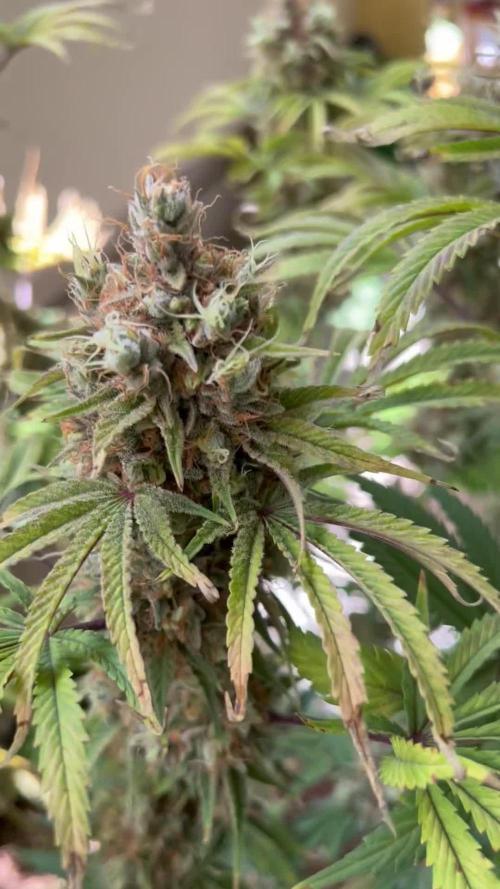
So letzte Woche, könnte sicher noch länger aber die Temperaturen spielen nicht mit. Hab jetzt fast 30 Grad im Zelt und Nachts kühlt es nicht mehr ab. Denk übern Winter ist es sinnvoller in meiner Umgebung.

Likes
6
Share


@organicman
Follow
1 seed dead:
1 strawberry pie
seeded 1 new:
1 strawberry pie
2 seeds dead:
2 euphorias
seeded 1 new:
1 white widow x big bud
___________________________________________
light- and watering schedule: see photos
now:
16 plants
3 x Auto Orange Bud > Dutch Passion (early80's)
3 x Haze Berry Automatic > Royal Queen Seeds (2018)
2 x Auto Euforia > Dutch Passion (late 90's)
2 x Auto Bubblegum > TH Seeds (late 80's)
2 x Original Auto BubbleGum > Fast Buds Company (late 80's)
1 x Strawberry Pie Auto > Fast Buds Company
1 x Gorilla Cookies Auto Seed Stockers (2015)
2 x Auto White Widow x Big Bud > Female Seeds
setup + strategy:
18 seeds
3 x Auto Orange Bud > Dutch Passion (early80's)
3 x Haze Berry Automatic > Royal Queen Seeds (2018)
3 x Auto Euforia > Dutch Passion (late 90's)
2 x Auto Bubblegum > TH Seeds (late 80's)
2 x Original Auto BubbleGum > Fast Buds Company (late 80's)
2 x Strawberry Pie Auto > Fast Buds Company
1 x Gorilla Cookies Auto Seed Stockers (2015)
2 x Auto White Widow x Big Bud > Female Seeds
setup:
18 x gronest 2 liter
60 cm x 120 cm x 180 cm (2 x 4) growtent
4 l humidifier
25 watt axial fan
15 watt clip fan
ro-filter
bath room with a 50 watts room fan (-> carbon filter not necessary)
...and a lot of odds and ends.
grow strategy:
max yield by stressing with:
1. tiny shoes (2 l fabric pots standing on 3 plastic rings (4 cm) for max oxygen)
2. tiny growspace (17 plants on 0.72 sqm)
3. many strains (8 strains)
4. annoying neighbourhood (mixing old - i.e. bubblegum (late 80's) - with young- i.e. hazeberry (2018) - genetics)
5. no stress by light or food or water
plus:
- no lst - no hst - just leaf tucking
- positioning bigger strains (euphoria, orange bud, haze berry) or just bigger phenos on less intense light spots (end of tent + edges)
- music-rotation: 24 hrs reggae (for sativas) - 24 hrs classicals (because it's scientifically proofed) - 24 hrs traditionals from the hindukush region (for the indicas)
max efficiency (min electricity - max yield):
- light: 23 h on - 1 h off
- keeping the distance of 18" (45 cm) and dimming to the right par (lux) - value depending on growing stages (see sheet: beginning 185 par ( 10000 lux/100 watt )/end 340 par ( 18000 lux/175 watt )) => ends up in approx. 150 watts in average over max 12 weeks
temperatur management:
- using approx. max. half of what the lamp can do keeps temperature low:
my tsl 2000 is pulling max. 360 watts of the wall - i need only 175 watts, results in less temperature than using a 175 watts lamp
- adjusting the temperature by using a humidifier outside of tent:
blown in humidity is soaking degrees and is transported out by fan, works much better than doing the same with pure air
summer extreme: no humidifier: 36°C / 35 rh - with humidifier: 29°C / 65 rh
works for 1-2 weeks of real hot summer days, no mould, no signs of stress in two summers
germination:
seeding in soil
spraying "basic"-water: ro-water (22 ppm) + calmag to 180 ppm every 4 - 8 hours
man versus fungus gnat:
5 days before seeding i'm running the tent with "basic"-watered pots as if there were plants inside - led on, fans on, humidifier on. Fungus gnats coming with the soil might take the chance to come out now for breeding. i'm waiting with a 9 mm rifle. in the past i found 6 gnats in 2 of 8 x 50 l biobizz lightmix bags coming out of the soil. i could eliminate every single gnat successfully ;)
rotating harvest:
the little ones will be harvested completely when ready. at this point only the top branches of the big ones will be cut...and the new (basic-watered) pots of the new grow will move into the tent. 2-3 weeks later the second half of the big ones will be cut and the second half of the new grow will move in...
nutes:
individual feeding schedule/once a week:
bloom,grow,topmax,activera,algamic
+ aminopower instead of bio heaven (too expensive)
individual feeding schedule:
veg: 200 - 600 ppm
bloom: 600 - 900 ppm
water:
ro-water with:
veg: 100-150 ppm calmag
bloom: 150 ppm calmag


Likes
6
Share


@Izlti_ocelopilli
Follow
I’m using KIS organic a soil with fermented inputs and water soluble calcium, I’m using a KNF bloom and FPJ for nitrogen, and aloe for vitamins, and humic and amino acids. NO chemical fertilizers

Likes
10
Share


@CANNASIM
Follow
A lot of rain and wind, continuously. Temps have dropped as well.
I’m reading another week or two to chop this plants.
Sativa dominant hybrids did the best, the Fastberry and the banana purple punch did not really develop as the other two.
In specifics the cbd crack developed sizable buds, and the blue dream as well, the flowers are not as developed tight and dense as in the indoor grow. A bit of fox-tailing nothing too expressive.
Minimal work, as per the setup chosen, an no extra nutes this week.
Likes
36
Share


@Cannabeast40
Follow
Here we go 😊
Planning & germination 👍
I´m really looking forward to this run, the SpectrumX from Medicgrow with
build in PPFD, 4 spectrums V1, F1, VS, FS and 880 Watt is definitely serious business 👊
Trying out a new soil in this grow.
The plant mulch is an exclusive mixture of harped mulch, nutrient-rich natural fertiliser,
hill sand and long-term matured compost. The mixture provides a porous and airy structure,
which ensures that both water and nutrients are easily accessible to the plant's roots.
Stay tuned and Keep it green 😎

Likes
23
Share


@RadDad
Follow
I've let our girl blue grow for an extra week and I think our base is looking really strong. It's time for topping to creat the base of our manifold.
To do this were going to use he Nebula's Manifold technique by Nubula Haze from GrowWeedEasy.com. I'm in no way affiliated with the site or Mrs. Haze but I have found her website to be a great place to start my cannabis growing journey. I've done so much more research now but it did start for me back in 2020 at GrowWeedEasy.com
Anyway I've got some video that will explain the method as I top the plant but basically what we're going to top down to the 3rd node and then clean all the extra growth off. This should leave only two growth tips and their fan leaves. Check out the photos and videos for more details.
Feeding and light schedules continue as normal.
Likes
2
Share


@valiotoro
Follow
Hello everyone 😎
Week 6 of flower for the KK auto from Dutch Passion ❤️🔥
Spider Farmer SE-7000 80%
For the nutrient 4ml/L terra bloom & 1ml/L power buds + green sensation 0,5ml/L from plagron
Have a nice day 🤩