




Likes
39
Share


@herewegrow
Follow
All three plants are hermaphrodites, however, plants 1 and 2 are showing minimal signs of male with seeds developing only on lower nodes, while plant 3 looks mostly male with a few pistils only on the very top nodes. I've decided to pluck the seeds from plants 1 & 2 as they develop, and to toss plant 3 to make room for the other 2. It's not ideal and I plan to buy feminized seeds or clones for my next grow, but the bud I got the seeds from was actually really good so I'm going to try to take 1 and 2 to harvest.

Likes
8
Share


@420cfm
Follow
Buds are really coming on now. Stretch is slowing. Very happy with the new lights and fan. Not sure I'll do scrog next time as its hard to keep up with all the grow and pruning/defoliation required. Adjusted my lights to get everyone even coverage. Light meter would be nice at some point!


Processing
Likes
15
Share


@HisHope
Follow
10/5 Week 12
Harvest day for Bea her pics later
Hero remains in the tent for now she could use more time think she may be larger than Bea now they we look close.
We will see wont we
10/5 HARVEST DAY FOR Beatrice
light trim on remaining leaves and she yielded 1585 grams wet
Dry report in a few days

Likes
6
Share


@MrPipi
Follow
Mr. Pipi welcomes you to the 15th Week of Grow and the ~6th week of flower.
I guess the Colas stopped bulking up as quickly as at the beginning. Sadly, but that´s nature.
Maybe a last time watering with molasses and then the next 2weeks flushing. Maybe some ice cubes to see if she gets purple, but i doubt it :D
Day 107: its exactly 7 weeks since Mr. Pipi switched light cycle.
Girl is starting getting purple.


Likes
12
Share


@2Stones1Bird
Follow
Checkout my Instagram @smallbudz to see the Small budget grow setup for indoor use, low watt, low heat, low noise, step by step.
17/11/2019 - Pot feels light and the is bottom dry to the touch time to water, gave her 1,5l of water PH 6.2 with 0.5ml Grow, 1ml, Bloom and 0.5ml Max Biobizz reduced the dosage from last time, watered util some runoff appeared.
18/11/2019 - Mixed another batch of Alg-a-Mic 2ml per liter to spray on lights off PH 6.2

Likes
88
Share


@Roberts
Follow
Gorilla Jealousy F1 has gotten acclimated, and has started making growth progress. Her roots just found the solution. Everything is looking good. Hopefully she takes to the solution well, and takes off. Thank you Spider Farmer, and Seedsman. 🤜🏻🤛🏻🌱🌱🌱
Thank you grow diaries community for the 👇likes👇, follows, comments, and subscriptions on my YouTube channel👇. ❄️🌱🍻
https://www.seedsman.com/?a_aid=Mrsour420.
This is my affiliate link to seedsman. Thank you
Happy Growing 🌱🌱🌱
https://youtube.com/channel/UCAhN7yRzWLpcaRHhMIQ7X4g

Likes
2
Share


@Jotagrower420
Follow
Segundo teste de sementes.
Foram 5 dias de germinação no papel toalha sendo 12h na água com PH 5.8.


Likes
9
Share


@Cogollo_eu
Follow
**Encontrarás la traducción a español al final de la descripción**
From/Desde: 23/09/19 || To/Hasta: 29/09/19
From day/Desde día: 22 || To day/Hasta día: 28
Ocean Grown Cookies Diary / Diario de las Ocean Grown Cookies:
https://growdiaries.com/diaries/38831-oceangrown-cookies-blues-sisters
If you like this week, please hit a like, it costs you nothing! 👊. Thanks in advance 😉!
-----IMAGES & VIDEOS-----
I'm so sorry about the quantity of contents for this week and the following ones, as I've been telling I was under hard work pressure, and this week and the next one where the worst of them. In fact this week has some more images, but I decided to move them to next week or otherways next week is empty of contents.
V1: Timelapse week video that covers 4 days. At about sec 25 I performed the topping on the babies, as I told before abobe 5th node, and one of them abobe the 6th.
P1: BlueBerry Cookies Left <--•--> Ocean Grown Cookies Right
-----WEEK SUMMARY-----
This week the growing was georgeous, the BlueBerries have doubled in size, the went from 15 to 31 cm even topping them. Sad I don't have pics of the distribution of the branches because is very beautiful, however, if you take a look into the week 4 of the Ocean Grown, there's a video where you can perfectly see the structure, they're very similar.
-----WATERING CALENDAR-----
28/09/19 DAY 27 - 1.5 l with all week nutrients @ (1.2 EC | PH 6.2 | 25.1ºc)
*****ESPAÑOL*****
Por favor, si te gusta esta semana dale un like, no te cuesta nada 👊. ¡Gracias por adelantado 😉!
-----IMÁGENES & VÍDEOS-----
Siento mucho la carencia de contenidos de esta semana y las que vienen, como he estado comentando he estado bajo muchísima presión de trabajo y esta semana y la siguiente han sido las peores de todas. De hecho esta semana tenía alguna imágenes más, pero he decidido pasarlas a la que viene, si no la semana que viene estaría sin contenidos.
V1: Un video Timelapse de 4 días. En el segundo 25 les realizo la poda apical a las pequeñas.
P1: BlueBerry Cookies Izqui <--•--> Ocean Grown Cookies Dere
-----SUMARIO SEMANAL-----
El crecimiento de esta semana ha sido brutal, las BlueBerry han doblado su tamaño, han pasado de los 15 a los 31 y eso que les he realizado la poda apical. Es una lástima que no tenga imágenes de la distribución de ramas de las BBerry pues es muy bonita, no obstante si le echáis un vistazo al diario de las Ocean Grown, en este hay un vídeo en el que se ve perfectamente la estructura de las plantas, que aunque difiere un pelín son muy parecidas.
-----CALENDARIO DE RIEGO-----
28/09/19 DAY 27 - 1,5 l con todos los nutrientes semanales @ (1,2 EC | PH 6,2 | 25,1ºc)

Processing
Likes
57
Share


@Silverback_Guerilla
Follow
1/17 - 1/24:
An excellent week for all the plants. Solid, steady fattening and frosting over. The Zenzations smell amazing.

Likes
321
Share


@Tropicannibis_Todd
Follow
🤔🤔🤔🤔🤔 HAPPY GROWING 🤔🤔🤔🤔🤔
We are now 49 Days into flowering and everything is going great 👍 👈 We are now playing the waiting game👌
👍 decided to showcase the Mini BigBand , was a extra seed that germed so I kept it as a Mini Me 😊 She's killing it 👈
Except for some watering it's been pretty smooth I've done a little maintenance and manipulation of the canopy 👈
👉Soil Medium Provided by ProMix.ca
👉Nutrients Provided by Agrogardens
👉Lighting Provided by MarsHydro.ca
I would like to thank the many growmies for support throughout the years 🙏 So Let's Do This 👊👊👊 Happy Growing

Likes
10
Share


@BossHogg6
Follow
Going into this week on the 12/12 light schedule. It grew to about 10.5 inches from the light. The light is now up to 50% brightness. A full dose of bud candy was added, instead of the half added last week.

Likes
9
Share

@Ribemarti
Follow
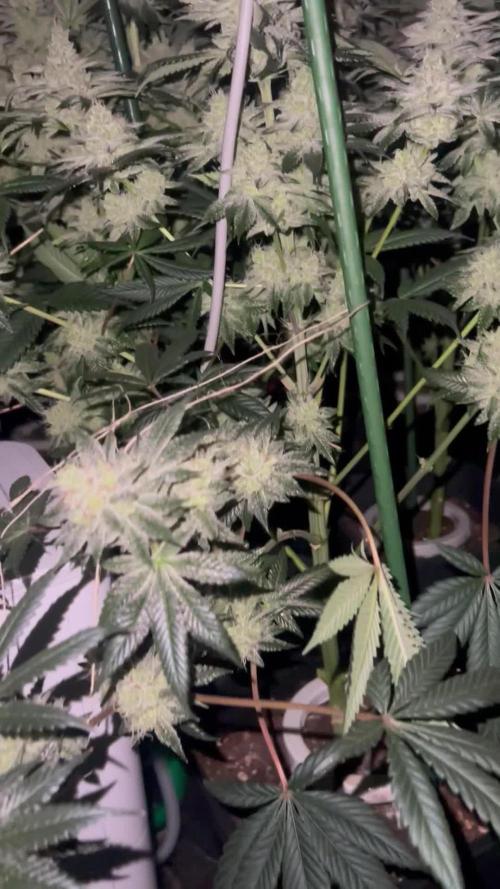
Las plantas ya tienen echo el lavado de raizes y ahora solo estoy regando con agua, a 400 ms y ph 6.5 estan repletas de cogollos y duros como piedras de arriba abajo,
Likes
19
Share


@Alice_in_Wonderland
Follow
Ladies are smelling strong and ready to be harvested. Chopping Venezia to be hung out to be dried tonight. Cheech can still go another day or two under the light with the lower pistols still a little blush.
Likes
47
Share


@terpproducer
Follow
👇 This week:
---
Watering 1l-1.5l every day.
PPFD at canopy height approximately 900 (increase slowly), VPD ~1.3
Big defoliation, lollipopped some plants at day 21, will wait for the last 2 till day 28
Ladys got 500ml compost tea each (biotabs recipe from kees) from now on every week - Recipe: 15gr compost PK/L, 5ml orgatrex/L, 1gr bactrex/L - brew for 24-36h)
---
Happy growing and thanks for checking out my report! I really appreciate you! 😁💪🙏

Likes
4
Share


@Achim026
Follow
Blüte geht immer weiter und obwohl ich so kleine behälter für die ladies habe wachsen sie super


Likes
175
Share


@love_2_grow
Follow
Day 63 Flower (Day 105)
I'm back! Iceland was breathtakingly beautiful as usual, and I even managed to see an active volcano. Amazing!
I have good news and bad news regarding my girls. The good news is that they are both still alive and are overall looking pretty good.
The bad news for the left girl is that the cheap irrigation system failed and only watered around 1 liter of water during the entire week. She was extremely thirsty, although still looking pretty good without any drooping. A couple of her leaves turned purple from the stress, though.
I recorded a video just as I opened the tent for the first time after coming back a couple of hours ago.
The news is worse for the right girl, though. The irrigation system worked flawlessly, so that wasn't the problem. Instead, I detected bud rot in three buds, and of course, it was in the three most significant colas. Fuuuuuuuu...
I also shot a video as I opened the tent, and the affected buds are visible if you are paying attention.
I have never had bud rot before, so I will need to do additional research on what to do next. I immediately cut off the affected buds and disposed of them outside. I hope I got all the affected areas, but I will inspect all the buds more closely tomorrow. Been traveling most of the day today and need some rest before scouting her buds.
I looked at her trichomes quickly and still couldn't see much amber, but I will have a better look tomorrow.
The worms have been busy while gone, though, and they were crawling all over when I lifted the old avocados.
They aren't the only ones who have been busy as the fungus gnats are back, Sigh. Only a few so far, but yeah, another thing to sort out. The fun just never ends...

Likes
4
Share


@Bunterbiber
Follow
During the week she was transplanted into her final 30L pot after the roots started spiraling at the bottom of the 0.5L container.
The substrate (80% Light-Mix soil & 20% perlite) was prepared following BioTabs guidelines. To fine-tune the mix, I added 1 g/L of Dolomite Lime to help stabilize pH and provide Calcium and Magnesium, plus 1 g/L of Primary Rock Dust / Basalt Dust (still need to grab some BioTabs Silicium Flash!).
For watering, I'm using a 50/50 mix of tap water and RO water (Tap specs: pH 8.5, Ca: 51 mg/L, Mg: 9 mg/L). Given the size of the new pot, I’ll be taking extra care to water lightly and sparingly for now.
The transplant went smoothly without a hitch. Now I’m letting her settle in and recover before we dive into some High-Stress Training (HST). Overall, she’s looking super healthy and growing nicely!
Weekly Stats:
LED Power: 35 W
Target RH: 75%
Watering Volume: 1 L (total for the week)